"The King of Channels" Nongfu Spring encounters new intermediaries
The same case of Oriental Leaf has six different prices across six online channels.
In July 2025, a report released by Guosen Securities recorded a price snapshot of 500ml×15 bottles of Oriental Leaf jasmine tea in the post-"618" period.
The six channel prices listed in the report range from 27.95 yuan to 69 yuan, with the highest price being 2.47 times the lowest. Among them, the price on Tmall is 58 yuan, 59.85 yuan on JD, 27.95 yuan on Pinduoduo; the product prices on Meituan Instant Delivery, Taobao Flash Purchase and JD Express Delivery are 48.9 yuan, 59 yuan and 69 yuan respectively, with additional delivery fees of 1.2 yuan, 3.3 yuan and 3.2 yuan listed separately.
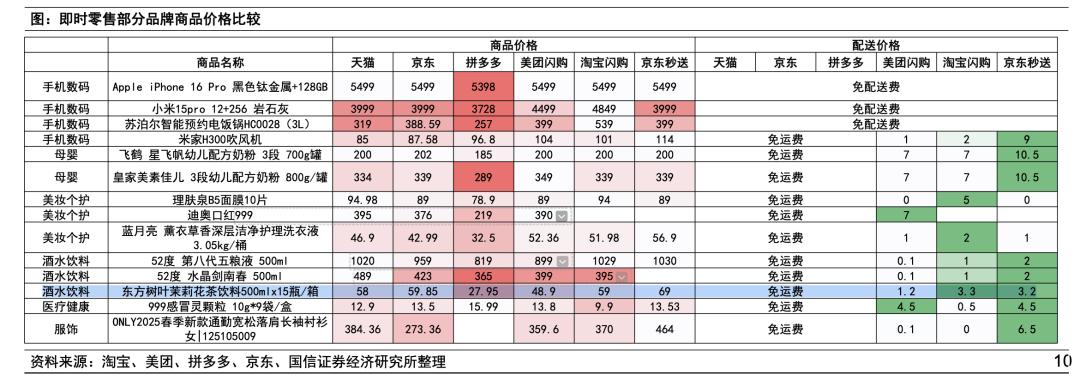
It reveals the ongoing changes in beverage distribution channels, and also forms the background of Zhong Shanshan's public criticism of platforms.
On the evening of August 8, Zhong Shanshan, founder and chairman of Nongfu Spring, was a guest on the CCTV Finance program Dialogue. The opening of the program was set in the flower fields of Hengzhou, one of the largest jasmine producing areas in China.
In the program, Zhong Shanshan stood in the industrial base built by Nongfu Spring with an investment of about 300 million yuan, talking about what kind of flowers can be used to make tea, how artificial intelligence enters farmland, and how machines turn the scenting process that used to depend on weather and experienced veteran craftsmen into a set of parameters. However, after the broadcast, the most discussed topic was "platform power".
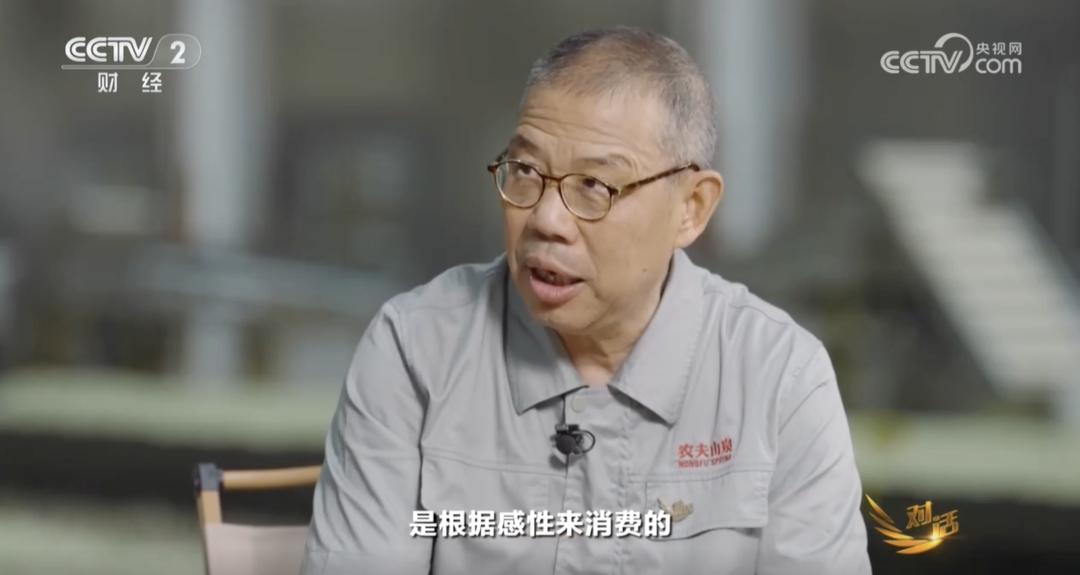
In the interview, Zhong Shanshan defined e-commerce platforms as "undoubted middlemen". He said that trading platforms have their own rules. Although e-commerce platforms are technical platforms, such technical platforms are just a special type of middleman, whose commission rate is not fixed, and merchants do not know how much profit they can make before each transaction is completed.
The paradox is that Nongfu Spring is precisely an enterprise that grew up highly relying on middlemen. It does not deliver every bottle of water directly to consumers, but has built a huge distribution network through distributors, supermarkets, family-owned stores, small supermarkets, grocery stores and convenience stores.
The so-called "unified pricing right", more accurately, refers to the brand's ability to maintain price stability, rather than forcing all stores to sell at the same price. In the past, brands mainly relied on salesmen's store visits, distributors' stock reports and terminal orders, and then restricted prices through rebates, display requirements and cross-regional goods shipment penalties. Now, under the impact of "new middlemen", the "mobile phone shelf" is tearing up this order.
1
The shelf has not disappeared, but the entry point has changed
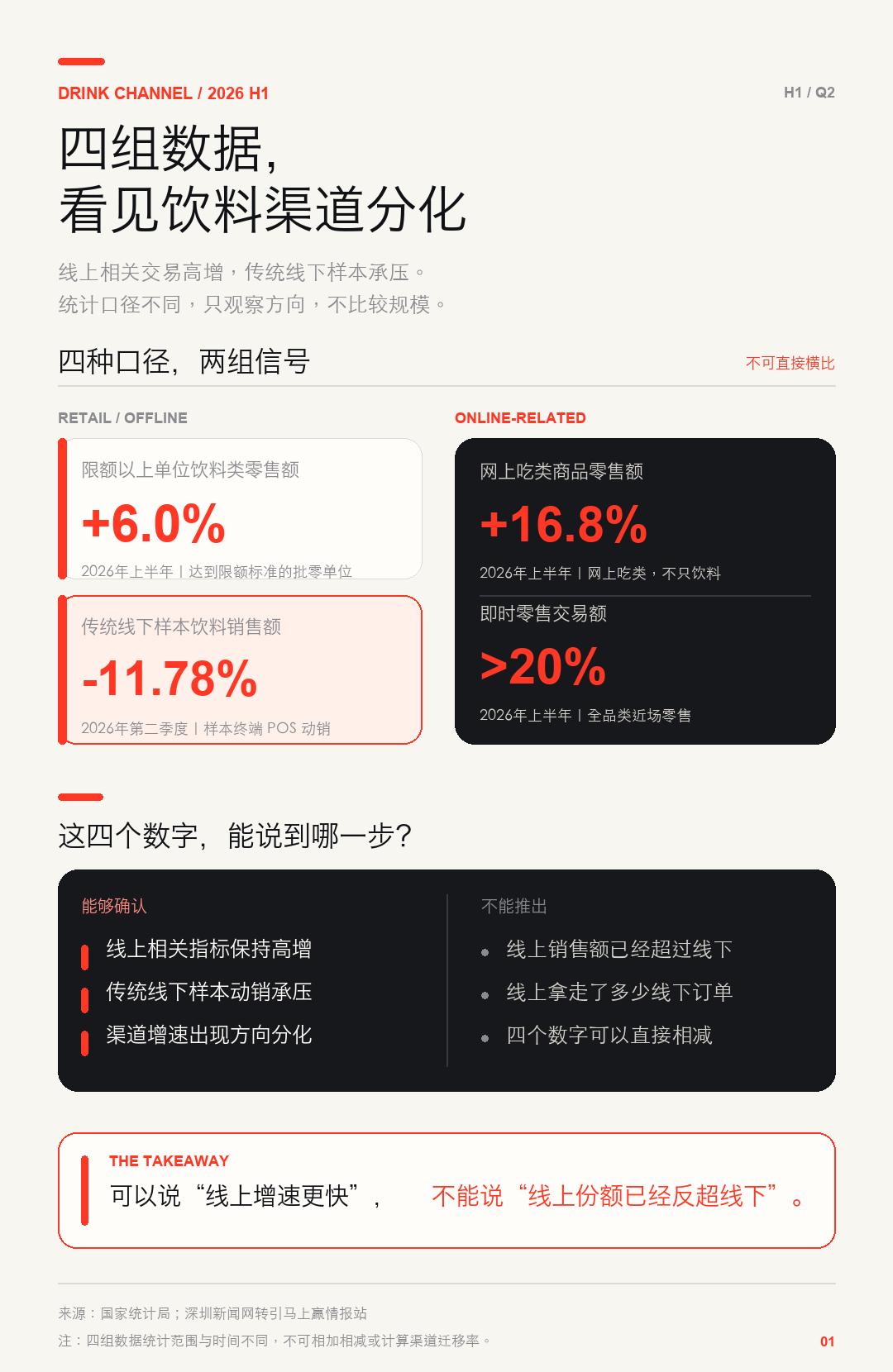
In the first half of 2026, several sets of beverage channel data seem to be heading in different directions, moving independently.
Data from the National Bureau of Statistics shows that the retail sales of beverages of units above designated size reached 160.1 billion yuan, a year-on-year increase of 6.0%; the food category in online commodity retail increased by 16.8%; the transaction volume of instant retail increased by more than 20%. On the other hand, among the traditional offline samples monitored by Mayingying, the beverage sales in the second quarter of 2026 decreased by 11.78% year-on-year.
Production: Hesong Finance
Note: The four sets of data have different statistical scopes, and can only be used to observe trends, not for direct comparison or subtraction. Among them, instant retail refers to the total transaction volume of all categories; online "food category" refers to online food-related commodities, not only including beverages; beverage retail sales only count units above designated size; the traditional offline data of Mayingying comes from the brand CT, MSY150 equilibrium model and full-store model, and the calibers adopted in specific charts are not completely the same.
These data cannot be pieced together into a complete map of beverage channel migration, but can show the differentiation status in the same period: the beverage retail of units above designated size is still growing, the sales of traditional offline samples are under pressure, while the online "food category" and all-category instant retail are growing rapidly.
The end shelves of domestic beverages have always been very scattered.
Large supermarkets, family-owned stores, small supermarkets, convenience stores and grocery stores together form the daily retail network. There are also a large number of street-side terminals around campuses, scenic spots, office buildings and transportation hubs. They are different in scale, procurement methods and digitalization level.
The Fifth National Economic Census shows that by the end of 2023, the number of individual business units in the national wholesale and retail industry reached 44.791 million, accounting for 50.9% of all individual business units. This does not mean that there are 44.79 million beverage stores across the country, but it shows that the domestic retail end is large in quantity, scattered and uneven in scale.
Another set of data from NIQ shows that in 2024, community stores accounted for 52% of the number of stores in modern channels; among them, 74% of community convenience stores cover an area of less than 50 square meters, and 52% of small community supermarkets cover an area of less than 100 square meters.
In the past, brands could only rely on salesmen's store visits, distributors' stock reports and terminal orders to judge layer by layer which shelves were out of stock and which products sold faster. Now, platforms are not only faced with several chains of convenience store networks, but also a store ecosystem with small scale, shallow inventory and scattered operation.
In the program, Zhong Shanshan described this change in very strong terms.
He even used the expression of "killing many retailers in the city". When talking about offline consumption, he criticized the platforms: "You are keeping people glued to the mobile screen all day long." Then he pushed the judgment to another grand proposition: "A society can only be creative when it retains sensibility."
Indeed, following his logic, the significance of street-side stores is not only to complete transactions, but also to retain offline interactions in the city. Consumers walking into stores, touching products and communicating with shop owners are themselves part of urban life and consumption experience. While platforms compress transactions into the screen, improving the efficiency of matching and fulfillment, they may also centralize the relationships that were originally scattered between people and stores into a single entry point.
The possible impact of this entry point is to put these originally scattered "inventories" into the same entry point.
In April 2025, Meituan Instant Delivery announced that its business had cooperated with retailers, brand owners and local small and medium-sized merchants in nearly 3,000 counties, cities and banners across the country; at that time, the daily non-catering instant retail orders of Meituan had exceeded 18 million. This set of disclosures illustrates two things: the supply side of the platform has covered retailers, brand owners and local small and medium-sized merchants; the daily order scale of non-catering instant retail has also exceeded 18 million, and the platform is obviously not only connected to chain convenience stores.
The change of entry point will naturally affect decision-making and roles.
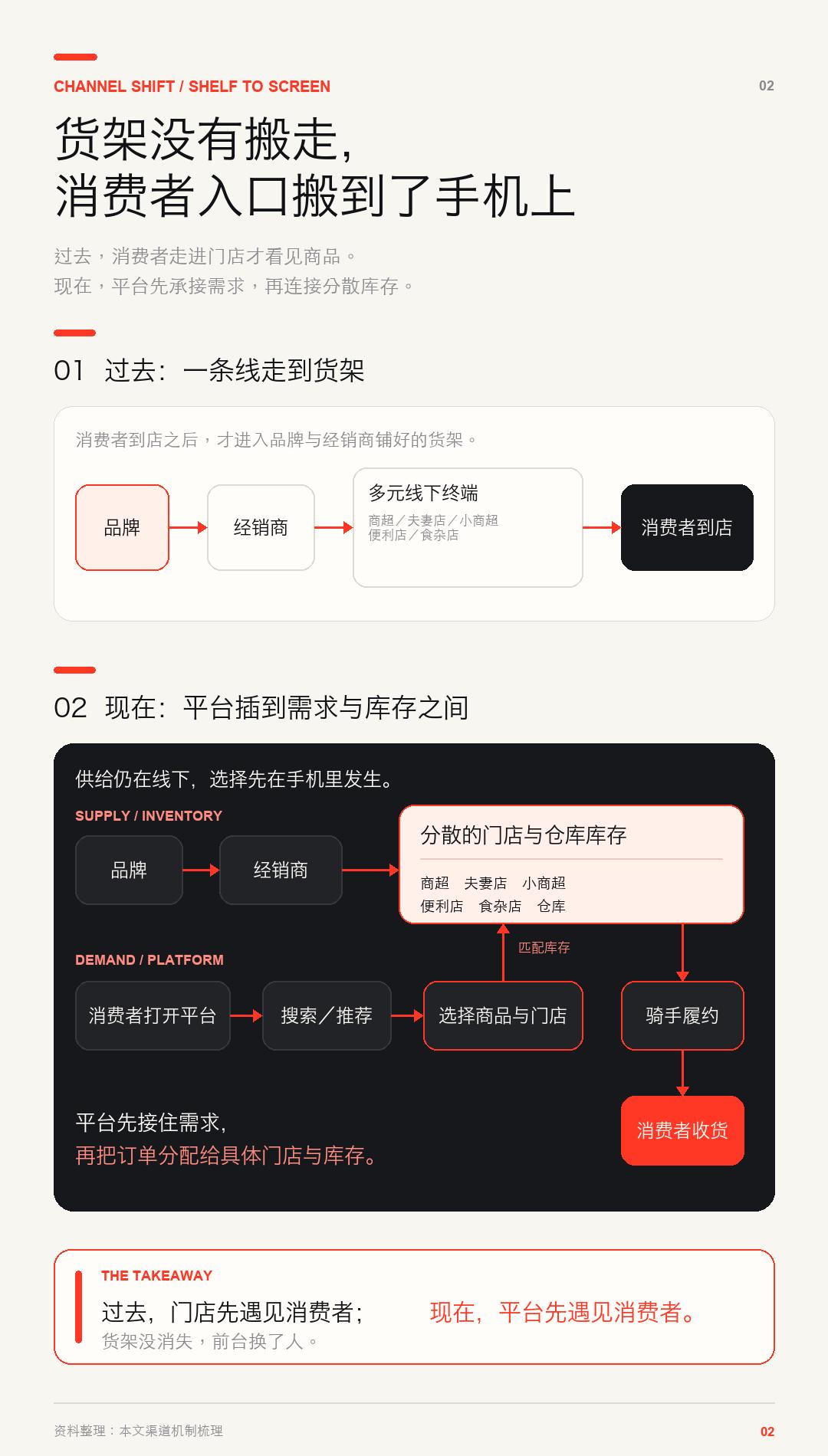
Beverages are naturally suitable for instant retail: they have quick decision-making, standardized attributes, need to be iced, can be bundled with meals, and can increase the customer unit price through whole-case sales. In the past, consumers would first walk into a store, and then face the products the shop owner placed on the shelf. Taking the publicly disclosed mechanism of Taobao Flash Purchase as an example, consumers first open the platform, then the system filters the delivery range according to the location, and then sorts the results combining search terms, sales volume, distance and historical behavior. After consumers select the product and the store, the rider will pick up the goods.
The change of this chain is not just "selling one more bottle online", but that the platform has rewritten the consumption path:
Production: Hesong Finance
The change is not only about how many orders the new channels have taken away from the old channels. More importantly, the platform stands in front of the old channels and rewrites the path for consumers to find products. In the past, consumers saw the store first, and then the shelf; now, consumers open the platform first, and the platform displays the products and the stores that can fulfill the order.
The platform has not removed the freezer, nor replaced the family-owned store, but it has indeed changed the path for consumers to reach the freezer.
2
2.43 million terminals create the "king of channels"
Zhong Shanshan's criticism of platforms is not new.
In January 2025, Zhong Shanshan posted 3 consecutive Moments to denounce e-commerce platforms, forwarding 2 videos in them. He said: "The four major e-commerce platforms have made us lose the opportunity to go beyond the economy, a large number of small and medium merchants are losing or have lost the ability to compete fairly, and a large number of employment opportunities have been seized by the platforms."
All along, pre-packaged beverage business is a business with low customer unit price and heavy logistics.
A bottle of water sells for two or three yuan, and its profit cannot withstand repeated long-distance and inefficient handling. If there is a shortage of goods in the peak season and the freezer is empty for one day, the sales volume will decrease by one day. If a brand wants to enter the national market, it cannot only rely on advertising. It also needs warehouses, vehicles, salesmen and distributors who are willing to stock goods.
This is also the background for the emergence of Wahaha's joint sales body system.
In 1994, as problems such as distributors' illegal cross-regional goods shipment, random price adjustment and payment arrears became more and more serious, they had endangered the foundation of Wahaha's development. Against this background, Zong Qinghou decisively launched the "joint sales body" model.
Zong Qinghou required all distributors to pay a certain amount of deposit annually, and settle payment once for each purchase in the business process. As corresponding returns, Wahaha promised to give more preferential policies, and pay interest on distributors' deposit at a rate higher than the bank deposit interest rate of the same period. Each distributor is strictly prohibited from cross-regional goods shipment, and at the same time needs to bear sales targets. Those who fail to meet the targets will be dynamically eliminated.
Under this method, the first-level distributors connect with secondary wholesalers, extending the market network to counties and rural areas. Wahaha later stated in its social responsibility report that after this network matured, new products could be distributed to more than 3 million terminals across the country within one week.
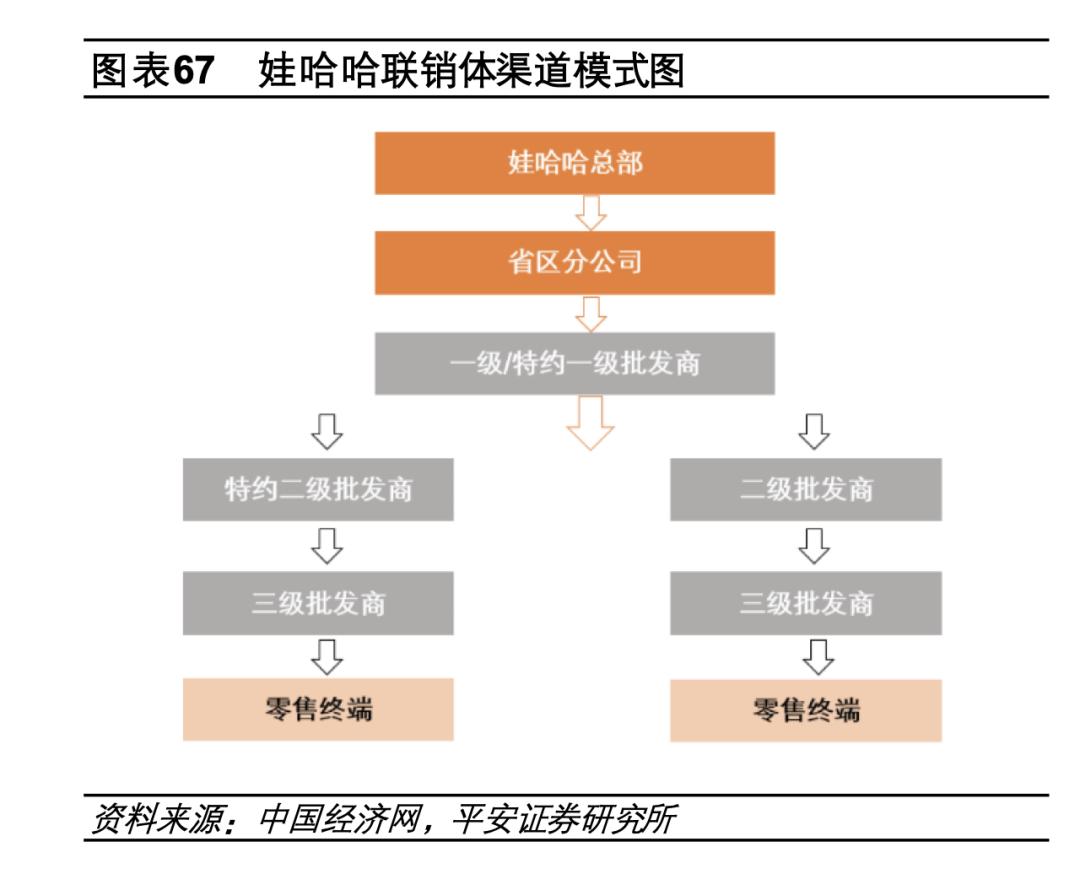
Parallel to Wahaha's joint sales body system, the beverage industry has also developed other channel organization methods, such as Master Kong's intensive channel cultivation. They did not eliminate middlemen, but chose to integrate scattered middlemen of different scales into the same set of interests and disciplines.
According to the relevant research report of Soochow Securities: when Nongfu Spring was established in 1996, it adopted a model similar to Wahaha's joint sales body system; it began to learn Master Kong's intensive channel cultivation model in 2008; it began to strengthen the distributor elimination mechanism in 2014, and carried out a special reform of distributors in 2016; since 2020, the company has signed agreements with secondary distributors in some township markets to promote channel sinking and further improve channel operation efficiency.
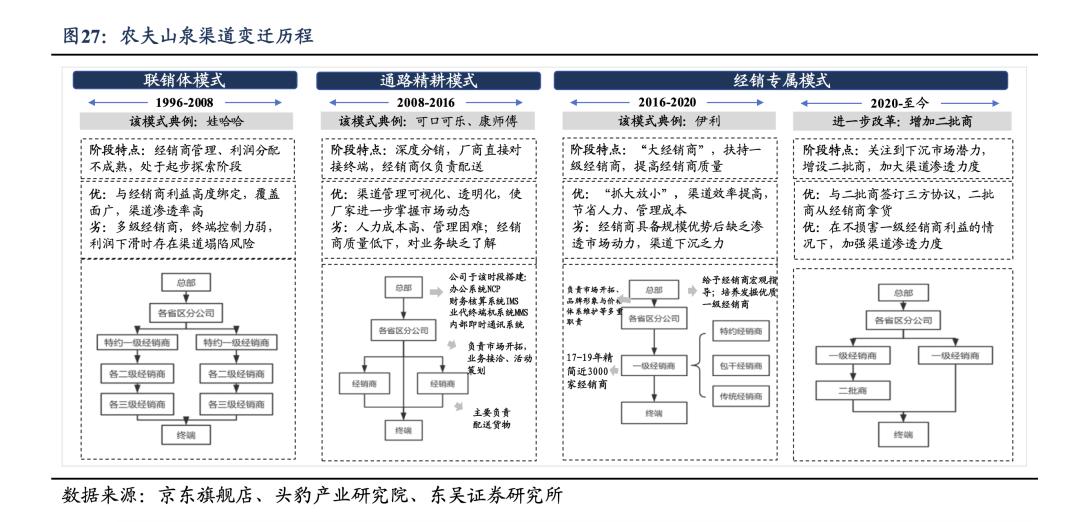
The organization method has been changing, but distributors have not disappeared from Nongfu Spring's system.
According to the 2020 prospectus, as of May 31, 2020, Nongfu Spring had 4,454 distributors, covering more than 2.43 million retail terminals. Among them, about 1.88 million terminals are located in third-tier and lower cities, and more than 480,000 terminals are equipped with Nongfu Spring brand freezers. In the first 5 months of 2020, the revenue contributed by distributors accounted for 93.6% of the company's revenue.
These terminals are not simply registered on a list.
The prospectus shows that at that time, about 12,000 front-line sales and management personnel of the company and distributors used the NCP system. Salesmen can upload display photos, check freezers, and record promotional activities; distributors share inventory data with the company, and the system can also send inventory warnings.
Channels have always been the sharp weapon held by FMCG enterprises such as Nongfu Spring.
In February this year, Tang Binsen, founder of Genki Forest, released an internal letter titled Focus, Stay Focused, Respond to Changes with Unchanged Principles. Tang Binsen mentioned that channels, especially offline channels, have become an important growth driver. "From streets and alleys to office buildings and communities, our reach is extending, and we are striving to reduce the fluctuation between peak and off seasons. More importantly, we have gradually explored the business rhythm of 'ploughing in spring, fighting in summer, harvesting in autumn, and leaping in winter', and our national sales partners are still promoting freezer placement in an orderly manner in the severe cold," he said.
At the same time, emerging beverage brands such as Guoshushule have also been firmly grasping channels.
Channel power is one of the most important competitive barriers in the beverage industry. This is not a feeling brought by a set of adjectives, but a system woven by rules.
Nongfu Spring's prospectus discloses that distributors need to pay before delivery, and usually cannot return or exchange goods; they need to operate in designated areas and channels; the company provides suggested retail prices, and checks distributors' resale prices and terminal retail prices. Salesmen upload display