Midea is injecting another 1.6 billion yuan to prop up Hiconics. Can it take a firm first step on the path to its 50-billion-yuan energy target?
Midea injects capital into Hiconics, as home appliance giants rush to deploy in the new energy sector.
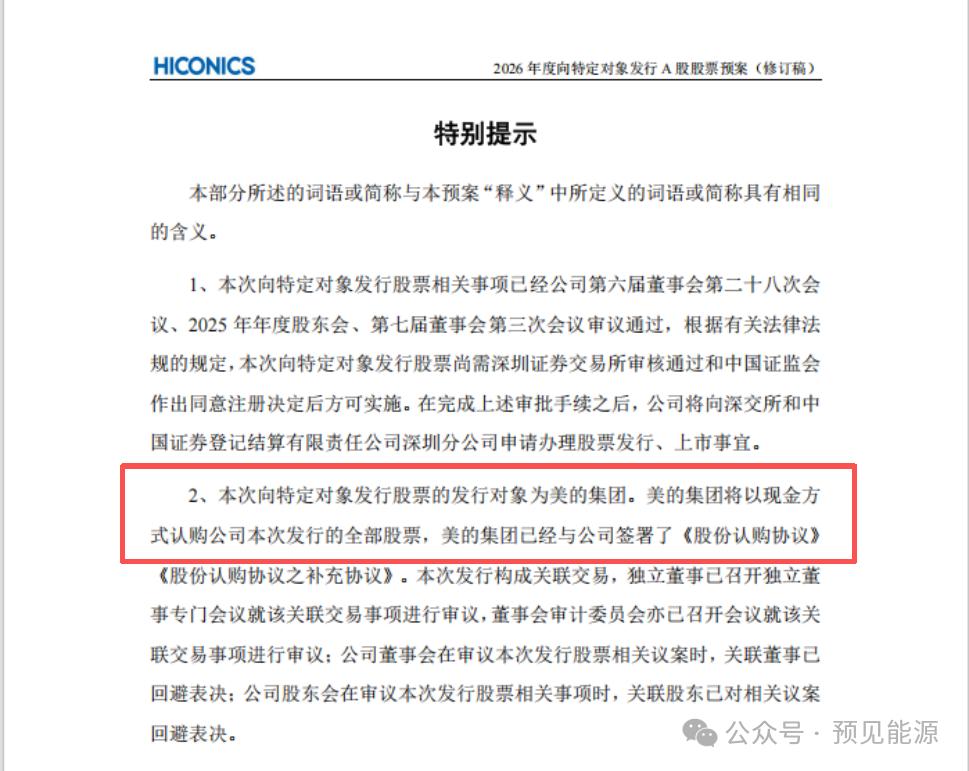
Foresee Energy noted that on August 11, Hiconics disclosed the revised draft of its private placement plan, proposing to issue no more than 288 million shares to its indirect controlling shareholder Midea Group, raising no more than 1.652 billion yuan, all of which will be subscribed by Midea in cash.
At the same time, Hiconics' Q1 financial data was not impressive: operating revenue reached 1.679 billion yuan, down 25.05% year on year; net profit attributable to shareholders was a loss of 11.5742 million yuan, compared with a profit of 28.1618 million yuan in the same period last year.
In the restricted stock incentive plan released at the end of 2025, the company set an assessment target of 108% growth in non-recurring net profit for 2026. The first-quarter performance report is still far from reaching this target.
Midea's choice to inject capital when its subsidiary is losing money is not complicated in logic.
At the end of 2025, Midea officially established the New Energy Business Division, with Executive President Wang Jianguo concurrently serving as its president, positioning it as one of the three strategic pillars of the group alongside home appliances, new energy and healthcare.
Midea's management put forward the target of "striking 50 billion yuan in revenue from new energy business within five years". In 2025, the total revenue of Hiconics and Clou Electronics just exceeded 13 billion yuan. There is a huge gap from 13 billion to 50 billion yuan, and only five years are left.
Midea needs Hiconics to grow as fast as possible.
01
Two Platforms, Two Core Assets
What Game Is Midea Playing
Midea's layout in the new energy track did not start in 2026.
In 2020, Midea took control of Hiconics to enter the photovoltaic and residential energy storage sectors. In 2023, it took over Clou Electronics to make up for the gaps in industrial & commercial energy storage and large-scale ground energy storage. At the end of 2025, the New Energy Business Division was established to bring the two companies under unified management. Clou Electronics focuses on large-scale source-grid-load-storage projects, while Hiconics focuses on the integrated R&D, production and sales of residential energy storage products and distributed photovoltaic solutions.
The logic behind this "dual-platform" structure is easy to understand. One covers large B-end projects, the other focuses on the C-end residential market, and the two lines cross-cover the whole chain from power generation to power consumption.
Hiconics actually has strong core advantages. High-voltage frequency converters are its most solid foundation, and the company has long been in the first echelon of domestic players in this field.
In July 2026, Hiconics and SPIC Shanghai Nuclear Engineering Research and Design Institute launched the joint R&D project for the localization of high-voltage frequency converters for the main pump of the "Guhe No.1" reactor. Previously, it has implemented the localized frequency conversion application projects for Units 3 and 4 of CNNC Xudabao Nuclear Power Plant, new supporting projects for Fuqing Nuclear Power Plant, and completed the localized frequency conversion replacement for the main helium fan of the Huaneng Shidaowan High-Temperature Gas-Cooled Reactor. The nuclear power industry has extremely high requirements for equipment safety and reliability. Passing the verification of this market means that the technical capability has gone through the strictest tests.
What Midea injects into Hiconics includes not only capital, but also channels. Hiconics clearly stated in its private placement plan that the photovoltaic grid-connected inverter and residential energy storage projects will "rely on Midea Group's mature overseas brand influence and global channel resources". Midea has a mature sales network and brand awareness around the world, which is ready-made resource for Hiconics to expand its overseas energy storage and inverter business.
However, Hiconics also has its own problems. The company's asset-liability ratio has reached 65.68%, and the loss in the first quarter indicates that the new energy business is far from the stage of stable profitability. The 1.652 billion yuan can help Hiconics survive the transition period, but whether it can achieve large-scale growth depends on whether its products can be sold well.
02
Skyworth, Haier, TCL
Photovoltaic Performance of Home Appliance Giants
Midea is not the only home appliance enterprise that has made heavy bets on the new energy track, but each company has taken a different path.
Skyworth entered the photovoltaic sector in 2020 with the most straightforward strategy, selling photovoltaic panels through the channels that used to sell TVs. In 2025, Skyworth's new energy business revenue reached 23.685 billion yuan, up 16.5% year on year, exceeding the 21.666 billion yuan of its smart TV business for the first time. By the end of 2025, Skyworth Photovoltaic had cumulatively built more than 800,000 power stations, with the grid-connected installed capacity exceeding 29.3GW.
It can be said that Skyworth has turned photovoltaic business into a channel-driven business. The 400 million household touchpoints, the dealer network covering counties and townships across the country, and the in-home installation service capabilities, all the resources accumulated from TV sales have become scarce resources in the residential photovoltaic track.
Haier has taken another path. In January 2026, Haier New Energy completed a Series B financing of over 1 billion yuan, with investors including ABC Investment, China Merchants Bank, Luxin Venture Capital, Shanneng Capital and others. In the same month, Haier New Energy officially launched its listing counseling.
Haier focuses on the three major industries of "green energy + energy storage + smart energy controller". The first phase of the ecological park put into operation in Qingdao Blue Valley in October 2025 has deployed 13 production lines, covering products such as inverters and power conversion systems for energy storage.
TCL's strategy is more "painful". In 2025, TCL Zhonghuan's new energy photovoltaic business revenue reached 22.725 billion yuan, accounting for 78.23% of total revenue, but its gross margin was -12.90%. The company recorded losses of 9.818 billion yuan, 9.264 billion yuan and 1.647 billion yuan in 2024, 2025 and the first quarter of 2026 respectively. In January 2026, TCL Zhonghuan announced its plan to acquire Yida New Energy. As previously reported by Foresee Energy, the more it sells, the more it loses, and TCL has the deepest understanding of the hardships of photovoltaic manufacturing.
The path differences among the three companies are obvious: Skyworth focuses on channels, Haier focuses on platforms, and TCL focuses on manufacturing. Midea has chosen the fourth path — taking control of two listed companies to build a "dual-platform" through capital integration.
03
Home Appliance Giants Crossing Into Energy Sector
Both Advantages and Shortcomings Are Very Obvious
What unique resources do home appliance enterprises have when they cross into the new energy sector that other players do not have?
Channels. Skyworth can quickly lay out residential photovoltaic business in the rural market relying on the sales network accumulated from TV sales in the past. Midea's channel and brand accumulation in overseas markets is also an important support for Hiconics to expand its overseas business. Haier relies on the COSMOPlat platform to embed into industrial scenarios, and has a huge industrial and commercial customer base on the B-end. These channel resources cannot be built overnight, and it is not easy for traditional energy enterprises to replicate them.
Brand trust. In the rural market, farmers may not recognize a certain photovoltaic brand, but they definitely know Skyworth, Haier and Midea. This brand awareness reduces customer acquisition costs and lowers the user's decision-making threshold.
But the shortcomings are also obvious. Home appliance enterprises are far less competitive than professional manufacturers such as CATL and Sungrow Power in terms of scale effect and cost control of core hardware such as energy storage cells and inverters. Home appliance enterprises generally lack the technical capability to connect the whole chain of "power generation - power storage - power consumption - power trading". The so-called "ecological complementarity" in most cases is only linkage at the promotion level, rather than collaboration at the technical level.
The greater risk lies in the business model. The EaaS model represented by Midea essentially transfers the asset risk from the property owners to itself. Midea relies on its AAA-level credit to raise funds at low cost and hold the assets, while property owners only need to use electricity at the agreed tariff.
This model sounds reasonable, but if the tariff in the spot market fluctuates drastically, the promised guaranteed tariff may turn into a loss black hole. Any problem in any link, such as the attenuation of photovoltaic modules, energy storage safety accidents, and extreme weather, may lead to asset impairment.
Home appliance enterprises are shifting from "selling equipment" to "operating assets", and this transformation is more difficult than imagined. Operation requires not only capital, but also in-depth understanding of power market trading, tariff fluctuation and asset management. Home appliance enterprises are still in the process of accumulating these capabilities in general.
Back to Midea and Hiconics. The 1.652 billion yuan has been invested, and the 50 billion yuan revenue target has been set. Next, it remains to be seen whether Hiconics can convert the technical advantages of high-voltage frequency converters into scale advantages in photovoltaic and energy storage business, whether Midea's overseas channels can help Hiconics sell its products, and whether the synergy of the "dual-platform" can produce the effect of 1+1>2.
Home appliance giants crossing into the new energy sector is a tough battle at the strategic level, and there are many tests to face.
This article is from the WeChat official account "Foresee Energy", written by Wang Mengjiao, and published with authorization from 36Kr.