Hilton, Marriott and other major hotel groups have begun to reduce burdens and offer profit concessions to their property owners.
In March this year, 51 hotel owners in North America who operate nearly 1,000 Marriott properties jointly wrote a letter to the senior management of Marriott International, bringing the long-overdue revenue-sharing disputes to the table.
No one expected that only five months later, Marriott would give a formal response.
During its Q2 earnings call this year, Marriott announced the launch of a commission rebate program called "ITR Incentive" (Intent to Recommend), under which eligible Marriott-branded hotels in North America can receive a fee rebate of up to 50 basis points of their total room revenue, which will be counted starting from the second half of the year.
Almost at the same time, the CEO of Hilton stated during its Q2 earnings call that the company has reduced the loyalty fees paid by most hotels worldwide, launched Hilton Rise, and plans to handle hotel renovations and brand standards in a more flexible manner.
The nearly simultaneous concessions and profit-sharing moves by the two top international hotel giants do not seem to be a coincidence.
An optimization and adjustment of the hotel franchise model driven by owners and featuring profit concessions and cost reduction from brand parties seems to have been launched across the globe.
Marriott and Hilton Roll Out Concessions Simultaneously
Recently, Hilton and Marriott have successively announced owner support policies during their respective Q2 earnings calls.
The two sets of plans are highly similar in their logic, both taking customer satisfaction as the assessment standard and granting direct fee reductions to qualified properties that meet the requirements, but there are certain differences in the underlying capital sources and the scope of profit concessions.
Let's start with the ITR incentive program launched by Marriott.
Marriott's CFO clarified all the details during the earnings call, noting that the program covers all franchise properties in the United States and Canada, with two core rules.
The first rule is that the property assessment criteria are tied to the ITR guest recommendation score. If checked-in guests fill out the survey questionnaire after check-out and give high ratings, and the overall guest reputation of the property meets the specified standards, the hotel can receive a rebate subsidy of up to 50 basis points of its total annual revenue every year.
We can do a simple numerical conversion: for a franchise hotel with annual room operating revenue of 10 million US dollars, if it meets the property assessment standards, it can receive a subsidy of 50,000 US dollars every year, which can directly increase the net operating profit of the hotel property.
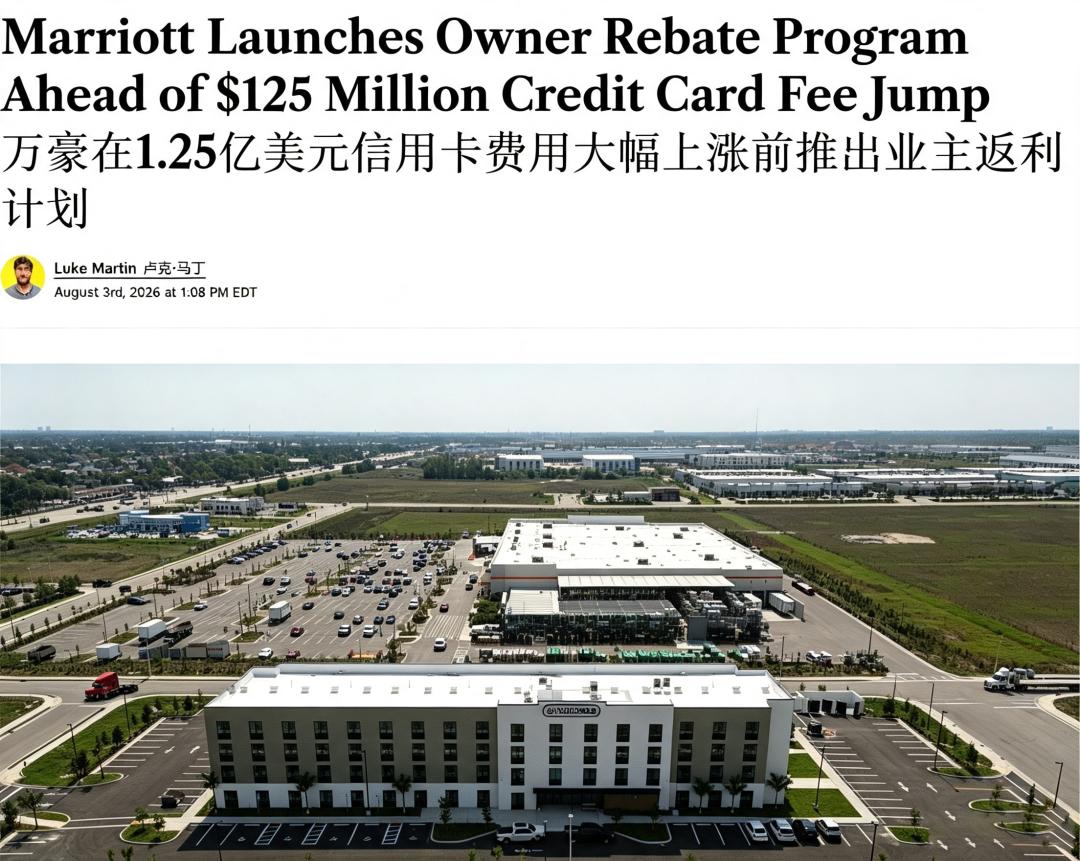
It is necessary to distinguish two capital accounts with completely separate purposes: the brand public operation fund pool refers to the fees related to member promotion and online system maintenance that each franchise hotel pays uniformly every year. The ownership of this fund belongs to all cooperative franchisees, and the fund can only be used for two purposes: unified brand-wide advertising and exclusive global member welfare activities.
For a long time in the past, most of the funds for various property support subsidies and fee reduction policies launched by hotel brands were drawn from this public fund pool. In other words, the brand used the operating fees paid by all owners to subsidize a small number of properties with good operating reputation, and the final cost was still shared by all cooperative owners.
However, all the cost of the 50 basis points fee rebate subsidy this time is borne by Marriott International itself, which means the group voluntarily reduces its own operating revenue to specifically benefit high-performing cooperative franchisees. The policy does not transfer any operating cost to small and medium-sized owners with small business scales, which clearly demonstrates the group's sincerity in offering support.
Almost in the same period, Hilton launched the RISE performance incentive program. The implementation logic of this program is very similar to Marriott's ITR policy, which is also tied to the in-house guest satisfaction score. Franchise properties that maintain high guest review data for a long time can reduce part of various service fees that need to be paid to the brand.
The burden reduction policy launched by Hilton actually offers greater support than Marriott, as the brand adopts a two-layer superimposed profit concession model.
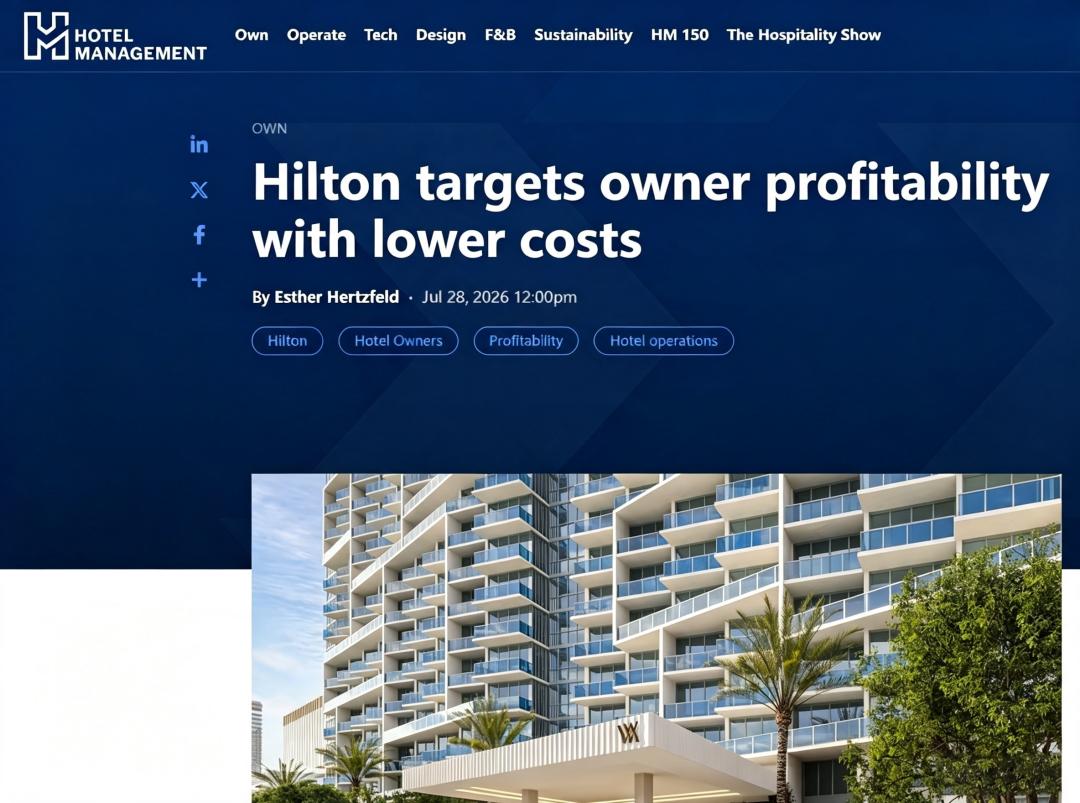
The first layer is the RISE performance fee reduction rule: if the property's guest satisfaction meets the standard, it can reduce a fixed proportion of the brand operation service fee;
The second layer is that the group reduces the basic member service fees payable by most franchise hotels worldwide. After the two support policies are implemented simultaneously, estimates show that the average operating profit of each franchise hotel can increase by 75 to 100 basis points.
The two international hotel giants launched property burden reduction policies almost at the same time, which does not seem to be a coincidence.
Marriott was previously under joint pressure from owners who operate thousands of chain hotels. If the group does not launch profit concession and subsidy policies, existing franchisees will easily terminate their cooperation and choose other competing hotel brands to join.
Hilton seized the time window of this industry change to launch its burden reduction plan at the same time, which can not only appease all its existing cooperative franchisees, but also attract investors who originally intended to join international hotel brands such as Marriott.
However, Marriott and Hilton's two support policies also have something in common: both subsidies require assessments related to guest satisfaction, and are not universal subsidies issued to all franchise properties without thresholds.
Only properties whose daily service level meets the unified standards and whose in-house guests give high recommendation scores are eligible for the fee rebate and service fee reduction benefits issued by the brand.
Both hotel groups have their own operational considerations. The group gives up a small part of its own operating revenue, hoping to use the subsidy assessment rules to urge offline franchise properties to maintain unified and standardized services, and hold the bottom line of the overall consumer experience of brand members.
However, what the owners really want seems to be to share the incremental revenue from co-branded credit cards and point sales, and to demand a redistribution of the profit cake of the membership system.
The support content currently launched by Marriott and Hilton is only a fixed proportion of operating cost rebate subsidies, which belong to phased one-time income compensation, and still do not open up the revenue sharing channels for the core operating revenue of the membership system.
Why Are the Owners Pushed to Their Limit?
Many people who travel and stay in hotels can see the lobby decoration, rich breakfast, and use points to redeem rooms for free, but few people probably think about who is paying the bill and taking the risks behind all this.
The vast majority of international chain hotels have long abandoned the heavy asset model where the group builds and operates the properties on its own.
Hilton's directly operated hotels account for less than 0.5% of its total properties, and Marriott's figure is only 0.6%.
Almost all of their hotels are franchisees who invest tens of millions or hundreds of millions of dollars to acquire land and renovate properties, and pay high franchise fees, system fees and member service fees every year. The group only outputs brand standards and member traffic, and does not bear costs such as property depreciation, labor, and utility consumption.
This light asset business model has been favored by both sides for more than a decade.
Hotel groups receive stable cash flow easily, and owners rely on the chain membership system to maintain high occupancy rates. The two sides share benefits tacitly and live in peace.
The turning point came with the boom of co-branded credit card business.
In recent years, Marriott has maintained in-depth cooperation with Chase and American Express, launching a number of exclusive co-branded credit cards.
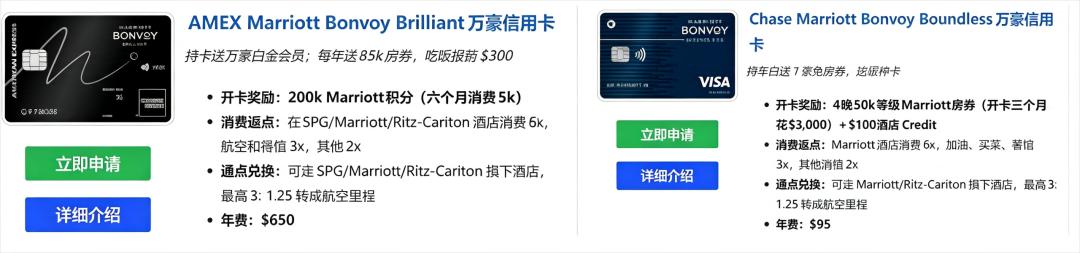
All offline consumption of consumers, including supermarket shopping, dining, and refueling for travel, can accumulate Marriott points.
For every credit card transaction, the bank pays Marriott high authorization sharing fees.
Public information shows that Marriott expects its co-branded credit card revenue from cooperation with JPMorgan Chase, American Express and other partners to grow by about 35% in 2026, reaching as high as 1 billion US dollars.
This sum of money is pure incremental profit, and no offline hotel needs to share the operating cost in the whole process, which belongs entirely to Marriott's headquarters.
I am also a Marriott member. When staying in a hotel, I hope to spend the least money to get the best room and enjoy the most value-added services.
This is human nature. Besides, the member points service is clearly stipulated in the member handbook before membership registration.
But after the total amount of points skyrocketed out of thin air, who was the cost passed on to?
Almost all the cost is paid by the franchisees themselves.
Therefore, in March this year, 51 Marriott owners with heavy assets jointly wrote a strongly worded open letter, which was directly delivered to Marriott CEO Anthony Capuano and Chairman David Marriott.
In the view of these Marriott owners, point-redemption room nights should at least get a compensation level close to that of orders from third-party platforms such as Expedia.
Do not underestimate these 51 people: they operate nearly 1,000 Marriott-branded hotels with a total of 182,000 rooms, accounting for one sixth of the total number of Marriott hotel rooms in the United States, and are the core franchise group that Marriott cannot ignore.
After years of accumulated disputes, the owners no longer hold back and choose to confront the brand directly.
The Era of Massive Devaluation of Membership Points
While Marriott is playing a game of interest distribution with its owners, it has quietly adjusted its membership point redemption policies.
Although it is not yet possible to confirm whether the two events are related, the massive devaluation of Marriott's membership points occurred just a few weeks after the owners jointly "forced the palace", and this "coincidence" has triggered widespread speculation from the public.
Not long ago, Marriott members wailed across social media platforms.
Many domestic Marriott members logged in to the Marriott Bonvoy app and found that the points required for redeeming room nights "increased by 1,000 points at the minimum, and 3,000 to 5,000 points at the maximum".
The ratio of some overseas hotels is particularly prominent: a hotel in the Jumeirah Village Triangle area of Dubai has a cash price of only 443 RMB per night, but requires 41,000 points for redemption.
According to media reports, a domestic Marriott member's statistics show that the point redemption price of Marriott hotels has increased by 15%-20% on average. Calculated based on the redemption value, the market value of Marriott points has dropped from the previous average of 400 RMB per 10,000 points to about 300 RMB per 10,000 points, a decline of about 25%-30%.
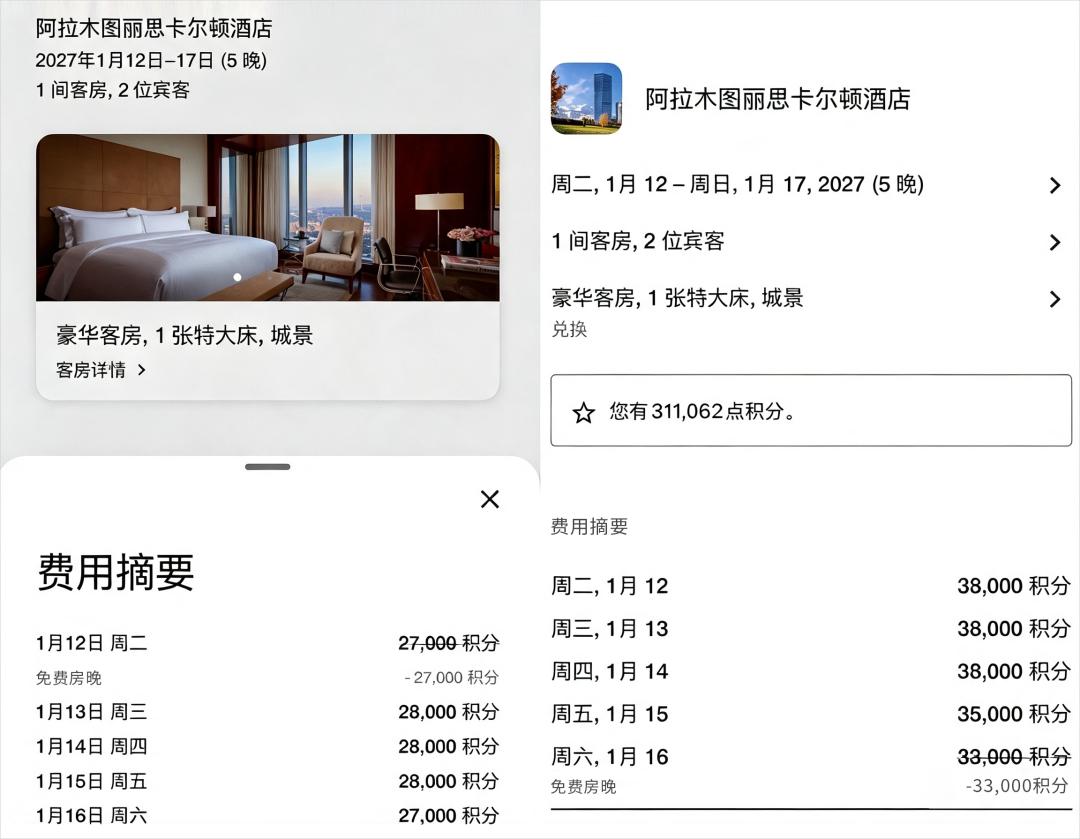
In fact, not only Marriott, but also Hilton, Hyatt and other hotel groups have intensively adjusted their point redemption policies in recent years.
Take Hilton as an example: it raised the redemption limit three times between December 2024 and September 2025, with the redemption cap for top-tier hotels rising from 150,000 points to 200,000 points first, and then to 250,000 points.
The total amount of membership points remains the same, but the purchasing power of points shrinks, which in essence reduces part of the cost brought by membership points and passes it back to members.
Coming from the golden age of membership systems, the three top international hotel groups all have a member base of over 100 million.
Public data shows that as of the first quarter of 2026, Marriott Bonvoy has more than 271 million members, Hilton Honors has more than 251 million members, and IHG Rewards Club has more than 160 million members.
Once the number of members is overloaded, hotel groups also need to strike a balance between member experience and controlling owners' costs.
The core of the light asset franchise model is originally a win-win situation for both the brand party and the owners.
The brand party provides traffic and standardized management, and charges reasonable brand service fees; the owners invest in properties and funds, and rely on the brand membership system to gain stable operating profits.
The era when the brand party holds absolute say is coming to an end, and franchisees with large hotel portfolios are beginning to have the right to speak matching their capital scale.
The profit cake of the membership business will most likely no longer be exclusively enjoyed by the brand party in the future.
The story of light asset expansion has been told for decades. When costs and benefits begin to decouple, the balance between the brand party and franchisees will be broken sooner or later.
This article is from the WeChat public account "Hotel Finance", written by Dasheng, and authorized for release by 36Kr.