Recall of Atlas 297 Days Later: The Shift in OpenAI's Product Strategy
At the end of July, amid the continuous rainy winter days in Melbourne, overseas Chinese student Lu Mo opened ChatGPT Atlas on his computer as usual, only to see a line of small text pop up above the chat box:
"ChatGPT Atlas is about to be discontinued. Atlas will no longer be available starting at 6 p.m. Pacific Time on August 13."
As an AI-native browser launched by OpenAI, ChatGPT Atlas was released on October 21, 2025. OpenAI stated in its product description: "This is a browser with built-in ChatGPT that can move closer to a 'true super assistant' — it can understand users' ideas and help improve their work efficiency." Even Sam Altman, CEO of OpenAI, held extremely high expectations for it, calling it a "once-in-a-decade" opportunity.
Over nearly 10 months, Lu Mo spent more than 280 days using Atlas. In her opinion, the user experience of Atlas kept improving, and Lu Mo could list 4 or 5 functions of Atlas that outperform other browsers just from memory.
Until July 9, 2026, James Sun, head of OpenAI's browser business, announced that Atlas would be discontinued in a month. "It's totally unbelievable," Lu Mo recalled her first reaction when seeing the news. "Atlas has been under continuous optimization, and I never expected it to shut down suddenly."
In the past year, AI browsers have sprung up everywhere. In May 2025, Josh Miller, founder of The Browser Company, announced that the company would stop developing Arc and shift to the AI browser Dia; in the same month, Norwegian company Opera launched the AI-powered proxy browser Opera Neon; in July, Perplexity released Comet, an AI-driven browser; three months later, ChatGPT Atlas was launched.
What makes people curious is: why did Atlas, born in the "first year of AI browsers", exit the market in a hurry less than 10 months after its launch? Multiple Atlas users told Tencent Tech that the shutdown of Atlas came with no warning, no clear explanation for users, and seemed rather "unexpected".
What is more worth asking is: if even ChatGPT, which has top large model capabilities and a huge user base, failed to seize the "entry" high ground of AI browsers with Atlas, do independent AI browsers really fit the form required by current search engines?
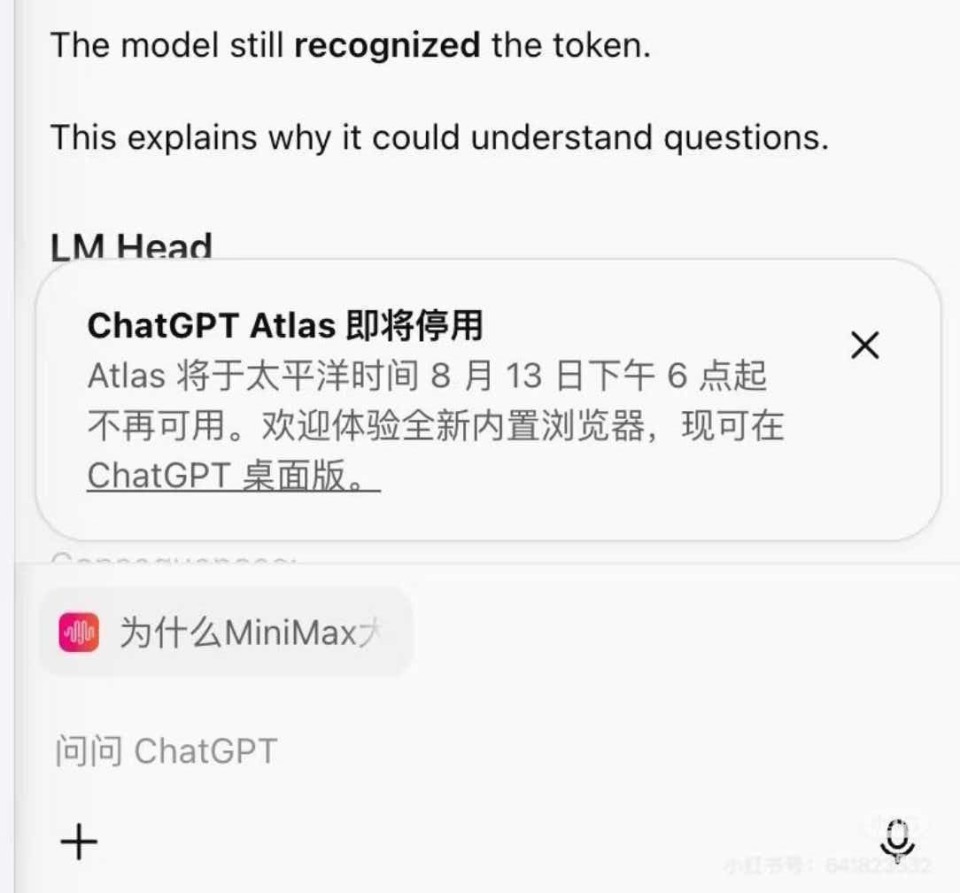
ChatGPT Atlas discontinuation notice, provided by the interviewee
01 When ChatGPT is integrated into the browser
ChatGPT Atlas was not the first AI browser that Lu Mo used.
In the middle to late period of 2025, Lu Mo once used "Doubao AI Browser" to assist her studies, but it often had limitations when translating some professional content. Therefore, she went to the official website of ChatGPT to search for similar browser products.
An icon with a dark blue border and a white arrow in the middle shaped like a stamen appeared in front of her. That day was October 23, 2025, the third day after the Atlas browser was released.
ChatGPT Atlas icon, sourced from the internet
In 1990, at the European Organization for Nuclear Research (CERN), a scientific research institution spanning the border between France and Switzerland, Tim Berners-Lee developed the world's first web browser, WorldWideWeb, which opened the door for mankind to enter the era of information technology revolution.
In the 36 years that followed, Microsoft launched Internet Explorer, Apple launched Safari, and Google developed Chrome. Browsers gradually evolved from the initial web readers into platforms that carry search, content, transactions and applications, and have developed more diverse forms in successive competitions of technology and ecosystem.
Only human wisdom, through repeated exploration and multiple inquiries in the search bar, accumulates slowly and brings about qualitative changes.
In 2024, along with the highly crystallized wisdom of mankind, the "artificial intelligence" era arrived, and generative AI also entered browsers, launching a challenge to traditional browsers dominated by a few giants.
The "save prompt" function, which traditional browsers do not have, is one of the reasons why Lu Mo took Atlas as her daily browser.
After studying abroad, previewing before class became a necessary preparation for Lu Mo. She saved a prompt in Atlas that says "make Chinese-English bilingual preview notes based on PPT". Every time she previews, she only needs to click once, and the system will automatically input this instruction. "The whole process is very convenient."
Since then, Atlas has almost become the entry for Lu Mo's study and work: translating menus when eating out, making course paper plans, designing travel itineraries, analyzing employment positions... These trivial daily tasks completed by Agent intelligent agents piece together bits and pieces of Lu Mo's life as an overseas student.
"Another representative function is the Agent intelligent agent mode promoted by Atlas, which is close to the currently mentioned GUI Agent, allowing AI to directly operate web pages on behalf of users." Cao Lichun is also a heavy user of Atlas, and Atlas is mainly used for light work and study on her computer.
She said Atlas also connected the context between the browser and AI. In the past, when using GPT, users needed to upload files and send screenshots, but in Atlas, this step is almost omitted. Users only need to select the content they want to ask on the browser page, and they can directly let AI understand it and continue to ask follow-up questions around it.
This is a bit like the point-and-read pen or word translation in the past, except that the selected content is no longer just translated or explained, but becomes a context that can have continuous conversations with AI.
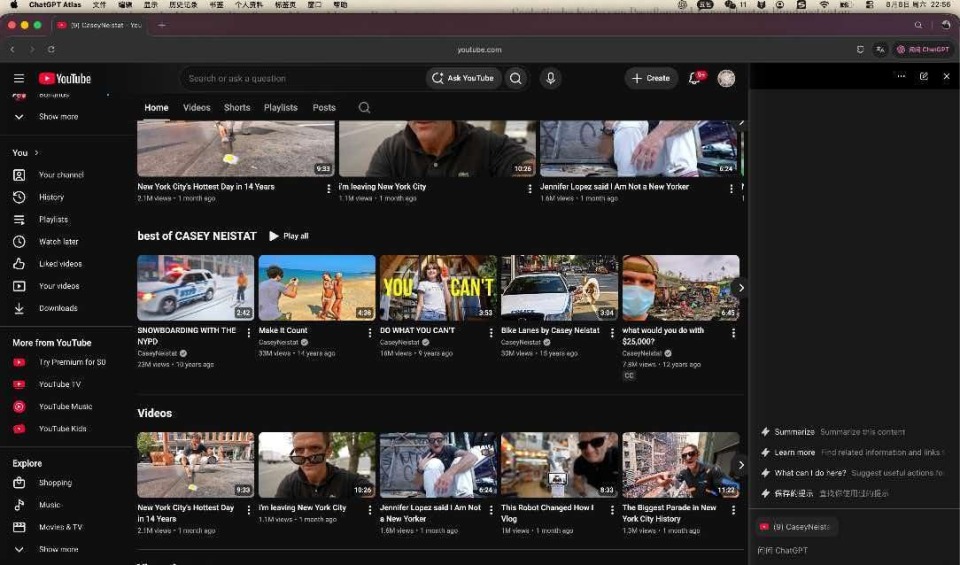
Atlas browsing interface, the dialog box on the right can be used to communicate about web content, provided by the interviewee
Lin Duyun, a doctoral student studying in Europe, was also deeply impressed by this function. On the first day of Atlas's release, Lin Duyun saw the introduction of this product on the official website of OpenAI.
Moreover, the "AI sidebar interaction" function of Atlas can also read the content of the current web page in real time, and perform summarization and Q&A based on the page. For Lin Duyun, this means that the original "A-B-C" three-step learning path that required repeated copying, pasting and questioning is compressed into the "A-C" two-step path. This simplification of the workflow made him shine with new ideas.
Later, when comparing the user experience of Dia, the AI browser under The Browser Company, with Atlas, he commented that Atlas has "stronger integration capabilities".
OpenAI stated in Atlas's product introduction that in Atlas, you can ask ChatGPT to perform operations directly in the browser on your behalf: "Suppose you are preparing for a dinner party and you already have a favorite recipe, you can hand the recipe over to ChatGPT, let it automatically search for supermarkets, add ingredients to the shopping cart, and then place an order for home delivery."
ChatGPT's nearly "strongest" model capabilities in the same period, coupled with Atlas's deep integration with browser scenarios, gradually made Lin Duyun a heavy user of Atlas. The download record shows that he has used Atlas continuously for more than 288 days.
02 297 days, regressing to a "chat box"
When seeing the news that "Atlas is about to be discontinued", Lin Duyun's first reaction was "sadness", "The thing I use all the time is no longer available," he said.
34 days is the time OpenAI left for users to react and transfer their data.
Lu Mo recalled that OpenAI officially gave users two options: one is to use the new ChatGPT desktop application, which will gradually obtain the original key capabilities of Atlas; the other is to use the ChatGPT Chrome extension or sidebar, and the bookmarks in Atlas can be imported into other browsers such as Chrome.
But in Lu Mo's eyes, the built-in browser in the ChatGPT desktop application is a completely different product from Atlas. "The new GPT also has a website function, but it is just a bare, crude entry," and the functions Lu Mo likes, such as bookmarks and sidebars, "have all been stripped down."
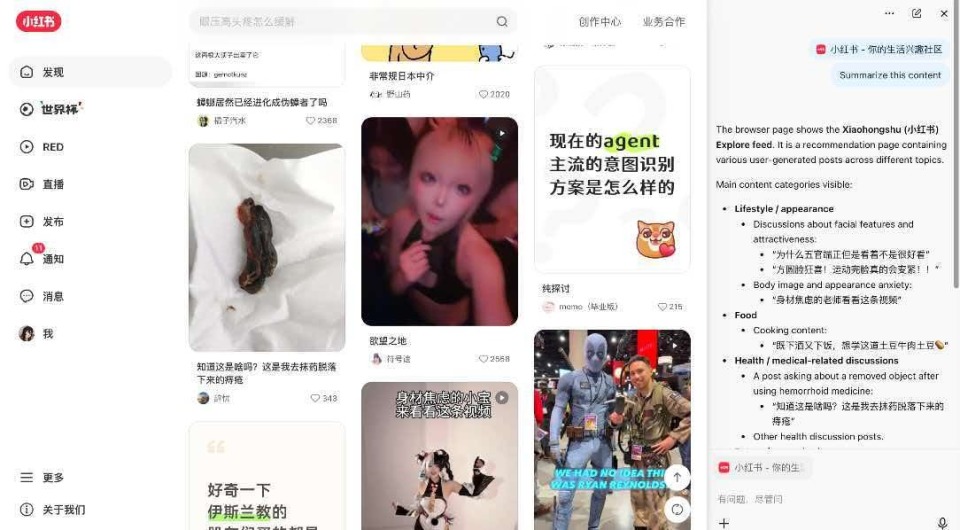
Original Atlas interface
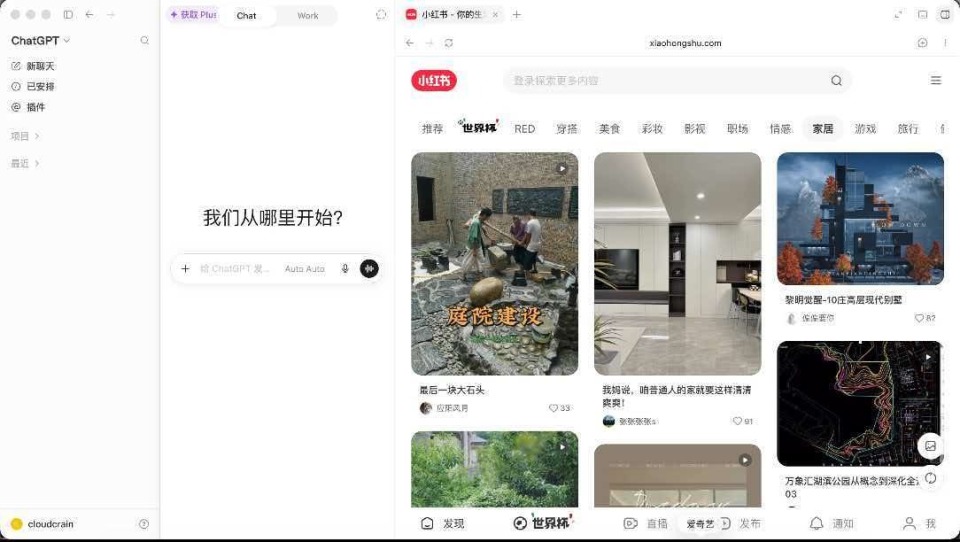
The adjusted built-in browser effect in the GPT desktop version is divided into three parts: the left side is various function entries, such as new chat, sites, plugins, projects; the middle is the main Chat or Work page; the right side is the browser part, which will embed a web page in about half of the right area. Provided by the interviewee
Looking at the GPT desktop version on the computer, Cao Lichun thinks the new browser layout is "weird". In her opinion, this web page window is not like a complete browser that can be operated naturally like Chrome or Atlas. Most of the time, Cao Lichun cannot operate the page smoothly, but needs to chat to let AI help her open or process the web page.
"It doesn't feel like the original native browser to me, but more like a temporary embedded web page in an AI chat software," Cao Lichun said.
03 OpenAI, strategic streamlining
In addition to being the "first year of AI browsers", 2025 was also a year of rapid expansion of OpenAI's product lines.
Last year, OpenAI simultaneously advanced projects such as Sora, AI browser Atlas, self-developed hardware, and embedding e-commerce functions into ChatGPT. According to The Wall Street Journal, Sam Altman compared this approach to "betting on a series of startups" inside OpenAI.
The day after Atlas was launched, Fu Sheng, Chairman and CEO of Cheetah Mobile, commented in a video that OpenAI's current product idea is to develop a wide range of applications, and as long as one product "goes viral", it may drive OpenAI to a new level.
He compared this strategy to the "lazy ant" theory in management. "In a huge ant colony, there are occasionally a few ants that do not follow the main force to carry food, but explore around and find new things before coming back," Fu Sheng said. These "lazy ants" precisely undertake the role of finding the right direction for the entire ant colony.
Yi An, who graduated with a computer science major and now works in the marketing field, is also one of the early users of Atlas. He started using Atlas since OpenAI launched it on October 21 last year, until he received the email that Atlas was about to shut down on July 24 this year.
Even though the official did not specify the specific reason for Atlas's shutdown, Yi An has some speculations: "From a commercialization perspective, although users use Atlas, they do not pay separately for the browser."
Lu Mo recalled that Atlas itself does not require additional payment, and its membership rights are bound to the ChatGPT account system. Users who do not subscribe to ChatGPT membership can also use the free version of Atlas.
The payment tiers include the light version "ChatGPT Go", the medium version "ChatGPT Plus" and the advanced version "ChatGPT Pro". Lu Mo chose to pay 33 US dollars for the "Plus" version. For her, this tier is enough to support her to smoothly use functions such as "deep thinking" and "image generation" in Atlas.
"In this process, OpenAI also needs to provide additional computing power support, memory support, including the occupation of context memory, etc. These computing power supports are not borne by our users," Yi An said. Long-term revenue failing to cover expenditure may drag down the Atlas project, and even hinder the development of OpenAI.
The Information cited people familiar with OpenAI as reporting that by the end of February 2026, OpenAI's annualized revenue exceeded 25 billion US dollars, which was a 17% increase from the annualized revenue of about 21.4 billion US dollars generated at the end of last year. It also announced the completion of a new round of financing at the end of February this year, with a valuation of 840 billion US dollars.
However, the addition of multiple product lines since last year and the expansion of enterprise organizations have led to uneven distribution of internal resources in OpenAI. Take Sora as an example, according to estimates by Forbes magazine in the United States, the annual operating cost of the Sora (video generation) project is as high as more than 5 billion US dollars, but the total revenue is only 2.1 million US dollars.
Taking Cheetah Browser as an example, Fu Sheng said that to make a good browser, a lot of basic work is indispensable. "Atlas only released the Mac version, which to a certain extent also shows that its resources are tight."
On March 16 this year, according to a report by The Wall Street Journal, Fidji Simo, Chief of Applications at OpenAI, said in an all-hands meeting: "We can't get distracted by various side tasks and miss this critical moment. We really have to do a good job in productivity."
Shortly after, on March 25, OpenAI announced the closure of Sora, refocusing on coding and business users, and lowering the priority of other fields.
"In August, the shutdown of Atlas, like the shutdown of Sora, happened in a very short moment, and even felt a little 'unreasonable' to users," Yi An said. But for OpenAI, "You have let us understand how agents can help improve the browsing and working experience on the open web, and we are applying these experiences to new products," said James Sun, head of the browser business.
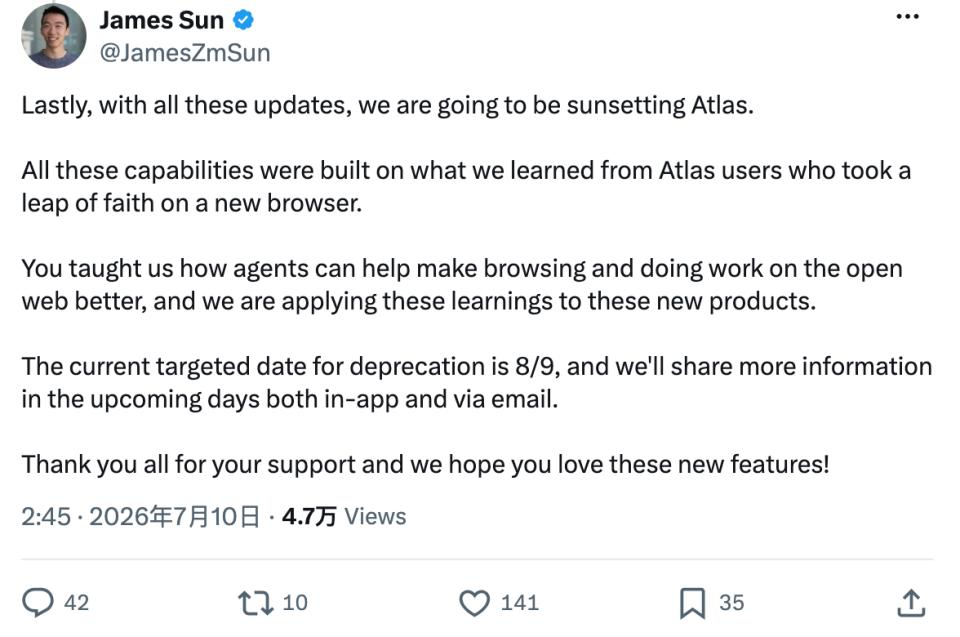
This means that the large amount of user data of the AI browser business is not a bubble, but will be re-precipitated, split and integrated to serve OpenAI's new strategic focus.
On June 2, according to a report by technology media The Information, OpenAI announced