After gold breaks through the $4,000 mark again
After moving sideways around the $4,000 per ounce level for a period of time, gold has recently shown signs of breaking through again.
The traditional framework for gold analysis has ceased to be valid since 2020.
The reason is quite simple: the US dollar is stepping down from its altar as a reserve currency and turning into a type of commodity.
The Fed's top KPI at present is to produce US dollars while maintaining the image of the US dollar, so as to maximize the total value of the US dollar as this single commodity.
The value of the US dollar is mainly affected by two factors: one is the overall national strength of the United States, and the other is fiscal discipline.
The measurement tool for the value of the US dollar is gold.
Gold is not a commodity determined by supply and demand. Gold was the king before the era of credit currency, and only lost its crown after the emergence of credit currency. But when credit currency fails, gold will restore its original value — currency.
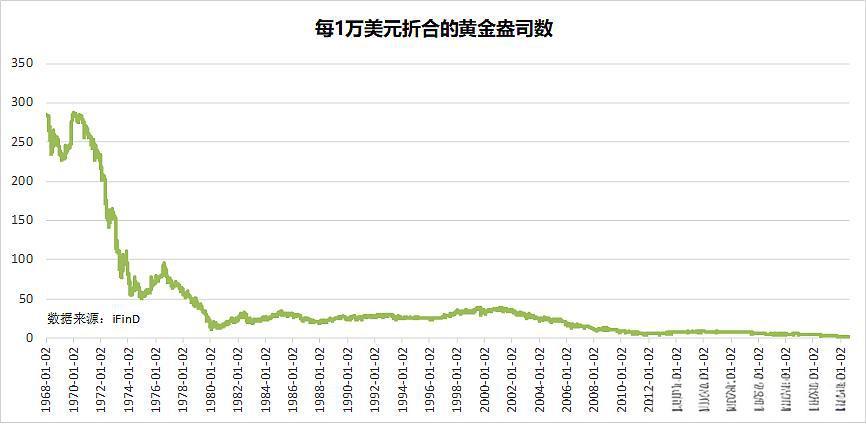
The value measured by gold for every 10,000 US dollars is continuously shrinking. Before the 1970s, 10,000 US dollars could be exchanged for more than 200 ounces of gold. Up to today, what is this number? As of August 11, 2026, 10,000 US dollars can only be exchanged for 2.28 ounces of gold.
From more than 200 ounces of gold for 10,000 US dollars to only 2.28 ounces now, this is the degree of shrinkage of the real purchasing power of the US dollar in the past 50 to 60 years.
To judge the trend of gold now is to predict the intrinsic value of the US dollar.
From the perspective of overall national strength, opinions vary. Although compared with China, the United States is indeed on the decline and going from bad to worse, its relative status may even be higher when compared with other countries except China.
The biggest problem at present is fiscal discipline. In August 2026, the US national debt has exceeded 40 trillion. If the current national debt interest rate level of 4%-5% is maintained, the interest expenditure will exceed military expenditure, which will trigger the "Ferguson Law", and the great power status will be lost. Spain and France in history are the lessons of the past.
The Fed is still holding its breath and refusing to cut interest rates. But at this interest rate level, I do not believe it can hold on.
Therefore, the intrinsic value of the US dollar will continue to decline, and the starting gun for the next wave of decline will be the US dollar starting to cut interest rates.
The Fed's management capability for this unprecedented commodity of the US dollar is already very perfect.
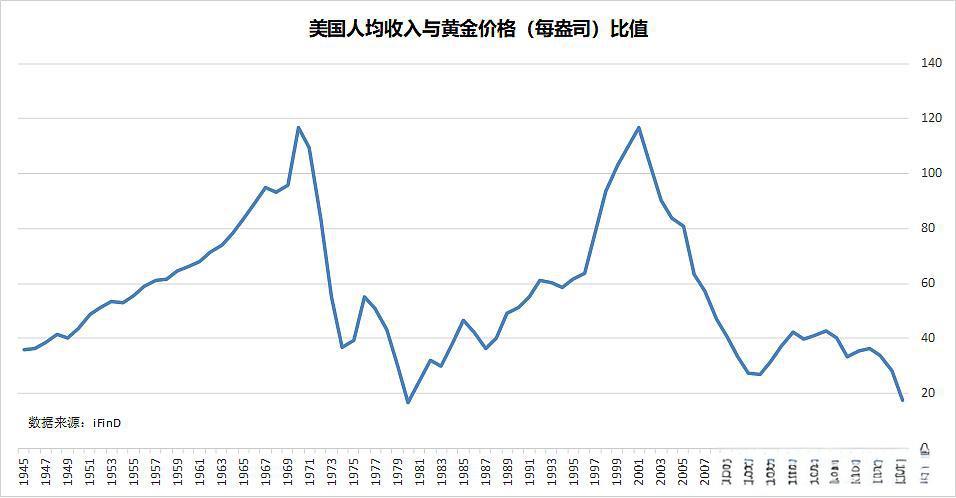
We can look at the chart above, the ratio of US per capita income to gold price. From 1945 to now, the per capita income of the United States can be exchanged for more than 40 ounces of gold most of the time. Note that the ounce here is not the conventional 28.35 grams, but the special troy ounce, which is 31.1 grams. 40 ounces of gold means that the income an ordinary American earns from working every day can be exchanged for 3.4 grams of gold.
The peak of the ratio of US per capita income to gold basically coincides with the peak of US national strength, such as 1970 and 2001. At that time, the per capita income of the United States could be exchanged for more than 100 ounces of gold. There are only two years in history when this figure was below 20, one was 1980, and the other was 2025.
From a cyclical perspective, technical analysts will come to the conclusion that this ratio will rebound in a V-shape. Since the short-term change of US per capita income is small, the only possibility is that the price of gold falls sharply.
But from a fundamental perspective, the decline of the United States is inevitable.
Looking at this chart, we can draw such a conclusion: For ordinary Americans, 2025 may be the worst year in the past 40 to 50 years, but it may also be the best year in the next 40 to 50 years, because the per capita income of the United States can still be exchanged for 17 ounces of gold.
Here is a side note: The US dollar is indeed very underperforming, otherwise the central banks of various countries would not have rushed one after another to convert their foreign exchange reserves from US dollars to gold. But interestingly, the US dollar has generally remained strong against the euro and the yen.
In short, although the US dollar is not doing well, Europe and Japan are doing even worse. Europe has slightly better fiscal discipline, but it has achieved nothing in emerging industries, getting up early only to end up late. As for Japan, it is not doing well in either emerging industries or fiscal discipline.
This article is written based on public materials, for information exchange only, and does not constitute any investment advice.
This article is from the WeChat Official Account "Jinduan" (ID: jinduan006), author: Yu Laotou, published by 36Kr with authorization.