Handheld imaging is becoming increasingly popular, but panoramic cameras are still a niche product.
This summer vacation, from cycling, mountain climbing, stream tracing to urban wandering and family outings, a growing number of people have got used to documenting their lives while on the move.
Different from the past when consumers simply pursued "clearer shooting", today their demands for imaging devices are becoming more specific — they want both high image quality and stability; they need devices that can record special scenarios, are easy to use, and do not require much time to learn or do post-production.
Therefore, after the start of the summer vacation, with the concentrated release of scenarios such as outings and outdoor sports, the demand for handheld imaging has further risen.
According to the latest *Weekly Tracking Report on China's Handheld Smart Imaging Device Online Retail Market* released by RUNTO, during the 2026 summer travel season (July 13, 2026 - August 9, 2026), the online retail market of handheld smart imaging devices in China (including traditional/panoramic/wearable action cameras and handheld gimbal cameras) reached a sales volume of 445,000 units, with a sales revenue of about 1.33 billion yuan, ushering in a summer-exclusive consumption boom.
Against this boom, on August 12 and 13, Insta360 and DJI will successively release new panoramic cameras, and HONOR will also launch an AI robotic mobile phone equipped with a mechanical gimbal.
Despite the booming market, from the perspective of competition pattern, DJI still leads the handheld smart imaging market with a share of 80.5%. In terms of product structure, handheld gimbals and action cameras are still the preferred devices for the public, accounting for nearly 90%, making them the absolute main consumption force among user groups; while the market share of panoramic cameras in domestic e-commerce data during this summer period is about 3%, hovering between 5% and 10% for a long time, still remaining in a niche circle.
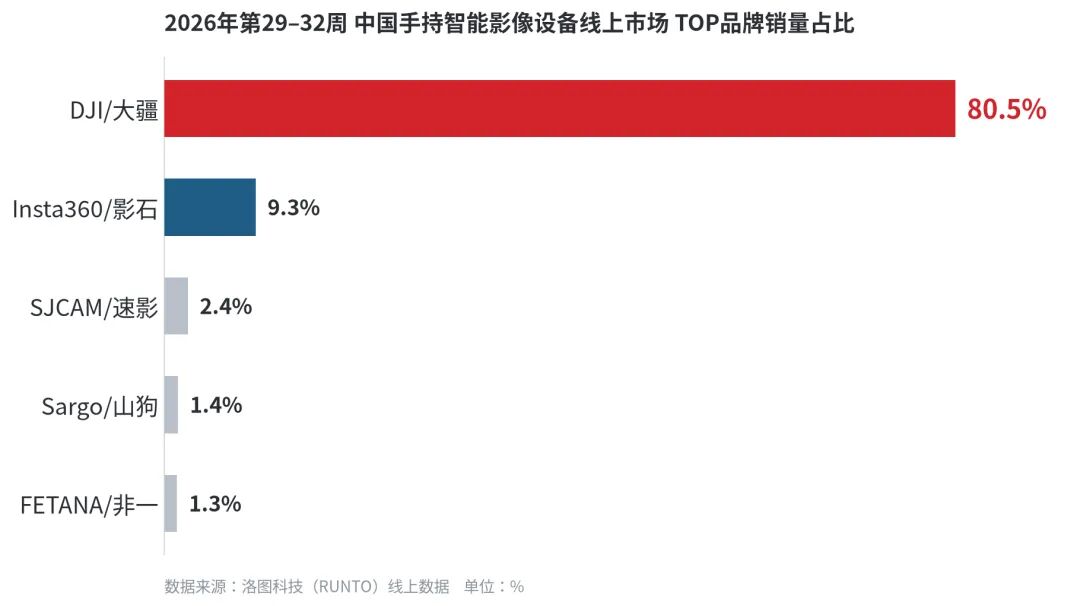
Obviously, for most consumers, handheld imaging is first and foremost a tool that meets the needs of daily recording, and the growth dividend is mainly concentrated in the two mainstream forms of handheld gimbals and action cameras.
New products and concepts are bustling, but what really determines the market size is still whether users are willing to pick up the devices frequently to shoot.
01
Handheld gimbals and action cameras remain the mainstream
Data from both IDC and RUNTO show that the overall handheld imaging market is still growing.
According to the *Global Handheld Smart Camera Market Tracking Report for the First Quarter of 2026* released by IDC, the global shipment of handheld smart cameras in Q1 2026 reached 4.14 million units, a year-on-year increase of 33%. The sales revenue exceeded 10.5 billion yuan, a year-on-year increase of 20%.
In addition, IDC predicts that by 2030, the global handheld smart camera market size will exceed 40 million units, with a five-year compound annual growth rate of nearly 18%.
This growth is not simply driven by new product marketing or concept hype, but based on the expansion of consumers' real usage scenarios.
If you break down today's handheld imaging market, you will find a very clear structure: handheld gimbals and action cameras are still the two most mainstream product forms.
RUNTO's summer data shows that handheld gimbals account for about 61% of the market share, traditional action cameras about 27%, wearables about 9%, and panoramic cameras about 3%.
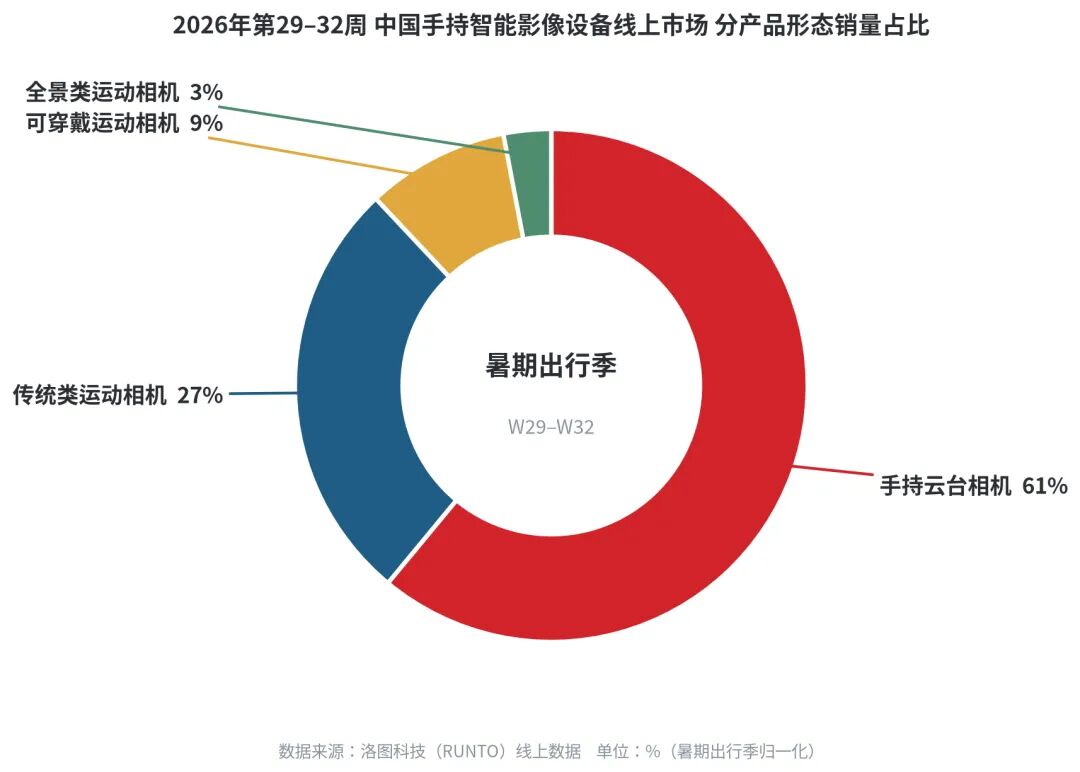
In other words, in the process of the continuous expansion of the entire handheld imaging market, the money of consumers first flows to products that can directly correspond to high-frequency usage scenarios.
In the past, image recording often had an obvious "sense of ritual": people needed to take out the camera specially, adjust parameters, and find a composition, so there was a certain distance between shooting behavior and daily life. But with the development of short videos, Vlogs and social platforms, recording itself has increasingly become a part of life.
Especially for young consumers, the value of shooting is no longer entirely about getting a "professional photo" in the end, but about whether they can quickly preserve content in the moment and further share it on social platforms.
This also means that the core competitiveness of devices is shifting from "how many functions they have" to "how reliable they are in use".
The handheld gimbal form solves the reliability problem in daily mobile recording.
The one-inch large sensor brings a relatively stable image quality foundation, while the mechanical gimbal solves the stability problem during movement. For ordinary users, the significance of this combination is not to add many professional parameters, but to reduce the probability of shooting failure.
Pick up the device, press the record button, and you can get a relatively stable, what-you-see-is-what-you-get picture. This kind of reliability is especially important for mass users.
Industry manufacturers including DJI are also continuously lowering this threshold through product and firmware upgrades. For example, functions such as automatic uploading essentially do not solve the "shooting capability" itself, but the problem of what to do after shooting.
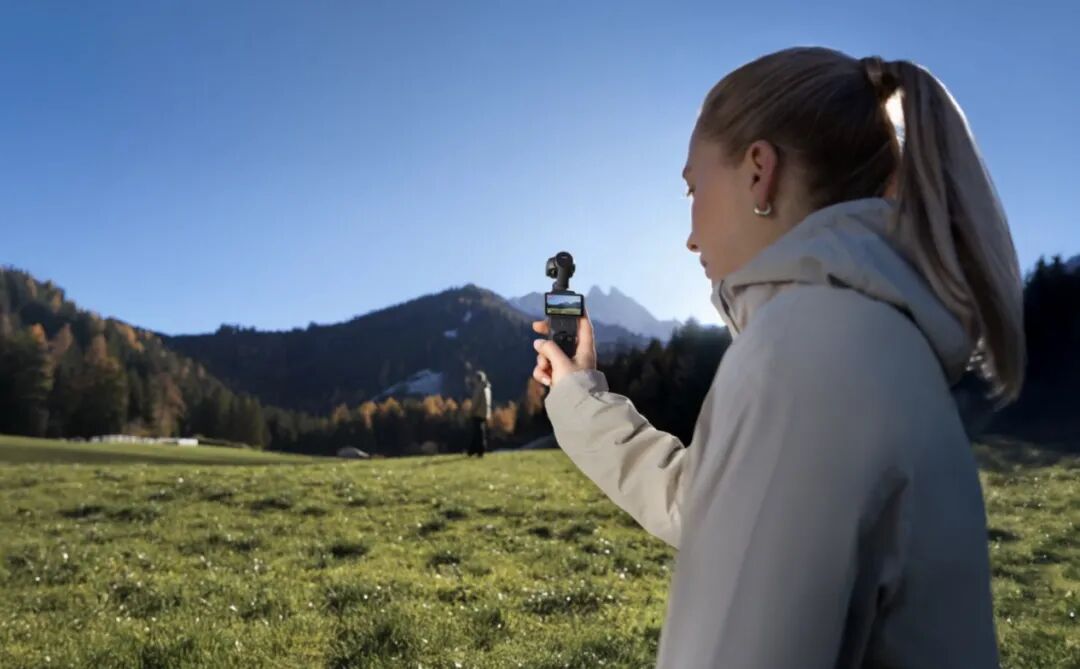
Action cameras solve another type of reliability — the dependability in extreme scenarios.
Summer vacation is usually a stage when the demand for outdoor sports is concentrated. Activities such as cycling, mountain climbing, stream tracing, going to the sea, and camping naturally require a recording tool that can withstand movement, collision, rain and even complex environments.
In these scenarios, users' expectations for the device are very simple: fix it if possible, shoot if you can, and don't fail at critical moments.
Therefore, although handheld gimbals and action cameras seem to target two different types of users, the logic behind them is highly consistent: one solves the problem of "shooting well" in daily recording, and the other solves the problem of "capturing the shot" in extreme scenarios.
In this sense, this is a round of demand-driven growth, not growth simply created by marketing.
Young people are going out, doing sports and traveling more, and are increasingly used to documenting their own lives. When these behaviors become high-frequency scenarios, devices that can lower the recording threshold and improve the shooting success rate will naturally be more likely to become the mainstream of the mass market.
02
Why haven't panoramic cameras become a mass necessity?
If handheld gimbals and action cameras represent the "base market" of the handheld imaging market, panoramic cameras are one of the most talked-about incremental directions recently.
Entering August, many manufacturers have concentrated their new product launches on panoramic imaging, and related discussions have heated up rapidly on social media. The dense emergence of new products has also made panoramic cameras one of the most popular categories in the handheld imaging market this summer.
However, if you compare the discussion heat on social media with the real market share, you will find an obvious contrast between the two.
According to RUNTO's summer market statistics, panoramic cameras currently account for only 3% of the entire domestic e-commerce handheld imaging market.
This does not mean that panoramic imaging has no value.
On the contrary, panoramic cameras solve a type of problem that traditional imaging devices are difficult to solve: users can first record complete spatial information, and then re-determine the final frame in post-production.
For scenarios such as cycling, traveling, extreme sports and other scenarios that require large-scale recording, this capability of "shoot first, compose later" has obvious advantages. It provides creators with more post-production space, which also means that shooters do not have to complete the final composition the moment they press the shutter.
But the problem also arises here. The higher the degree of freedom, the higher the cost users have to bear.
When shooting with a traditional camera, users need to complete the composition before shooting; panoramic imaging delays part of the decision-making to after shooting.
It sounds more free, but in fact it also means that users still need to perform secondary composition, editing, export after shooting, and even make trade-offs between file size, image quality and device performance.
For professional creators and advanced players, these costs may be worthwhile.
But for ordinary consumers, they may not want to face a large number of materials to sort out after returning from a trip. This is also one of the important reasons why panoramic cameras have long maintained a relatively niche market share.
In addition, the audiences of the panoramic camera track and the traditional action camera track highly overlap, and to a certain extent, the two constitute a zero-sum game relationship.
If you regard the handheld imaging market as a continuously expanding pyramid, then at present, handheld gimbals and action cameras still form the widest base, while panoramic imaging is more in the upward extending part.
This also means that panoramic imaging may continue to grow in the future, but whether it can truly break through the 3% market share ultimately depends on a key question: whether manufacturers can continue to reduce the usage cost brought by "shoot first, edit later".
Therefore, what is really worth paying attention to in the summer market data is not just how much the overall handheld imaging market has grown, but where the growth actually occurs.
Judging from the current market structure, the answer is quite clear: demand is driving the expansion of the entire track, but the first to enjoy this round of growth dividends are still mainstream products that can convert complex technologies into simple experiences and convert special scenarios into high-frequency usage.
For the entire handheld imaging industry, the real competition in the next stage may not be who can tell a bigger category story, but who can continue to make the act of "documenting life" easier.
This article is from the WeChat official account "Wall Street CN", and is authorized for release by 36Kr.