Why does LONGi Green Energy's "anti-involution" market value management fail to work?
Industrial policies often bring incremental demand and pattern optimization to the industry, helping enterprises achieve better value creation and further play a role in market value management.
The supply-side reform in 2015 is a typical example. Industries such as coal have benefited from the pattern optimization after supply clearance, achieved profit growth, weakened the industrial cycle, and China Shenhua has also witnessed a 10-year long bull market with its stock price rising nearly 4 times.
With successful precedents in place, the anti-involution narrative of the photovoltaic industry was once highly anticipated. The market expectation after photovoltaic was named at the anti-involution meeting was that the continuously intensifying anti-involution policies would guide the photovoltaic sector to eliminate backward production capacity, realize the balance between supply and demand and the rise of prices, and become a key force driving the revaluation of asset value.
Longi Green Energy also seized the opportunity to continuously promote the anti-involution narrative, and its stock price rose by more than 50% at the highest from July to November 2025. However, the good times did not last long. After November 2025, Longi Green Energy's stock price fell again, and has dropped by more than 40% so far.
The reason is that the anti-involution effect of the photovoltaic industry has not met expectations. The prices of silicon material, silicon wafer, cell and module have continued to fall below the cost line, and the losses of Longi Green Energy in the first half of the year are still expanding.
The underlying deep logic reflected behind is that the regulatory measures and self-discipline agreements for anti-involution can hardly change the industrial cycle.
Photovoltaic is characterized by fast technology iteration and strong scale effect. This determines that in the technology iteration period, in order to gain the cost advantage of the next generation, photovoltaic enterprises will inevitably expand production capacity collectively in the short term, and the profit decline brought by this expansion cycle is also inevitable.
After the failure of the anti-involution narrative, the photovoltaic industry needs to find a new growth story.
01
The Failure of the Photovoltaic Anti-Involution Narrative
In July 2025, Longi Green Energy, which had been lingering at the bottom for many years, ushered in a long-awaited sharp rebound. From July to November of that year, its stock price increased by more than 50% at the highest point.
This wave of rise in Longi Green Energy's stock price was partly driven by its leading BC technology and the rapid increase in penetration rate, but it was also inseparable from the boost of the anti-involution narrative.
At the end of June 2025, official media successively published important commentaries on anti-involution, and after the important meeting on July 1 re-emphasized "anti-involution" and named the photovoltaic sector, it was the starting point of this round of rise of Longi Green Energy.
At that time, the market expected that the anti-involution policies would continue to intensify, stepping from the expectation stage to the substantive implementation stage, which would guide the photovoltaic sector to eliminate backward production capacity, realize the balance between supply and demand and the rise of prices, and become a key force driving the revaluation of asset value.
Photovoltaic companies also took the initiative to repeatedly explain the logic of anti-involution in public speeches, media interviews and performance communication meetings, which became the standard wording for listed companies to communicate with investors.
The core of the continuous narrative logic output by Longi Green Energy is that low-price involution forces the industry to reduce product quality and hinder technology R&D, policy-driven anti-involution is a long-term benefit for leading enterprises, and the enterprise itself chooses to focus on the differentiated route of BC batteries to break away from the homogeneous price war.
Tongwei's narrative further elevated its position in the anti-involution trend, proposing that silicon material, as the "faucet" of the industrial chain, drives the whole chain to restore profitability through a tight balance of production capacity, analogous to the supply and demand adjustment mechanism of OPEC.
However, in the end, the anti-involution narrative of photovoltaic only played a phased role and did not last for too long. After November 2025, Longi Green Energy's stock price fell again, and has dropped by more than 40% so far.
The core logic of the decline is that the anti-involution effect of the photovoltaic industry has not met expectations. According to reports from Yicai, in the first half of the year, the prices of silicon material, silicon wafer, cell and module continued to fall below the cost line.
The performance of photovoltaic enterprises naturally did not improve. Longi Green Energy estimated that the net loss attributable to shareholders of listed companies in the semi-annual period of 2026 would be 3.4 billion yuan to 3.8 billion yuan, which expanded compared with the 2.598 billion yuan in the same period of the previous year.
From the perspective of the whole industry, among the 26 listed photovoltaic enterprises that have disclosed the semi-annual report forecast, only 4 achieved profits, and 22 were mired in losses. The total loss of the industry reached 18.3 billion yuan to 21.4 billion yuan.
Looking back on the past, the industry pattern optimization brought by supply contraction is often a very good theme for market value management, which has been repeatedly proven effective in history.
Since 2010, China has experienced at least four typical "supply contraction" cycles in history: for example, the "power rationing" to control the expansion of high energy-consuming industries in 2010, the supply-side reform in 2016, the power restriction and production limit under the dual carbon goal in 2022, and the continuously promoted anti-involution in 2024.
The first three supply contraction cycles drove many industries such as steel, coal, industrial manufacturing, glass and chemicals to realize the path of supply contraction - pattern optimization - profit rise - stock price increase.
Why did the anti-involution of photovoltaic fail this time?
02
The Unchangeable Industrial Cycle
There is a perspective that can reflect the reasons for the failure of photovoltaic anti-involution.
On the evening of August 6, eight major polysilicon enterprises that account for more than 90% of the effective domestic production capacity jointly signed the anti-involution "Initiative" in Shanghai. The enterprises jointly promised:
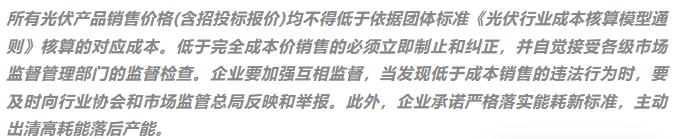
At first glance, it is a major positive for the industry to take the initiative to stop losses and support prices. But the reality is that the self-discipline initiative has no legal mandatory binding force, and its implementation depends entirely on the consciousness of enterprises. More critically, the core consensus of the initiative is to support prices, and there is no clear guidance on how to reduce production capacity specifically.
The core problem of the current photovoltaic industry is not the malicious low-price involution of enterprises, but the severe overcapacity.
Taking polysilicon as an example, the current total inventory of the whole industry is 50-52 million tons, which is equivalent to 4-5 months of total global consumption, far higher than the healthy level of the industry (1-1.5 months). It is a huge "supply barrier lake". As long as the price rebounds slightly, the inventory will flow to the market and suppress the price.
Then why can't photovoltaic enterprises stabilize prices through collective production reduction like many industries such as coal in history? The core reason lies in the different industrial logic.
Traditional industries such as coal lack technology iteration, and it is impossible to achieve product differentiation through technological competition to eliminate competitors. But photovoltaic is different. The characteristics of fast technology iteration and strong scale effect determine that involution is inevitable in the technology iteration period.
The technology iteration of the photovoltaic industry has always been very fast. What enterprises are most worried about is that after the large-scale investment of projects based on a certain technology, their technological advancement lags behind that of enterprises that put into production later.
For example, in the past few years, the photovoltaic industry was in the stage of clearing P-type batteries and fully replacing N-type batteries, and N-type batteries are further divided into TOPCon and BC battery technology routes.
For photovoltaic enterprises, after P-type batteries become backward production capacity, if they want to maintain their leading advantages, they must deploy new N-type batteries. In this process, the layout of photovoltaic enterprises must be large enough. The logic is that photovoltaic competition depends on both performance and cost. The law of the photovoltaic industry is that for every doubling of the cumulative installed capacity of photovoltaic modules, the product price will drop by 20%.
This collective pursuit of scale in the technology iteration period will also cause cyclical overcapacity. For example, the global photovoltaic module production capacity reached 1430.2GW in 2025, while the global installed capacity was only 647GW, and the production capacity was twice the demand.
In the anti-involution stage, the severe imbalance between supply and demand in the photovoltaic sector also shows that administrative measures and self-discipline agreements can hardly reverse the cyclical nature of the photovoltaic industry. The final improvement of industry profitability will ultimately depend on the upward turning point of the industrial cycle.
03
A New Growth Story Is Needed
From a long-term perspective, the value of the photovoltaic industry has long been constrained by the industrial cycle.
In the past 20 years, the photovoltaic industry has experienced four complete ups and downs of the industrial cycle, each of which went through the full cycle of boom expansion - overcapacity - price plunge - industry clearance. Each cycle also caused huge fluctuations in the value of the industry. In the fourth downward cycle of photovoltaic that started around 2022, the stock prices of many leading enterprises have fallen by 80%.
In order to reduce the value fluctuation brought by the cyclical nature to the industry, many enterprises are looking for new narratives. Lan Tianshi, co-CEO of GCL Technology, said bluntly: "If we still position ourselves as a photovoltaic manufacturer and do not change our thinking, even if our cost is as low as possible, we will have no future."
The new narrative sought by leading photovoltaic enterprises is to transform into comprehensive energy service providers. Leading photovoltaic enterprises such as Longi Green Energy, JinkoSolar, Trina Solar and JA Solar Technology are breaking away from the traditional positioning of photovoltaic production, and extending their business to distributed photovoltaic power station development, energy storage supporting, park microgrid, green power direct supply, and integrated power supply services for computing power supporting.
The key for leading photovoltaic enterprises to transform into comprehensive energy service providers is the integration of computing and power. In simple terms, the integration of computing and power means that around the electricity demand of data centers, intelligent computing parks and supercomputing bases, distributed photovoltaic power stations and supporting energy storage systems are built nearby. Relying on the mode of self-use of generated electricity and feeding excess power to the grid, it provides low-cost and stable green power for computing power projects.
If the transformation narrative of photovoltaic succeeds, it will also change the business model of the industry:
Photovoltaic manufacturers sell hardware products, while comprehensive energy service providers sell continuous and stable power supply and complete energy solutions. The revenue changes from one-time product sales revenue to long-term electricity bills and energy trusteeship service fees for 15 to 25 years. This will enable the industry to transform from earning volatile profits through manufacturing capacity expansion in the past to earning long-term and stable cash flow through energy operation.
The transformation direction is correct, but the difficulty is not small. After all, to complete the transformation into a comprehensive energy service provider through the integration of computing and power, there are not only the pressure of further increasing capital expenditure, but also the challenges of cross-track technology, as well as resource barriers to face.
In the end, whether the new narrative of photovoltaic can change the industry value depends on the actual business implementation in the next stage.
This article is from the WeChat official account "Insight Finance", author: Yang Yang, published by 36Kr with authorization.