As Zhiyuan strives for a listing on the Hong Kong Stock Exchange, what will become of the Shangwei New Materials it has acquired?
Recently, Ziyu, a unicorn enterprise in the embodied intelligence track, announced that it has launched the listing process in Hong Kong, and has not disclosed the sponsor, submission date and fundraising scale for the time being.
Ziyu's plan to list in Hong Kong has brought another listed company into the spotlight — Swancor New Materials.
A year ago, Ziyu acquired Swancor New Materials and became its new actual controller. Driven by the expectation of a "backdoor listing", the share price of Swancor New Materials has experienced several rounds of sharp surges.
However, Ziyu's current choice to list in Hong Kong means that the probability of Swancor New Materials being used for a backdoor listing has further decreased.
Over the past year, Swancor New Materials has also actively developed its own embodied intelligence business for home scenarios, which is differentiated from the main robot application scenarios of its parent company Ziyu. According to the latest news, Swancor New Materials has completed the layout of offline sites in 7 first-tier and new first-tier cities across the country, and it seems that the commercial closed loop is being implemented.
The core of the problem is that to promote the new embodied intelligence business, the profits of Swancor New Materials in last year's annual report and this year's first quarterly report have been significantly under pressure, and this situation is expected to be reflected in the financial statements for a fairly long period of time in the future. But no one can give a specific answer now on whether and when the embodied intelligence business of the company can be successfully operated to form a commercial closed loop.
By acquiring a listed company, Ziyu naturally values the financing capacity of the A-share market. Telling a seemingly closed-loop story to drive the share price up several times before launching a new round of financing is very common in the capital market. But is this model of "making money together if we win, and letting shareholders pay the bill if we lose" fair to the shareholders of Swancor New Materials?
Failed Expectations
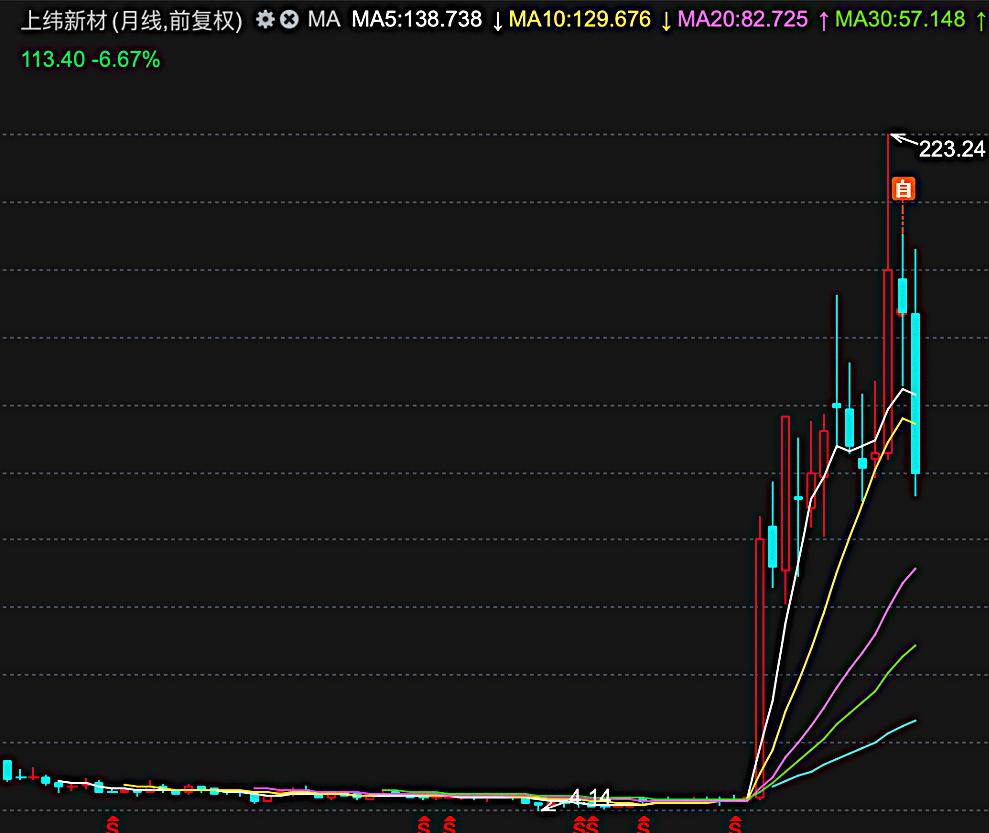
When the news that Ziyu planned to acquire Swancor New Materials was exposed last July, it once attracted a lot of attention in the capital market. The share price soared directly from 6.5 yuan per share to 97.6 yuan per share that month, and later reached a maximum of 223.24 yuan per share, instantly turning from a neglected stock into a highly sought-after one.
According to the announcement, Ziyu's acquisition of Swancor New Materials is mainly completed through two parts: "agreed transfer + partial tender offer".
First, parties related to Ziyu Robot signed a share transfer agreement with the original shareholders of Swancor New Materials (SWANCOR Samoa, STRATEGIC Samoa and Goldwind Holdings) to obtain 29.99% of the shares and become the controlling shareholder. After that, Ziyu made a tender offer for 33.63% of the shares of the company at a price of 7.78 yuan per share. So far, Ziyu Hengyue and its concert parties hold a total of 63.62% of the shares of the listed company, achieving absolute control.
Ziyu's acquisition of Swancor New Materials is an extremely well-calculated capital deal. For the hard technology track of humanoid robots, which is still in the stage of high-intensity capital consumption, the time cost and uncertainty of independent IPO are rising rapidly.
The fundamentals of Swancor New Materials just meet Ziyu's requirements for industrial asset injection.
In terms of main business, in recent years, the growth rate of new domestic wind power installed capacity has dropped sharply, and the price war in the blade composite material track has fully broken out, leaving the whole industry stuck in the dilemma of "revenue growth without profit growth".
In terms of equity structure, Swancor New Materials is even a rare "clean shell": the original controlling shareholder SWANCOR has long held concentrated shares, with no complex nested state-owned shareholders, no historical legacy equity disputes and litigation, and no hidden risks of large-scale pledge liquidation or impact from restricted share lifting. With clear property rights and short decision-making chains, industrial capital does not need to spend a lot of time sorting out historical legacy issues after taking control.
In terms of acquisition cost, the total market value of Swancor New Materials at the time of acquisition was about more than 3 billion yuan. It only cost less than 1 billion yuan to take 29.99% of the controlling right, and even with the tender offer to achieve absolute control, the total investment was controlled at the level of 2 billion yuan, making the acquisition cost fully controllable.
At the same time, the market value base of 3 to 4 billion yuan will neither lead to limited space for subsequent private placement financing due to too small plate, nor raise the acquisition threshold and excessively dilute the shareholding ratio of the industrial party due to too large volume, which just falls at the golden balance point of "affordable to acquire" and "accessible to financing".
At that time, many investors believed that Ziyu's acquisition of the control of the listed company was expected to skip the long IPO cycle and directly open up the secondary market financing channel, providing a continuous capital supply outlet for subsequent R&D investment, capacity expansion and industrial chain mergers and acquisitions.
The expectation of backdoor listing is the fundamental reason for the continuous surge of Swancor New Materials' share price. The traditional material business of Swancor New Materials continues to decline, and its fundamentals cannot support several times of valuation increase at all.
What the capital market obviously values is the industrial dividend and valuation bubble brought by the robot track after Ziyu's entry. Although Ziyu has clearly stated that it will not promote backdoor listing within 36 months, as long as the long-term imagination space of asset injection exists, this valuation aura will not fade.
In May this year, Swancor New Materials completed the industrial and commercial change, and Peng Zhihui, co-founder of Ziyu Robot, officially took the position of chairman of the company, which means that Swancor New Materials has completed the personnel changes after the acquisition, once again exciting the capital market.
Unexpectedly, on July 24, Ziyu launched the listing process in Hong Kong, which means that the possibility of Swancor New Materials being used for backdoor listing has further decreased.
If Swancor New Materials is not intended to be used for "backdoor listing", what role will this listed company play in Ziyu's ecosystem?
Where Will Swancor New Materials Head?
In fact, after Ziyu completed its holding, the business operations of Swancor New Materials have changed to a certain extent.
In July, Swancor New Materials officially announced that Qiyuan T1, the world's first consumer-grade robot under its personal robot brand "Qiyuan" that supports free switching between two forms, was officially released.

Relying on the self-developed Transformer cross-form integrated architecture, Qiyuan T1 can automatically identify the environment and switch between wheeled-legged humanoid and quadruped forms, making up for the industry shortcoming that the single form of consumer-grade household robots is difficult to adapt to multiple scenarios.
Thus, Ziyu's robot matrix ecological territory has become increasingly clear. The parent company Ziyu Innovation is responsible for the currently hot industrial and commercial tracks, and at the same time builds a huge "Ziyu Ecosystem" through direct investment and internal incubation.
In Ziyu's embodied intelligence ecosystem, the parent company Ziyu undertakes the R&D of the most core complete machine product lines and brand operation. Its Expedition series full-size biped humanoid robots target high-end industrial and commercial scenarios; the Elf series industrial-grade wheeled embodied robots focus on factory and logistics operations; the Lingxi series medium-sized biped robots focus on service and general commercial scenarios.
At the same time, Ziyu independently splits the vertical track business into subsidiaries, which implement independent operation and independent financing.
For example, Lingjiedian Innovation, incubated by Ziyu, focuses on the R&D and mass production of robot dexterous hands. It is the self-developed carrier of Ziyu's core actuator components, focusing on industrial-grade dexterous hands with high degrees of freedom and high load, to ensure the independent controllability of the core components of the complete machine.
Ziyu Kuotuo, a subsidiary, mainly operates the quadruped robot business, focusing on the R&D and commercialization of quadruped products, expanding scenarios such as security inspection, industrial survey, and consumer-grade companionship.
In the field of commercial cleaning robots, Ziding Robot, a subsidiary under Ziyu, focuses on the implementation of embodied intelligence in commercial cleaning scenarios. Its core is to reuse Ziyu's environment perception, autonomous navigation and motion control technologies in the cleaning track, to create commercial cleaning robots for scenarios such as office buildings, shopping malls, parks and factories.
In the field of intelligent training data collection and labeling, Mifeng Technology, incubated by Ziyu, focuses on high-quality and multi-scenario embodied data assets, providing training fuel for embodied large models and exporting data services externally, and has completed hundreds of millions of yuan in independent financing so far.
In terms of services, Qiantianzu, a robot leasing operation platform incubated by Ziyu, provides enterprise customers with full-process services including robot leasing, on-site deployment, operation and maintenance iteration, reducing the implementation threshold for customers.
Swancor New Materials mainly targets the "consumer-grade" market for individuals and families, which does not overlap with Ziyu's existing embodied intelligence ecosystem. Instead, it is an important part to complete the household market layout.
At the same time, Swancor New Materials itself is a listed company. Once the embodied intelligence business polishes samples in the early stage and creates a story convincing to the capital market, it can quickly realize financing from the capital market, reducing the financing cost and difficulty of Ziyu's embodied intelligence ecosystem.
Risks Cannot Be Underestimated
If the business of Swancor New Materials is only a part of Ziyu's ecosystem, whose role is to rely on the financing function of the capital market to realize the development of household consumer robot business, then the risks for shareholders cannot be underestimated.
After all, if this system works well, everyone makes money; if it loses money, shareholders will pay for Ziyu's dream.
For Swancor New Materials, which is still in the initial stage of cross-border transformation, the implementation of consumer-grade robots is far less easy than it seems at the press conference.
From the product release stage of Qiyuan T1 to the realization of stable large-scale mass production and the opening of the omni-channel delivery chain, there are still multiple hurdles to cross, such as process yield ramp-up, supply chain collaborative running-in, and mass production quality control system construction. There are still considerable uncertainties in the official product launch timeline, post-launch market promotion rhythm and terminal acceptance.
What's more, although the household robot track belongs to the emerging industry, there are no shortage of players.
In the internet camp, ByteDance, Tencent and Baidu have all quietly entered the market to layout family companion and service robots. With traffic ecology and large model capabilities, they form dimensionality reduction strikes on household-grade embodied intelligence. Among traditional home appliance giants, Midea and Haier are no longer satisfied with letting robots only do housework, but are accelerating the implementation of humanoid robots in broader family scenarios. These enterprises have rich manufacturing experience, forming their natural moat. Original players such as UBTECH and Unitree, which have been deeply engaged in the consumer-grade track for many years, have far higher popularity and market attention than Swancor New Materials, which has just entered the industry, and their product strength is generally strong.
In this light, the household-grade embodied intelligence track has long been a market crowded with players and with rapid product function iteration. For Swancor New Materials, it is by no means easy to tear a gap in this heavily guarded track only with a differentiated form selling point.
Looking at the performance of Swancor New Materials, its revenue reached 1.797 billion yuan in 2025, a year-on-year increase of 20.29%; but its net profit was only 41 million yuan, a year-on-year decrease of 53.35%.
The profit decline is closely related to the sharp increase in R&D expenses. In 2025, the R&D expenses of Swancor New Materials reached 51.5863 million yuan, a year-on-year increase of 69.98%. Most of the R&D expenditure was used to form the R&D team for consumer-grade embodied intelligent robots.
In the first quarter of this year, the financial situation of Swancor New Materials further deteriorated. Although the revenue reached 418 million yuan, a year-on-year increase of 13.23%, the net profit was -41 million yuan, turning from profit to loss year-on-year.
The reason for the loss is also related to the R&D of embodied intelligence. In the first quarter of this year, the R&D expenses of Swancor New Materials were 45.8517 million yuan, a substantial year-on-year increase of 5 times. More than 80% of the R&D investment is related to the embodied intelligence business, which has become the primary factor eroding the current profit.
It can be seen that the large-scale investment in the embodied intelligence track is eroding the already thin profit base of Swancor New Materials.
After the share price has gone through several rounds of rise driven by the robot concept, the valuation of Swancor New Materials has long overdrawn the imagination space in advance. At this time, once the mass production and implementation rhythm and terminal market performance of consumer-grade robots fail to meet expectations, the fundamental valuation backlash will often come faster than the market expects.
This article is from the WeChat official account "Luming Finance" (ID: luminglab), written by Jin Delu, and authorized for release by 36Kr.