36Kr Exclusive | Aerospace Veteran Develops Space Orbit Transfer Vehicle, Closes Nearly 100 Million Yuan Series A Financing
Author | Qiao Yujie
Editor | Yuan Silai
36Kr has learned that Beijing Infinite Astronautics Technology Co., Ltd. recently announced the completion of a nearly 100 million yuan Series A financing. This round of financing is led by Dingfeng Venture Capital, followed by Yunding Capital and Taiya Investment, with continued additional investment from existing shareholders Shendan Venture Capital, Songhe Venture Capital, and Shouren Co-Creation.
The raised funds in this round will be mainly used for the first flight verification of the "Space Bus" series Orbital Transfer Vehicle (OTV), subsequent model development, engineering iteration and large-scale manufacturing capacity building, to accelerate the layout of the "Space Bus" series of products and promote the company's transition from the technology verification stage to the commercial operation stage.
Founded in 2023, Infinite Astronautics is an infrastructure provider of orbital transportation and on-orbit services for commercial satellite constellations. The company's core team brings together senior experts and engineering technical talents who have long been engaged in the development of major national aerospace projects, with an average of more than 15 years of aerospace industry experience. Li Jian, the founder, once participated in the development of the world's first active space debris removal vehicle and completed relevant flight tests.

(Source: Enterprise)
With the accelerated construction of low-orbit satellite constellations and the gradual mainstreaming of the rideshare launch mode in commercial aerospace launch services, how to complete satellite deployment more efficiently has become a new concern in the aerospace industry chain. In recent years, the Orbital Transfer Vehicle (OTV) has gradually moved from the technology verification stage to commercial application, becoming one of the important directions of international satellite deployment services.
The traditional rideshare launch mode usually can only send multiple satellites to the same initial orbit, and the satellites need to rely on their own propulsion system to complete subsequent orbit changes to reach their respective target orbits. The orbital transfer vehicle adds a "space transportation link": after being sent to the basic orbit, it can use its own propulsion system to complete operations such as orbit raising, inclination adjustment, and phase maneuver, send multiple satellites to different target orbits respectively, solve the "last mile" problem in the satellite deployment process, and reduce the complexity of satellite platform design and the full life cycle cost.
In the overseas market, the commercialization of orbital transfer vehicles is accelerating. Impulse Space, founded by Tom Mueller, the former co-founder and first employee of SpaceX, has completed 3 flight missions as of November 2025, with an order size of 200 million US dollars. The ION satellite carrier under the Italian company D-Orbit has also carried out missions on multiple rockets such as Falcon 9 and Vega, completing multiple payload deployments cumulatively, and can provide services such as off-orbit release and payload hosting.
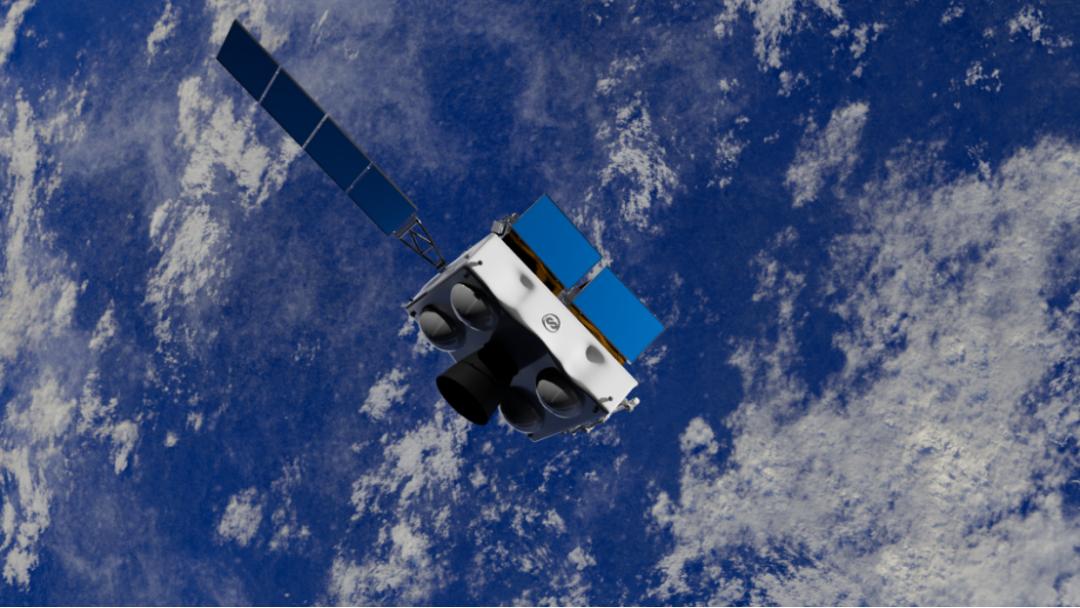
The self-developed "Space Bus" series Orbital Transfer Vehicle (OTV) of Infinite Astronautics provides space transportation services for orbit altitudes ranging from 200 km to 36,000 km, which can realize satellite off-orbit deployment, multi-satellite rideshare launch and intelligent constellation deployment, and improve the efficiency and cost-effectiveness of satellites entering the target orbit. In addition, relying on its long-term on-orbit retention capability, the "Space Bus" can continue to perform long-term on-orbit service tasks such as on-orbit verification, on-orbit maintenance, and on-orbit refueling after completing the deployment mission.
(Source: Enterprise)
In terms of technical system, Infinite Astronautics builds a core technical chain around capabilities such as propulsion, control and space operation. Among them, the orbit transfer engine and attitude control engine developed by the company adopt regenerative cooling technology, which is the first 300N engine in China to adopt this technical route. Its relevant performance indicators have reached the leading domestic level and been selected as an excellent achievement of commercial aerospace and applied technology innovation in Beijing in 2024.
The self-developed high-precision GNC system of the company has the capabilities of wide-range orbital maneuver, large mass change adaptation and future rendezvous and docking expansion. At the same time, the company has deployed space operation capabilities and self-developed space manipulators, and has the system engineering capability of highly integrated propulsion, control and structure.
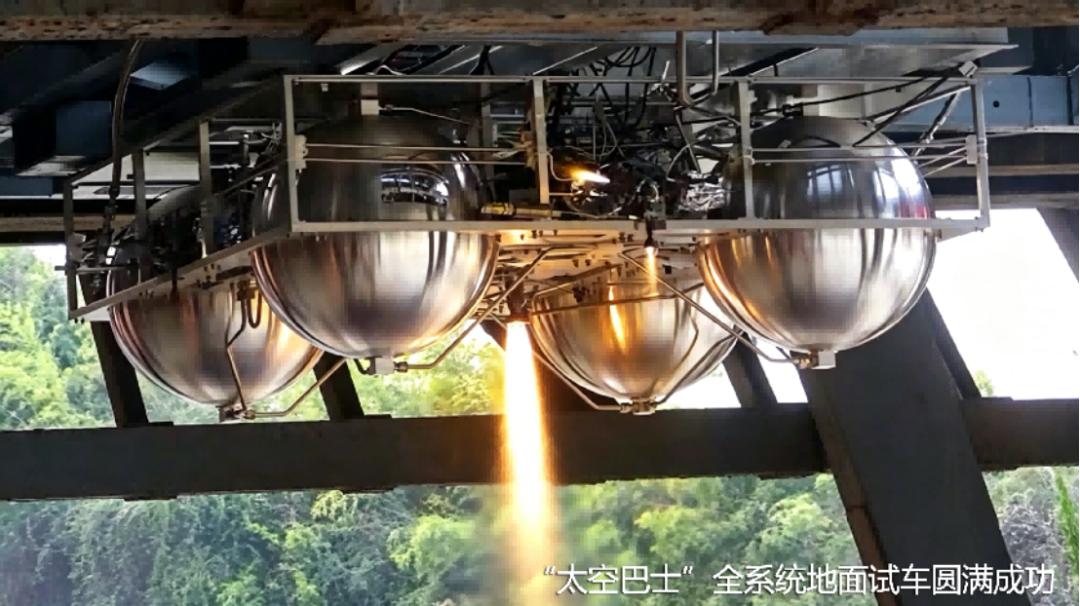
In March 2025, Infinite Astronautics completed the full-system test and verification of "Space Bus-1", becoming the first orbital transfer vehicle in China to pass the full-system ground test verification and reach the flight state. According to the company, the full-system test is mainly to carry out ground verification on the whole machine prototype, and fully simulate the processes of orbit change, attitude adjustment and orbit transfer involved in future on-orbit operation on the test bench, so as to verify the overall reliability of the system. After completing the test, the company has carried out further iteration and optimization based on the experimental results.
(Source: Enterprise)
In the next stage, Infinite Astronautics will promote the joint verification of the control system and the propulsion system to complete the collaborative verification of the two core systems. The company plans to carry out the first flight verification at an appropriate time in the fourth quarter of this year.
The following is an excerpt of the exchange between 36Kr and Li Jian, the founder of Infinite Astronautics:
36Kr: From your current contacts with satellite general contractors, is the market's willingness to demand orbital transfer services strong?
Li Jian: Overall, the market's willingness to demand orbital transfer services is quite clear. Especially as commercial aerospace enters the stage of large-scale development, satellite deployment modes are changing. We already have some commercial cooperations in progress, which are gradually entering the scheduling stage.
In fact, the demand for orbital transfer services is not limited to satellite customers, but also includes rocket enterprises.
At present, commercial launch still faces a practical problem, that is, the efficiency of "matching payloads with target orbits". A single rocket launch can usually only provide one main orbit condition, while different satellites have different demands for orbit altitude, orbit inclination, orbit plane, etc. If the target orbit of the satellite is quite different from the rocket's orbit, the satellite will not be able to take the upcoming rocket, which leads to the problem that the rocket is not fully loaded and the capacity utilization rate is not high.
The orbital transfer vehicle can provide the "last mile" service after launch, connecting the standardized transportation capacity provided by the rocket with the personalized orbit entry demands of satellites. Therefore, some rocket enterprises will also take the initiative to cooperate with us to expand the orbit range covered by rocket launch services through orbital transfer services, and improve the overall mission efficiency.
36Kr: Why can "Space Bus" solve the problem of underutilized rocket launch rideshare based on its off-orbit transfer capability?
Li Jian: At present, rocket launch is essentially still a "point-to-point" transportation mode. A rocket can usually only send payloads to a specific orbit, while the target orbit demands of satellite customers are actually diversified.
We can use ground transportation as an analogy. If there is no taxi system, the plane can only send passengers to the airport, and passengers can only reach their destinations by walking after getting off the plane, then the area covered by the airport will be very limited. But with taxis, the airport is actually connected to the whole city.
The "Space Bus" plays a similar role. In the past, if a satellite wanted to take a rocket into space, it needed to find "fellow passengers" with similar target orbit altitude, inclination and other conditions. For example, if a rocket enters a 500km orbit, only satellites with target orbits close to 500km are suitable for rideshare, while satellites of 600km, 700km or even different orbit planes are difficult to participate in the same launch.
The off-orbit transfer capability reconstructs this transportation mode: the rocket is responsible for sending satellites to the basic orbit efficiently and in large quantities, and the "Space Bus" completes subsequent orbit adjustment and precise deployment according to the mission requirements of each satellite.
In this way, a connection is established between the rocket's transportation network and the application demands of satellites, which greatly improves the utilization efficiency of launch resources and makes large-scale constellation deployment more flexible in the future.
36Kr: What factors will drive the growth of demand for orbital transfer and on-orbit services in the future?
Li Jian: First of all, it is the demand change brought by the large-scale development of the aerospace industry.
As rocket reusable technology matures gradually, the cost of entering space will further decrease, and the number of satellite launches and the scale of space infrastructure will continue to grow. In the future, the bottleneck of space development will no longer be just "how to send things up", but "how to operate and manage these space assets more efficiently".
One of the core logics for commercial aerospace to reduce costs is reusability. In the past, rocket recycling solved the problem of reusability in the launch link; while we hope to solve the problem of continuous utilization of space assets and space resources. For example, more and more satellites are beginning to require active deorbiting capability at present, but due to factors such as cost, weight, volume and technical complexity, some satellites are still difficult to complete the end-of-life disposal independently. At this time, external on-orbit service capabilities are needed to help complete orbit cleaning and improve the sustainability of the space environment.
At the same time, high-quality orbit resources themselves will become more and more precious in the future. A stable and efficient orbit position is essentially a limited space resource. If failed satellites occupy the orbit for a long time, it will not only increase the risk of space debris, but also affect the development of subsequent space activities.
Therefore, we believe that future on-orbit services are not just about solving a specific task, but about building a future-oriented space infrastructure system. In addition to auxiliary deorbiting, services such as on-orbit refueling, on-orbit maintenance, on-orbit life extension and space transportation are essentially to improve the use efficiency of space assets, so that satellites will gradually change from one-time consumables to maintainable and operable space assets.