Why are small bistros being reduced to "the abandoned outcasts of nighttime"?
At 7:30 p.m. on Friday, Chen You, who lives in Gongshu District, Hangzhou, carried a two-liter transparent beer bucket and walked slowly along the pedestrian path of the Beijing-Hangzhou Grand Canal with her friends.
The bucket contained osmanthus wheat craft beer that she had just bought from the bulk beer shop downstairs of her community. The unit price per jin was less than 20 yuan, which was just enough for two people to share and get slightly tipsy. The wind blowing over the river brought a cool feeling, and around her were familiar friends. There was no need to shout to talk, nor to deal with strange neighboring tables.
Two years ago, on such a Friday night, she would most likely be in a chain pub in the city center.
Under the dim warm lights, the wooden tables and chairs were crowded tightly. A dozen beers and several fried food platters were placed on the table. The sound of dice hitting the dice cup mixed with the background music, and people had to lean close to each other's ears to hear clearly. After a drinking party, the per capita cost easily exceeded 100 yuan. When they got home, their bodies smelled of smoke and the lingering noise. They hardly felt relaxed, but were really exhausted.
This shift in consumption choices is happening simultaneously among young people across the country.
The pub track, which was once hailed by capital as "the rigid demand for young people's night socialization" and "Third Space 2.0", is experiencing a silent exodus of customers. According to the 2024 catering business monitoring data from the China Cuisine Association, the store closure rate of traditional pubs nationwide exceeds 30%, and the survival rate of this track is significantly lower than the average level of the catering industry.
From Helens, the "first pub stock", closing its directly-operated stores on a large scale, to the mass closure of internet-famous Chinese-style pubs, and then to the frequent posting of transfer notices on individual street pubs, the once bustling pub business seems to have turned cold overnight.
Are young people no longer fond of slight intoxication? Or has the business logic of pubs, which was repeatedly verified by capital, come to an end in itself?
1
The glory fades:
The 100-billion-yuan track slams on the brakes
Three years ago, the pub track was a veritable golden track in the eyes of capital.
In 2021, Helens landed on the Hong Kong Stock Exchange, with a market value exceeding HK$30 billion on the first day of listing. The narrative of "Starbucks for young people at night" resounded through the primary market. Capital believed that with the release of the social needs of the younger generation and the popularization of drinking culture, affordable chain pubs would replicate the expansion path of the tea drink track and produce a national brand with a scale of 10,000 stores.
But in just three years, the story can no longer go on.
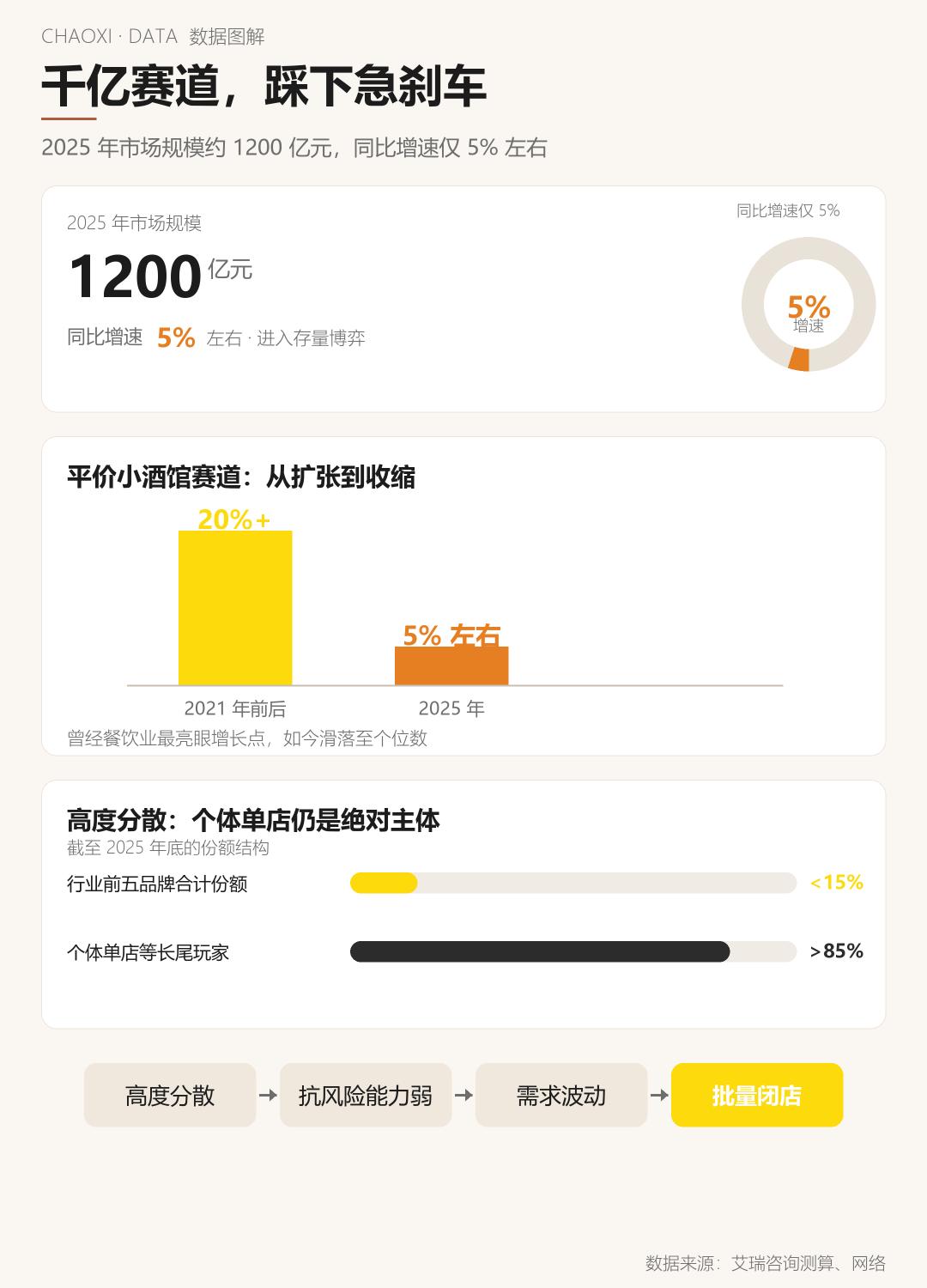
According to estimates by iResearch Consulting, the overall market size of the domestic pub industry in 2025 is about 120 billion yuan, with a year-on-year growth rate of only about 5%, officially entering the stock game stage of single-digit growth.
Among them, the standardized affordable pub track, which was once highly expected, has the most drastic contraction. Around 2021, the growth rate of this sub-track once remained above 20%, which was the most eye-catching growth point in the entire catering industry; by 2025, the industry growth rate has dropped to single digits, and a large number of small and medium-sized brands have been eliminated directly.
The data on the store side is even more cold. By the end of 2025, chain brands with more than 100 stores accounted for only about 5%, the total market share of the top five brands in the industry is less than 15%, and the vast majority of market share is still in the hands of individual single stores.
Under the highly fragmented pattern, the industry has extremely weak risk resistance. Once there is a fluctuation in consumer demand, mass store closure becomes inevitable.
As the absolute leader of the industry, Helens' trajectory is the epitome of the entire affordable pub track. Its rise verified the feasibility of the standardized pub model, and its contraction also announced the growth ceiling of this model.
2021 was the peak moment for Helens. According to the company's annual report of that year, the total revenue reached 1.836 billion yuan, a year-on-year increase of over 120%; the number of directly-operated stores reached 782, with nearly 500 new stores added in one year.
However, starting from 2022, Helens' revenue declined for the first time, and the loss expanded significantly; in 2023, the company launched a large-scale store closure wave, and the number of directly-operated stores was reduced all the way from the peak of 854. According to the company's 2025 annual report and the latest operation announcement, as of March 2026, Helens had only 108 directly-operated stores left, with a contraction rate of nearly 90%.
Revenue also shrank from 1.836 billion yuan in 2021 to 539 million yuan in 2025, declining for four consecutive years.
It is thought-provoking that Helens delivered a financial report of "turning losses into profits" in 2025, with a net profit attributable to owners of the parent company of 33.95 million yuan for the whole year.
But this is not a signal of business recovery, but a typical "shrinking profit": by closing loss-making stores on a large scale, drastically cutting rigid costs such as rent and labor, and relying on the franchise model to collect franchise fees and supply chain fees, it barely achieved book profit.
The data does not lie. By the end of 2025, among all 578 stores of Helens, 429 are franchise stores under the partner model, and the proportion of directly-operated stores is less than 20%. The average daily sales of a single franchise store is only about 4,100 yuan. Calculated according to the average gross profit margin of the alcohol industry, after deducting rent, labor and material costs, the profit level of a single store is extremely meager.
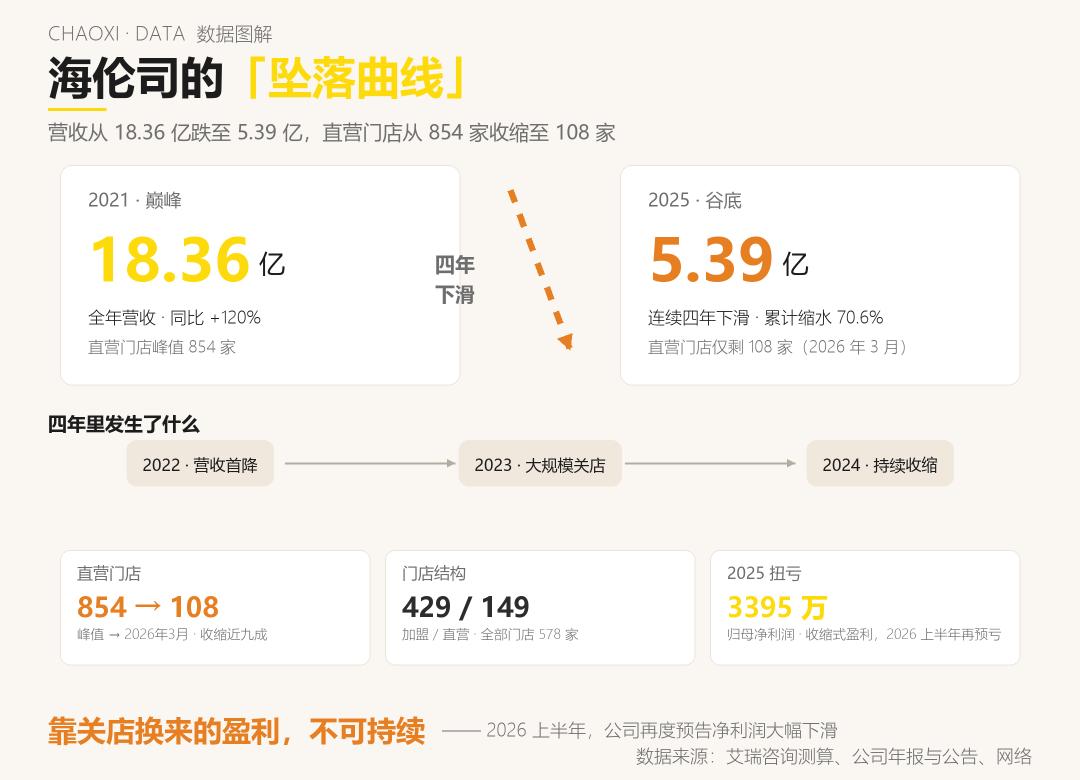
Entering 2026, the company once again predicted a sharp decline in net profit in the first half of the year. The profit obtained by closing stores is obviously unsustainable.
The defeat of Helens is never a strategic mistake of a single enterprise, but the overall peak of the standardized affordable pub model. When the capital-accelerated expansion period ends and the tide recedes, all the inherent defects of this model are exposed.
More fatal than the shrinking demand is the high degree of homogenization across the industry.
Walk into any commercial pedestrian street in a city, and you will find that the vast majority of affordable pubs look the same: industrial-style decoration, warm yellow string lights, long wooden tables and chairs, internet-famous slogans posted on the walls, beer buckets and drinking game sets that are almost identical on the wine list, and dice and board game cards are always placed on the tables.
From Sichuan-style drinking game pubs to Chinese-style pubs, from chain brands to individual stores, only the decoration shell is changed, and the core experience is almost the same.
Erma Pub, which once became popular with "fancy drinking games", is a typical case. With creative drinking game products such as nine bowls of special drinks and "tipsy tea", Erma Pub was extremely popular in Sichuan and Chongqing. At its peak, the monthly revenue of core regional stores could reach millions of yuan.
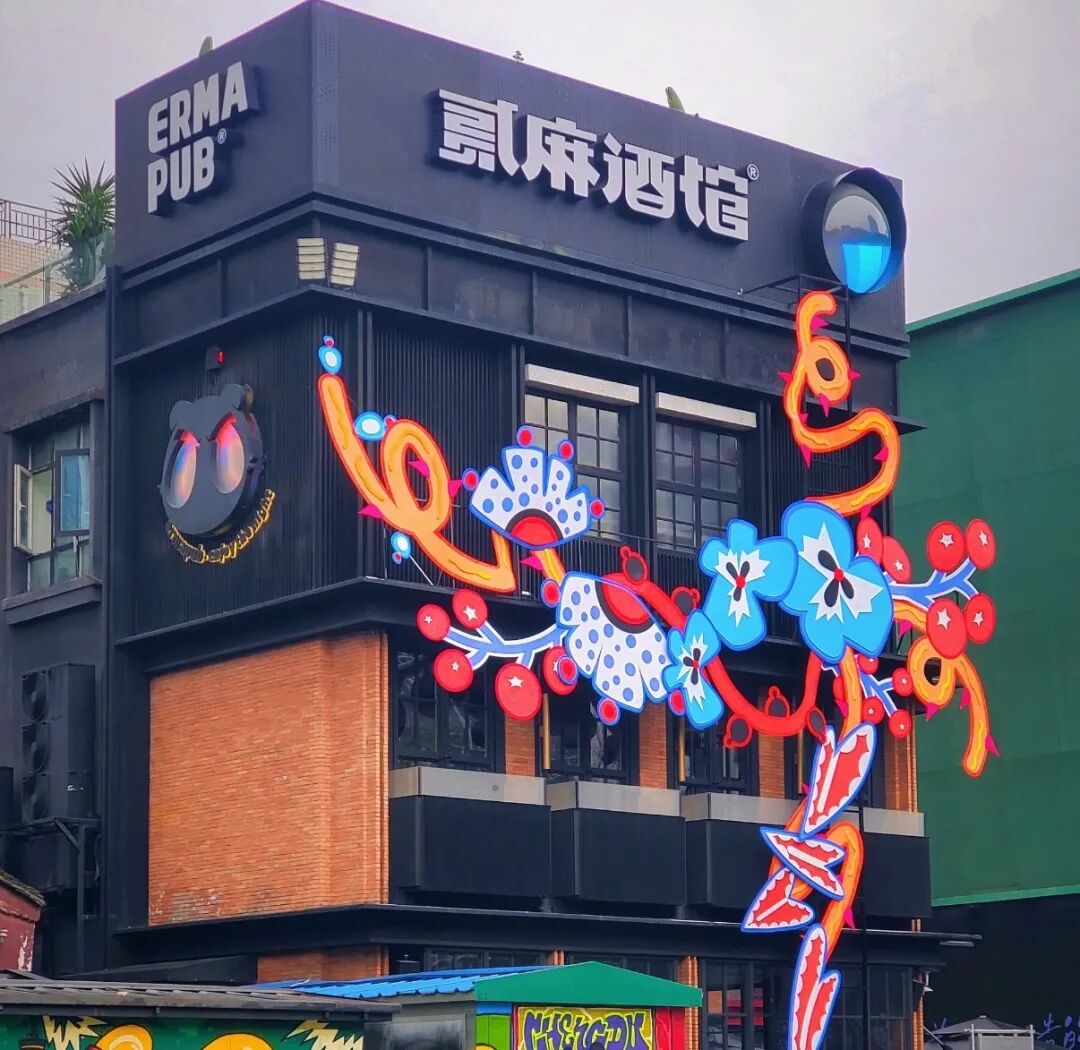
But when it expanded out of Sichuan and Chongqing to the whole country, it encountered severe acclimatization.
The drinking game culture has extremely strong regional social attributes. The lively drinking parties that people in Sichuan and Chongqing are used to are not suitable for young people in the Yangtze River Delta and Pearl River Delta. Without the soil of regional culture, what is left is only an ordinary pub experience, which naturally cannot form differentiated competitiveness.
The Chinese-style national trend pubs that have emerged in recent years have also failed to break out of the homogenization trap. Hanfu decorations, poetry-themed wine names, and ancient-style music seem to be packaged with a strong cultural sense, but in essence they are still traditional pubs with new decorations, and there is no essential upgrade in products, gameplay or experience.
Such stores usually attract customers through social platform check-ins, and they are very popular in the first three months of opening. Once the freshness fades, the passenger flow drops sharply, and their life cycle is generally short.
When all pubs provide highly similar experiences, consumers lose the reason to "make a special trip". Pubs are not a rigid demand for catering. Without a reason to go and an irreplaceable experience, they can only survive by low prices and good locations.
Once there are cheaper and fresher options around, users will leave without hesitation.
2
Multi-faceted attack:
The diverted "night budget"
The loss of favor for pubs is never due to too fierce competition among peers, but that they are facing substitution and diversion from all directions.
Young people's demand for drinking has not disappeared, they just changed the scene, the way and the carrier. Bulk beer shops, home-style slight intoxication, and diverse night entertainment are dismantling the living space of pubs from different dimensions.
Since 2023, community bulk beer shops have expanded rapidly across the country, becoming the most popular new business form in the alcohol track. Its appearance is almost a reverse revolution against the traditional pub model.
Completely different from the traditional pub model which usually covers hundreds of square meters, with heavy decoration and heavy service, the bulk beer shop adopts an extremely asset-light route: the store area is generally 20-40 square meters, most of which are opened in the ground-floor shops of communities or at street corners, with simple and clean decoration, no complicated lighting and live performances, and few dine-in seats.
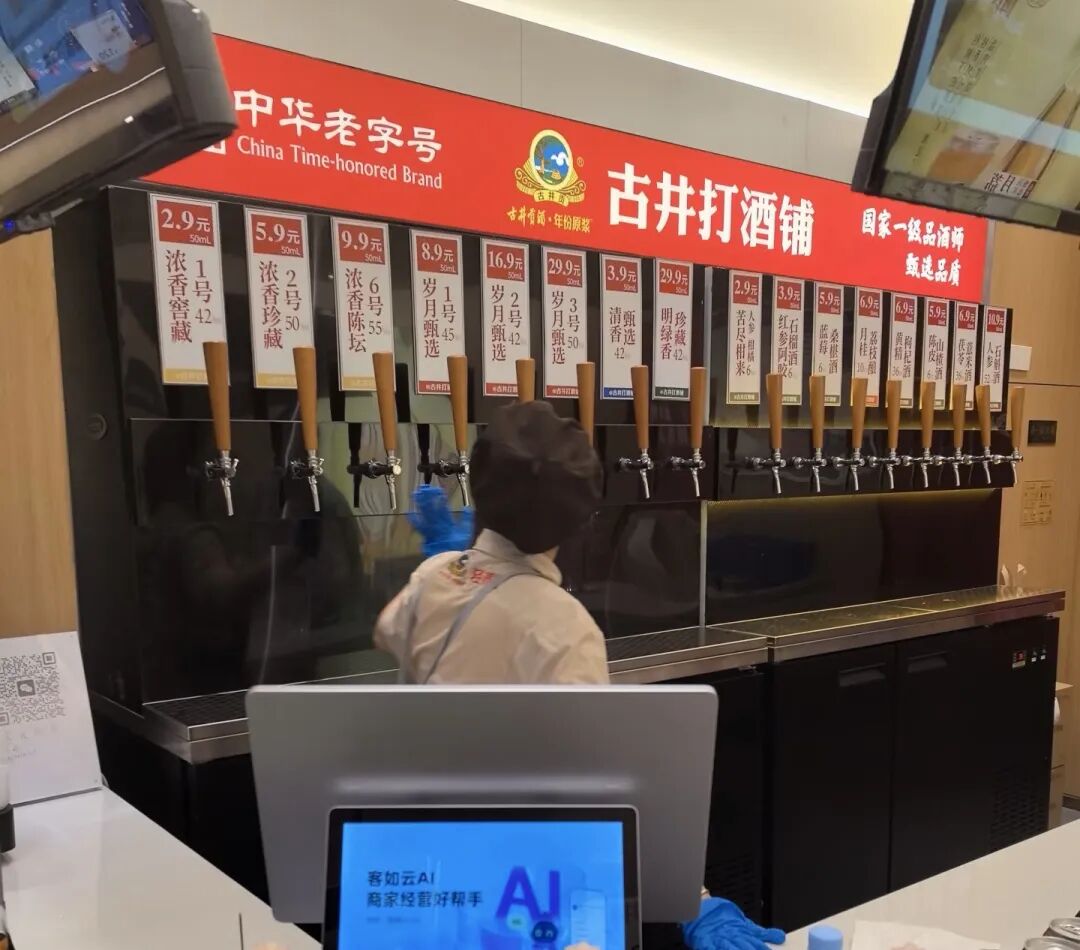
The core model is to sell alcohol by milliliters, craft beer, fruit wine and Baijiu can be sold by the jin, take away immediately, and also support takeout delivery. The customer unit price is generally 15-35 yuan, which is equivalent to the price of a cup of milk tea.
According to the general industry calculation, the initial investment of a bulk beer shop is only 100,000 to 300,000 yuan, which is 1/5 to 1/3 of that of a traditional pub, and the payback period is shortened from 12-18 months of traditional pubs to 6-8 months.
The light model brings a faster expansion speed. Head bulk beer shop brands such as Tang San Liang and Bama Xia have opened hundreds of stores across the country in just two years.
What is more noteworthy is that traditional famous Baijiu enterprises such as Gujing Gongjiu, Luzhou Laojiao and Kouzijiao have also entered the market one after another, launching their own brand of community bulk beer shops, trying to sink into the community channels in this way to digest base liquor production capacity.
Many people attribute the popularity of bulk beer shops to consumption downgrade, thinking that young people have no money so they go to buy cheaper bulk alcohol. But this is actually a misreading. The core of bulk beer shops is not low price, but "de-scenarization", which completely eliminates the scene premium contained in the wine price of traditional pubs.
In a traditional pub, a cup of craft beer sells for 38 yuan, of which the cost of the wine may only be 8 yuan. The remaining 30 yuan includes scene costs such as rent, decoration, service, music and lighting. While consumers pay for drinking, they are also paying for this space and this atmosphere.
But bulk beer shops remove all these scenes, only retain the wine itself, so the price naturally drops.
For craft beer of the same quality, the price of bulk beer shops is less than half of that in pubs, and you can take it to the riverside, park, home or anywhere else to drink, which is far more free than the fixed pub space.
The rise of bulk beer shops is essentially the return of alcohol consumption from "social props" to "daily drinks". And this return process first impacts the traditional pubs that survive on scene premium.
Along with the rise of bulk beer shops, home-style slight intoxication is also emerging. More and more young people choose to move the pub back to their rental houses, and get a more comfortable drinking experience at a lower cost.
According to public sales data from e-commerce platforms such as Tmall, the proportion of household consumption of low-alcohol fruit wine, pre-mixed drinks and small-bottle Baijiu has continued to increase in the past three years, with a compound annual growth rate of over 20%.
On the Xiaohongshu platform, there are more than a million notes related to "home slight intoxication". From wine list matching, atmosphere arrangement to snacks for drinking, young people have made drinking at home a complete lifestyle, and the cost of building a home pub is also relatively lower.
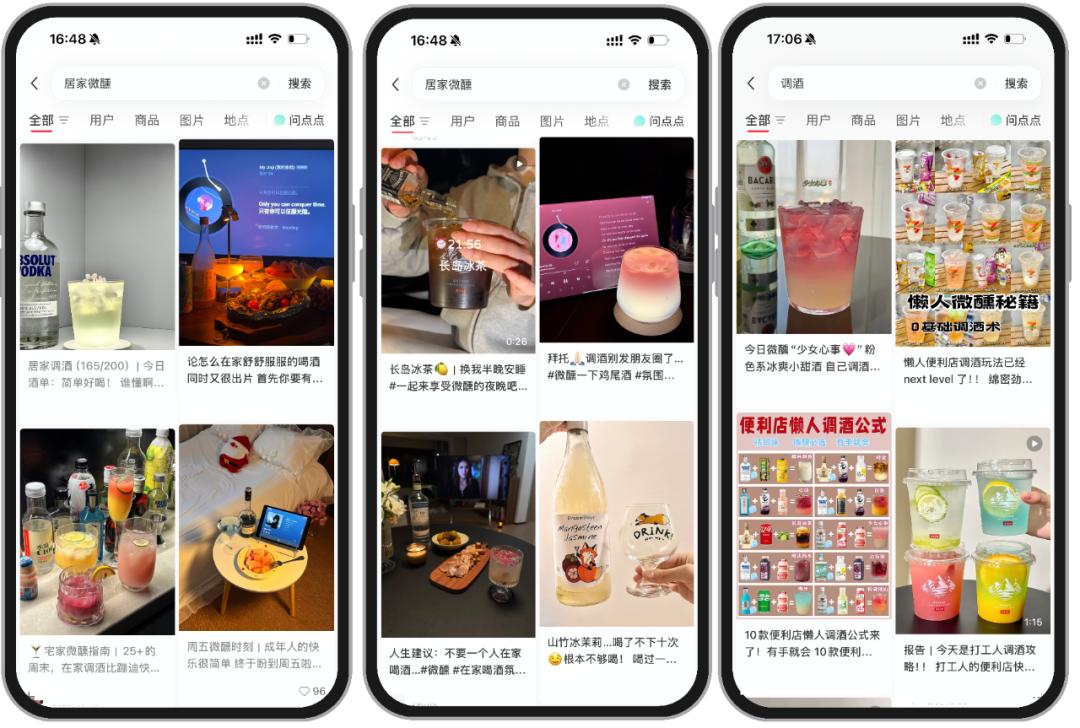
The deep-seated reason for this change is the shift in the social logic of young people.
Nowadays, young people's socialization is shifting from "outward expansion" to "inward contraction". Everyone begins to actively streamline their social circles, reject ineffective socialization, and pay more attention to the comfort of getting along and emotional value. This "self-pleasure" drinking is replacing "social" drinking and becoming the most mainstream drinking scene for young people.
This scene migration has directly taken away the core customer base of traditional pubs.
In addition to the diversion of drinking scenes, pubs are also facing the impact of the diversification of night entertainment categories. Young people's night budget is limited. When more and more fun options appear, the priority of pubs naturally drops.
Five years ago, when young people wanted to go out at night, the optional categories were very limited: eating, watching movies, KTV, and pubs were almost all the options.
Now, the map of night consumption has been greatly enriched: Livehouse, talk show, improvisational comedy, murder mystery game, escape room, urban camping, late-night bookstore, 24-hour gym, self-service chess and card room... Every category is competing for young people's night time and money.
The more critical gap lies in "experience density".
Spending 200 yuan, you