The landscape of China's major automotive manufacturing provinces is undergoing a reshuffle: Anhui and Zhejiang have staged a remarkable rise, who is falling behind?
In the first half of 2026, new changes have taken place in the ranking of automobile output across all provinces in China.
According to data from the National Bureau of Statistics of China, in the first half of this year, Anhui's automobile output reached 1.6867 million units, and its new energy vehicle output hit 881,800 units, both ranking first nationwide. Guangdong continued to rank second in the country with an automobile output of 1.3785 million units.
Zhejiang's automobile output reached 1.174 million units, rising from the 7th place nationwide in the same period last year to the 3rd, surpassing provinces such as Chongqing and Shaanxi; Jiangsu ranked 4th with 1.122 million units.
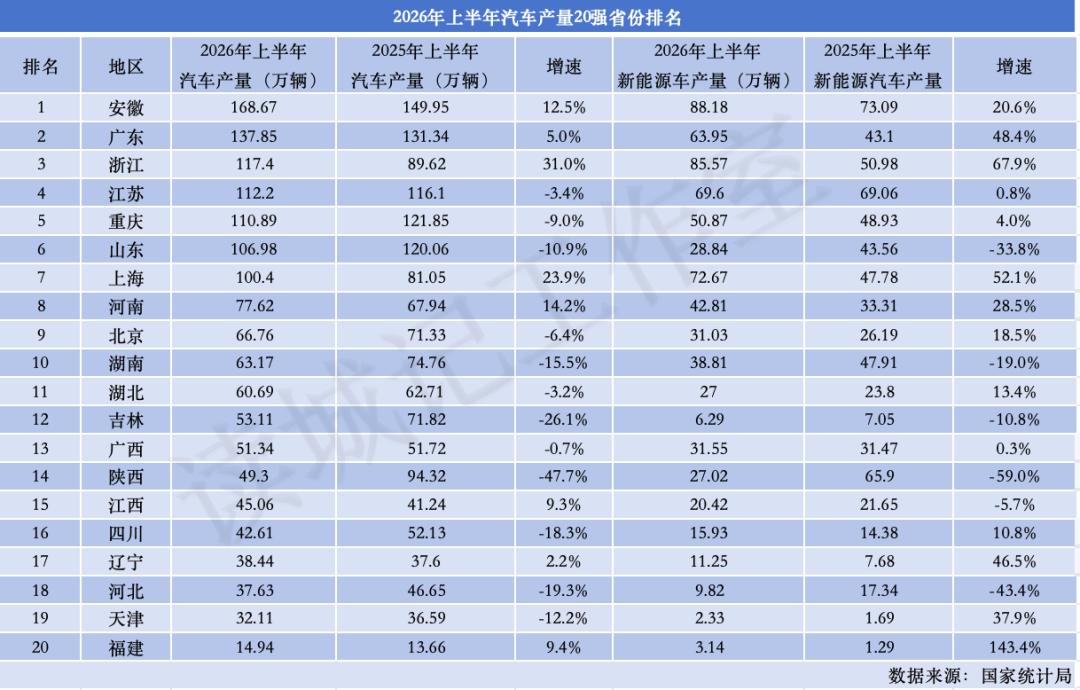
In contrast to the growth in automobile output of the above-mentioned provinces, some major automobile-producing provinces have still not reversed the downward trend, with their output continuing to decline and their rankings dropping further.
Chongqing's automobile output was 1.1089 million units, falling from the 3rd place nationwide in the same period last year to the 5th; Shandong's output was 1.0698 million units, dropping from the 4th place a year earlier to the 6th; Jilin's output was 531,100 units, with its ranking sliding from 10th in the same period last year to 12th nationwide. Shaanxi saw the most notable change, with its automobile output in the first half of the year falling by 47.7% year on year and its ranking dropping to 14th.
Changes in the automobile industry not only affect industrial rankings, but also influence the economic performance of local regions. As a key pillar of the manufacturing sector, the automobile industry has a long upstream and downstream industrial chain and strong driving capacity. Changes in automobile output usually transmit to industrial growth, and further affect the regional economic growth rate.
In the first half of this year, Jilin and Shaanxi, which saw a relatively obvious decline in automobile output, recorded GDP growth rates of 2.4% and 3.8% respectively. For these provinces, against the backdrop of slowing growth of fuel vehicles and intensifying competition in the new energy vehicle industry, how to find new growth momentum has become an issue they must address going forward.
Rapid growth of automobile output in Anhui and Zhejiang
In the first half of this year, Anhui's automobile output ranked first nationwide again. Data shows that from January to June, Anhui's automobile output reached 1.6867 million units, new energy vehicle output reached 881,800 units, automobile export volume hit 1.006 million units, and export value reached 1043.6 billion yuan, with all four indicators ranking first in the country.
The changes in Anhui did not come about in a short period of time. Apart from the impact brought by the adjustment of statistical calibers, the more important factors are the industrial foundation laid by years of independent cultivation, and the acceleration of industrial agglomeration by introducing leading enterprises in recent years.
In the past, Anhui laid the foundation for automobile manufacturing relying on independent brands such as Chery and JAC. With the accelerated development of new energy vehicles, Anhui has introduced enterprises including NIO, Volkswagen Anhui and BYD to speed up the improvement of the new energy industry chain.
At present, Anhui has gathered 7 complete vehicle manufacturing enterprises and more than 3,000 auto parts enterprises, covering key fields such as power batteries, motors and electronic controls, and intelligent driving. The vision of "manufacturing a complete new energy vehicle without leaving Anhui" has become a reality.
Against the trend of "fuel vehicles phasing out and new energy vehicles rising", Zhejiang is another example of catching up from behind.
In the first half of this year, Zhejiang's automobile output reached 1.174 million units, ranking 3rd nationwide; its new energy vehicle output reached 855,700 units, second only to Anhui. In terms of the growth rate of automobile output among the top 20 provinces, Zhejiang ranks first this time.
Behind the growth of Zhejiang's automobile output is the driving force from two local complete vehicle enterprises, Geely and Leapmotor.
In the first half of this year, Geely Auto's retail sales reached 1.021 million units, making it the champion of domestic sales of Chinese passenger vehicles, and also the only auto enterprise whose domestic sales exceeded 1 million units in the same period. In the same period, Leapmotor's sales rose 29.3% year on year to 260,200 units, entering the top 10 of domestic passenger vehicle sales for the first time.
Zhang Hong, an expert member of the China Automobile Dealers Association, once stated in an interview that local Zhejiang enterprises including Geely and Leapmotor have accelerated their new energy transformation, and improved their market competitiveness through technological innovation and differentiated products. Meanwhile, Zhejiang has more than 2,500 auto parts enterprises above designated size, with a complete industrial chain supporting system, which provides support for output growth.
Among the top 20 provinces by automobile output, Shanghai ranks second in the growth rate of automobile output in the first half of the year, second only to Zhejiang.
In the first half of this year, Shanghai's automobile output reached 1.004 million units, up 23.9% year on year. In terms of industrial performance, the output value of the automobile manufacturing industry above designated size increased by 8.9%, and the output value of the new energy automobile manufacturing industry rose by 33.9% year on year.
This growth is driven by the Shanghai Gigafactory of Tesla, and also benefits from the rising sales of new energy models of SAIC Motor and the improved performance of automobile exports.
Changes in the automobile industry are affecting local economic performance.
The automobile industry has a long industrial chain and strong driving capacity. Behind each automobile are multiple industries including steel, electronics, machinery, logistics and services. The growth of automobile output can not only directly drive the expansion of the complete vehicle and parts manufacturing industries, but also expand investment, create jobs, and promote the coordinated development of the entire upstream and downstream industrial chain.
In recent years, regions with rapid development of the automobile industry such as Anhui, Zhejiang and Shanghai have obtained strong support for industrial growth. In the first half of this year, the added value of industries above designated size in Anhui increased by 12.4%, ranking among the top in the top 10 provinces; the GDP growth rates of Zhejiang, Shanghai and Anhui reached 5.7%, 5.6% and 5.6% respectively, all at a relatively high level nationwide.
Of course, the automobile industry is not the only factor that determines economic performance, but for regions with a high proportion of manufacturing, the transformation and upgrading of the automobile industry is becoming an important force to promote industrial growth and enhance industrial competitiveness.
At present, the competition in the new energy vehicle industry has entered a new stage. Whether local regions can seize the opportunity of industrial transformation will also affect the space for future economic growth.
Some major automobile-producing provinces are facing transformation pressure
While some regions deliver excellent performance, the automobile industry in some other regions is still facing pressure from transformation and adjustment.
In the first half of this year, Shaanxi saw an obvious decline in automobile output. Data shows that from January to June, Shaanxi's automobile output was 493,000 units, down 47.7% year on year; its new energy vehicle output was 270,200 units, down about 59% year on year. Affected by this, Shaanxi's ranking in automobile output dropped from the 6th place in the same period last year to the 14th, and its new energy vehicle ranking also slid from the 3rd place a year earlier to the 12th.
The fluctuation of Shaanxi's automobile output is related to its high dependence on leading enterprises. In 2022, the new energy vehicle output of BYD Xi'an Base reached 1.008 million units, accounting for 75.3% of the province's total new energy vehicle output; by 2024, this proportion still exceeded 60%.
In the past few years, the rapid expansion of BYD has promoted leapfrog growth of Shaanxi's automobile industry, keeping Shaanxi's automobile output ranking at a high level. However, high industrial concentration also means that once leading enterprises adjust their production rhythm, local automobile output will be significantly affected.
In early 2026, BYD Xi'an Base was in the stage of switching between old and new models, production of some old models was adjusted, and new models and new production lines were still in the ramp-up phase. The connection of short-term production capacity was affected, which further dragged down Shaanxi's automobile output.
Different from the phased fluctuation of Shaanxi caused by the adjustment of leading enterprises, Jilin is facing structural pressure in the transformation process of the traditional automobile industry.
As a traditional major automobile hub, Jilin has long taken FAW Group as the core, forming an industrial pattern dominated by fuel vehicles. With the accelerated replacement of traditional fuel vehicles by new energy vehicles, the industry pattern is changing.
Data from the China Passenger Car Association shows that retail sales of fuel passenger vehicles dropped by 39% in June, the share of conventional fuel vehicles stood at 37.2%, and the year-on-year reduction accounted for 78% of the total reduction in passenger vehicles. For Jilin, which has a high proportion of traditional fuel vehicles, the industrial transformation pressure is obviously not small.
Across the country, there are quite a number of provinces with declining automobile output.
Among the top 20 provinces by automobile output in the first half of this year, 12 provinces saw a year-on-year decline in automobile output, including provinces with high automobile output such as Jiangsu, Chongqing and Shandong.
In terms of new energy vehicle output, some regions are also facing growth pressure. Among the top 20 provinces, 6 provinces recorded a year-on-year decline in new energy vehicle output, namely Shandong, Hunan, Jilin, Shaanxi, Jiangxi and Hebei.
However, the decline in automobile output does not equal the decline of industrial competitiveness. The current automobile industry is in the stage of switching between old and new driving forces. The adjustment in some regions is not only related to the shrinking fuel vehicle market, but also related to enterprises' active optimization of production capacity and promotion of new energy transformation.
In the future, what determines the competitiveness of the local automobile industry will not only be the output scale, but also the new energy layout and industrial chain competitiveness.
Competition in the automobile industry enters a new stage
Judging from the changes in output rankings, the automobile industry across the country is being reshuffled; from the market side, the industry competition environment is also changing.
Data released by the China Association of Automobile Manufacturers shows that in the first half of 2026, domestic sales of traditional fuel passenger vehicles were 3.694 million units, down 31.9% year on year, 1.732 million units less than the same period last year. In contrast, the overall sales of new energy vehicles maintained a growth trend, with sales from January to June reaching 7.446 million units, up 7.3% year on year.
In terms of penetration rate, in the first half of the year, the proportion of new energy vehicle sales in total passenger vehicle sales reached 51.3%; this figure further rose to 63.1% in June.
With the continuous increase of penetration rate, the new energy vehicle market is shifting from rapid popularization to exploring new growth space.
The past development model that relied on expanding production capacity and seizing market increments is unsustainable. In the future, the competition of the local automobile industry will not only depend on the complete vehicle output, but also on the completeness of the industrial chain, technical capabilities and service system.
For traditional automobile-producing provinces that are still in the period of transformation and adjustment, the key is to promote the extension of industrial advantages from traditional complete vehicle manufacturing to new energy and intelligent fields.
Facing the changes in the automobile industry pattern, traditional major automobile hubs are accelerating transformation.
Jilin is promoting the upgrading of the automobile industry towards new energy and intelligent connected vehicles, accelerating the introduction of new energy models, and improving the new energy product competitiveness of complete vehicle enterprises. Meanwhile, it is improving the industrial ecosystem around fields such as intelligent driving and vehicle-road-cloud collaboration, promoting auto parts enterprises to transform into core new energy component sectors, and enhancing industrial chain supporting capabilities.
For regions that have already formed new energy vehicle industrial advantages, the focus of competition has shifted from expanding production capacity to enhancing industrial value.
Chongqing has proposed to build a trillion-level intelligent connected new energy vehicle industrial cluster, and accelerate the layout of key fields such as automotive chips and intelligent driving; Shanghai, focusing on the development of intelligent connected new energy vehicles, is promoting the automobile industry to extend to directions including intelligent driving, vehicle-road collaboration and software application, and accelerating the construction of a new ecosystem integrating technology R&D, scenario application and industrial collaborative development.
At the same time, the overseas market is becoming a new direction for automobile industry competition.
Data shows that in the first half of this year, China's automobile exports reached 5.096 million units, up 65.3% year on year; new energy vehicle exports hit 2.355 million units, up 1.2 times year on year. For the automobile industry in all regions, supporting enterprises to enhance their international competitiveness and expand overseas markets will also become an important direction to explore new increments in the future.
The pattern of the automobile industry is undergoing accelerated adjustment. Past advantages do not mean future advantages. For all regions, how to find new growth points amid industrial changes will determine their positions in the next round of competition.
This article is from the WeChat official account "Du Cheng Ji Studio", written by Li Hang, and authorized for release by 36Kr.