Has the real estate market entered a policy lull?
After the "730" Political Bureau meeting mentioned "stabilizing the real estate market", Beijing quickly rolled out a new round of property market adjustment policies last Friday.
From the content of Beijing's policy adjustment, it follows the path of "optimizing existing stock and unblocking precisely", and implements targeted policies from three aspects: home purchase threshold, intergenerational inheritance, and provident fund quota.
When looking at the central and local policies together, we would like to talk about a highly vane-significant signal released behind them: the policy window gap period has arrived.
The current property market has bid farewell to policy-driven stimulus and ushered in a repair market dominated by market supply and demand.
01
The policy window gap period does not mean that no policies are introduced at all, but that no heavyweight policies will be introduced at the national level.
The Political Bureau meeting included real estate in the category of "security barrier" for the first time, which means that real estate is embedded in a more macro financial systemic security framework. Compared with the "strive to stabilize the real estate market" statement at the April Political Bureau meeting, the statement at the 730 Political Bureau meeting has been simplified to "stabilize the real estate market".
That is to say, do not expect any "big moves" in the real estate market policies in the second half of the year. In particular, strong stimulus tools such as mortgage interest rate subsidies that are rumored in the market are very unlikely to be implemented in the short term.
There are only two core policies at the central level: urban renewal and high-quality housing.
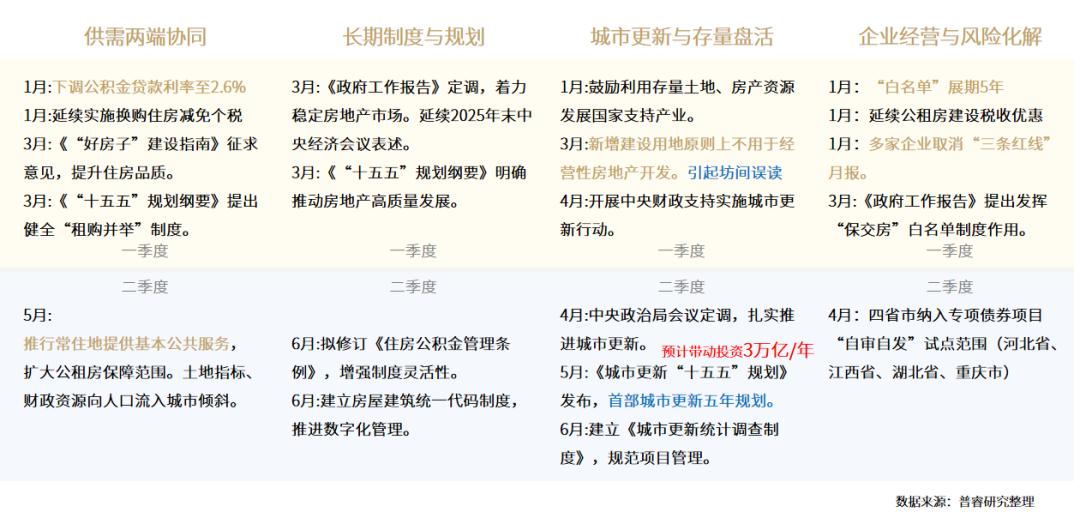
Since the beginning of this year, policies at the practical level have been significantly delegated to lower levels, and there are no shortage of policies at the local level. The release of Beijing's new property market policies further reflects that market-stabilizing policies are still being continuously intensified and implemented. Judging from the policy content, the logic of local policy implementation is also changing.
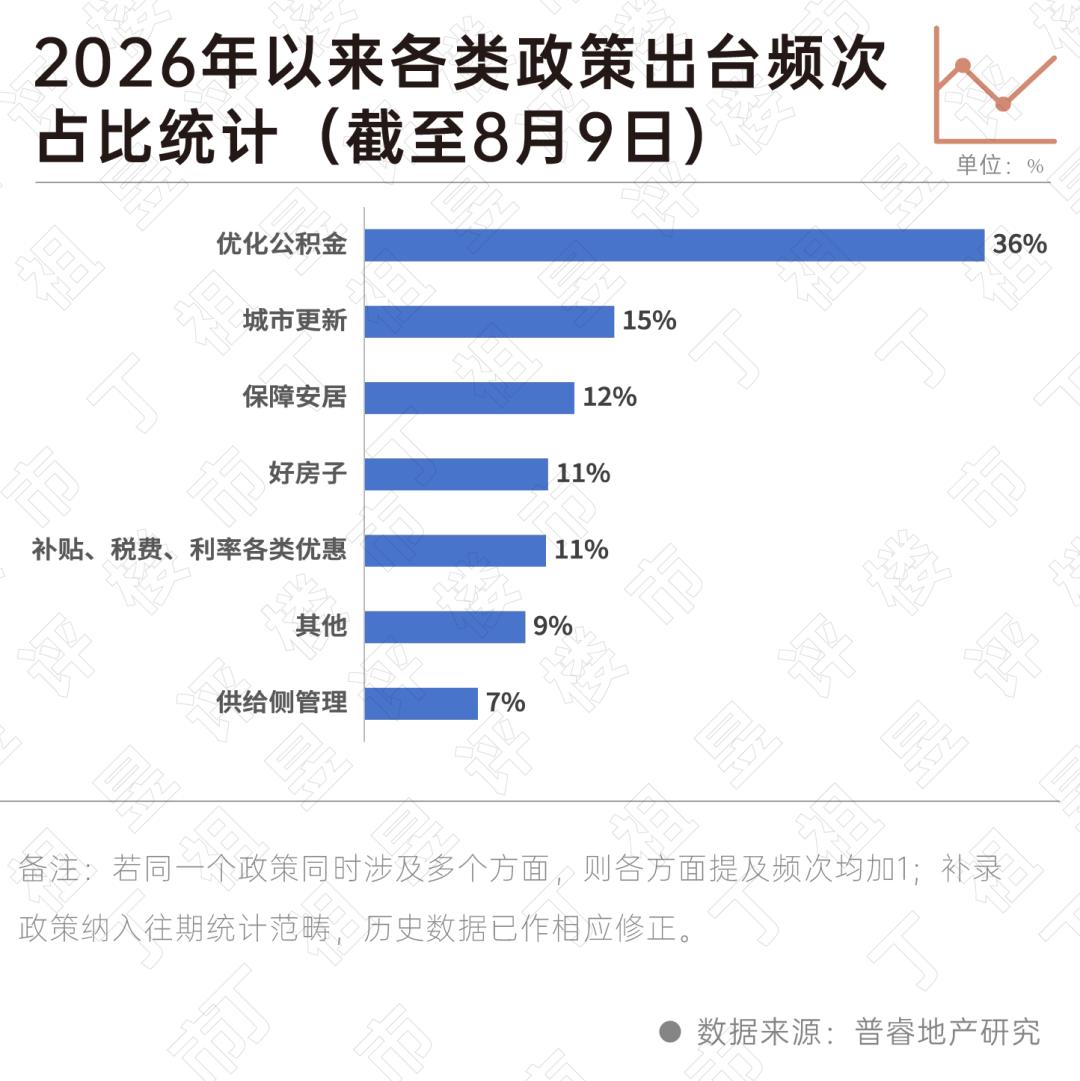
According to incomplete statistics from Pury Research Center, a total of 620 various national property market stabilization policies have been issued since 2026, among which the three types of measures including provident fund optimization, urban renewal, and affordable housing security rank top in terms of release frequency.
Among them, the optimization of provident fund policies remains the core. As of August 9, a total of 328 provident fund-related policies have been issued in 200 provinces and cities, accounting for 36% of the total policy releases, which means that the provident fund policy tool has accounted for the vast majority of policies, and is the core starting point for local governments to stabilize home purchase demand and guide market expectations. Judging from the policy effect in first-tier cities, the leverage boost from the provident fund may have a stronger driving effect on new homes than the relaxation of purchase restrictions itself.
The second most frequent policy is urban renewal policy. As of August 9, local governments have issued urban renewal policies 132 times this year, accounting for 15% of the total policy releases.
In addition, affordable housing security policies account for 12% of the total, followed by high-quality housing policies, home purchase subsidies and tax preferential policies, each accounting for 11%.
Combining the content of local policies, the focus of policies has moved away from the short-term "support for the property market" and shifted to the long-term goals of "stabilizing risks, adjusting structure, optimizing stock, and improving quality".
02
Why do we say that the policy has entered a window gap period? There are three underlying reasons.
From the perspective of the policy itself, after multiple rounds of policy easing in the past two years, traditional demand-side tools such as down payment reduction, interest rate cut, and optimization of the four core restrictions in first-tier cities have been basically fully utilized, local governments are mostly making fine-tuning and optimization of existing policies rather than launching strong stimulus. At the same time, the current policy tools have limited room for adjustment, and the pulling effect of policies is marginally weakening, which is a major realistic factor for the arrival of the policy window gap period.
Take Beijing as an example. Before the release of the new policy on August 7, Beijing had already carried out a round of purchase restriction relaxation as early as December 2025. After two rounds of adjustment, the remaining room for conventional policy tools in Beijing has been significantly narrowed: the number of years of payment requirement has been reduced to the lower limit of 1 year, the interest rates for first and second homes have been unified in December 2025, and the policy allowing two-child families to purchase one additional home has also been implemented, the marginal room for subsequent policies is much smaller than that of the first round.
From the perspective of demand-side stimulus, it faces the remaining demand that has been screened by the first round of policies, and its absolute elasticity is weaker than that of the first round.
Looking at a longer time horizon, since Beijing relaxed purchase restrictions in December 2025, Shanghai and Shenzhen followed up in February and April this year respectively. But the policy effects are highly consistent: they support the second-hand housing market, while the transmission to the new housing market is slightly insufficient.
In the first half of 2026, the number of second-hand housing online signings reached 107,500 in Beijing, 147,000 in Shanghai, and 35,000 in Shenzhen. Both Beijing and Shenzhen hit new highs in nearly five years, and Shanghai's figure was only 641 units lower than the same period in 2021. The cumulative year-on-year growth of second-hand housing transactions in the three cities was 11%, 13% and 6% respectively, all positive.
The cumulative year-on-year transaction volume of new homes is still in a negative growth channel. In the first half of the year, the cumulative year-on-year decline of new home transactions was 7% in Beijing, 17% in Shanghai, and 16% in Shenzhen. This shows that the relaxation of the "four restrictions" mainly releases the demand for replacement and circulation of existing housing stock, rather than incremental purchasing power.
Policy tools are still available, but with the same policy intensity, the market elasticity that can be leveraged is far less than before.
The deeper reason comes from the change of demand logic on the resident side.
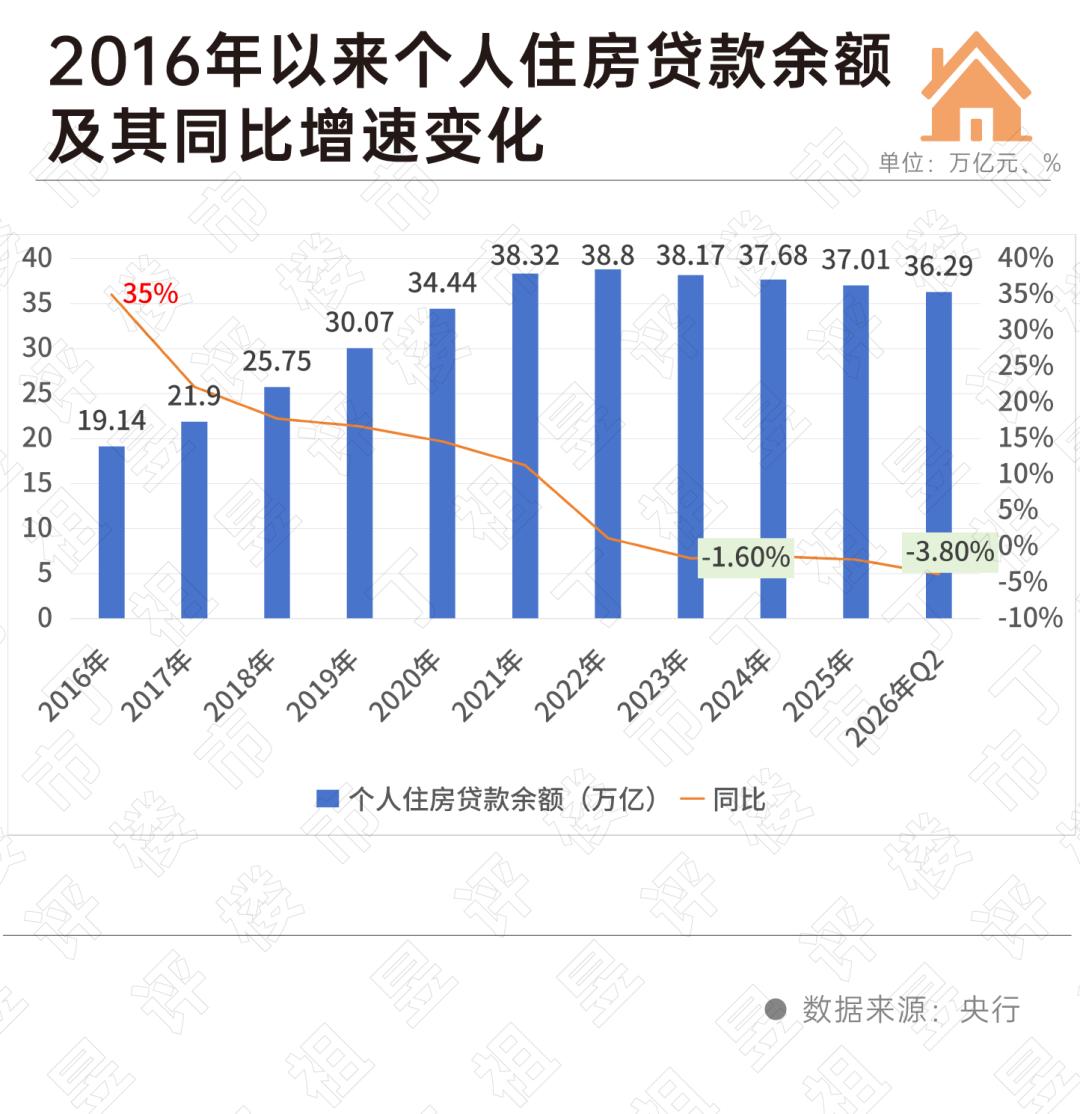
The balance of resident housing loans has declined for four consecutive years after reaching a phased high in 2022. By the first half of 2026, the balance of personal housing loans reached 36.29 trillion yuan, a year-on-year decrease of 3.8%; Since 2021, the monthly new amount of medium and long-term loans for residents has decreased significantly, and the new amount has been negative in most months since last year. Even if the mortgage interest rate continues to fall to around 3%, residents are still actively deleveraging as a whole. Rigid demand groups have to use credit leverage due to housing needs, but many improvement replacement groups are more cautious about adding leverage, and more choose to replace their properties with equal total price or even lower total price.
In fact, policies can only solve the two constraints of "qualification" and "leverage", but cannot solve the two fundamental variables of "income expectation" and "housing price expectation". In the current market environment, policy is only a necessary condition, not a sufficient condition.
A set of key data shows that the current market fundamentals are characterized by self-repair.
In the first 7 months, the total transaction volume of new and second-hand homes in 18 key cities was basically the same as the same period last year, and the total volume was at a high level in the past three years. The cumulative year-on-year growth of second-hand housing transactions reached 4%, which has become the basic disk for the market to stop falling and stabilize. In terms of housing prices, the prices of new homes in 21 cities stopped falling month-on-month in the first half of the year, and the number of cities where second-hand housing prices stopped falling month-on-month has been no less than 10 for 4 consecutive months. At the same time, the contraction of land investment led to a 23% year-on-year decline in new housing supply in the first 7 months, and the supply contraction is adjusting the market supply and demand relationship.
This round of bottom confirmation is the result of the combined effect of price adjustment, release of real purchasing power and supply contraction, rather than relying solely on policy stimulus.
The arrival of the policy window gap period means the market has bid farewell to the old model of nationwide strong stimulus. Policies can drive the release of previously accumulated demand in the short term, but how far the market rally can go ultimately depends on the improvement of residents' purchasing power, supply structure and market expectations. The core of the current market repair has been switched to the release of real housing demand under the adjustment of supply and demand structure.
This article is from the WeChat Official Account "Ding Zuyi Reviews Real Estate", author: Editorial Department, authorized for release by 36Kr.