The news that banks enjoy a 1.5-hour lunch break has sparked a fierce debate among office workers all over the internet.
An ordinary lunch break notice has unexpectedly sparked a huge stir across the entire internet.
Recently, the Enshi Branch of China Construction Bank announced that all outlets under its jurisdiction will pilot a 1.5-hour lunch break, during which manual counter services will be suspended.
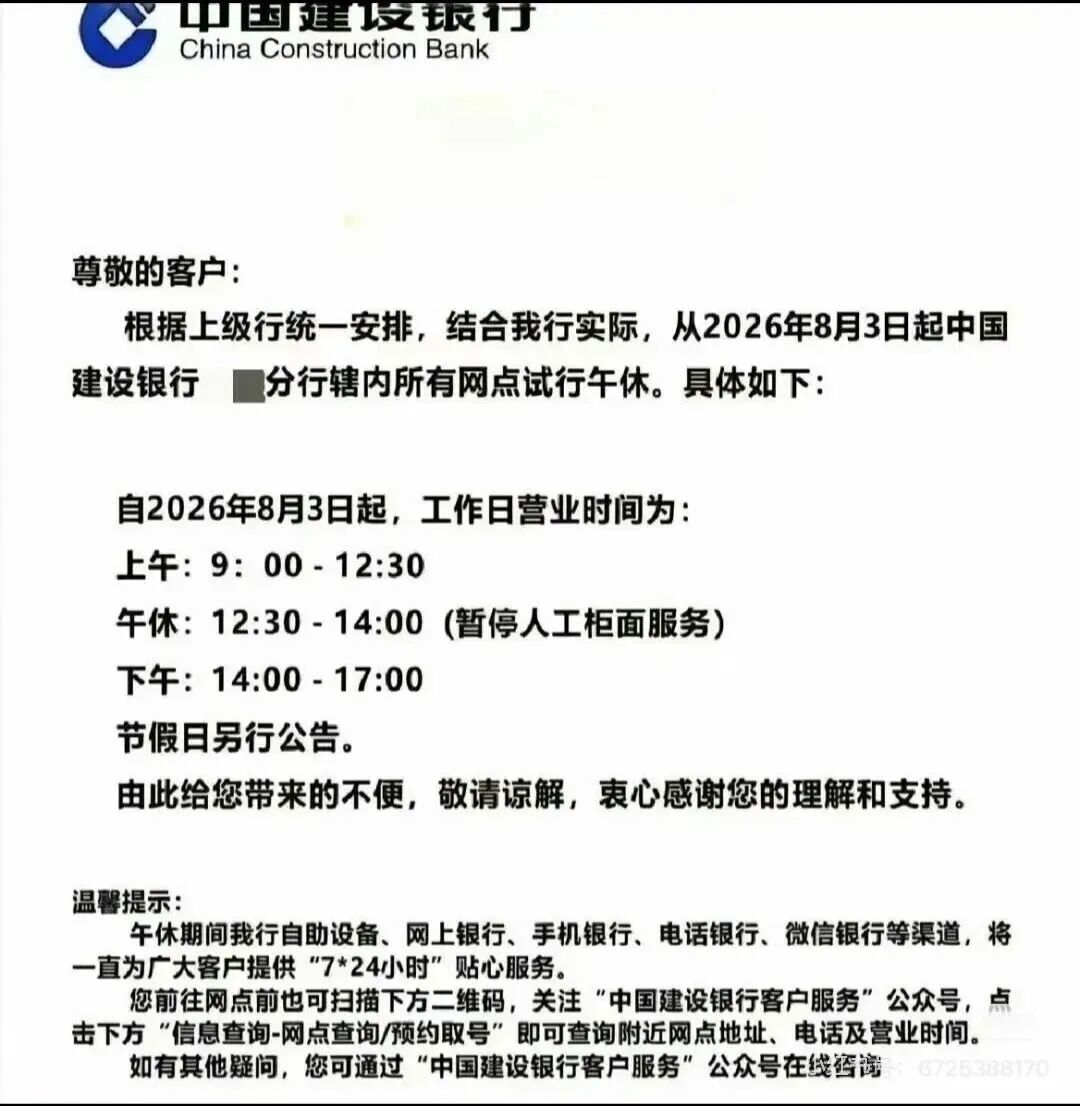
The moment the news came out, public opinion was instantly split into two camps.
One side is the frustrated office workers: "The bank's working hours almost completely overlap with those of office employees. We usually have to sacrifice our lunch time to handle bank business, and now even that last option is blocked!"
The other side is the aggrieved bank staff: "Aren't tellers also office workers? Don't we even deserve the right to have a peaceful meal and catch our breath?"
The related topic even topped the trending search list, with over 100 million views. Internet users took sides one after another and engaged in heated debates.
How could a working hour adjustment of a local branch set off such a huge public outcry?
01
Banks' Lunch Break Triggers Public Outrage
People who oppose the bank's lunch break hold very simple reasons, full of the bitterness of ordinary office workers:
"You work when I work, and you rest when I rest. How am I supposed to handle my business at the bank?"

For the vast majority of office workers, the only free time they have on workdays is just over an hour at noon. Once the counter service is suspended at noon, the only way left to handle bank business is to ask for leave.
But in the current workplace environment, asking for leave is never as easy as just saying a word. For a trivial matter, you have to go through approval, watch your leader's mood, and may even lose half a day's salary, which inevitably makes people feel it's not worth it.
Therefore, some people proposed a seemingly win-win solution:
"Bank tellers take staggered breaks in shifts."

In this way, tellers can have meals and rest, and customers can also handle their business smoothly, no one needs to make sacrifices.
However, this suggestion was quickly refuted by many bank practitioners.
Many netizens working in banks revealed: "Banks are all cutting costs and increasing efficiency now, many outlets only have one teller, so staggered breaks are completely unrealistic."

In addition, supporters also see another layer of the problem.
The reason why many people can only go to the bank during lunch break is not that the bank's business hours are unreasonable, but that their own working hours are almost completely inflexible.
"This is a problem between office workers and their companies, not a problem of the bank."
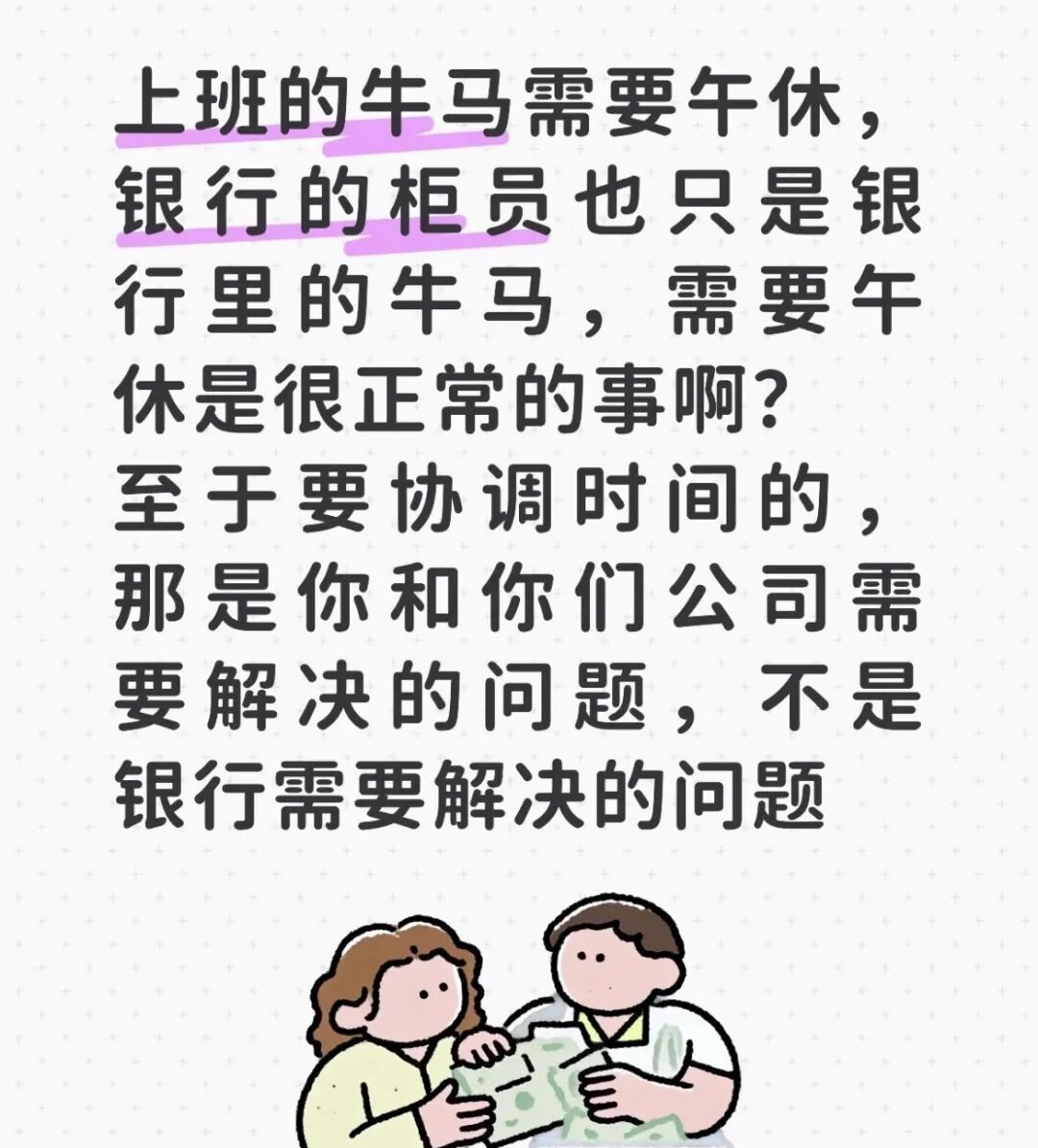
Asking for leave is indeed troublesome, but that can't be a reason to ask another group of office workers to give up their rest time. Customers have difficulties handling their business, and bank employees also have the need to eat and rest.
"We are all just working hard to make a living, why make things difficult for each other?"
Some people even regard this pilot as the "first step against involution": If large enterprises like banks start to openly guarantee their employees' rest rights, more and more companies may follow suit, and eventually all office workers will benefit.

In this way, opponents are complaining about the increased cost of handling business, while supporters are emphasizing the normal rest rights of laborers.
Both sides stick to their own opinions, and no one can convince the other.
02
When Two Kinds of Normal Needs Collide
The predicament of opponents is not overreacting. If the bank suspends noon business, the inconvenience to customers does exist.
And the insistence of supporters is also not unreasonable.
In many people's traditional impression, a bank job is a well-known "golden rice bowl":
You won't be exposed to wind or rain, sit in an air-conditioned room counting money, and the job is both prestigious and well-paid.

But when you open social media, the complaints from bank staff are almost all full of grievances.
There is hardly any industry where leaders are not satisfied, colleagues are not satisfied, customers are not satisfied, and finally even the employees themselves are not satisfied.
But the banking industry can be like this.

The most troublesome thing for bank staff is the never-ending KPI that can never be completed.
An ordinary teller may be burdened with millions of deposit targets. In addition to deposit targets, there are also credit card opening quotas, hundreds of thousands of consumer loan targets, and various tasks are continuously added one after another.

Don't think that only customer managers and marketing positions need to complete performance targets.
In banks, a position may not be related to marketing, but it can never be free of KPI. Some netizens even said that even the security guards at the outlets may be assigned performance tasks.
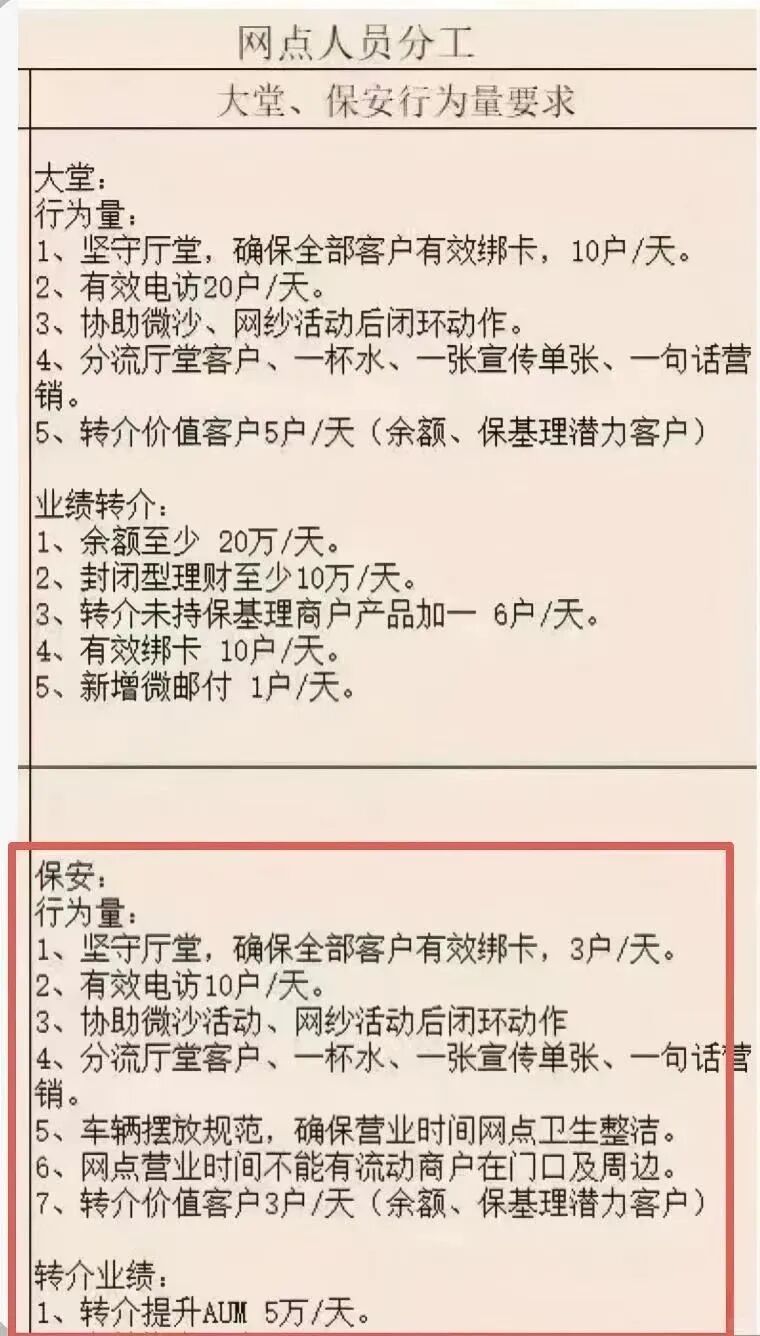
As a result, the contact lists of bank staff have been fully exploited. They ask all their relatives and friends for help, exhaust all their connections among classmates and colleagues, and when they are really desperate, they even try to reconnect with their exes and people they used to have bad relationships with.
But the problem is that their social connections are almost exhausted, and the performance tasks are still far from being completed.
Some netizens joked: Even if Wang Jianlin came, he could only save two customer managers for one year, because the performance targets will rise again next year.

If you can't complete the tasks, the consequences are very direct: performance deduction, public notification of criticism, and being scolded in meetings, none of these can be avoided.
Some people even found another way out: they spend their own money to buy financial products to boost their performance. Literally, they are paying to go to work.

Sometimes, banks' pursuit of performance targets has reached a surreal level.
They need to count how many customers are added to the corporate WeChat account, and the addition rate must be calculated. Only manually added customers count, automatically added ones don't.
Even the printer has its own "performance report".
The year-on-year change of quarterly printed paper volume, and how many black-and-white and color pages are printed respectively, all need to be counted clearly.
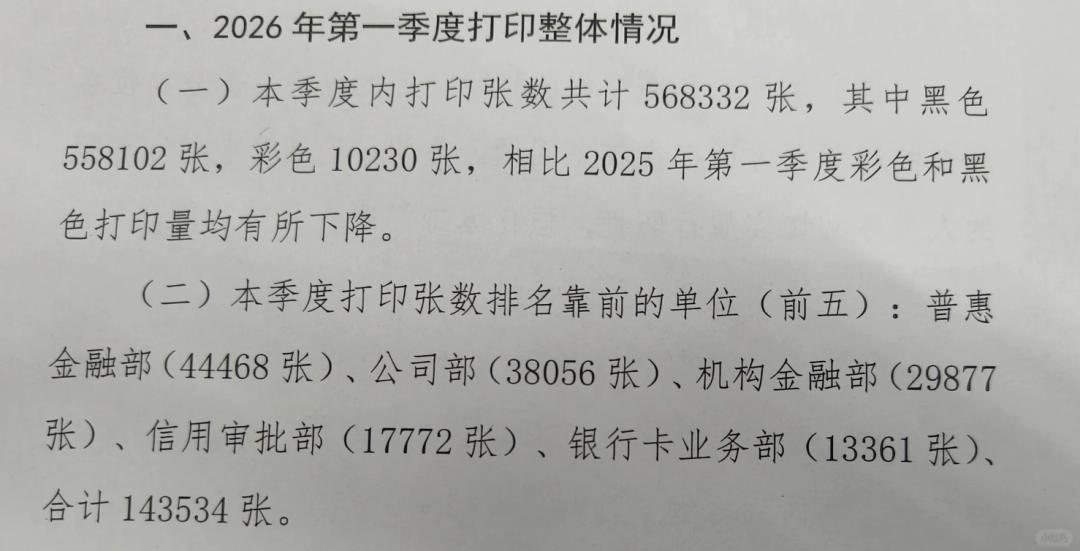
If you can't finish the KPI, you naturally can't get off work on time.
Some people complained that trainings often last until 7 or 8 p.m. Someone in the comment section immediately asked: "7 or 8 p.m. is considered late? 9 p.m. is the standard end time for us." Scrolling down further, many people said they have experienced working until half past eleven, two or three in the morning, or even all night.
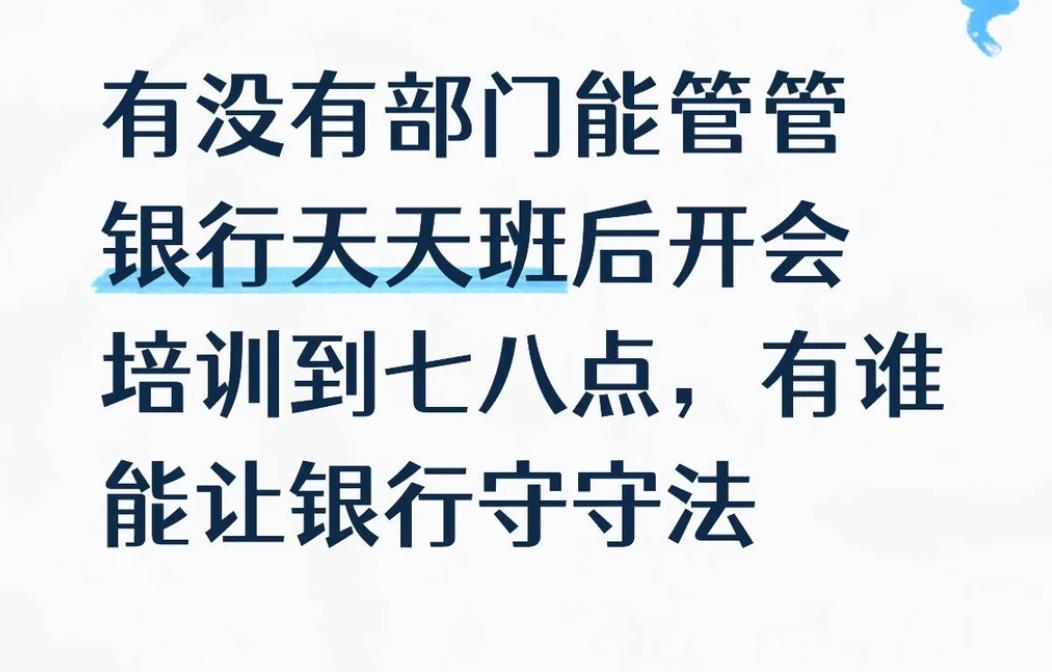
Probably the only thing that can get off work on time is the rolling shutter door of the outlet.
This kind of overtime culture has even been packaged as the core competitiveness of enterprises.
The chairman of China Merchants Bank once claimed at the 2025 performance meeting that the real moat of China Merchants Bank is to internalize "customer-centric" as the corporate culture, and "employees rarely get off work on time" is the proof of that.
Unfinished KPIs, endless work calls, endless overtime, endless salary deductions, this is the other side of the so-called "golden rice bowl" pieced together by countless bank practitioners on social platforms.
The involution-style competition in the financial industry is no longer a secret in the industry.
As early as in the 2025 annual report of the National Audit Office, it was publicly pointed out that some financial enterprises had serious problems of "involution-style competition".
In 2026, the National Administration of Financial Regulation took even tougher measures, issuing special penalties for illegally assigning deposit assessment targets.
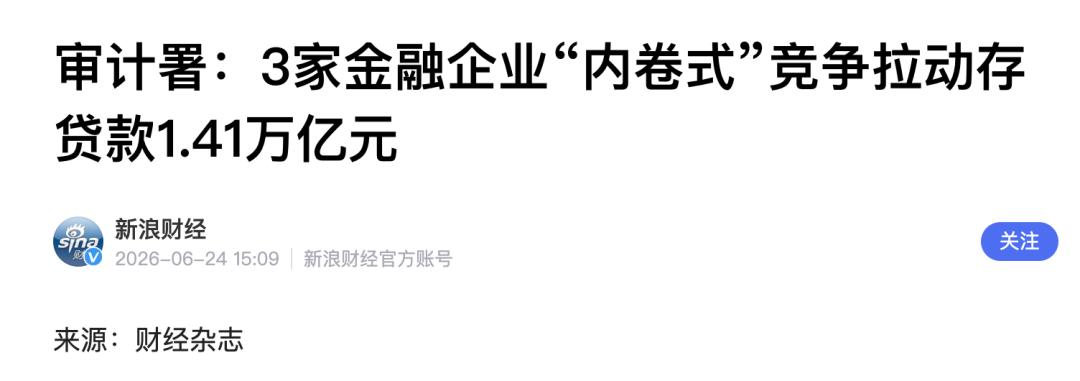
The repeated interventions of the regulators have indirectly confirmed how fierce the involution in this industry is.
Under such a high-pressure environment, this 1.5-hour lunch break pilot of the Enshi Branch was quickly endowed with the symbolic meaning of "anti-involution" by netizens.
But according to the local response, the lunch break is mainly for the consideration of counter risk control — cash business highly relies on concentration, and continuous long-time work not only easily leads to fatigue, but also increases the risk of operational errors.
And at present, this is only an attempt of local outlets in Enshi, not promoted nationwide.
The really interesting part is: most of the netizens participating in the discussion may never go to China Construction Bank's Enshi outlets to handle business, but they still quickly and enthusiastically got involved in this debate.
So why did a lunch break adjustment of a local bank arouse such strong public sentiment?
The answer may not lie in the bank itself.
What really touches everyone's nerve is everyone's anxiety about their own rest time.
03
What Is Truly Scarce Is Never Just This One and a Half Hour
In this noisy and heated debate, there is at least one point that almost no one opposes. That is —