WeChat and Douyin are competing fiercely for the mini-games market.
In recent months, after WeChat increased the exposure of ad placements, the number of mini-game ads has risen significantly.
You can run into a mini-game ad before scrolling through a full page of Moments; when you open an official account article, mini-game ads will pop up repeatedly in the text, at the end of the article, and in the comment section. Coupled with various mini-game mechanisms that reward users for sharing, many primary school classmates you haven't contacted for ages will send you mini-program links every few days.

Screenshot from WeChat Official Account
There are also plenty of mini-game ads on Douyin. Most short videos for mini-games are extremely interesting, but once you take a second look or click in to try it out, you will be continuously pushed with similar ads infinitely later.
In 2026, WeChat and Douyin are once again locked in head-to-head competition on the mini-game track.
The latest data from QuestMobile shows that as of May 2026, the monthly active users of WeChat mini-games have reached 654 million, a year-on-year increase of 32.7%; while the monthly active users of Douyin mini-games have declined slightly, they still remain at around 100 million.
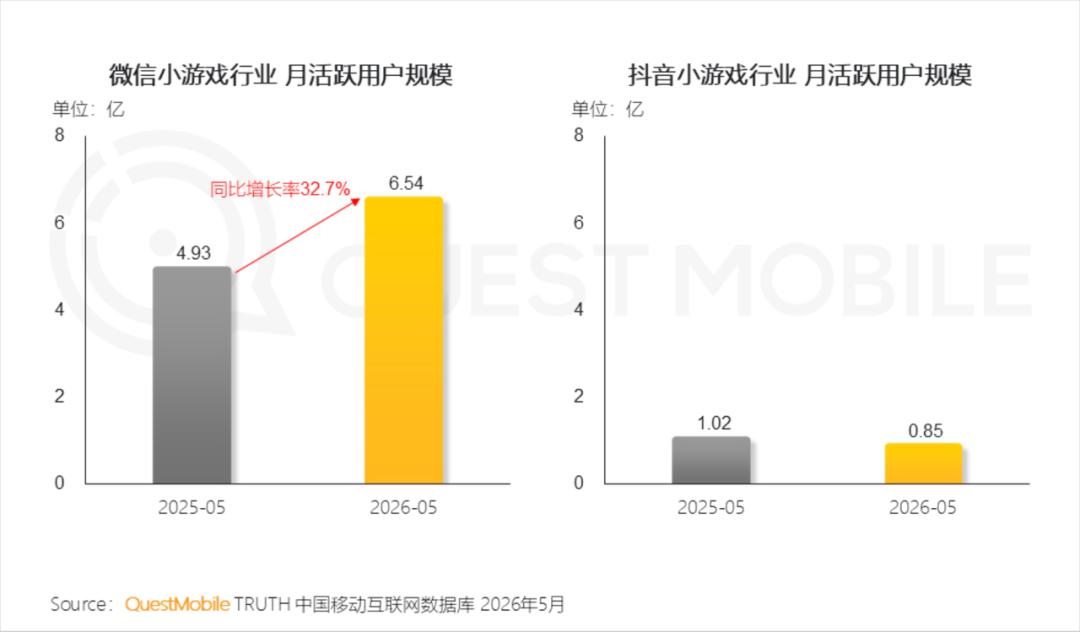
Data source: QuestMobile
Why is the overall game market weakening while mini-games continue to grow? What are the differences between the competitive logic of mini-games for WeChat and Douyin? Let's find out together with "TopKlout"!
01
The overall game market lacks blockbuster hits
Mini-games have become the only gold mine
To understand why WeChat and Douyin are not giving an inch on mini-games, we need to look at a larger background: Mini-games have been the track with the highest net added value in the game industry for several consecutive years.
The "2026 Jan-Jun China Game Industry Report" released by the Game Publishing Committee of the China Audio-Video and Digital Publishing Association shows that as of June, the actual sales revenue of the domestic game market reached 1884.5 billion yuan, a year-on-year increase of 12.17%. Among them, the revenue of the mini-program mobile game market was 316.57 billion yuan, a year-on-year increase of 36.01%, far higher than the overall market data.
Even the superstar Jay Chou endorsed the mini-game "Eternal Blue Planet" this year. There has seemingly never been a celebrity of this level endorsing a mini-game before, which fully demonstrates how lucrative and hot this market is.

Data source: The login page of "Eternal Blue Planet"
Why is the overall market growth slowing down while mini-games remain hot? From the perspective of "TopKlout", the main reasons are as follows:
First, the public's time is increasingly fragmented
The times have changed, and users' habits have also changed. Think about our lives today, aren't they cut into pieces by countless trivial matters?
Time spent on the subway or bus to work, waiting for meals or coffee, slacking off at work, relaxing before going to bed... These time slots are not long enough to start a round of "Honor of Kings", but are perfect for a mini-game, as one round only takes a minute or two, and even leaving the game idle will not affect the gaming experience.
Second, traditional high-quality mobile games have encountered severe bottlenecks
In the past few years, the game industry has been advocating high-quality development. Embarrassingly, the high-quality development trend has not produced a large number of new national-level products. The games our colleagues around us talk about and play are still "Honor of Kings" and "Peacekeeper Elite". How many years have these "old" games dominated the market?
There have been challengers during this period, such as "Eggy Party" and "Delta Action", but almost none of them can reach the same level in the three dimensions of user scale, social influence and commercial returns.
Mini-games just fill the gap in this window period. They have low decision-making costs, no need to download installation packages, you can play immediately after clicking, and quit right away when you are done. Their lightweight feature precisely fits contemporary users' content consumption habits of fragmentation, low decision-making cost and high frequency.
Third, the AI era has rewritten the cost logic of game production
In the past, a traditional mobile game often required a team of hundreds of people, several years of time, and hundreds of millions of funds; now AI has greatly reduced all these costs. Many developers can develop a mini-game in just ten days with the help of AI, at a cost of only 10,000 to 20,000 yuan, and it can quickly make profits after launch as long as the operation is proper.
When the threshold of game production is infinitely lowered and the trial-and-error cost is close to zero, the heavy asset model of traditional large games is completely left behind by mini-games in terms of efficiency. It is not so much that mini-games are too strong, but that traditional games are too slow.
Similarly, for platforms, mini-games are not only traffic consumers, but also traffic value amplifiers. Watching video ads to get rewards, buying props in games, various brand placements, mini-games have a short commercialization chain, fast closed loop, and extremely high ROI.
In addition, the time each user spends scrolling through WeChat and Douyin is fixed. If they can be encouraged to watch a few more ads and play a few more games during this period, the commercial value of a single user can be further increased.
Based on the above reasons, it is inevitable that WeChat and Douyin are competing for mini-games. What they are competing for is not just a type of game, but also one of the few incremental opportunities in the stock era.
02
WeChat and Douyin
One track, two sets of logic
However, facing the same gold mine, WeChat and Douyin have completely different ways of mining.
WeChat's logic is acquaintance social fission.
Owning a social relationship chain of 1.4 billion users is WeChat's most core and most irreplicable barrier. Therefore, WeChat mini-games are parasitic in high-frequency social scenarios such as chats, groups, Moments, and official accounts.
The 2026 WeChat Open Class Pro disclosed that 30% to 50% of new users of mini-games come from social fission, and some products even reach 80%.
Of course, if the fission is only limited to friends who play games together, it is not that bad. The more troublesome thing is that there are always "acquaintances" who haven't been in touch for many years suddenly popping up, sending you a game link and saying "it's super fun".
At this point, will you click it? They send it every two days, won't you get annoyed? There is really no other way except to mute the message notification.
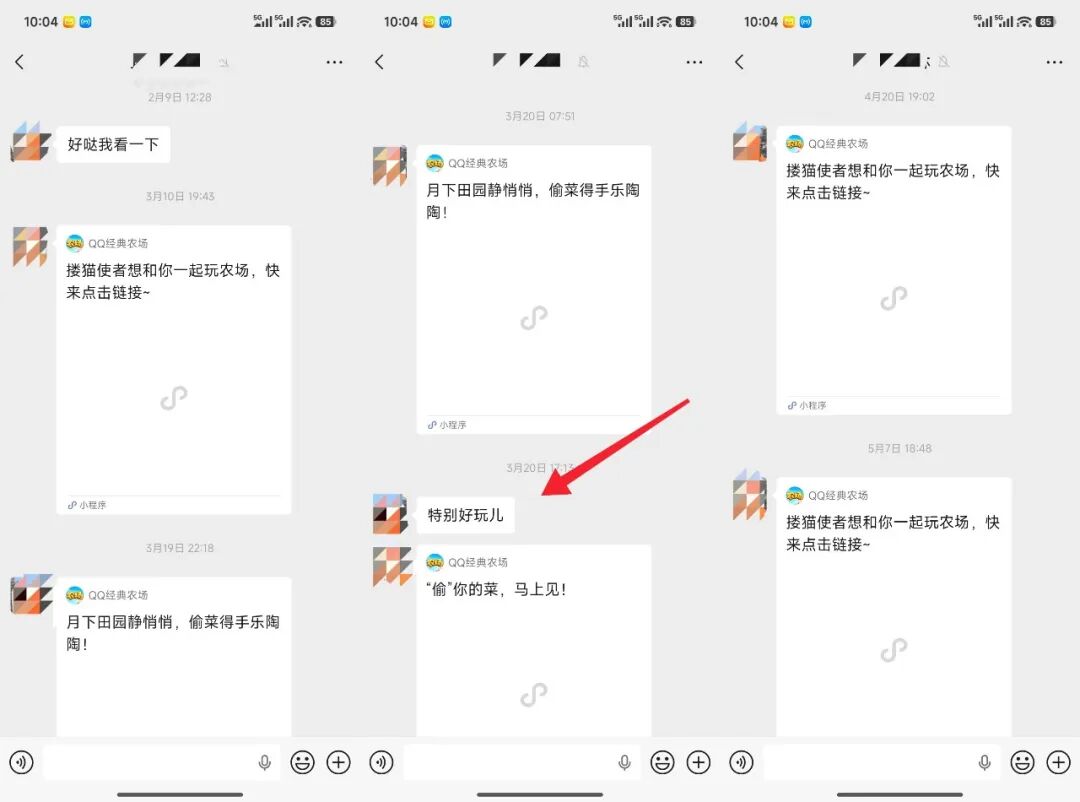
Screenshot from the author's WeChat
Douyin's logic is interest-based content marketing.
Douyin relies less on social relationships and more on algorithm recommendation. An eye-catching short video showing the highlights of a mini-game, paired with a plot that you can never clear the level, can easily arouse people's desire to click. For this reason, the monthly active users of Douyin mini-games once hit 171 million in 2025, with both revenue and activity doubling, and its momentum even surpassed WeChat.
However, Douyin also has many annoying points. For example, the short videos of mini-games are often shot very well, but nine out of ten games you click in are inconsistent with the promotional content. You will also be pushed with infinite mini-game ads just because you clicked such a video, which is extremely disturbing.
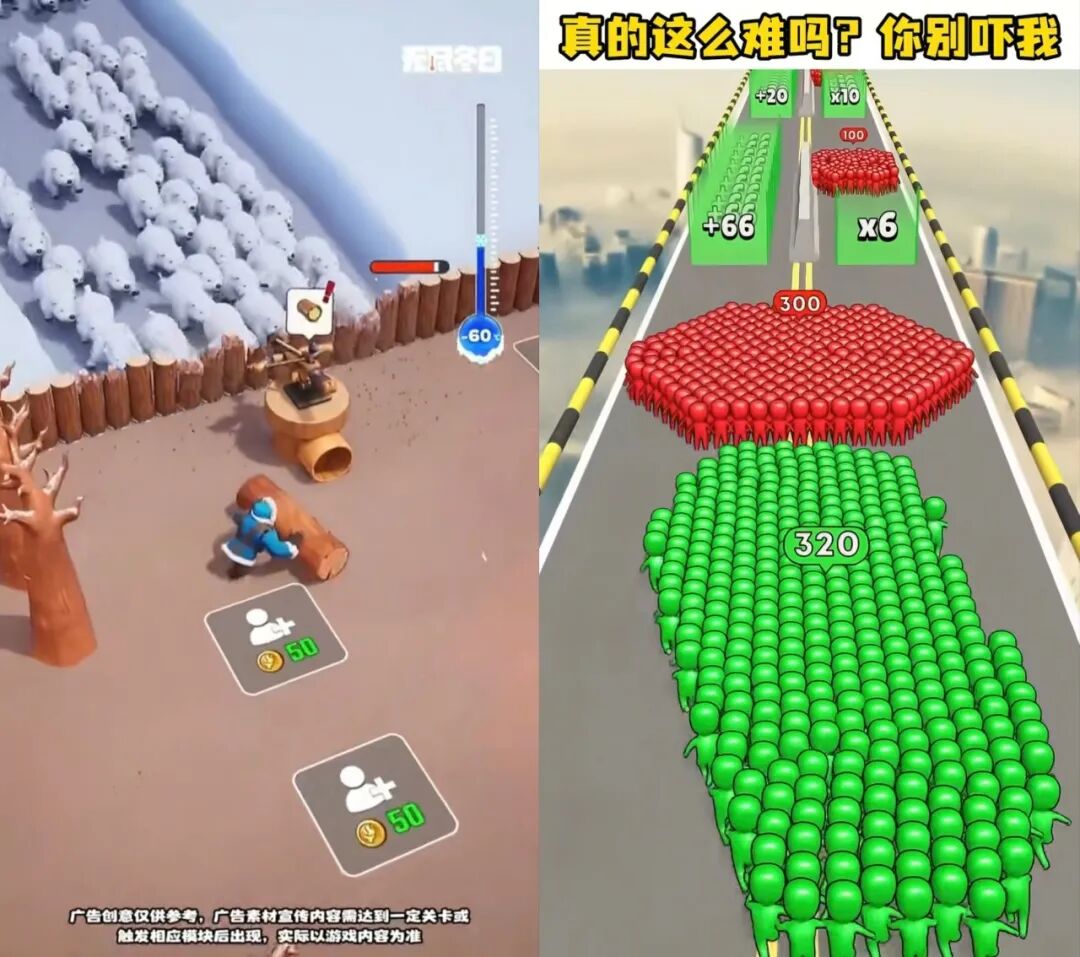
Many people must have come across this kind of mini-game ads
Because I have been tricked many times, wasted several first top-ups and many hours, I have developed a habit now - click "Not Interested" directly when seeing such ads, to reduce the frequency of algorithm recommendation as much as possible, so as not to be tempted again.
Overall, WeChat has the depth of the social chain, and Douyin has the sharpness of the algorithm. Each has its own hole card, and each has its own weakness.
WeChat is afraid that the social relationship will be over-consumed, and eventually even friends will no longer want to share or click; Douyin is afraid of the inconsistency between the promotional content and the actual game, which will make its reputation worse and worse, so that users will swipe away as soon as they see such ads. Both methods have their own shortcomings, but because mini-games perfectly fit the "human weaknesses" of the current era, the results are still direct and effective.
03
Conclusion
WeChat has raised the number of mini-game ad entrants and the proportion of ad placement in Moments and Official Accounts, which means the defender has shifted from waiting for customers to taking the initiative to attract users. It does not want Douyin to completely take away the "play immediately after clicking" user mindset.
Douyin continues to leverage its advantage of the content marketing engine, trying to tear a hole in WeChat's social barrier. Even though the monthly active user data in May 2026 has declined, its offensive posture has never been relaxed.
This article is from the WeChat Official Account "TopKlout" (ID: TopKlout), author: Xiao Song, published with authorization from 36Kr.