A-Share Valuation Ranking: Rebalancing in Progress

Entering the second half of July, the months-long broad-based rally in the A-share market began to show signs of loosening. The index fluctuated at high levels, sector rotation accelerated, the market swung back and forth between rises and falls, and investors' concerns about "whether the rally is over" gradually heated up.
But we tend to believe that this is not an ordinary technical correction, but the start of a round of capital rebalancing.
It must be stated in advance that the rebalancing of the capital market, in our view, is by no means a pessimistic take on the prospects of technological innovation, nor is it an advocacy of the bubble theory.
To borrow a classic statement from Carlota Perez in *Technological Revolutions and Financial Capital*: Every systemic transformation driven by technological revolution does not rise linearly, but unfolds in a cycle of financial prosperity and institutional restructuring.
In the deployment period, financial capital takes the lead and pushes the outbreak of new technologies; but investment mania and institutional lag will inevitably lead to crises. Subsequently, in the deployment period, social systems and corporate assets are matched with new technologies, productive capital regains the dominant position, and the economy enters a relatively stable and prosperous "Golden Age".
From the perspective of valuation, the A-share market may be about to stand at the node of this cycle.
01
Valuation divergence is already quite obvious
As usual, we unify the caliber first: we counted the data of all A-shares (excluding the Beijing Stock Exchange), all data are from the WIND client and the 12-month data pushed back from the latest quarterly financial report of enterprises, unless otherwise specified, the unit is 100 million yuan.
In the past year, A-share investors have had divided experiences. Some people's accounts have doubled, while others have lost more money as they added positions. This difference is not a matter of luck, but the structural dislocation between sectors is widening.
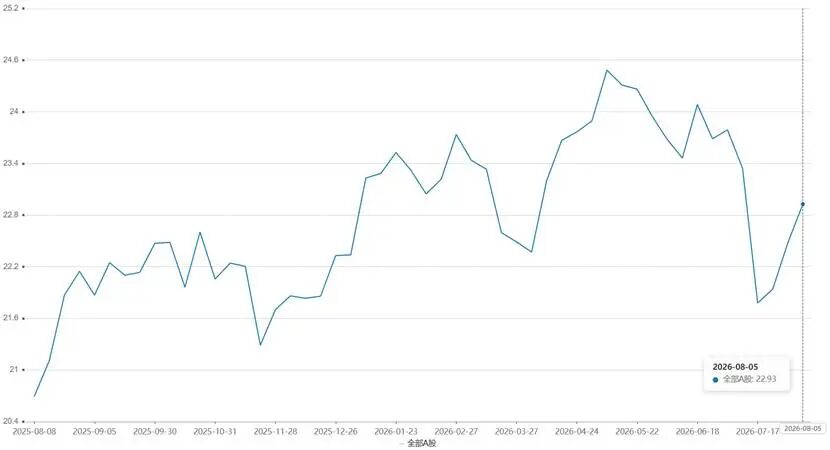
Let's first look at the overall valuation level of the A-share market after the annual report season. As of August 5, the Shanghai Composite Index was around 3880 points, down 320 points from the annual report period, and the overall valuation level also fell, the valuation was around 24x during this year's annual report period, while the latest valuation is about 22x.
Although there has been a pullback, the overall PE quantile is still not low: the quantile of Wind All A is currently around 82%, the Shanghai Composite Index is 90%, the Shenzhen Component Index is 95%, and the CSI 300 is 85%, only the ChiNext Index, which hit an absolute high in 2020, has a quantile of around 58%.
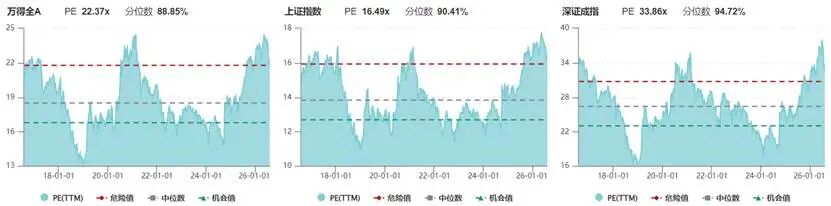
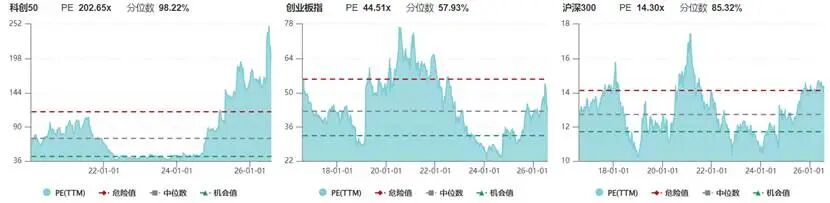
If only looking at the quantile, the A-share market seems to be in a booming bull market where everyone is enjoying gains, but the actual situation is not the case.
Looking at the longer cycle, from the same period three years ago to the high point on July 10 this year, the cumulative valuation growth of the Sci-Tech Innovation Board (STAR Market) is 252%, the overall valuation of the ChiNext Board has increased by 90%, Shenzhen A-shares by 77%, while Shanghai A-shares have only increased by 37%.
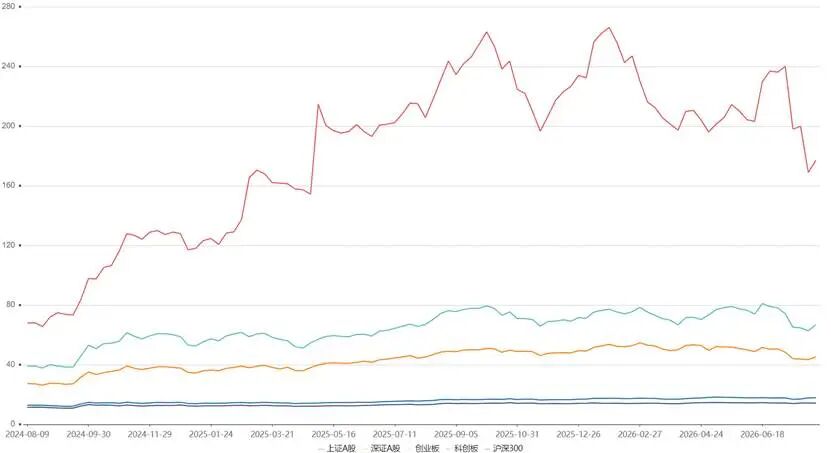
It is obvious that investors in different sectors have had very different experiences in the past three years. Therefore, in the past month, the valuation levels of different sectors have experienced a small-scale rebalancing: the overall valuation of Shenzhen A-shares has dropped by 6%, the ChiNext Board by 10%, the Sci-Tech Innovation Board by 26%, while the valuation of Shanghai A-shares has increased by 1% instead.
Of course, this level of rebalancing is far from enough to make up for the difference in investment experience, which is also the fact. We counted the net inflow of single large orders in Shanghai, Shenzhen, ChiNext and Sci-Tech Innovation Board in the past year (due to factors such as restricted share lifting and cash out, the net inflow of large orders is often negative).
It can be clearly seen that compared with Shanghai and Shenzhen, main funds have a significantly higher preference for the Sci-Tech Innovation Board, with less net outflow, while retail net inflows are basically concentrated in Shanghai, Shenzhen and ChiNext, and the capital of the Sci-Tech Innovation Board also shows a net outflow state.
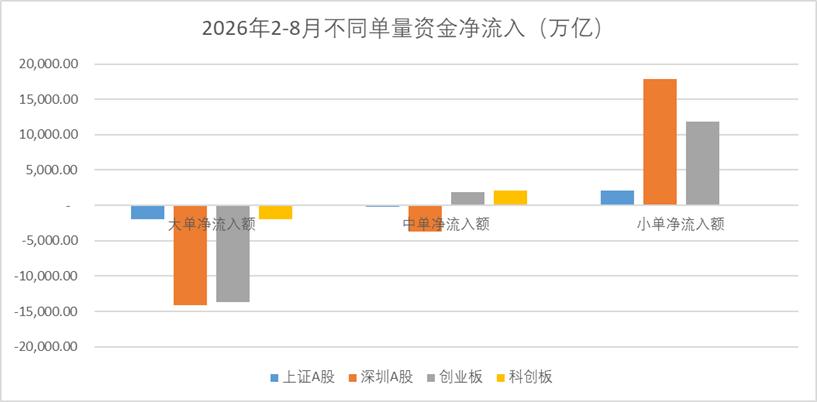
The root cause of the poor experience of some investors lies in the differentiation of capital structure. Main funds are gathered in a few high-growth sectors, pushing up local valuations and widening the temperature difference between sectors. Retail funds, on the other hand, are mostly concentrated in value-oriented enterprises, failing to enjoy the dividend of valuation expansion, but instead bearing the pressure of capital siphoning, and continuously losing blood in the stock game.
02
Rebalancing momentum is gathering
Ray Dalio, founder of Bridgewater Associates, made a straightforward judgment on the current market pattern in a public interview in June 2026: "The market is highly concentrated in AI tech stocks, and history and mathematics have both proved that diversification is always better than concentrated betting".
Dalio is not the only investor who holds this view. The legendary investor John Templeton has a more extreme statement: "The only investors who don't need to diversify are those who are 100% right". Templeton also has a sentence worth chewing over and over again: "The growth of world prosperity will be made greater by our ability to invest in each other's progress".
When capital is compressed into a few themes, the fragility of the entire market will be amplified.
The rational prosperity of the capital market has never been separated from the support of fundamentals. Back to the A-share market, from three major trends, we can clearly see the necessity of A-share rebalancing in the next stage:
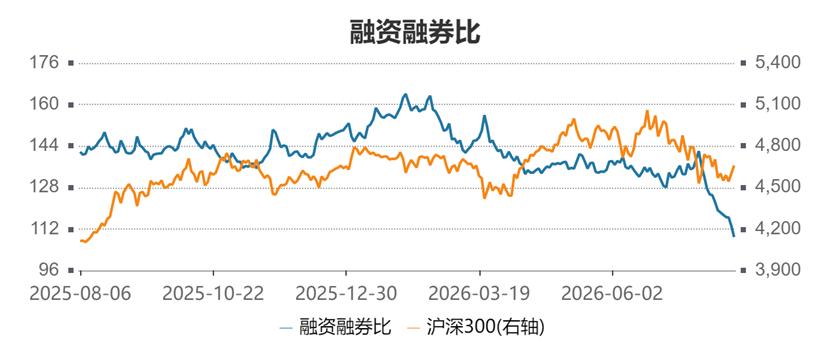
1) Capital risk aversion is intensifying, and the margin trading ratio is declining rapidly
According to Wind data, the current margin trading ratio of the Shanghai and Shenzhen stock exchanges has dropped very significantly compared with the same period last year and the beginning of this year. Although it has not yet approached the boom-bust watershed, the sentiment of absolute bulls in the market has clearly weakened.
From the perspective of full-market fund position adjustment and risk appetite, since late July, the weight of large-cap portfolios has soared, while small and mid-cap portfolios have declined rapidly. At the same time, from the perspective of fund divergence on future market trends, the divergence has also dropped significantly in mid-to-late July.
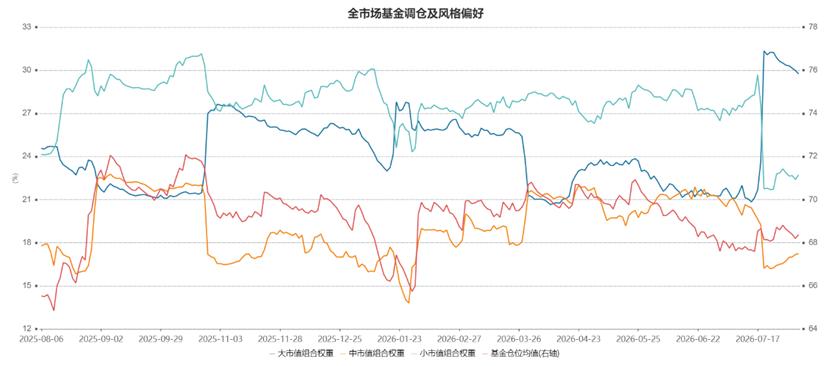
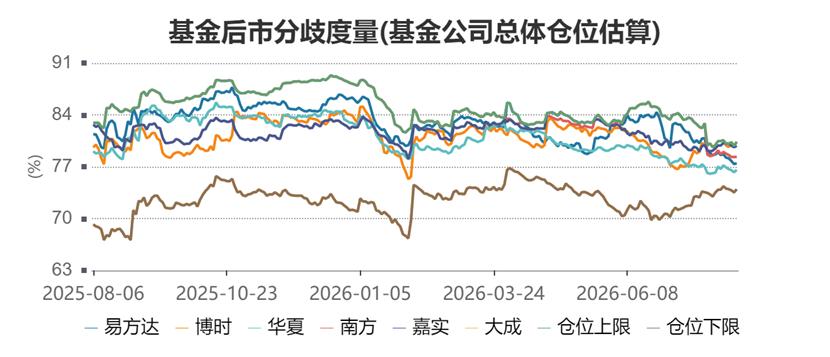
It is obvious that the current main positions are quietly shifting from growth investment to value investment, risk aversion is gradually increasing, and the overall degree of divergence is slowing down. From the perspective of large capital, this round of rebalancing has just begun.
2) Although the valuation percentiles are all at high levels, the growth of traditional sectors has not received reasonable consideration
In addition to large capital positions, as we mentioned earlier, the market prosperity in the past year has not brought reasonable capital consideration to value-oriented enterprises, and the valuation difference between different sectors is widening.
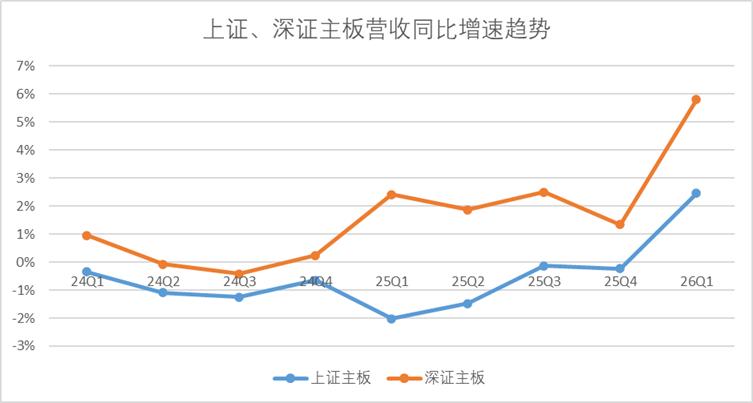
However, from the fundamental point of view, with the continuous deepening of supply-side reform this year, the performance of main board listed enterprises has been improved in all aspects. In terms of revenue scale, the growth rates of the Shanghai Main Board and Shenzhen Main Board in the first quarter of this year reached 5.8% and 2.5% respectively, completely getting rid of the negative growth in 2024, and the growth rate has rebounded significantly.
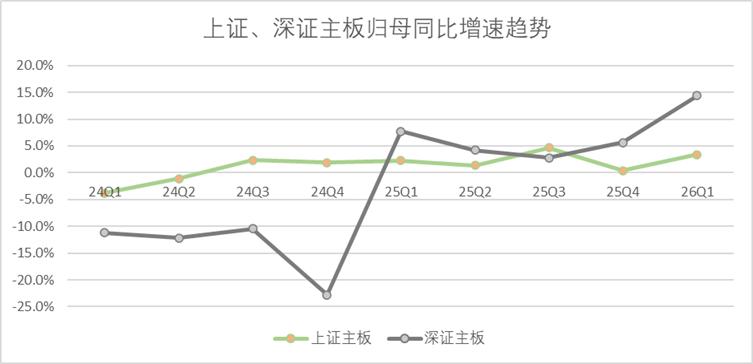
And from the profit caliber, the marginal profit space of value-oriented enterprises is also gradually expanding. From the perspective of attributable net profit, the attributable net profit growth rate of the Shanghai Main Board in the first quarter of this year reached 3.4%, an increase of 300bp over the end of last year, and the Shenzhen Main Board even reached 14.4%.
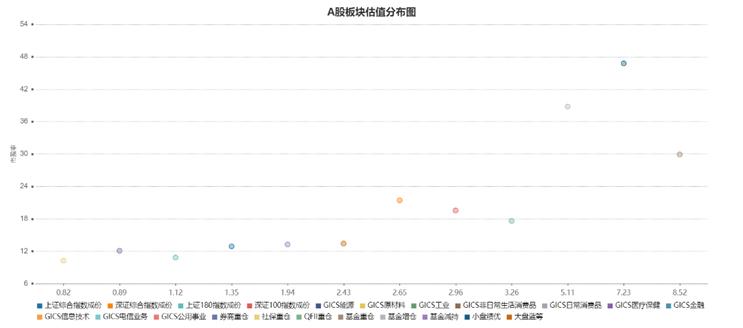
Therefore, supported by fundamentals, although the Shanghai Main Board and Shenzhen Main Board have also experienced a small increase in valuation since the beginning of this year, when horizontally comparing the valuation levels of various A-share sectors, the main board market is still the most cost-effective risk-resistant harbor at this stage.
3) The operating quality of main board enterprises has also improved
For main board enterprises since the beginning of this year, it is not only the improvement of revenue scale and attributable net profit, but also the operating level and earnings quality that have performed well if you look closely.
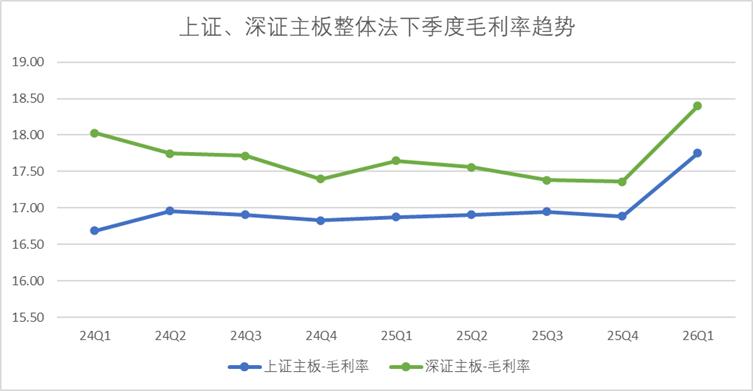
With the continuous promotion of anti-involution and anti-monopoly, the gross profit margin of sales of enterprises on the Shanghai Main Board and Shenzhen Main Board has increased significantly month-on-month compared with the fourth quarter of last year. In the first quarter of this year, the gross profit margin of sales of the Shanghai Main Board under the overall method reached 17.8%; while the gross profit margin of sales of the Shenzhen Main Board reached 18.4%.
In addition, the inventory clearance cycle is gradually coming to an end. The inventory turnover days of Shanghai Main Board enterprises dropped from 99.5 days in Q1 2024 to 94.1 days in Q1 this year, while the inventory turnover days of Shenzhen Main Board enterprises dropped from 139.2 days to 109.7 days, and the pressure on the supply side has also been released.
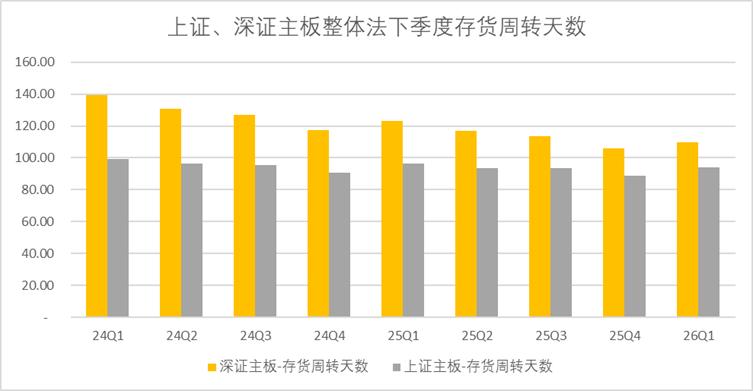
Benefiting from the overall optimization of asset quality, revenue scale and turnover level, on the whole, the ROE levels of the Shanghai Main Board and Shenzhen Main Board have returned to a relatively high level.
