Qianwen App: Can charging for advanced features break through the internal and external predicaments
In the second half of the year, the AI application market is less overheated and more pragmatic than that in the first half.
On August 7, the Qwen App received a major update, with new features including office assistant, in-depth research and scheduled tasks launched, and the access permission for the flagship Qwen3.8-Max model was also opened to users.
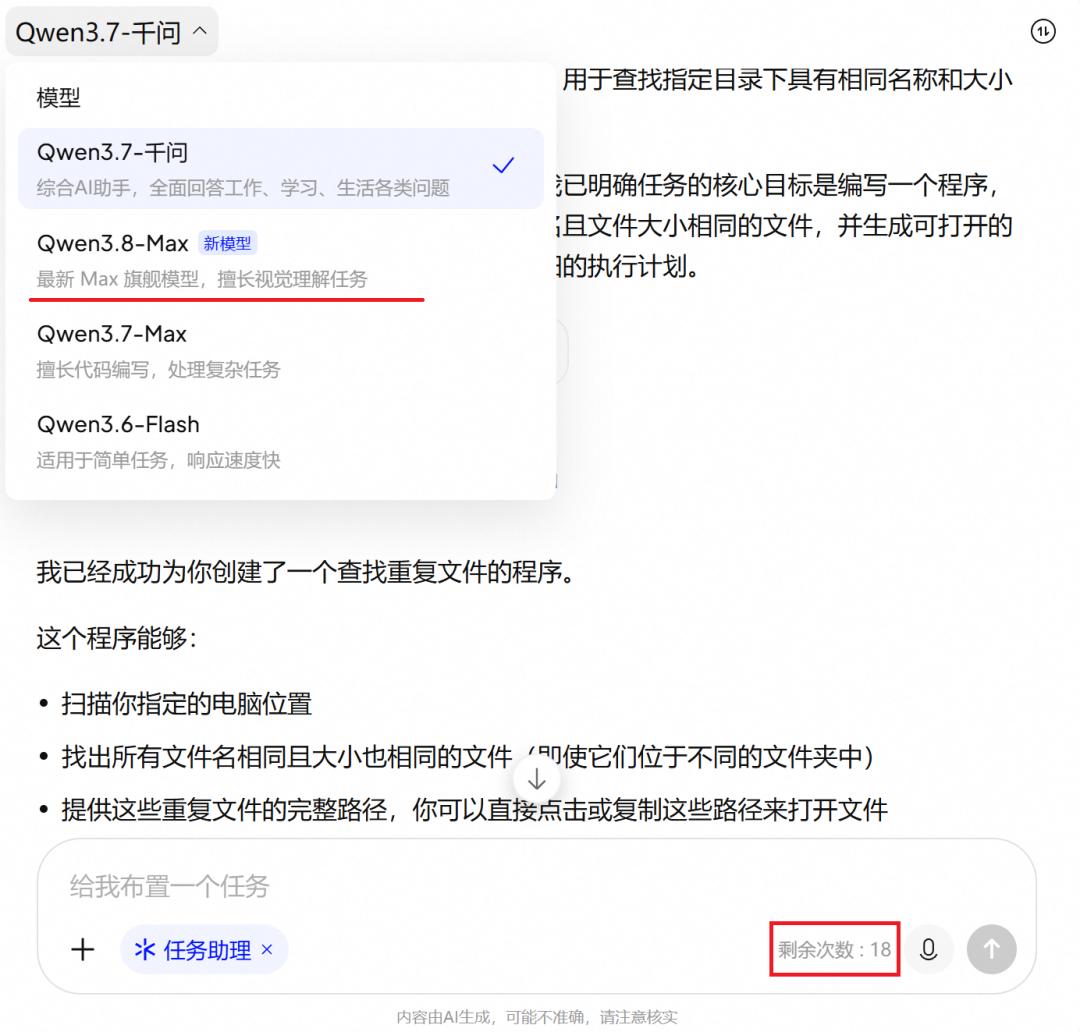
(Free usage limits for Qwen3.8-Max access permissions and advanced features on Qwen App, Source: Qwen)
Of course, this update also marks Qwen's first clear signal of commercialization: basic features will remain free of charge, while advanced capabilities such as the office assistant will have usage quotas, and paid options for additional quotas may be launched in the future.
In the past, major tech players focused their competition on user traffic, aiming to seize the super entry in the AI era. The red envelope wars and "free milk tea" campaigns during this year's Spring Festival carried a distinct legacy of the mobile internet era.
As the second half of the year kicks in, the entire AI industry is also undergoing a collective shift. Doubao took the lead in launching paid subscription plans in June, rolling out three tiers of professional version subscriptions priced from 68 yuan to 500 yuan; Tencent's WorkBuddy soon followed with three tiers of personal packages priced from 99 yuan to 999 yuan.
The common choice of almost all these players points to the office scenario. The reason is simple: the milk tea war once again proves that making money from 2C users is far harder than generating revenue from 2B customers.
It is interesting to note that Qwen Office was officially launched just 4 days earlier, on August 3. Chen Yusen, who is in charge of DingTalk, integrated QoderWork, Wukong and MuleRun to roll out Qwen Office, which is deeply connected with DingTalk and positioned as an enterprise-level AI productivity platform.
Facing the current situation, Wu Jia who leads the Qwen business group may end up telling a story of infighting between products that has played out countless times inside Alibaba.
Mutual Learning Between Rivals
In terms of product performance, the office assistant of Qwen App can be rated as fully competent.
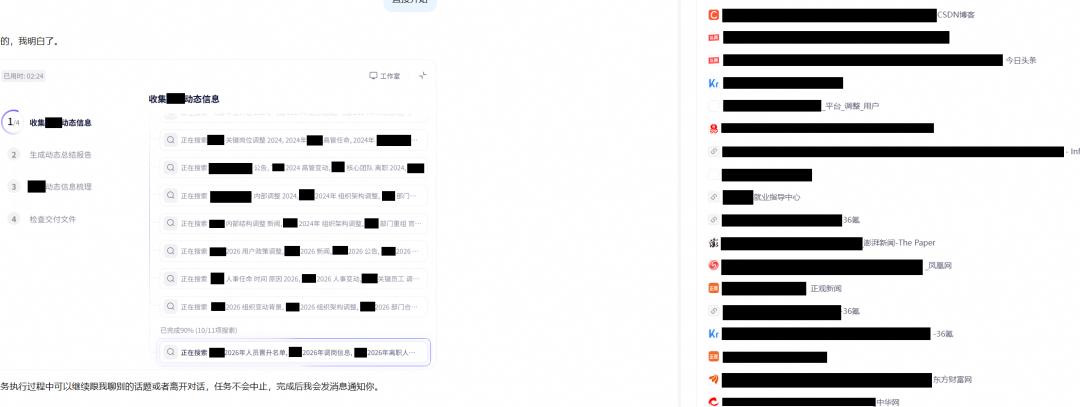
(Source: Qwen)
The author experienced the office assistant function immediately after the update, and the most intuitive feeling is that compared with other free products on the market, this update does make Qwen much more user-friendly.
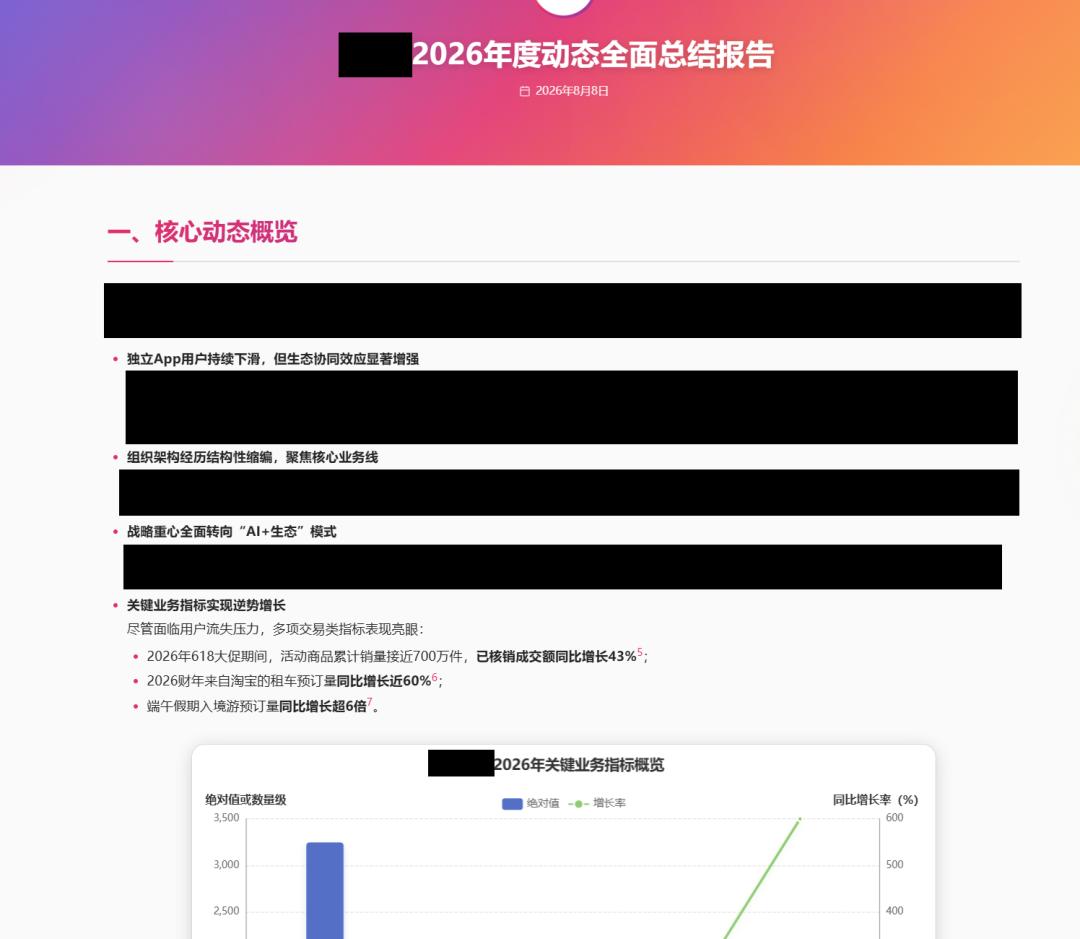
(Source: Qwen generation result)
For example, when the author asked Qwen to collect recent news related to a certain company, the search depth and breadth of Qwen's office assistant outperform most free general AI products. After the search is completed, it will automatically summarize the results and export them as a downloadable Excel spreadsheet.
In terms of enterprise analysis, Qwen's office assistant can generate reports in Html format, which includes key points summarized from extracted news, data statistics tables and key point tables generated by Qwen. The report is neat and elegant in overall layout, with comprehensive coverage of content.
It can be said that this update of the office assistant is another major step forward for Alibaba on the path of making AI truly practical.
Since the beginning of this year, "being able to get things done" has become the core line of Alibaba's AI business. Qwen's goal is to truly become the "world's first AI assistant that can complete complex real-life tasks" as Alibaba previously claimed.
In January 2026, the Qwen App announced full access to Alibaba's ecosystem businesses including Taobao, Alipay, Fliggy and Amap, and launched more than 400 AI service functions. The Qwen App can support operations such as ordering food delivery, hailing a taxi, booking flight tickets and train tickets, which is backed by Alibaba's integrated ecosystem advantage. Beyond Alibaba's ecosystem, the Qwen App has fully opened up access for third-party Agents, with numerous merchants including SF Express, Tianjin Wujia and Shansong joining the platform one after another.
However, competition between AI products does not follow the rule that "good wine needs no bush".
Qwen can order food delivery, and Meituan can do that too; Qwen can book flight tickets, and Ctrip can do that as well; Qwen can hail a taxi with one sentence, and Didi also supports that. Mainstream enterprises have added AI functions to their own apps more or less. From the perspective of consumers, Qwen's only advantage is that it covers almost all the above demands, and the user experience of its AI functions is far better than most enterprises with tight budgets.
But in the office scenario, Alibaba's integration advantage of other ecosystems cannot be easily leveraged. In some specific scenarios such as travel arrangement, the office assistant of Qwen App can cooperate with other Alibaba ecosystem services that have been connected to Qwen App at the current stage. But in most cases, work is work, and demands for food delivery and taxi hailing will only be considered after working hours end.
As a result, the fragmentation of scenarios has led to the "both-and" design. A new scenario switch between "Daily" and "Office" is added to the PC sidebar, giving Qwen two distinct roles: "Life Assistant" and "Office Assistant".
This positioning also shows the trace of Doubao's transformation from a pure C-end product to a professional service provider.
Doubao's dominance in the C-end market is self-evident. Back when Baoyu was at its peak, "search on the internet" became a synonym for "Baidu it"; nowadays, "ask Doubao" is becoming a nationwide linguistic symbol for "ask an AI assistant a question".
However, after gaining huge popularity in the C-end market, Doubao did not stop its pace of expanding into the B-end market. On June 24, Doubao officially announced the launch of Doubao Professional Edition. Professional users can access the office task mode powered by the Doubao 2.1 Pro model, with the standard monthly subscription priced at 68 yuan, and free users can also experience this mode within a certain usage quota.
Both are office modes, Qwen3.8-Max and Doubao 2.1 Pro are the top models of their respective developers, and both charge professional users for services. The development path of Qwen is strikingly similar to that of Doubao.
Interestingly, Feishu carried out an organizational structure adjustment on July 30, where the original Feishu product team and the Doubao team were merged to form a new Doubao product team. Similarly, for the combination of office software and cloud services, Alibaba upgraded DingTalk to a large DingTalk business division on September 27, 2020, for full integration with Alibaba Cloud, to ensure the full implementation of the "Cloud-DingTalk Integration" strategy.
The two tech giants have inadvertently formed a delicate duality in their choice of commercial paths.
For Survival
Of course, the giants' obsession with seizing the super entry of AI has never faded.
This year's Spring Festival, Alibaba, which had just wrapped up the food delivery war, immediately threw itself into another marketing campaign. According to incomplete statistics, all AI products including Yuanbao, Doubao and Qwen spent over 10 billion yuan on marketing around the Spring Festival.
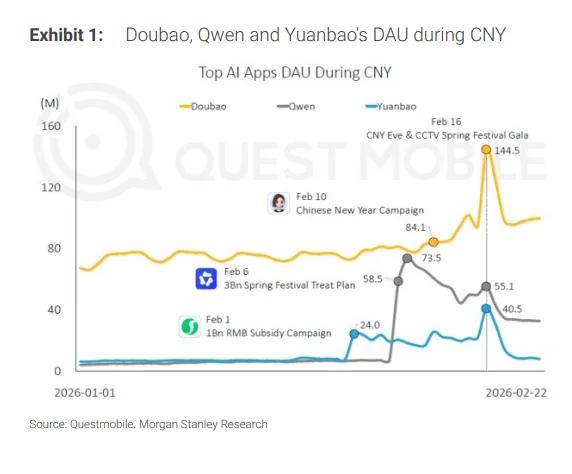
(Source: Morgan Stanley)
The Qwen App invested 3 billion yuan in the campaign, covering free orders ranging from milk tea and fresh produce to grain and oil, setting a new record for the investment in Spring Festival promotional activities. According to official statistics of Qwen, 9 hours after the campaign was launched, the number of milk tea orders exceeded 10 million, and the daily active users of Qwen App skyrocketed from the usual 7.06 million to a peak of 73.52 million.
However, the good times did not last long, and Qwen App failed to maintain its previous strong momentum.
Morgan Stanley pointed out in its report that the average daily usage duration per user of Qwen dropped sharply from 6.3 minutes before the campaign to less than 5 minutes. Among all periods, the average daily usage duration per user from February 16 to 22 hit a historical low of 3 minutes.
Morgan Stanley believes that this data shows that the traffic of Qwen App during the Spring Festival was highly concentrated on transaction behaviors such as placing orders and receiving coupons, with extremely short user stay time, which is a typical "transactional, low-duration" usage pattern.
During the college entrance examination season in June, Qwen App launched another campaign of free AI college application consultation. According to Qwen's data, as of July 8, more than 40 million users in total consulted Qwen about college application related questions, and 23 million free AI college application reports were claimed in total.
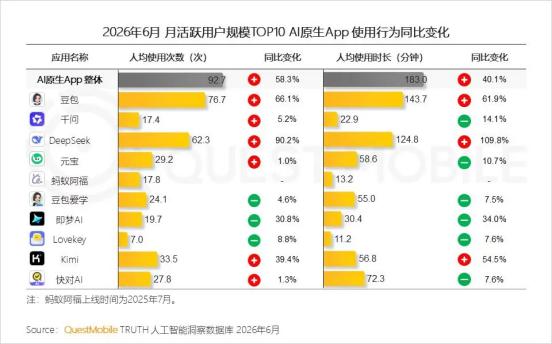
(Source: QuestMobile)
However, the result shows that among the Top 10 apps by monthly active user size counted by QuestMobile in June 2026, the average usage times per user and the average usage duration per user of Qwen App are 17.4 times and 22.9 minutes respectively, far lower than 76.7 times and 143.7 minutes of Doubao, and 29.2 times and 58.6 minutes of Yuanbao; even lower than that of players that did not participate in the Spring Festival campaign such as Dream AI, KuaiDui AI and Ant A Fu.
The current situation of Qwen App is that a huge amount of capital has been burned, the product is well received by some users but cannot achieve satisfactory commercial performance, and the external pressure has not been reduced at all.
Therefore, for Qwen App, adding new office functions and trying paid services this time is not only a step to keep up with the industry trend and explore commercialization, but also a struggle for survival.
Because a bigger threat has emerged inside Alibaba.
On August 3, Qwen Office officially entered public beta. Although it is named after Qwen, Qwen Office belongs to the Wukong Business Division and DingTalk system, which is on a different organizational line from the C-end Qwen App.
The backstory of Qwen Office is even more interesting.
Qwen Office is a product built by Chen Yusen after he took charge of DingTalk by integrating QoderWork, Wukong and MuleRun, and these three product lines have their own distinct backgrounds. Wukong is an enterprise-level AI native working platform incubated by Wuzhao during his tenure to realize the integration of AI into DingTalk. Wuzhao once hoped that Wukong could deeply integrate AI capabilities into enterprise workflows, so as to connect all enterprise scenarios.
MuleRun is a personal cloud AI agent platform incubated internally by Chen Yusen when he was still working at Alibaba Cloud. With the features of zero deployment, available directly after opening the browser, 7*24 hours online and self-evolution, MuleRun is very popular in overseas markets, and its registered users had exceeded 500,000 as early as November 2025.
QoderWork is a desktop Agent product developed by Alibaba's AI programming tool Qoder to expand its business to the office scenario. The Qoder product line it belongs to was led by Ding Yu, one of the founders of Alibaba Cloud native technology system and vice president of ATH. QoderWork ranks first in terms of user data within the Alibaba Group.
Therefore, from a technical perspective, QoderWork, MuleRun, Wukong and DingTalk respectively provide Qwen Office with technical foundation, personal and enterprise-level AI agent capabilities, and a huge user base.
From a personnel perspective, this cooperation reveals a distinct implication: recognition from top executives, placement of trusted core personnel, and takeover of original teams and resources.
It can be said that Qwen Office has obtained the best possible resources that any product can get within Alibaba at the current stage.
Then the pressure falls back on the Qwen App.
Alibaba does not reject loss-making businesses, but it will not be tied down by sunk costs. The Qwen App used to be the favorite of the group and the jewel in the palm of Alibaba. However, many products that have received huge investment of capital and manpower, and even have achieved mature commercial performance, such as YiGuo Fresh, Lingxi Games, Kaola Haigou and Koubei which was founded four years earlier than Meituan, were either cut off or marginalized by Alibaba. It can be said that no product is absolutely safe within the Alibaba system.
Therefore, Qwen App has no choice but to take this step of commercialization.
But this is only the first step of a long march. Solving the problem of whether to charge users does not automatically mean that the revenue target will be achieved.
By contrast, Qwen Office is born with enterprise-level genes, and scenarios ranging from programming and document processing to workflow all have strong willingness to pay and high customer stickiness. More importantly, DingTalk's years of accumulation have screened out a large number of customers who have already paid for services and are willing to make repurchases.
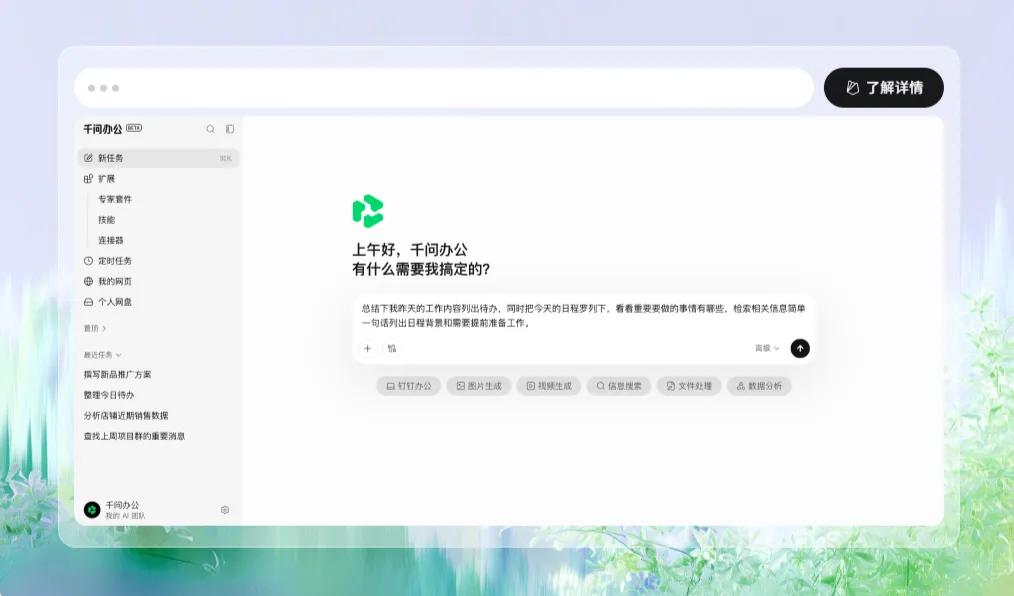
(Source: Qwen Office official website)
In comparison, the C-end users of Qwen App have low willingness to pay, scattered usage scenarios, and there is no support from a team similar to Alibaba Cloud's To B sales system. But the advantage is that Qwen Office is too much like a pure enterprise-level product, while the office assistant of Qwen App is more suitable for lightweight office demands of small companies and single PC users.
This may be the biggest balance Alibaba has made between the two products at present.
But the problem is that the end point of AI office is unlikely to be as simple as a clear division between an enterprise version and a personal version.
In the future, whether it is individual users or enterprise users, the competition may focus on the same entry: who can become the first AI that users think of when they need to complete a task. This also means that the competition between Qwen App and Qwen Office will eventually lead to head-on conflicts in internal resource allocation.
In the past few years, many similar stories have taken place inside Alibaba.
For a huge organization like