Cambricon: Posted a staggering profit of 2.3 billion yuan in the first half of the year, with delivery performance as the core focus in the second half of the year.
Cambricon is arguably one of the most widely discussed companies on the A-share market in the past two years. Before 2024, the market focused on whether it could turn a profit. After it recorded its first single-quarter profit in Q4 2024 and its share price kept rising, the debate shifted to its growth rate and market capitalization. The 2026 semi-annual report released on the evening of August 7 is worth interpreting against these two core questions.
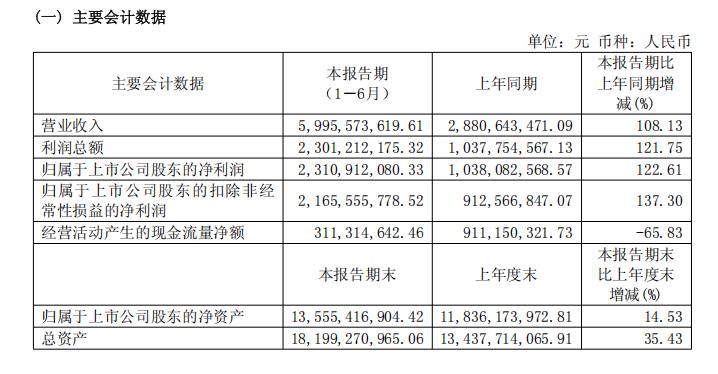
Let's start with the first question. Its revenue in the first half of the year reached 6 billion yuan, up 108% year on year. The net profit attributable to shareholders was 2.31 billion yuan, up 123% year on year, marking seven consecutive quarters of profitability. Profits are mostly generated from its main business, with the growth rate of non-recurring profit deducted net profit (137%) higher than that of net profit attributable to shareholders (123%), while government subsidies (91.72 million yuan) only account for 4% of the total profit. There is no longer any dispute over whether the company can make a profit based on this financial report.
Source / 2026 Semi-Annual Report of Cambricon
The second question is far more complicated. On the day the financial report was released, Cambricon's share price closed at 1199.9 yuan, with a market capitalization of about 754 billion yuan, up 30% since the start of the year. However, after its market capitalization first exceeded 1 trillion yuan on June 30, the share price fell by a quarter.
The high level of attention Cambricon receives is directly related to the industry background. After the supply of NVIDIA's high-end chips to China was restricted, the computing power procurement of domestic large internet companies required domestic suppliers. There are very few companies on the A-share market that can directly meet this demand, and Cambricon, which focuses all its main business on AI chips and takes the lead in revenue, is one of them.
Nearly all of its revenue in the first half of the year came from cloud data center chips. Since 2024, the surge in procurement from the financial and internet industries has been the main driver of its revenue growth. Profit growth mainly comes from diluting expenses through scale effect. The total of three expenses in the first half of the year was just over 100 million yuan, while revenue doubled.
There are relatively big changes on the balance sheet, inventory increased by 3.75 billion yuan in Q2 alone, reaching 8.25 billion yuan at the end of the period, exceeding the total revenue of the first half of the year.
However, on a quarterly basis, revenue in Q2 was only 7.8% higher than that in Q1, while the company converted 3.75 billion yuan into inventory in the same quarter. At present, the key point for evaluating Cambricon, in addition to its profit, is whether the stock it has prepared can be converted into revenue as planned.
01. 6 Billion Yuan in Revenue, Expense Ratio Less Than 2%
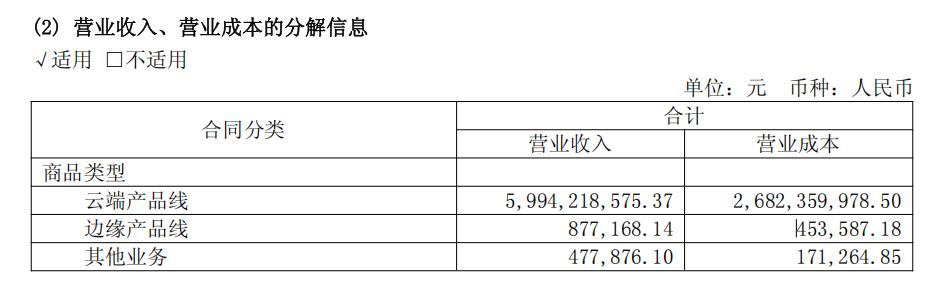
Cambricon's business was previously divided into three product lines: cloud, edge, IP licensing and software. In the actual revenue of the first half of 2026, the cloud product line accounts for more than 99.9% of the total, and the edge product line only generated 877,000 yuan in revenue. The IP licensing and software business, which recorded 2.29 million yuan in revenue in the 2025 annual report, no longer appears in the revenue classification table of this semi-annual report.
Source / 2026 Semi-Annual Report of Cambricon
IP licensing was the founding business of Cambricon. In 2017, Huawei's Kirin 970 chip adopted the Cambricon 1A processor, and IP licensing once accounted for more than 90% of the company's revenue. After terminating cooperation with Huawei, the company mainly relied on smart computing cluster projects from the government and state-owned enterprises to maintain revenue, and this stage lasted until 2023. Starting from 2024, the computing power procurement of large internet companies surged, and cloud chips became the absolute main revenue driver. After several such strategic shifts, Cambricon has become a single-product-line company. The advantage is that resources are highly concentrated, but the company's performance is also almost entirely determined by this single cloud business line.
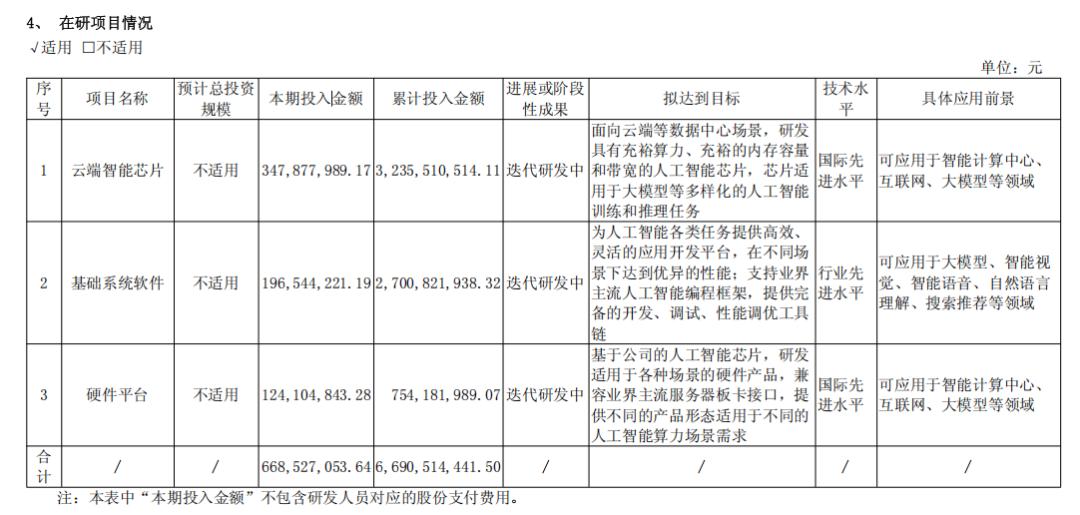
What Cambricon delivers to customers is not only chip hardware, but also a complete set of self-developed software that enables the chips to operate. This business line is referred to as the basic system software platform in the financial report. The in-development project table shows that its cumulative investment in this area has reached 2.7 billion yuan, equivalent to 85% of the cumulative 3.24 billion yuan investment in cloud chips. The instruction set, compiler and operator library are all independently developed. The company chooses not to rely on CUDA and builds its own ecosystem, which represents substantial costs.
At present, mainstream domestic models including GLM, DeepSeek, Qwen, Kimi and MiniMax have completed adaptation to its products, and DeepSeek's new model can be deployed on the day of its release. The financial report mentions that during the reporting period, the company "realized scenario expansion of large-scale training technology". Previously, the market's perception of Cambricon mainly focused on the inference scenario, and the large-scale implementation in the training scenario means it has started to expand from the inference market to the training market.
Source / 2026 Semi-Annual Report of Cambricon
Apart from revenue, let's look at profit. The gross profit margin in the first half of the year was 55.3%, basically flat with the same period last year. The improvement in profit margin is driven by expenses. The total of three expenses reached 110 million yuan, accounting for only 1.9% of revenue.
Excluding share-based payment, the total of sales expenses and management expenses is about 98 million yuan, basically flat with the same period last year. During the same period, revenue doubled, so sales expenses decreased by 6.7% year on year, and management expenses decreased by 15.9%, which is mainly due to the fact that the amortization of the 2022 batch of restricted shares is almost completed, and has little to do with operating efficiency.
Another reason for the low expense ratio lies in the business model. Cambricon adopts almost full direct sales with highly concentrated customers, so there is no need to maintain a large sales network. For a company with more than 1200 employees, the total sales and management expenses in the first half of the year are less than 100 million yuan. However, 1.9% is already close to the phased low point. The early-stage incentives are still being amortized, and the newly disclosed draft in July covers 945 people. The risk section of the financial report indicates that this will continue to generate large share-based payment expenses.
R&D investment increased by nearly 30%, but due to the doubling of revenue, the proportion of R&D investment in revenue decreased from 18.8% to 11.7%. According to the financial report, the new generation of intelligent processor microarchitecture and instruction set are still under development. The 6 billion yuan revenue in this half year is the result of increased sales of existing products. The early-stage R&D investment does not increase with sales volume, so every additional chip sold generates additional profit.
02. Stockpiling 8.2 Billion Yuan of Goods to Secure Production Capacity
Revenue in Q2 reached 3.11 billion yuan, the highest single-quarter revenue in the company's history, but it was only 7.8% higher than that of the previous quarter, compared with 52.6% in the previous quarter. Net profit increased by 28% quarter on quarter, more than three times the quarter-on-quarter revenue growth rate. The reason for the accelerated profit growth is that the gross profit margin rose from 54.3% in Q1 to 56.1%, and the provision for inventory impairment losses decreased from 250 million yuan to 150 million yuan.
To understand why revenue growth slowed down, simply looking at the quarter-on-quarter growth rate is not enough, we need to refer to the balance sheet.
At the end of Q3 2025, Cambricon's inventory stood at 3.73 billion yuan, at the end of 2025 it was 4.94 billion yuan, and at the end of Q1 this year it was 4.5 billion yuan. By the end of Q2, this figure suddenly reached 8.25 billion yuan, up 83% quarter on quarter.
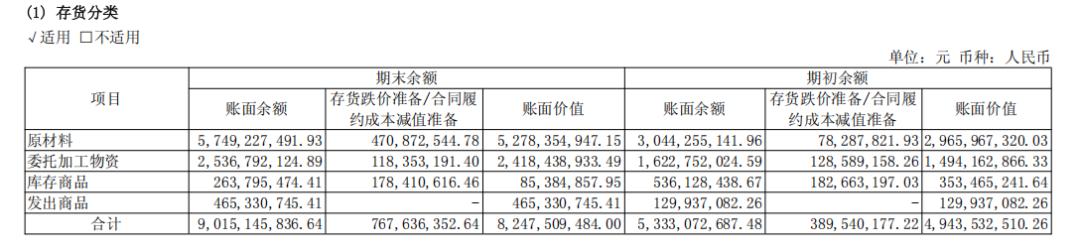
8.25 billion yuan is the book value after deducting the impairment provision, and the total book balance of inventory is 9.01 billion yuan. Most of these inventories are invested in the front end of production. Raw materials amount to 5.75 billion yuan, and goods in subcontracting processing are 2.54 billion yuan, the two of which add up to nearly 8.3 billion yuan, all of which are unfinished investments. There are very few finished products in stock instead. The book balance of finished goods inventory is 260 million yuan, and after deducting 180 million yuan of impairment provision, the book value is only 85.39 million yuan. Meanwhile, goods in transit for delivery to customers amount to 470 million yuan, which refers to goods that have been delivered to customers but not yet recognized as revenue, and this figure was only 130 million yuan at the beginning of the year.
There are almost no finished products waiting to be sold in the company's warehouse, and almost all the products that have been manufactured are being delivered or on the way to delivery. This set of data rules out two concerns at the same time: Cambricon currently has no backlog of products, and it does not artificially push goods to distribution channels to inflate revenue.
Source / 2026 Semi-Annual Report of Cambricon
Inventory did not increase but decreased in Q1, falling from 4.94 billion yuan to 4.5 billion yuan. The consumed materials exceeded the replenished materials, and part of the stock prepared at the end of 2025 was converted into revenue in a concentrated manner in Q1, with operating cash flow reaching a positive 830 million yuan in that quarter.
Following this logic, the quarter that was abnormally fast was actually Q1. Revenue in Q4 2025 was 1.89 billion yuan, and it jumped to 2.89 billion yuan in Q1, which was the result of concentrated delivery of the goods accumulated in the second half of 2025. Q2 only returned to the level that the stockpiling rhythm can support.
In the chip business, from material input to revenue recognition, there are multiple links including wafer manufacturing, packaging and testing, and customer acceptance, which take at least several months, so it is impossible to replenish materials while selling. The delivery volume in Q2 was basically determined by the end of Q1, and the goods delivered in this quarter were mainly the part of the 4.5 billion yuan inventory at the end of Q1 that could be completed and delivered in Q2. The 3.75 billion yuan net increase in inventory in Q2 can only be converted into revenue in Q3 and Q4 at the earliest. Accordingly, the operating cash flow in Q2 turned to a net outflow of 520 million yuan. Taken together, the operating cash flow in the first half of the year was still a positive 310 million yuan.
The answer to why the material replenishment speed cannot be increased lies in the upstream. Cambricon adopts the Fabless model, and wafer manufacturing is completely dependent on external foundries. As the company is on the entity list, it needs to place orders for materials several months in advance and pay in advance. Prepayments amount to 2.9 billion yuan, nearly four times the figure at the beginning of the year, and the top two suppliers account for 89% of the total, which is the cost of locking in resources in advance. On the downstream side, revenue doubled, but accounts receivable decreased from 670 million yuan to 220 million yuan, indicating that customers pay very promptly. Cambricon has strong bargaining power over downstream clients, but no bargaining power over upstream suppliers. The bottleneck in the upstream is the several-month cycle from placing an order to receiving the goods.
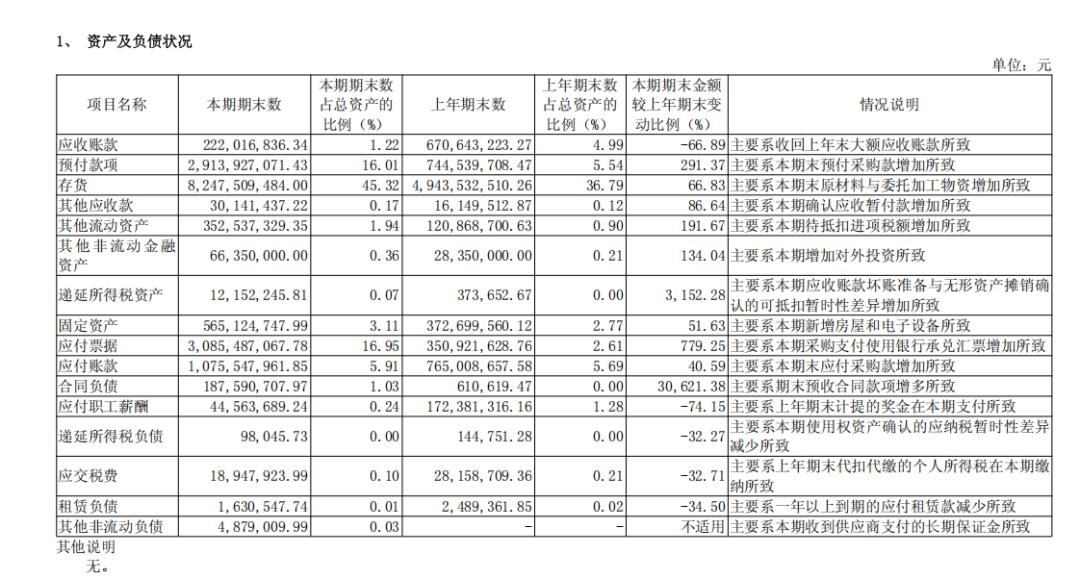
Source / 2026 Semi-Annual Report of Cambricon
In the first half of the year, while Cambricon purchased materials on a large scale, it accrued nearly 400 million yuan of impairment losses for raw materials, compared with only about 54 million yuan in the same period last year. The structure of the accrual is more noteworthy: the impairment provision for finished products was almost fully accrued at the beginning of the year, and there is almost no new accrual in the current period. Nearly 400 million yuan of new accruals are almost all attributed to raw materials. The simultaneous occurrence of purchasing new materials and the impairment of old materials is most reasonably explained by the ongoing product line transition, where old model materials are depreciating as old products are phased out. The overlapping of the transition period and the upstream supply lag further limited the delivery volume in Q2.
The risk section of the financial report mentions that the company will respond to rising raw material prices through methods such as strategic stockpiling. Bank deposits plus structured deposits amount to about 4.3 billion yuan, plus credit lines from multiple banks and the nearly 4 billion yuan private placement completed in September 2025, the company faces little financial pressure for stockpiling.
There is a clue about Q3 in the financial report. The aforementioned 470 million yuan of goods in transit for delivery will most likely be recognized as revenue in Q3. Contract liabilities fell from nearly 400 million yuan at the end of Q1 to 190 million yuan, while this figure was close to zero at the beginning of last year, and the data of the two quarters is not enough to show a clear trend.
The management also gave expectations for the future outside the financial report. On July 28, one week before the release of the financial report, Cambricon disclosed a new equity incentive draft, with assessment targets of 13.5 billion yuan in revenue in 2026, cumulative 40.5 billion yuan in revenue from 2026 to 2027, and cumulative 100 billion yuan in revenue from 2026 to 2028.
A simple calculation shows that with 6 billion yuan of revenue in the first half of the year, the company needs to achieve 7.5 billion yuan in the second half of the year to hit the 13