The person in charge of DeepSeek Harness complains that the financing materials are overhyped: the programming capability of V4-Pro is only 0.3% lower than Claude's flagship model, and the front-end service fee is as high as 10%
At the sensitive juncture when DeepSeek's second round of financing is restarted, a document involving DeepSeek's equity investment leaked on social platforms, not only exposing highly controversial financial terms, but also pushing DeepSeek's unreleased V4-Pro into the spotlight.
According to the leaked document, V4-Pro's programming performance is only 0.3% lower than Claude's flagship model, supports a 1 million-token context, and its API pricing is between 1/10 and 1/100 of that of overseas competitors.
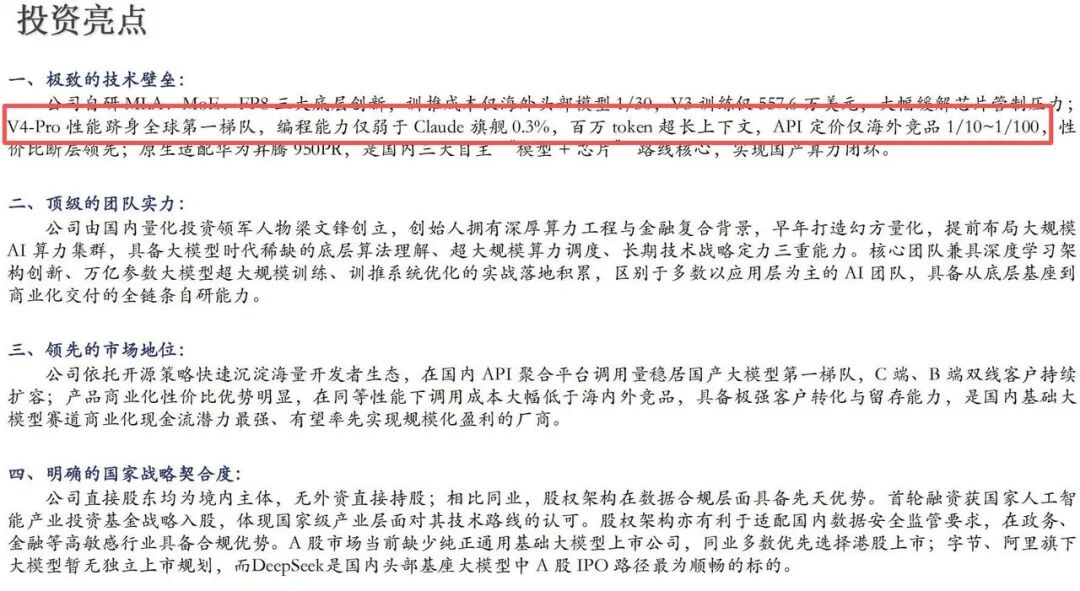
Referring to the two most cutting-edge benchmarks that are most valuable for evaluating AI programming agents: Terminal-Bench 2.1 (including DeepSWE 1.1) and SWE-bench. If the "Claude's flagship model" here refers to Opus 5, the corresponding performance of the official V4-Pro should be as follows:
Terminal-Bench 2.1: ~83.5% (Opus 5 scores 83.8%)
DeepSWE: ~69.7% (Opus 5 scores 69.9%)
SWE-bench Pro: ~80.1% (Opus 5 scores 80.3%)
This unusually precise yet heavily sales-oriented data directly prompted insiders of DeepSeek to respond. Cui Tianyi, head of the DeepSeek Harness team, quipped on social platforms: "It can't be said that it's completely made up, right?"
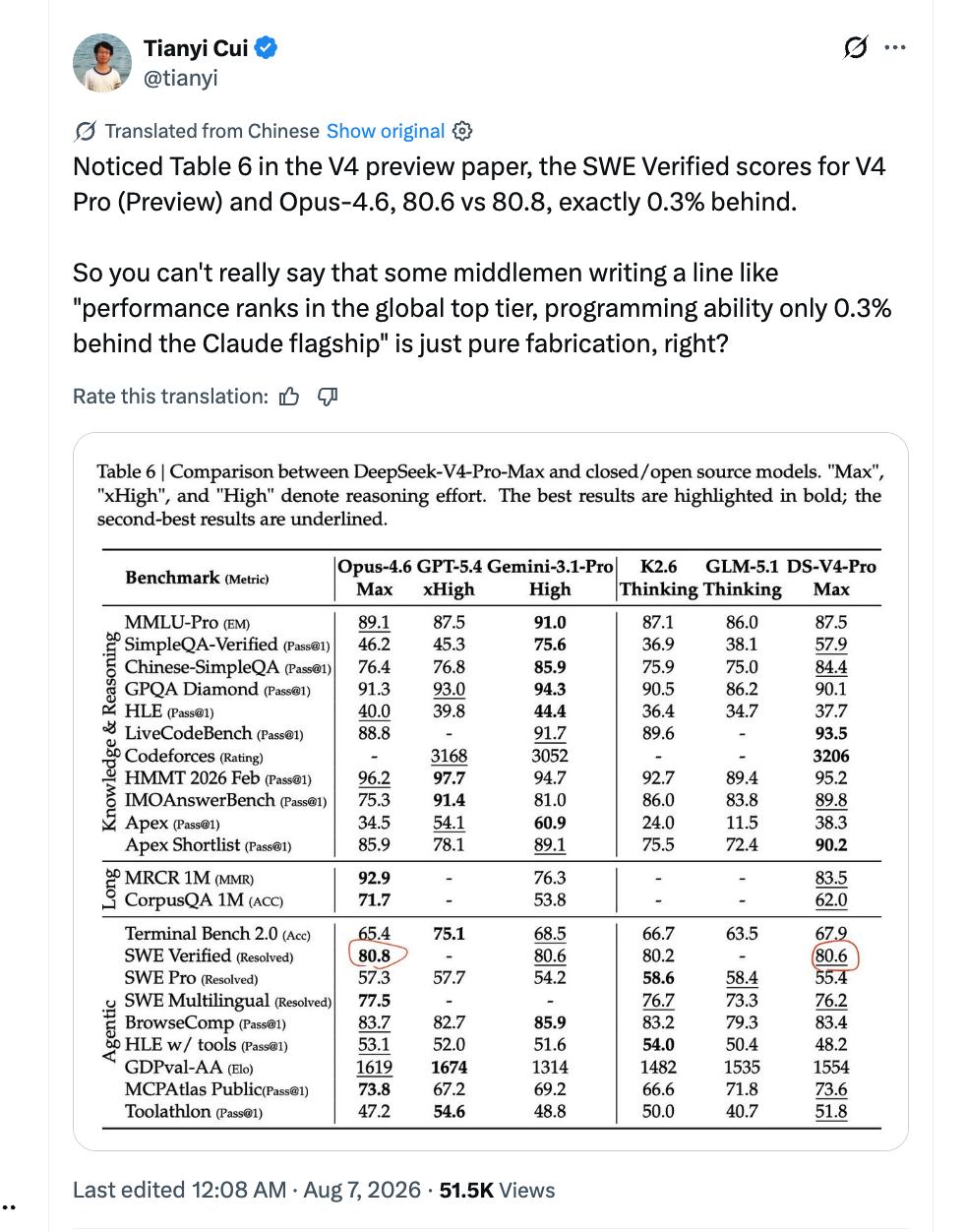
According to the V4 Preview technical report released by DeepSeek in April this year, V4-Pro-Max scored 80.6% on SWE-bench Verified, which measures the ability to solve practical engineering problems, while Claude Opus 4.6 for comparison in the same period scored 80.8%.
If we calculate the relative performance, V4-Pro is exactly about 0.25% lower, which rounds up to the so-called "0.3%" in the BP (Business Plan).
From Cui Tianyi's playful attitude, it can also be seen that the relevant material is more like a "scattered order promotion BP" produced by investment intermediaries/FAs around DeepSeek's scarce shares, rather than DeepSeek's official financing material; the so-called "0.3%" is very likely a marketing rhetoric for the public test results of V4-Preview.
However, packaging "being 0.3% behind in a single benchmark" as "being 0.3% behind in overall programming ability" is an obvious conceptual distortion, and Anthropic has successively updated to Fable 5 and Opus 5, so Claude's capability baseline has also been improved.
However, putting aside wordplay, the restructuring of computing power costs is a definite commercial variable.
In terms of pricing, the API pricing of Claude Opus 5 is $10 per million input tokens and $50 per million output tokens. The current official pricing of DeepSeek V4-Pro is $0.435 for input cache miss and $0.87 for output cache miss.
Calculation shows: the input cost is about 23 times cheaper, and the output cost is about 57 times cheaper.
For a job containing 1 million input and 1 million output tokens, the total cost of Opus 5 is $60, while the cost of V4-Pro is only $1.305, the total cost is about 46 times cheaper.
If V4 cache hit is triggered, the unit price of V4 will further drop to $0.003625 per million tokens, which is only 1/276 of the price of Opus 5.
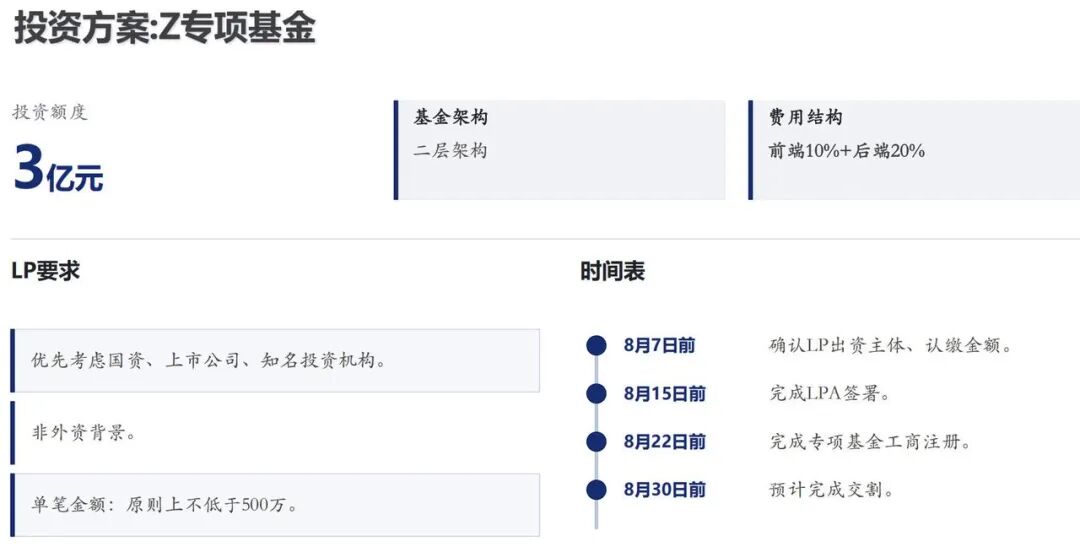
300 Million Fund, But 10% Front-End Fee to Be Charged First
Apart from technical parameters, this fundraising document also exposes the extremely distorted supply-demand relationship for leading large model assets in the current primary market.
The document explicitly mentions a "China Renaissance-affiliated fund" with a scale of only 300 million RMB, with a pre-money valuation of up to 71 billion US dollars (about 500 billion RMB), and lists exit path plans for the Sci-Tech Innovation Board, Hong Kong Stock Exchange or Beijing Stock Exchange. The most eye-catching part in the industry is the 10% front-end management fee.
In other words, if an LP invests 100 million RMB, the entry fee alone will be as high as 10 million RMB, and there may be additional annual management fees and carry later.
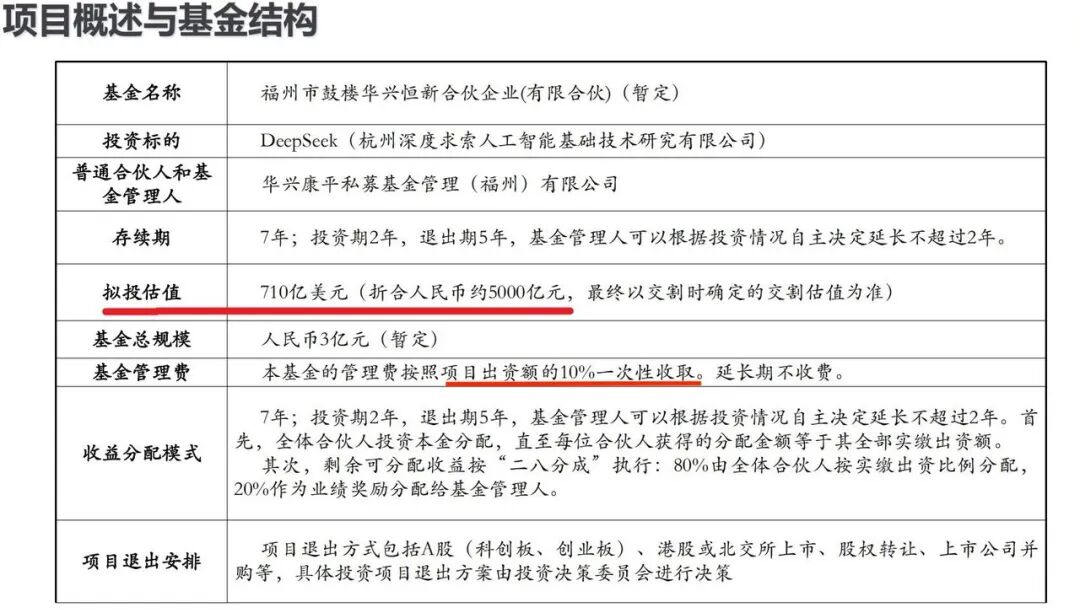
In the mainstream operation standards of venture capital funds, usually after LPs contribute capital to the fund, GPs will charge management fees and performance remuneration as agreed, but the conventional charging model usually follows the classic "2/20 principle", that is, 2% annual management fee and 20% excess return share. Even for distribution through formal wealth management channels, the front-end subscription fee is usually strictly controlled at the upper limit of 1% to 3%.
The "10% management fee" that appears here is also quite similar to the charging structure that has appeared in the DeepSeek share trading market before.
Previous media undercover investigations found that some intermediaries publicly quoted "10% channel fee, plus 2% annual management fee"; other channels offered a plan of "10% front-end fee + 2% management fee + 10% performance remuneration" for "combined" investments of less than 5 billion RMB. In other words, this 10% is more like a one-time channel cost paid by investors to access scarce shares.
According to the author's understanding, as DeepSeek launches its second round of financing with a pre-money valuation of about 500 billion RMB, hundreds of billions of yuan of intended funds that did not get allocated in the first round are still waiting for opportunities to compete. The scale of funds that expressed investment intention in the first round once exceeded 1 trillion RMB. Even though 500 billion RMB has been absorbed in the first round, a large amount of capital is still waiting for new entry opportunities.
Under the extreme imbalance between supply and demand where the buyer completely loses bargaining power, the channel parties that control the underlying quota have absolute pricing power.
In fact, a secondary sales chain composed of intermediaries, FAs, private equity funds and SPVs has long been formed around DeepSeek's scarce financing shares. The more difficult it is to get a share in the primary market, the more opportunities the intermediate links have to sell at a higher "scarcity premium".
500 Billion Financing Restarts, Kimi Is Also Racing Against Time
This half-true, half-false BP was leaked at this time by no accident. The current first echelon of domestic large models is at the core of a new round of ranking competition and capital meat grinder.
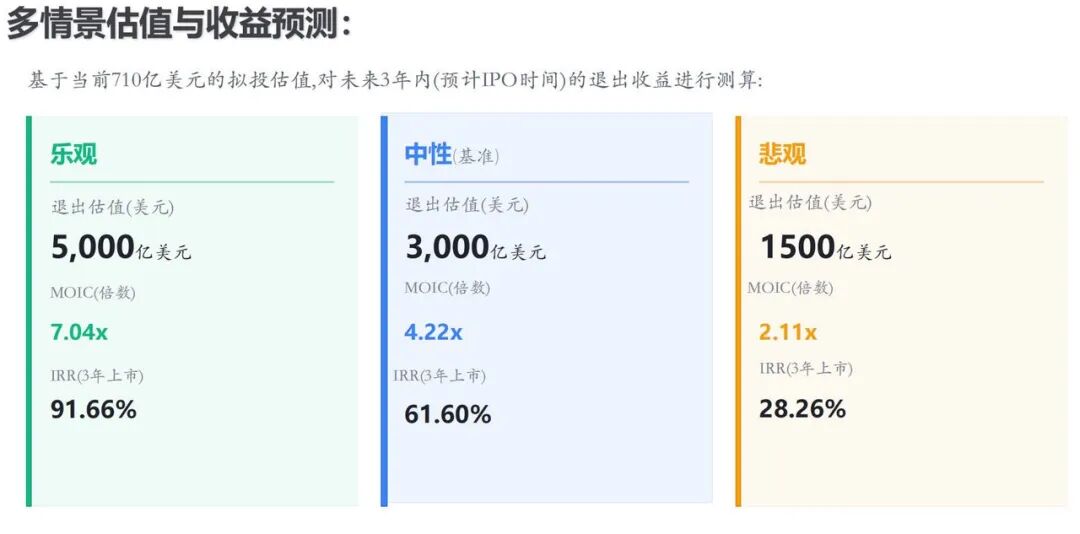
In April this year, DeepSeek launched its first large-scale external financing since its establishment, and completed the delivery in June, raising about 500 billion RMB with a valuation of over 3.5 trillion RMB.
Just over a month later, the second round of financing was launched again. According to information obtained by *Caijing* from multiple transaction parties, DeepSeek plans to raise another 500 billion RMB in this round, with a pre-money valuation of about 5 trillion RMB, an increase of about 43% over the previous round. At the end of July, this round of financing was suddenly suspended for a while. Now the latest reports from Reuters and Bloomberg indicate that financing has been restarted.
DeepSeek's current pressure mainly comes from two aspects:
The first is the expectation management of its own model iteration. The official public beta of the V4-Pro official version has been delayed, and the market's expectation for it to undertake the underlying architecture upgrade has been fully raised.
The second is the step-by-step pressure from competitors in the same echelon.
After Moonshot AI completed a new round of financing with a valuation of 31.5 billion US dollars at the end of July, it immediately leveraged the global popularity of Kimi K3 to seamlessly launch its Pre-IPO round of financing at a valuation of 50 billion US dollars, which also triggered a frenzy of capital grabbing. According to its current capital advancement pace, this round of fundraising is expected to be completed in August, and it plans to officially submit its listing application within the year.
At a time when model capabilities are iterated on a monthly basis and computing power costs are exponentially declining, the traditional pricing model based on discounted financial cash flow has completely failed. Investors' pursuit of leading AI companies has essentially evolved into an "option bet" on the final outcome of AGI.
This article is from the WeChat public account "AI Front" (ID: ai-front), author: Siyue, authorized for release by 36Kr.