The Disney dream that Sam Altman failed to fulfill has been realized by Zhang Yiming.
Mickey Mouse could never have imagined that one day he would dance the same dance with Marvel superheroes on TikTok.
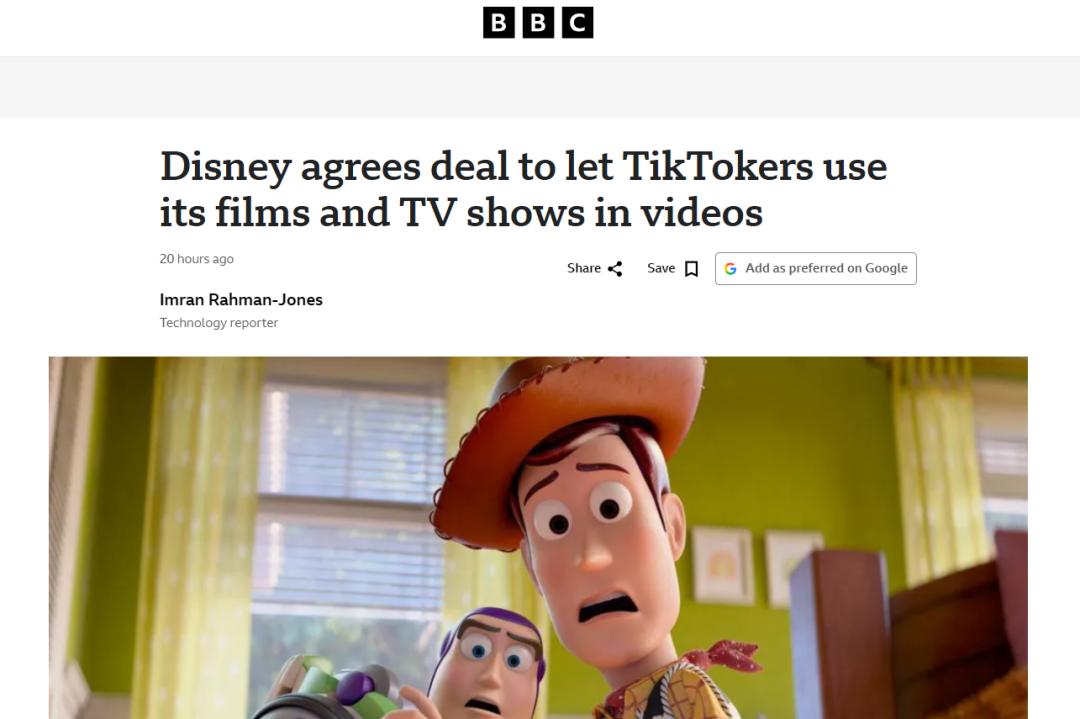
On August 5, Disney and TikTok jointly announced a global short-video content sharing agreement. Creators on TikTok can now openly use all IPs under Disney for derivative creation, freely editing hundreds of works from Pixar, Marvel, Star Wars, FX and other labels. The videos produced can not only be posted on TikTok, but also be simultaneously synced to Verts, the vertical-screen channel on Disney+.
Nobody would have dared to imagine this half a year ago.
In December 2025, Disney signed a huge 3-year contract worth 1 billion USD with OpenAI. Sam Altman promised that Sora would allow users to generate AI videos with more than 200 Disney characters. Mickey Mouse, Princess Elsa, Iron Man, users can create whatever AI content they want. Hollywood was in an uproar at that time, with some crying that the "wolf is coming" and others hailing it as a great deal.
However, on March 24, 2026, OpenAI announced the shutdown of Sora. The 1 billion USD partnership vanished before it could be fully implemented. Disney's spokesperson responded gracefully that they respected OpenAI's decision, but no one but themselves knew how they truly felt.
Less than five months passed between the collapse of the AI dream and the partnership with TikTok. The Disney dream that Sam Altman failed to fulfill was realized by Zhang Yiming.
From AI to UGC: Disney's Obsession with Short Videos
Disney has a deep-seated obsession with short videos.
Disney+ has around 130 million global subscribers, ranking third in the US streaming market with a market share of only about 5%. Netflix and YouTube are leading the race, while a host of competitors are catching up from behind.
Official TikTok statistics show that last year, users on the platform posted 6.5 million film and television related videos per day on average, and nearly half of the users would go to streaming platforms to watch the full-length content after browsing short videos. Short videos have also become an important search engine and traffic entry for film and television content overseas.
At the investor conference call in May 2026, CEO Josh D'Amaro announced that the company is exploring various forms of short video content, with a particular focus on young users. At that point, Disney had already launched the vertical short video section Verts in the ESPN streaming service, and planned to integrate this feature into the main Disney+ platform.
The question is, where will the content come from?
Disney has no shortage of IPs under its belt: Marvel has dozens of superheroes, Star Wars has half a century of story heritage, and any animated character from Pixar is a shared memory of generations of people. However, Disney cannot convert all these IPs into short video content on its own.
So Disney came up with two solutions.
The first solution is AI. At the end of 2025, Disney invested 1 billion USD in OpenAI and signed a 3-year licensing agreement, allowing Sora users to generate AI videos with Disney's characters. Disney became the first major film company to license its IP to an AI video tool, and the deal was once regarded as a "qualitative shift" in the relationship between Hollywood and generative AI.
As it turned out, Sora was shut down not long after.
On March 24, 2026, OpenAI announced the shutdown of Sora. The official statement said the strategic focus has shifted to robotics and world simulation, while insiders revealed that Sora consumed too many GPU resources, which affected other more profitable businesses. Disney's 1 billion USD investment had not yet been fully executed when the partnership was terminated.
The second solution is TikTok, the world's largest short video platform.
This partnership allows TikTok to open its material library of hundreds of Disney films and TV series to creators, covering all labels including Pixar, Marvel, Star Wars, and FX. The short videos created by creators will not only be posted on TikTok, but also simultaneously appear in the Verts vertical-screen section on Disney+. The two sides also launched the "Disney Creator Ambassador Program" to provide selected creators with traffic support, event opportunities and career development resources.
The partnership will first be piloted in the United States, and then rolled out globally.
Two Paths, One Destination
The partnership between Disney and OpenAI, and the partnership between Disney and TikTok, on the surface, are both "let others use my IP to make videos", but their underlying logic is completely different.
In the partnership with OpenAI, the content is AI-generated. Users input a piece of text, and Sora outputs a video. Disney's characters move in the AI's "imagination" without the intervention of human creators.
The advantage of this path is that in theory it can be scaled up infinitely: anyone with a prompt can generate an unlimited number of Disney short videos. The downside is the risk of loss of control: AI-generated videos can place Mickey and Stitch in any scenario, leaving Disney with almost no control over the content.
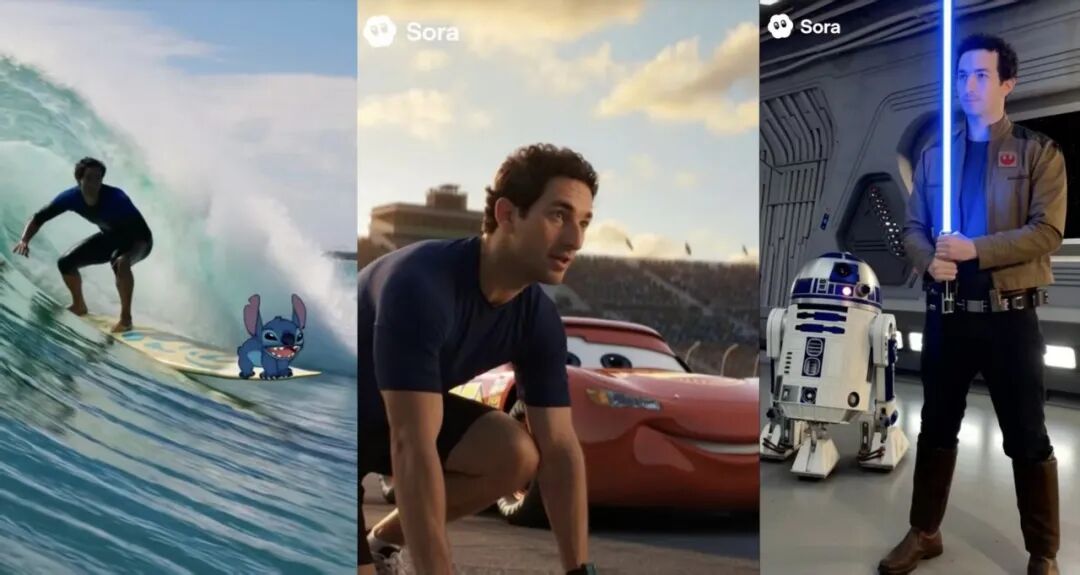
A 1 billion USD investment and a 3-year licensing period only brought a bunch of AI-generated videos, and it is completely unknown whether these videos can attract users, bring traffic, or convert into Disney+ subscriptions.
In the partnership with TikTok, the content is mainly co-created with users. Millions of real short video creators use their own creativity to re-edit, reinterpret, and mix Disney's characters and stories. This path cannot generate massive content overnight like AI, but it can give full play to the initiative of content creators, who are themselves traffic nodes on TikTok, with their fans viewing, sharing and discussing the content.
More importantly, there is the cost structure. Disney does not need to pay sky-high content costs, nor does it need to bear the copyright and ethical disputes that may be caused by AI videos. It only needs to open its material library, and wait for millions of creators to produce content for it. These contents will also flow back to Disney+, filling the content gap of the Verts vertical-screen section.
TikTok also has its own considerations.
The platform has long been navigating tensions with regulators, legislators and public opinion. In January 2026, ByteDance sold most of the equity of TikTok's US business to investors from Oracle, Silver Lake and Abu Dhabi. At this juncture, reaching this "first-of-its-kind global partnership agreement" with a US cultural icon like Disney is a huge boost to TikTok's brand image.
There is another underrated detail in this deal: the short videos produced by creators will be simultaneously displayed on Disney+'s Verts, which marks the first time that TikTok's content appears on another platform. For TikTok, this means its content ecosystem has obtained recognition and distribution channels from traditional media.
The Underlying Logic of the IP Business Has Changed
In this deal, the most subtle position is occupied by creators.
On the surface, creators are the beneficiaries: they get the legal right to use Disney's IP without worrying about copyright complaints, and can also participate in the "Ambassador Program" to get incentives. But on second thought, creators are essentially working for Disney and TikTok.
Every video they produce increases the exposure and popularity of Disney's IP, fills content for TikTok, and provides free short video supply for the Verts section of Disney+. In return, they get more exposure opportunities.
Some industry insiders believe that the direct revenue for creators from this deal may be limited. Neither Disney nor TikTok has announced the revenue sharing mechanism for creators. The specific content and value of the so-called "incentive measures" are still unknown to the public.
But this does not undermine the commercial rationality of the deal.
Disney obtains massive UGC content at zero marginal cost, filling its content gap in the short video track. TikTok strengthens its legitimacy and brand image through an IP licensing agreement. Creators get the opportunity to use IP compliantly and potential traffic dividends.
The three parties all get what they need, no one loses, but some gain far more than others.
Behind Disney's deal lies a larger trend: the monetization model of IP is shifting from "licensing fees" to "traffic tax".
The traditional IP licensing model is very simple: if you print Mickey on a T-shirt, you pay me a licensing fee. The partnership between Disney and OpenAI is essentially following this logic: OpenAI pays (1 billion USD investment), and Disney provides the IP.
But the partnership with TikTok breaks out of this framework. Disney does not charge TikTok any licensing fees. The return it gets is not cash, but millions of traffic-carrying short videos produced by creators that can fill Disney+'s content library.
The underlying judgment is that in the short video era, the value of IP does not lie in how many times it is licensed, but in how many times it is spread. A short video of Iron Man that has been viewed millions of times on TikTok may bring more potential subscribers to Disney+ than a single licensing fee.
Disney CEO D'Amaro released the company's Q3 2026 fiscal year financial report on the same day the partnership was announced, showing that the combined streaming profit of Disney+ and Hulu reached 712 million USD, doubling year on year. It is hard to say that announcing the partnership with TikTok at this point in time is just a coincidence.
The short video dream that Sam Altman's Sora failed to help Disney realize is now fulfilled by millions of real creators on TikTok. The difference is that AI-generated videos are cold, while human-created content is warm. Disney is betting on the latter.
It is still too early to conclude whether this deal will ultimately help Disney gain a firm foothold in the short video era. But at the very least, it has found a way to make Mickey and Spider-Man go viral on mobile phones without spending 1 billion USD.
And Zhang Yiming, or rather, the new owners of TikTok, have also got a ticket to the core circle of Hollywood.
This article is from the WeChat official account "Foci Hyperfocus", authored by Fang Wensan, and published with authorization from 36Kr.