The Second Half of the Education and Training Track: TAL Pursues Profit via Contraction, New Oriental Seeks Cost Reduction through Expansion
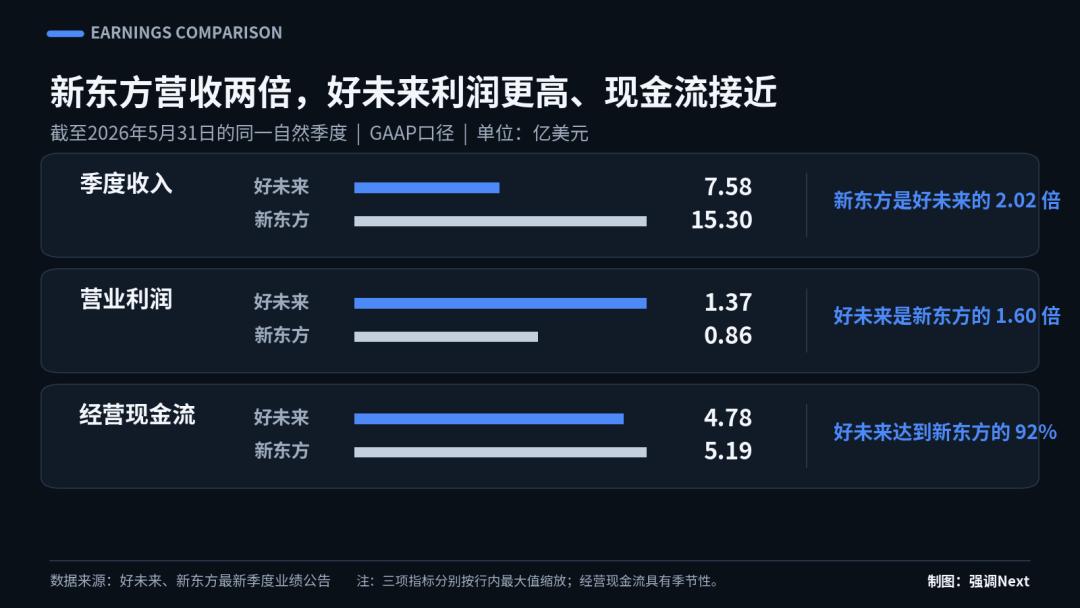
In the same quarter, New Oriental's revenue was nearly twice that of TAL, yet TAL's operating margin was more than three times that of New Oriental.
As of May 31, 2026, New Oriental recorded quarterly revenue of 1.53 billion US dollars and an operating profit of 85.8 million US dollars. TAL posted revenue of 758 million US dollars and an operating profit of 137 million US dollars. The operating cash flows of the two companies were also almost at the same level, with TAL at 478 million US dollars and New Oriental at 519 million US dollars.
Out of TAL's 408 million US dollars in net profit, 405 million US dollars of "other income" mainly came from changes in the fair value of investments, which does not prove that learning tablets have suddenly become profit-generating machines. But after excluding this floating profit, why can TAL still earn more operating profit than New Oriental with half of the revenue?
"Release of operating leverage" is only a financial result, not a business explanation. The deeper difference is that after the "double reduction" policy, TAL narrowed its business focus and repeatedly sold its teaching research, teacher training and technology platforms to classrooms and learning terminals. New Oriental, however, continued to add livestream e-commerce, cultural tourism and family membership systems when its education business still needed to improve urban density and teaching capacity utilization.
TAL reuses its supply, while New Oriental tries to reuse its user base. Whether supply can be reused has been answered by the cost sheet. As for whether users can consume across businesses, New Oriental has not yet presented data on cross-sales revenue and customer acquisition costs.
Therefore, this is not just an efficiency gap between two education and training companies. TAL has begun to reap the rewards of focus, while New Oriental has paid a "complexity tax" before the value of its "family entry point" is realized.
1 · TAL's profits come from the standardization dividend after business contraction
TAL generated an additional 183 million US dollars in revenue this quarter, bringing 123 million US dollars in additional gross profit. Its total sales and administrative expenses reached 301 million US dollars, about 90,000 US dollars less than a year ago. As a result, the additional gross profit almost fully flowed into operating profit.
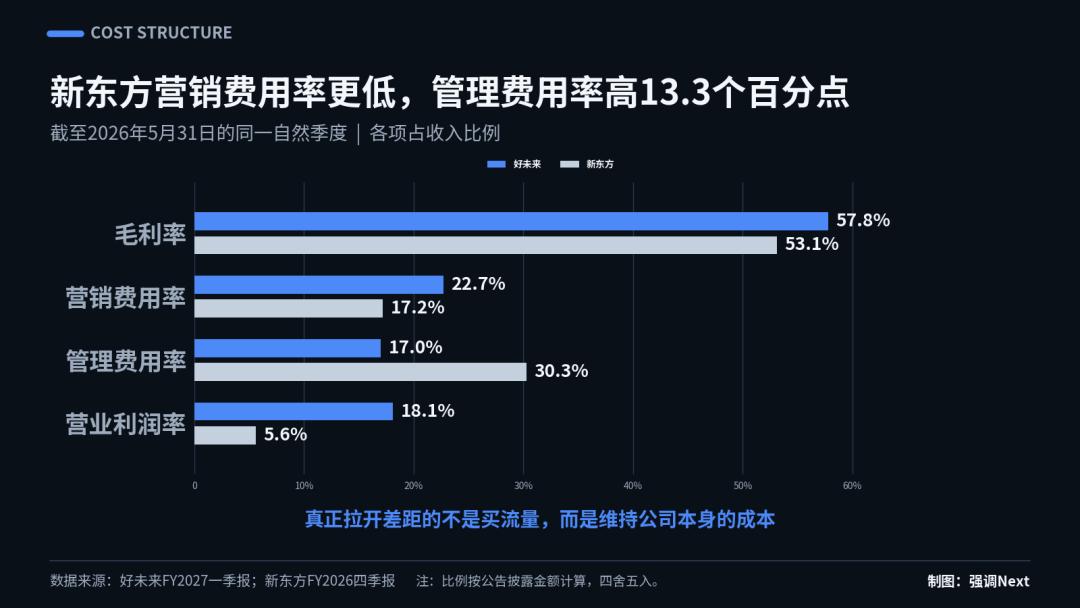
This is not just a simple cut in marketing spending. TAL's sales expense ratio still stands at 22.7%, 5.5 percentage points higher than that of New Oriental. What has actually been diluted are the back-office and platform costs: its administrative expense ratio dropped from 20.9% a year ago to 17.0%, while New Oriental's reached as high as 30.3% in the same quarter.
When we extend the time horizon, the change becomes clearer:
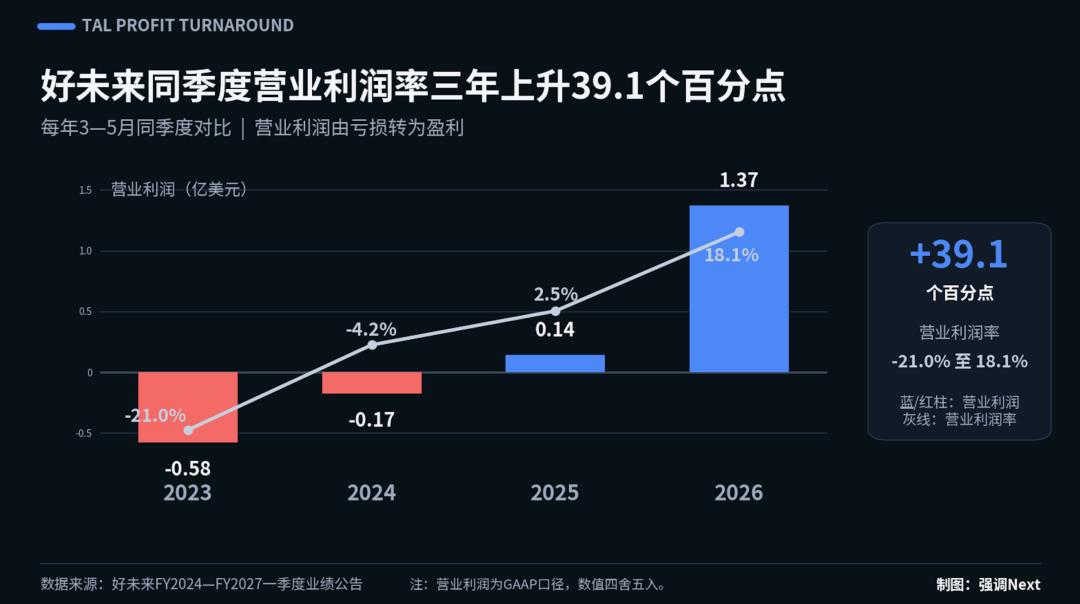
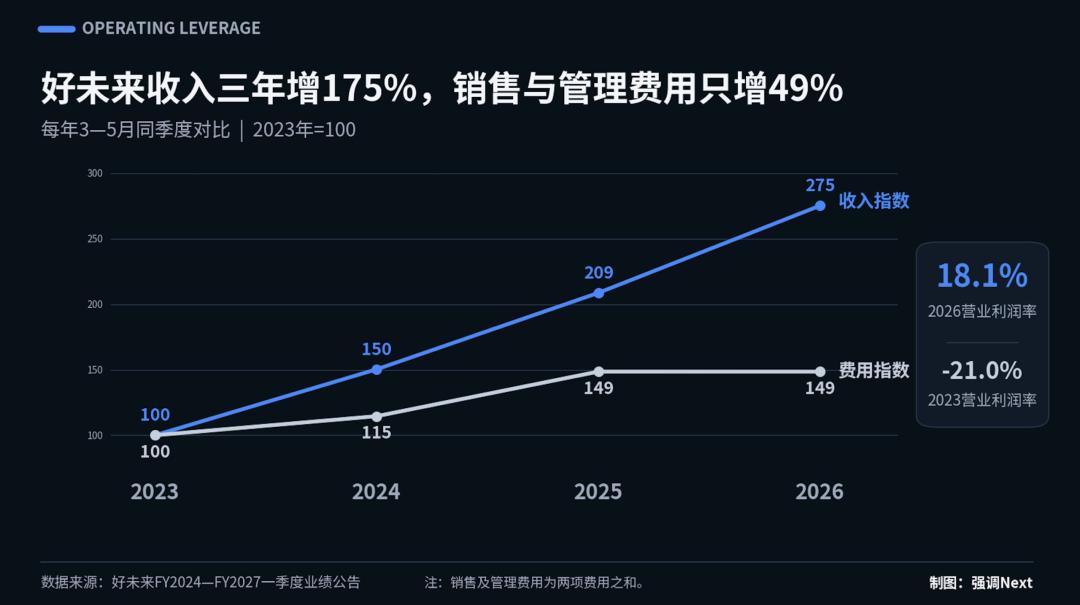
Over the past three years, TAL's revenue in the same quarter increased by 175%, while total sales and administrative expenses only increased by 49%. It has not become a "light-asset company" and still operates more than 600 learning centers at present. What TAL chose to do is to integrate the same set of teaching research, teacher training and technology backends rebuilt after the "double reduction" policy into a larger revenue base.
This also explains the real position of learning tablets in TAL's strategy. Learning tablets are not a new business line parallel to courses, but a way to resell its existing question banks, content and learning data through a different medium. Every time offline courses expand to a new city, more classrooms, teachers and regional management staff are required. Adding a new user for a learning tablet, by contrast, does not require a proportional increase in teachers' working hours.
The role of AI here is more like a hypothesis to be verified rather than a proven result: if pre-class guidance, real-time feedback, diagnosis and learning plans can truly be completed by the system, the same teaching research supply can cover more learning hours, thus reducing marginal delivery costs. However, TAL has not separately disclosed the revenue, sales volume and gross margin of its learning tablet business, which is still a direction to explore rather than a verified source of profit.
The profits TAL earned this quarter may not be stable and sustainable. Whether the decline in sales expenses this quarter can withstand the competitive intensity after the peak enrollment month, and whether the efficiency dividend of the learning tablet track can continue, still need to be verified in the next quarter. But at least in this quarter, what it realized is the standardization dividend, not the AI story itself.
2 · New Oriental's education profits are diluted by peripheral businesses
The problem for New Oriental is that the profits earned by its education business are diluted by a more complex corporate structure.
In the latest quarter, New Oriental's marketing expense ratio was 17.2%, lower than that of TAL. What really widened the gap is the gross margin and administrative expense ratio. New Oriental's gross margin was 53.1%, 4.7 percentage points lower than TAL's, and its administrative expenses reached 464 million US dollars, equivalent to 30.3% of its revenue. In other words, New Oriental is not spending more heavily on traffic acquisition, but it costs more to run the company itself.
The 20-F filing for fiscal year 2025 provides a more direct breakdown. Revenue from education services and exam training reached 3.456 billion US dollars that year, with segment operating profit of 808 million US dollars; the self-operated products and livestream e-commerce segment recorded a loss of 10.3 million US dollars, the "other" segment recorded a loss of 88.67 million US dollars, and there were another 364 million US dollars in unallocated headquarters expenses. As a result, New Oriental's total consolidated annual operating profit was only 428 million US dollars.
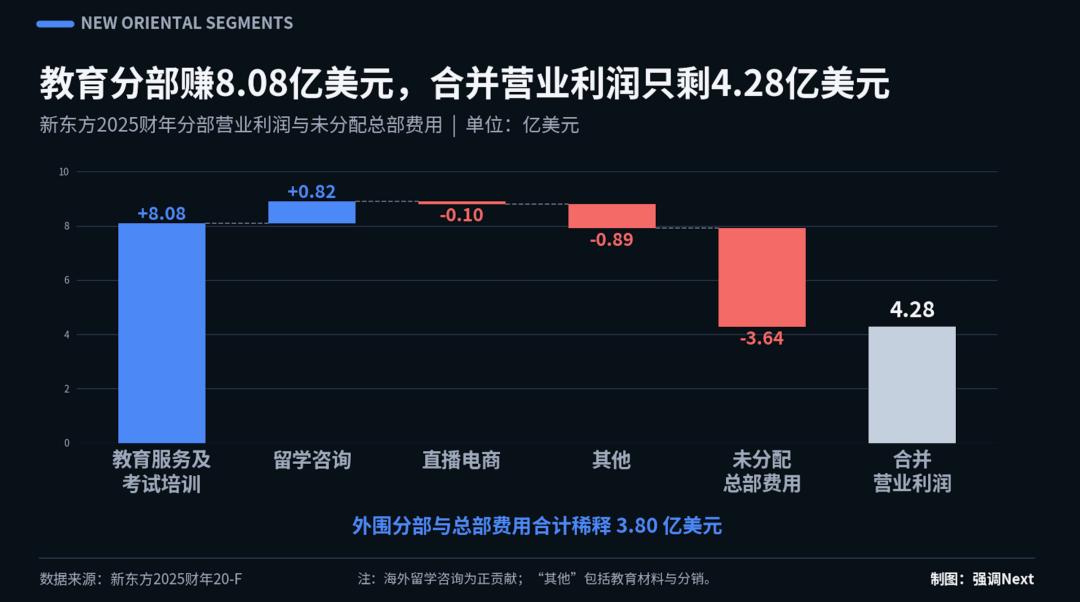
This set of data cannot prove that every dollar of headquarters expenses is caused by diversification, but it is enough to refute the superficial judgment that "New Oriental's core education business has thin profits". The core education business is still the profit engine, while losses from peripheral businesses and huge headquarters expenses are the main dilution factors.
In the fourth quarter of fiscal year 2026, New Oriental's administrative expenses still increased by 13.2% year-on-year to 464 million US dollars. The company is undergoing restructuring, and some expenses are temporary, but the problem clearly predates this restructuring: courses require teachers and campuses, overseas study services require consultants, cultural tourism requires destinations and fulfillment capabilities, and self-operated commodities also require procurement, quality control, warehousing and logistics. Brands can be shared, but the supply chains cannot be merged under a single account.
This is the most critical strategic divergence between New Oriental and TAL. TAL puts the same set of content into more classrooms and terminals, and every additional delivery has the opportunity to dilute the original costs. New Oriental puts more demands into the same company, and every time it enters a new industry, it has to build a new fulfillment system from scratch.
Diversification can certainly raise the revenue ceiling, but before the synergy value is proven, what it usually expands first is organizational cost.
3 · The "family entry point" is temporarily only an expensive assumption
The solution New Oriental put forward is "New Oriental Home". The platform connects education, East Buy and cultural tourism products to the same family account. It has been piloted in 69 cities with more than 950,000 registered families. The management also disclosed improvements in activity participation rate, activation rate and retention rate.
These figures can prove that users have been reached, but they are not enough to prove that business value has been generated. To judge whether a family account has commercial value, at least three results need to be examined: the proportion of education users who purchase retail or cultural tourism products, the incremental revenue brought by cross-selling, and how much customer acquisition cost the unified membership system has actually reduced. New Oriental has not disclosed any of these three items so far.
A parent who trusts New Oriental's English courses does not necessarily buy self-operated food from it; someone who is willing to sign up their children for training courses does not necessarily trust the same company to arrange a trip. Education, retail and cultural tourism only share the broad label of "family", and they do not naturally share consumption decisions.
What is more worthy of vigilance is the strategic sequence. New Oriental's non-disciplinary training and intelligent learning systems have covered about 60 cities, but the top 10 cities contribute about 60% and over 50% of the revenue respectively. This shows that while the brand radius of New Oriental's core education business has expanded, its mature enrollment, delivery and profit models are still concentrated in a small number of cities.
The company increased its teaching capacity by about 13% in fiscal year 2026, and plans to increase it by 10% to 15% in fiscal year 2027, expecting revenue growth to outpace capacity growth. In other words, New Oriental's own financial targets have acknowledged that its core business still has a tough battle to fight to improve utilization. At this time, adding retail, cultural tourism and a unified family account system means that the risk is not just "low profits during the investment period", but that the management has to tackle two difficult problems at the same time: to expand the coverage of education outlets, and to prove cross-industry synergy.
New Oriental is not short of traffic, but it prematurely equates "having the same group of users" with "running the same business". If "New Oriental Home" fails to deliver improvements in cross-sales revenue and customer acquisition costs for a long time, the so-called family entry point will not be a moat, but just a more expensive organizational packaging.
4 · Overtaking in a single quarter is enough to send a warning signal
TAL's 18.1% quarterly operating margin cannot be directly extrapolated to the long term. Looking at the most recent full fiscal year, TAL's operating margin as of the end of February 2026 was 9.2%, while New Oriental's was 11.4% as of the end of May 2026. The two companies have different fiscal year end dates, but this at least shows that New Oriental has not lost the game in terms of long-term profitability.
TAL also has its own overstated figures to adjust. At the end of May, its deferred revenue increased by 337 million US dollars compared with the end of February, and both operating cash flow and revenue recognition were affected by the enrollment season; the decline in sales expenses this quarter may not be sustainable in the long run amid intensified competition. The fact that learning tablet business has not separately disclosed revenue and gross margin further means that "secondary monetization of content" still needs to be verified.
But these caveats should not erase the core conclusion. A single quarter does not represent a long-term victory or defeat, but it is enough to reveal that the two companies are facing different levels of difficulty in proving their strategies.
The next step for TAL is only to prove that this round of expense dilution is not an accidental result of the peak season, and that learning tablets and offline centers can continue to reuse the same set of supply. New Oriental has more things to prove: whether its administrative expense ratio can decline, whether peripheral businesses can stop diluting education profits, and whether "New Oriental Home" can truly turn registered families into cross-sales revenue sources.
The former problem is whether efficiency improvement can be sustained, while the latter is whether diversification is viable. These are not the same problem.
In the first stage after the implementation of the "double reduction" policy, the two companies competed to see who could recover revenue faster. Now, the income statement has begun to vote on their strategies: reusable supply is generating revenue, while unproven synergy is still incurring costs.
This article is from the WeChat Official Account "Emphasis Next" (ID: leo89203898), written by Yixiu, edited by Xiaobai, and authorized for release by 36Kr.