Liang Wenfeng, bid farewell to the "price slasher"
Will users still accept DeepSeek after its price hike?
A new announcement released by DeepSeek on the morning of August 6 upset a large number of users. It stated that "we plan to raise the overall pricing of API services in the near future, with an expected significant increase..."
The well-known AI content creator "Digital Life Kazx" wrote on his personal social platform: "In recent years, domestic large model players have been engaged in cutthroat price competition, and DeepSeek has always been the most radical one. Its price was so low that we dared to actually launch Agents, consume a large volume of Tokens, and build real products on it." "My rationality tells me that training costs are high, inference costs are also high, and the price hike is completely justified. But my emotion makes me wonder, how could you, the reliable and honest player, turn against us?"
Source: AI Generated
This post quickly resonated among the developer community. Within just a few hours, hundreds of comments poured in: Where is the ceiling of DeepSeek's price hike? Can we still afford to use it? Are there any alternatives? Some fans even joked that Liang Wenfeng's AI inclusion public image has collapsed, and "the honorable Liang has been demoted to 'prisoner Liang'".
Over the past two years, DeepSeek's pricing curve has been the most intuitive benchmark for the "price war" in China's large model industry.
In April 2024, it dragged the entire industry into "floor price" competition with the pricing of 1 yuan per million input Tokens and 2 yuan per million output Tokens. The price kept sliding down afterwards. In February 2025, the preferential period ended, and it adjusted its price for the first time. In July this year, the official version of V4-Flash was launched, and its pricing still remained at that low level. It kept pushing the price far below the industry floor, until peers and users all got used to this "dramatic discount price".
Now, this benchmark is about to be redrawn.
The real problem lies in the wording of "significant increase" in the announcement. How large can the increase be to count as "significant"? The answer is not only related to the pricing strategy of DeepSeek, but also related to the development direction of the entire large model industry. Is the era of "subsidizing to scale up" coming to an end?
After the price hike, DeepSeek will also face the ultimate test: whether its core competitiveness comes from the extreme cost performance of "cutting price to the floor" or the hard strength of its model itself, and the market will give a new answer.
From "Floor Price" to "Significant Increase": The Computing Power Shortage
"The core reason for the API price hike is that everyone is facing a computing power shortage." A senior executive from a vertical large model product company told China Entrepreneur.
The shortage of computing power has become a consensus across the industry. On the morning of August 4, OpenCode, an overseas open source AI Coding Agent platform, published a post saying that users complained about frequent response timeouts of DeepSeek-V4-Flash's API, and the service was almost unavailable for a while — the official attributed the problem to "unprecedented traffic".
Public data shows that in the week from July 27 to August 2, OpenRouter recorded that DeepSeek-V4-Flash topped the global model call rankings with 7.22 trillion Token calls, exceeding the total call volume of more than 400 models on the platform. On OpenCode, a platform more focused on developers, the total volume of Tokens processed on August 1 alone reached 8 trillion, 5 trillion of which came from free trial quotas.
The single-day consumption of one model has exceeded the total volume of a platform that hosts hundreds of models. Such a huge call volume puts enormous pressure on the computing power infrastructure. The inference cost of large models mainly consists of hardware depreciation, power consumption and operation & maintenance costs. When the Token processing volume reaches the trillion level, even if the marginal cost of a single call is extremely low, the total cost will still be a huge expenditure.
More importantly, the call structure of DeepSeek is changing.
As the V4 series fully supports the 1 million Token context window and more advanced chain-of-thought inference, users are no longer just calling for simple question-and-answer tasks, but a large number of complex tasks containing deep Agent loops. Especially with the explosion of Agent applications, the Token consumption of a single task has jumped from less than 2000 in the dialogue era to 500,000 to 1,000,000.
Source: AI Generated
Some industry insiders estimated that DeepSeek-V4-Flash's previous pricing, which was "1 yuan per million input Tokens and 2 yuan per million output Tokens", was most likely lower than its real cost, with a negative gross profit margin.
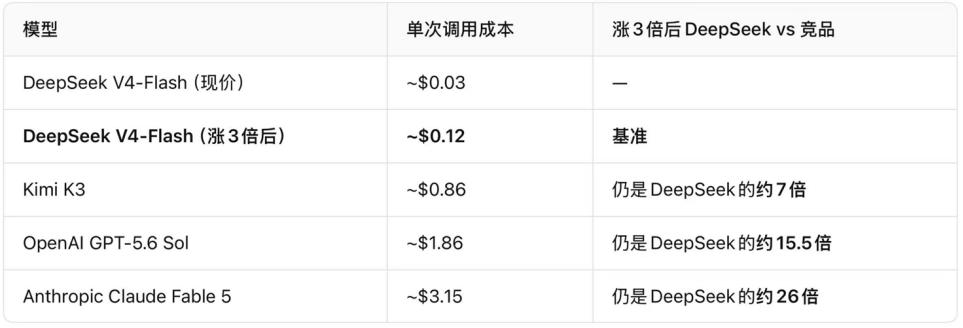
According to the benchmark test released by Artificial Analysis at the end of July, the cost of a single call for mainstream large models varies greatly: DeepSeek-V4-Flash is about 0.03 USD, Kimi K3 is about 0.86 USD, GPT-5.6 Sol is about 1.86 USD, and Claude Fable 5 is about 3.15 USD. That means DeepSeek's price is only 1/105 of that of Claude Fable 5.
However, some industry practitioners questioned the reference system of the above product price comparison.
As the aforementioned senior executive of the vertical large model company said, V4-Flash should be positioned closer to the level of Claude Opus 4.8, rather than the tier of Kimi K3 or Fable 5. "It is not appropriate to make a simple comparison like that," he emphasized to China Entrepreneur. Claude Opus 4.8, released by Anthropic in May this year, is the flagship model of its series, positioned for the high-end enterprise market. According to public information, the pricing of Opus 4.8 per million output Tokens is about 85 times that of V4-Flash.
The price hike is not an isolated incident of DeepSeek. Since the beginning of this year, domestic large model vendors have ushered in a wave of collective price adjustments.
Zhang Peng, CEO of Zhipu AI, explained the "price adjustment" by saying that "long-term reliance on low-price competition is not conducive to the development of the entire industry", and the cost increase brought by capability upgrade is a natural result. According to multiple sources, Zhipu AI has completed three API price increases within this year. The call pricing in the first quarter of 2026 is about 83% higher than that at the end of 2025, while the call volume still increased by 400%, showing a trend of "both volume and price rising".
When Moonshot AI released Kimi K3 in July, its input price increased by more than 3 times compared with the previous generation, and the output price increased by nearly 4 times. The official stated directly that "smarter models perform more complex tasks, and the resources consumed are enormous".
On the cloud vendor side, in March this year, Alibaba Cloud and Baidu Intelligent Cloud adjusted the prices of their AI computing power products simultaneously, with an increase of 5% to 34% and 5% to 30% respectively. Tencent Cloud raised prices twice in a row within this year: it first increased the price of large model APIs, and then raised the price of AI computing power products by 5%. The reason given was "the surge in global AI computing power demand and the sharp rise in the supply chain cost of core hardware".
How Much Will It Rise, Who Is Calculating The Bill?
The trend of rising computing power costs is already certain, and how large the increase will be is the most concerning point for the market at present.
"DeepSeek will still be the cheapest one even after the price hike, and it will remain competitive," a senior executive from one of China's top 5 cloud vendors told China Entrepreneur. He speculated that "a maximum 3-time increase would be reasonable", but he was not sure about the actual increase, saying "we will wait for the final result".
Different ranges of price increase correspond to completely different commercial effects.
A 100% to 200% increase is generally regarded by the market as a "moderate range", which is unlikely to cause a large-scale loss of users. It is reported that Liang Wenfeng once revealed a core judgment in an exchange meeting with investors: In the extremely low price range, the price elasticity of developers is almost close to zero, "even if the price doubles, the Token consumption will not drop significantly".
If the increase reaches 300%, it will enter a different logic.
Calculated based on a 3-time increase, the input price will rise from 1 yuan per million Tokens to 4 yuan, and the output price will rise from 2 yuan per million Tokens to 8 yuan. The gross profit margin of the API business is expected to rise from negative to the 30%~40% range, basically realizing independent profitability. At the same time, a 3-time increase can effectively eliminate low-value crawler scripts and "arbitrage" traffic, and significantly improve system stability.
But if the increase hits 400%, the situation may change. DeepSeek's input price will rise from 1 yuan per million Tokens to 5 yuan, and the output price will rise from 2 yuan per million Tokens to 10 yuan. This price is still lower than that of major domestic competitors — currently, the input price of domestic flagship models is generally in the range of 5~10 yuan per million Tokens, and the output price is in the range of 10~30 yuan per million Tokens. Even if DeepSeek raises its price by 4 times, it only touches the lower limit of its competitors' pricing.
However, the price gap advantage has narrowed from "10 times level" to "2 times level". Calculated by output price, the minimum gap between DeepSeek and its competitors is less than double. When the price difference is not enough to cover the migration cost, some high-frequency users may seriously test alternative models.
User feedback indirectly confirms the existence of this "critical point". A person engaged in scientific research introduced to China Entrepreneur that currently he uses DeepSeek API mainly for personal assistant, technical report writing and stock analysis, "I can accept another 100% price increase, but if it exceeds that, I will switch to other models."
Another Agent application developer holds a more tolerant attitude: "A double increase is acceptable. After all, compared with other players, its price is still a dramatic discount." He also pointed out that the only shortcoming of DeepSeek is that "it does not support multimodality", and users still need to switch to other models for tasks that require image generation and visual understanding. "If DeepSeek raises its price, GPT Plus will be the most cost-effective solution at present," he added.
However, some enterprise customers are not sensitive to the "price hike".
The aforementioned senior executive of the vertical large model company said directly to China Entrepreneur, "The price hike has little impact on us. We use privately deployed models in our development scenarios, all running on the internal network." He revealed that his company has deployed the latest open source large models such as GLM, DeepSeek and K3, and the cost is only on computing power and electricity. "The API price hike mainly affects small and medium-sized developers, startup teams and individual projects."
This senior executive also expressed his respect for DeepSeek: "Among all the price hikes, DeepSeek announced it openly and is not afraid of losing users, which is respectable. Other vendors raised their prices in a hidden way."
After The "Price War" Pauses
The "price war" initiated by DeepSeek was finally paused by itself, and the timing of the choice is quite meaningful.
The day before DeepSeek released the price adjustment announcement, according to foreign media reports, Mark Zuckerberg, founder of Meta, announced that the first programming AI agent Muse Code was open for testing, with a pricing of 4.25 USD per million output Tokens, and the contributor subscription price was as low as 0.20 USD. One player is cutting prices to grab users, while the other is raising prices to prepare for competition, outlining the fork in the commercialization path of global large models.
Many industry insiders believe that for DeepSeek, the significance of this price hike goes far beyond the adjustment of pricing strategy itself.
Multiple media reports said that DeepSeek's first round of 51 billion yuan financing has just been completed, with Tencent, CATL, NetEase, JD, IDG Capital and other industrial and financial capital participating in the joint investment, and the National Artificial Intelligence Industry Investment Fund participating as a strategic investor. The second round of financing has also been launched, with a planned fundraising of 50 billion yuan, a pre-money valuation of about 500 billion yuan, and the signing is expected to be completed in late August.
If the two rounds of financing are successfully completed, DeepSeek will raise more than 100 billion yuan in total in less than 5 months.
However, financing is not the only choice for DeepSeek. A product leader of a top large model company who asked for anonymity said frankly to China Entrepreneur, "All model developers are losing money now, and the loss is far larger than any previous level." His judgment reflects an industry reality: even under the wave of price hikes, the losses of large model companies are still expanding, though the growth rate has slowed down. But "no one wants to give up this visible future, so those who originally did not plan to go public now have to rely on IPO to survive."
In any case, the cash flow improvement brought by the "price hike" will directly respond to investors' concerns about commercial sustainability. After all, DeepSeek's API business has long been operating at a loss and relying on financing for blood transfusion.
The deeper change lies in the re-anchoring of the industry pricing system.
In the past two years, DeepSeek's pricing was regarded by the market as a "price butcher" strategy, which greatly squeezed the profit space of domestic competitors. As long as it maintained the "floor price", other vendors did not dare to raise prices significantly. Now that DeepSeek exits the price war, the released pricing space will benefit the entire industry.
Goldman Sachs also pointed out in a recent research report that the demand for domestic AI models continues to be strong, computing power resources are tightening, and industry competition is gradually returning from radical price wars to a more rational pricing framework.
However, DeepSeek's core competitiveness is built on "extreme cost performance". When the price advantage is no longer "extreme", are developers willing to pay higher prices for the same level of technology?
In the long run, the interweaving of computing power shortage, high-end chip embargo and cost pressure is still an unsolvable equation on DeepSeek's commercialization path.
Source: AI Generated
In July this year, according to reports, DeepSeek has secretly launched a self-developed AI chip project, focusing