Lawsuits and talent poaching, the hardware war between Apple and OpenAI has only just begun.
Since the second half of 2026, the most high-profile lawsuit in Silicon Valley is none other than Apple's action against OpenAI for trade secret misappropriation and breach of contract. The same level of closeness the two companies once shared when they collaborated to develop Siri has now turned into utter awkwardness.
One month after the lawsuit was filed, Apple applied to the court for a preliminary injunction, prohibiting OpenAI and former Apple employees from using or disclosing any of Apple's trade secrets, and barring them from further access to Apple's confidential information. In addition, Apple also demanded that OpenAI return all of Apple's proprietary materials.
A few hours later, OpenAI hit back at Apple, publishing an article titled "Apple is getting this wrong" on its official website, publicly responding to the trade secret lawsuit previously filed by Apple.
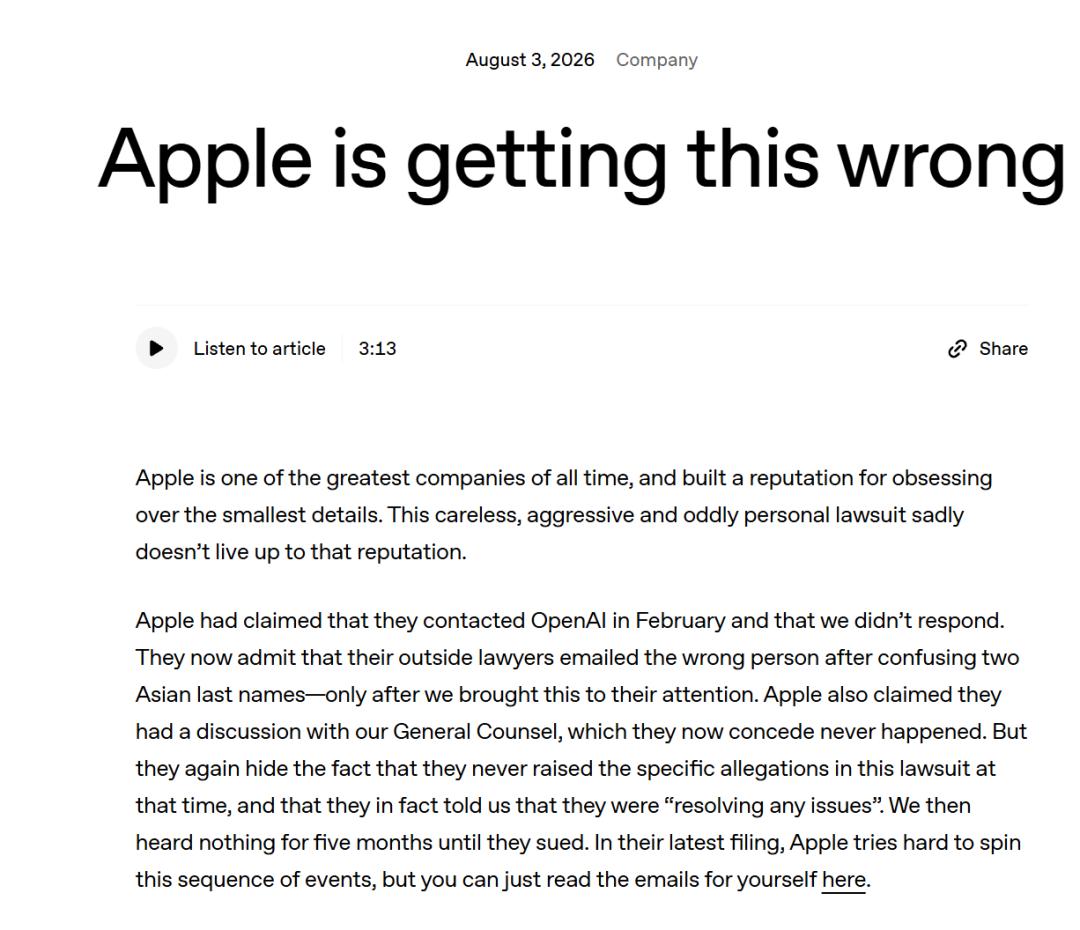
The article stated that Apple's lawsuit is "hasty, aggressive, and strangely personal", and attached multiple emails and iMessage screenshots as evidence.
The article presented a great deal of solid evidence. For example, Gross, the external lawyer hired by Apple, confused two Asian surnames, mistakenly sent an email intended for someone else to OpenAI's general counsel, and even claimed in the email that he had already spoken to him over the phone.
After OpenAI voluntarily pointed out this error, Apple's law firm admitted that it had sent the email to the wrong recipient.
In addition, OpenAI also stated in the article that Apple accused a former Apple executive of stealing Apple's confidential information after switching to OpenAI, but evidence shows that active Apple employees took the initiative to ask this transferred executive for documents, project information, and contact details of liaisons. This executive only downloaded and sent Apple's confidential documents to complete the work handover.
But the essence of this lawsuit is far more complicated than just trade secrets.
In the complaint filed on July 10, Apple disclosed the fact that more than 400 former Apple employees are now working at OpenAI. These people cover almost all key links including product design, hardware R&D, screen technology, antenna engineering, supply chain management, and hardware procurement, basically forming a complete hardware R&D chain.
This is not an ordinary talent flow. This is OpenAI using Apple's personnel to recreate an Apple.
The lawsuit itself is only the surface of this war. What really deserves attention is: why does an AI company that started with software and algorithms systematically poach talents from a hardware giant? What does it want to do? How will Apple fight back?

How OpenAI poached these 400 people
Everything starts with an acquisition.
In 2025, OpenAI acquired io Products in a $6.5 billion all-stock deal. This is a hardware design company founded by Jony Ive, Apple's former chief designer.
However, the core of this transaction is far more than OpenAI simply wanting to obtain a design team.
Ive worked at Apple for nearly 30 years, leading the design of almost all iconic products from the iPod, iPhone to Apple Watch. Under the influence of his prestige, the core team of io Products is almost entirely composed of veterans who came out of Apple.
This is equivalent to OpenAI directly purchasing a complete team for Apple's hardware design. After the acquisition was completed, Ive and his team began to plan consumer-grade hardware product lines for OpenAI.
The first thing Ive thought of after getting the funds was to expand recruitment, and his talent pool naturally came from his old employer, Apple.
However, what really made Apple angry was not Ive, but an executive named Tang Tan.
Tang Tan worked at Apple for 24 years, and before leaving his position, he served as Vice President of Product Design for iPhone and Apple Watch, making him one of the core figures in Apple's hardware design system.
In early 2026, he joined OpenAI as Chief Hardware Officer, directly responsible for all of OpenAI's hardware business.
Tang Tan not only understands Apple's products, but also understands the people working at Apple. He knows which teams are working on which projects, which engineers are key roles, and even knows everyone's salary level and career development bottlenecks.
Apple alleged in its complaint that Tang Tan used his knowledge of Apple's internal organizational structure to systematically screen and recruit Apple employees, and used Apple's internal project codenames during interviews to extract information about unreleased products.
Apple also stated that when Tang Tan interviewed Apple employees who had not yet left their jobs, he would directly ask them to bring physical Apple parts to the interview for "demonstration and communication". These parts include batteries, logic motherboards, system-in-package (SiP) modules, and casings. Many interviewees later said they were shocked by this request at the time, and one interviewee even said, "I didn't even know these things could be taken away from the office."
Another key figure mentioned in the complaint is Chang Liu. He worked at Apple for 8 years as a senior system electrical engineer and participated in iPhone hardware R&D.
In January 2026, he also switched to OpenAI, but did not return the MacBook laptop issued by Apple when he left.
The key point is that he discovered a previously unnoticed authentication vulnerability in Apple's enterprise system, so he used this unreturned computer to continue accessing Apple's cloud storage and downloaded dozens of confidential documents, including technical presentations and specifications for unreleased products.
Foreign media reports said that he even sent a message to his former colleagues at Apple to show off: "Haha, I found that I can still access the network storage, it's so funny."
Apple also accused OpenAI of instigating employees to bypass the post-resignation security checks.
For example, when HR urges them to leave, they find ways to delay signing any resignation documents to avoid triggering the immediate removal security mechanism. Because Apple's internal file synchronization mechanism will continue to push updates to the personal iCloud accounts of these employees who have long since left, this leads to the situation where some people have left their jobs for several years, but their iCloud still retains Apple's confidential documents.
This vulnerability is somewhat ironic to talk about.
All internal collaboration at Apple relies on Pages, Keynote, iMessage and iCloud. When new employees join the company, the company provides 2TB of iCloud space, and kindly suggests merging it with the personal iCloud plan.
However, an iPhone can only log in to one primary Apple ID at a time, so most employees simply use their own Apple accounts to log in to the company's iCloud. As a result, work and personal data are mixed together.
Of course, Apple is not unprepared. It once launched a company-managed "Apple Work" folder that automatically disappears when an employee returns their work ID after leaving.
But the problem is that to err is human, and it is inevitable that people will save files in different directories during the work process.
For example, Pages documents collaborated on by colleagues, Keynote shared by project teams, and people may still save them in their personal iCloud directories for convenience.
As long as the files are not placed in the "Apple Work" folder, they will not be automatically deleted when the employee leaves.
These management loopholes objectively create conditions for information leakage during talent flow. But the more core question is: why are so many Apple employees willing to leave?
The answer lies in culture.
For hardware engineers, what they do at Apple is iterative improvement of the next-generation iPhone, and every change has to go through layers of approval, but the final product may still look similar to last year's model.
In contrast, at OpenAI, they are creating something brand new. Every OpenAI employee can participate in shaping what hardware in the AI era should look like.
Coupled with the compensation packages and equity incentives offered by OpenAI, it is indeed very attractive to mid-level engineers who have not yet achieved financial freedom.
Foreign media reports said that seeing hundreds of employees leaving, Apple began to issue retention bonuses to core employees targeted by OpenAI, with restricted stocks worth up to $400,000.

OpenAI's ambition: recreate an Apple
Richard Ho, Head of Hardware at OpenAI, previously stated in a speech at Stanford: "Phones are not designed for Agents."
His core judgment is that the interaction logic of today's smartphones is "app-based" and "session-based".
Users have to actively look for functions, such as opening an App or a web browser, but the phone will not actively reach out to you.
Richard believes that the logic of AI Agents is completely different. It should be always online, understand your context, and actively help you handle things, instead of waiting for you to open it.
"If AI is the future, then the hardware that carries AI should not look like what it is today," Richard said.
OpenAI needs its own hardware, a piece of hardware designed for AI Agents from the bottom layer.
According to currently exposed information, OpenAI's hardware roadmap is quite clear: a speaker, a mobile phone, followed by glasses, a desk lamp, and possibly headphones. Among them, the speaker, as the earliest launched hardware product, is expected to hit the market in early 2027; the mass production time of the mobile phone has been advanced to the first half of 2027.
OpenAI's speaker is not a product like HomePod or Amazon Echo. According to product descriptions flowing out of the supply chain, it is rechargeable, can be carried between rooms, has a camera for understanding the surrounding environment, and has a movable mechanical structure that makes it seem "alive".
OpenAI positions it as an AI companion that lives in your home and behaves like a human.
It is powered by ChatGPT, uses GPT-Live for conversations, has its own personality, and will become more personalized and proactive the more you use it. It has no screen and no App, so there is no "opening" action for it.
Although it sounds a bit creepy, OpenAI's design philosophy is to let the speaker always listen, watch, and respond to various instructions.
The second product is a mobile phone.
Ming-Chi Kuo, an analyst at TF International Securities, first broke the news in April, saying that this is an "AI Agent phone" built around a continuous, context-aware interface.
Kuo's view is that the mobile phone is the only device that can capture the user's complete real-time status, including the user's location, activities, communications, and the situation they are in. This is the most important contextual input for real-time Agent reasoning. To deliver a complete Agent service, one must take control of both the operating system and the hardware.
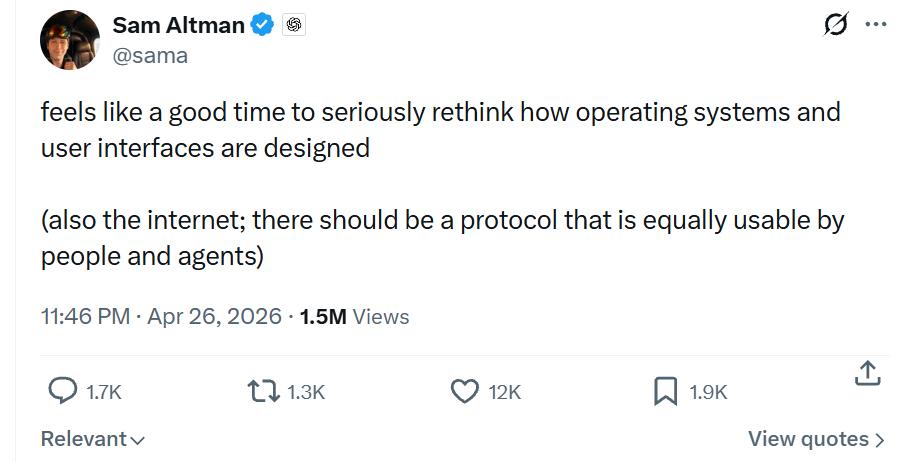
On the same day, Altman posted a tweet saying, "It's time to rethink how operating systems and user interfaces should be designed."
Now there is more information about the specifications of this mobile phone. For example, its processor uses the same process as Apple's next-generation A20 processor; it is manufactured by Luxshare Precision, and the camera module is produced by Sunny Optical.
But interestingly, the highlight of the entire specification sheet is its ISP (image processing chip) with an enhanced HDR pipeline. Its function is to improve the ability to perceive the real world through the camera. It is also equipped with two separate AI processors next to it, which process vision and language respectively at the same time.
Another point that can be seen from the supply chain is that OpenAI has been completely "Apple-ized". Luxshare is one of Apple's most important OEMs, and it is io Products mentioned earlier that facilitated the entire production line.
OpenAI is not learning from Apple to make products, it fundamentally wants to replicate Apple. The only difference is that in the finally delivered device, the default entry is changed from App Store to Agent.
Even at the chip level, OpenAI is following Apple's path. In June 2026, OpenAI and Broadcom jointly released their first custom AI inference chip Jalapeño, which is specially designed for large language model inference, and it only took 9 months from architecture design to manufacturing and tape-out. This chip is not a modified general-purpose GPU, it is deeply customized around the kernel functions, memory movement, network and service modes of large model inference.
Apple built a hardware differentiation barrier with its self-developed A-series and M-series chips, and OpenAI obviously wants to take the same path.
Kuo predicts that if development goes without unexpected issues, the total shipments of OpenAI AI Agent phones in 2027 and 2028 will be about 30 million units, which translates to more than 10 million units a year, roughly the volume of a second-tier brand in the mobile phone industry. Therefore, OpenAI cannot shake the basic market of iOS and Android in the early stage.
But OpenAI's original goal may not be market share. Richard once said that if an Agent wants to obtain the user's current status, it must have full permissions at the operating system level. In other words, OpenAI wants a mobile phone that it has full control over.
So in terms of sales volume, 10 million units is indeed a small volume for OpenAI, let alone for Apple and Samsung.
But if the sales volume can really reach 10 million, it will prove that OpenAI's theory of Agent phones is feasible.

Apple's counterattack
Facing OpenAI's pressing moves, Apple certainly will not wait for its doom. The lawsuit is the most direct counterattack, but it is only the surface. Apple's real hidden card actually lies in its products.
To completely cut off ties with OpenAI, Apple decisively abandoned ChatGPT for its AI models and turned to Google. In January 2026, Apple and Google officially signed a multi-year agreement, paying about $1 billion per year to use Google's Gemini large model to power the new version of Siri and Apple Intelligence.
Another point is that compared with Google, Apple is more worried about OpenAI.
Google already has its own mobile phone, but OpenAI is different, it does not have a mobile phone yet. Moreover, what it is making is not an ordinary mobile phone, but an AI Agent device that may redefine human-computer interaction.
For Apple, Google is far less dangerous than OpenAI. Google's threat is known