Being among the first batch of regions to be "delisted", this northern province has taken the lead in carrying out radical internal self-reform.
National-level Economic and Technological Development Zones (ETDZs) are entering an era of "major reshuffling".
Recently, the Ministry of Commerce announced the 2025 assessment results for the comprehensive development level of national-level ETDZs. Five underperforming ETDZs, namely Jiedong ETDZ in Guangdong, Puyang ETDZ in Henan, Hulunbuir ETDZ in Inner Mongolia, Yingkou ETDZ in Liaoning, and Daqing ETDZ in Heilongjiang, have been removed from the national-level ETDZ roster.
This is the first large-scale "delisting" operation since the *Measures for the Assessment of the Comprehensive Development Level of National Economic and Technological Development Zones (2021 Edition)* was implemented in 2021, which also means that the relevant provinces "shall not recommend provincial-level development zones for upgrading" within the next two years.
Prior to this, Guangdong, Henan, Inner Mongolia, Liaoning and Heilongjiang had 8, 9, 3, 10 and 7 national-level ETDZs respectively. Among them, Inner Mongolia had the smallest number, and now there are only two national-level ETDZs left, namely Hohhot ETDZ and Bayannur ETDZ.
On July 31, the official website of Inner Mongolia updated a document *Implementation Opinions of the People's Government of Inner Mongolia Autonomous Region on Accelerating the Improvement of Development Zones' Development Capacity* (hereinafter referred to as the "Implementation Opinions"), which requires adhering to the principle of optimizing, expanding and strengthening development zones, focusing on optimizing the industrial structure of the parks, expanding the output scale of the parks, and enhancing the overall strength of the parks.
It is hardly a stretch to say that this is a systematic "operation" in response to the "delisting". In recent years, the adjustment of provincial-level development zones in regions including Zhejiang, Liaoning and Sichuan has become increasingly intense. Now that national-level development zones have also entered a period of in-depth adjustment, what kind of signals do Inner Mongolia's series of actions send out? How will these adjustments affect the economic momentum of Inner Mongolia?
01 "Delisting"
As a high-level opening-up platform, national-level ETDZs contributed 11.4% of China's gross domestic product (15.4 trillion yuan) in 2024, and accounted for 1/4 of the country's total import and export volume, actual utilization of foreign capital and tax revenue. Distributed across 31 provinces, they are the engines driving local economic development.
"China's ETDZs have gone through a large-scale expansion period, and it is inevitable that a number of them will be eliminated during the development process, which is a natural phenomenon of economic and social development." Niu Fengr, President of the Small and Medium-sized Cities Research Institute and former Director of the Institute of Urban Development and Environment of the Chinese Academy of Social Sciences, told *City Evolutionism* that when a large number of spatial carriers for industrial agglomeration emerge, most of them are led by government behaviors, but their judgment may not be consistent with the actual economic scale. It is a normal phenomenon that a number of national-level ETDZs are "delisted" after assessment now.
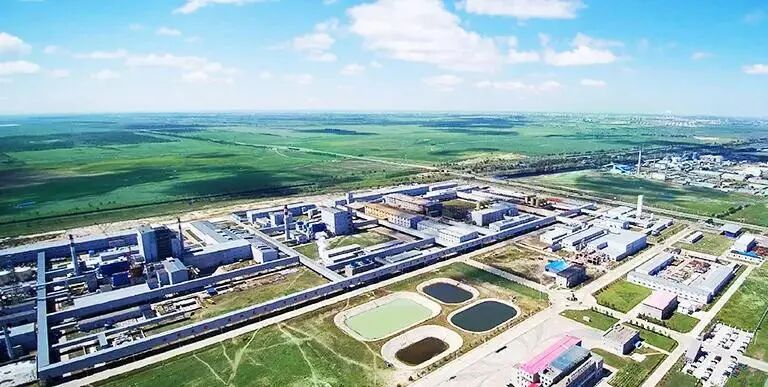
Image source: Administrative Committee of Hulunbuir Economic and Technological Development Zone
This is backed by the evolution of the management mechanism of national-level ETDZs. In 2016, the Ministry of Commerce issued the *Measures for the Assessment of the Comprehensive Development Level of National Economic and Technological Development Zones* (hereinafter referred to as the "Assessment Measures"), marking that national-level ETDZs entered a dynamic adjustment stage, which clarified that "national-level ETDZs that rank in the last 5 for two consecutive assessments shall be reported to the State Council for approval before being removed from the roster". In 2021, the newly revised Assessment Measures began to conduct classified assessment and ranking for the eastern, central and western regions, further strengthening the driving force for transformation:
ETDZs that enter the last 5 of their respective regions twice within three consecutive years will be included in the candidate list for downgrading; the Ministry of Commerce will study and propose the list of zones for downgrading by region based on the average score of the two assessments, and after being approved by the State Council, these zones will be removed from the national-level ETDZ sequence.
This can also be confirmed from the track of "delisting" of ETDZs across the country.
In early 2020, the Ministry of Commerce conducted interviews with 10 underperforming national-level ETDZs to urge rectification. Jiuquan ETDZ in Gansu, which ranked in the last 5 for two consecutive years, became the first national-level ETDZ to be "red-carded and removed". In 2021, Shizuishan ETDZ in Ningxia was removed from the national-level ETDZ sequence, and later Suihua ETDZ in Heilongjiang was also "delisted" from the national-level ETDZ list announced in 2024.
"In this round of adjustment, 228 development zones are involved and 5 are removed at one go. The scale far exceeds the previous case-by-case 'delisting'. In essence, it marks the institutional inflection point of national-level ETDZs shifting from 'lifelong identity system' to 'dynamic capacity management'." Feng Lei, President of Huoshi Creation Industry Research Institute, told *City Evolutionism* that three clear signals are conveyed behind this:
First, the assessment standard has shifted from "total volume worship" to "quality and density". National-level ETDZs are no longer policy enclaves like special economic zones, but functional nodes for China's opening-up and industrial upgrading.
Second, market-oriented reallocation of policy resources. The logic of development zones is no longer "issuing licenses", but signing "performance commitment agreements". The exit mechanism, combined with the associated constraint that "relevant provinces shall not recommend provincial-level development zones for upgrading within two years", has forced all regions to shift from "applying for more zones" to "cultivating zones with high quality".
Third, regional policies have shifted from "universal equalization" to "efficiency priority". The state no longer maintains regional psychological balance through equal distribution of qualification licenses.
Behind this is the shift of the development model of national-level development zones, as well as the logic of cultivating and optimizing provincial and municipal development zones across the country. To a certain extent, the integration of provincial-level development zones in Zhejiang, Liaoning, Sichuan and other regions in the past two years is also an advance "calibration" to grasp the development trend.
02 Structure
Among the five provinces that were "delisted" in this round, Inner Mongolia has the smallest number of national-level ETDZs.
"Inner Mongolia has a huge regional area with a large east-west span, but its total economic volume is not at the top of the country. Industrial development itself requires agglomeration and concentrated construction of infrastructure and business environment. Therefore, the number of development zones in a province or autonomous region should be consistent with the local regional economic development level."
Niu Fengr believes that the "delisting" of Hulunbuir ETDZ is not unexpected, after all, its own economic volume is small, and the conditions for industrial development are not very prominent.
Statistics show that in the first half of 2026, Inner Mongolia achieved a GDP of 12.81 trillion yuan, a year-on-year increase of 4.5%. Among them, the GDP of Hulunbuir was 69.775 billion yuan, a year-on-year increase of 1.9%, ranking 6th and 11th in the region in terms of scale and growth rate respectively.
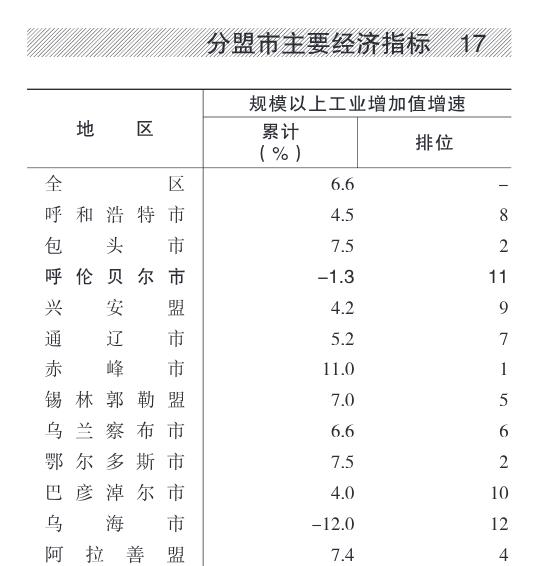
Image source: Hulunbuir Bureau of Statistics
Among them, the growth rate of the added value of industries above designated size in Hulunbuir was -1.3%, which was almost at the bottom of the whole region. To a large extent, this is because Hulunbuir ETDZ, as the "main position" of industrial economic development, has not played a sufficient supporting role.
In Feng Lei's view, Inner Mongolia originally had only 3 national-level ETDZs, and 1 of them was removed, which to some extent explains that this round of adjustment focuses on "the inherent quality of the park" rather than "the quantity held by the province". Hulunbuir is located at the northernmost tip of China, far away from the main trade channels, with an industrial base of energy (it once attracted central state-owned enterprises such as Datang and Huadian, with 193 settled enterprises) and agricultural and livestock product processing. Measuring an ecological barrier zone and energy-base-oriented park with the standard of "export-oriented manufacturing platform" puts it at a natural disadvantage in terms of indicators.
At the same time, the population of Hulunbuir continues to shrink, with a vast territory and sparse population and a long winter. The logistics cost and construction cost are both high, making it difficult to form the density economy required for manufacturing agglomeration. It undertakes the function of a national ecological security barrier, and large-scale industrial expansion itself is restricted by policy red lines, which determines the ceiling of its industrial output value.
In the short term, the sense of policy gain and the attractiveness of new projects may be reduced, but in the long run, Hulunbuir can also further focus on differentiated tracks such as realizing the value of ecological products, ice and snow economy, border trade and port economy.
As the first province to take action after this round of "delisting", Inner Mongolia proposed in the Implementation Opinions that "in principle, no new development zones will be established except for major deployments by the State Council or the autonomous region", and "revoke a number of development zones that have no progress for a long time and have few output values and projects", which is rare across the country.
In Feng Lei's view, this kind of self-restraint shows that the decision-making level has clearly realized that the surplus of parks itself is a kind of financial liability. Behind each inefficient park are precipitated infrastructure investment, staffing cost and land opportunity cost.
In coordination with this, the "park version of supply-side structural reform" is also advancing. In the next three years, the autonomous region's finance will allocate 100 billion yuan to focus on supporting key development zones with "large output scale, good development prospects and prominent industrial characteristics". Water, energy use and pollutant discharge indicators also clearly "prioritize supporting high-quality projects in key development zones in accordance with laws and regulations".
"The 'integration wave' of Inner Mongolia's development zones is on the way, which may be more resolute than the outside world expects. I predict that in the next two to three years, the number of development zones in Inner Mongolia will shrink significantly, and the Hohhot-Baotou-Ordos-Ulanqab urban agglomeration and the economic belt along the Yellow River and the border will undertake most of the integrated industries and elements." he said.
03 Momentum
From the perspective of the national development map, Inner Mongolia, which is "full of unlimited potential in wind and solar resources", is drawing an upward curve.
In January 2025, Inner Mongolia announced that its total economic volume returned to the middle reaches of the country after an interval of 5 years. Entering the 15th Five-Year Plan period, it is moving towards the goal of a regional GDP of 2.67 trillion yuan and a per capita regional GDP ranking among the top 8 in the country.
This depends on the "radiation effect" of the transformation of the industrial system. The outline of the 15th Five-Year Plan of Inner Mongolia points out that positive results should be achieved in building a modern industrial system, with the production capacity of more than 80 products ranking first in the country. Dairy products, rare earth new materials and modern coal chemical industry have been selected as national-level advanced manufacturing clusters, and the scale of computing power and intelligent computing ranks at the forefront of the country.
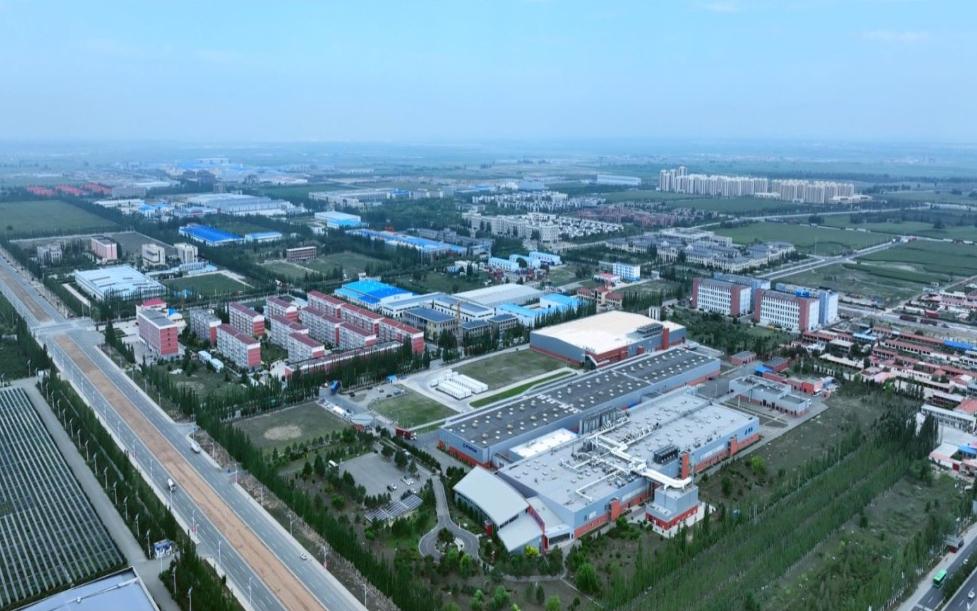
Aerial photo of Hohhot Economic and Technological Development Zone Image source: Xinhua News Agency
Behind this, Inner Mongolia needs to accelerate the transformation of its advantages in energy, resources, location, agriculture and animal husbandry into high-quality development advantages, so as to support the further improvement of its development status and capacity. An unavoidable proposition is how to speed up the integration into the national unified large market and break the implicit barriers to the flow of factors?
Development zones are becoming the key link connecting the upper and lower levels.
According to the plan, by 2030, Inner Mongolia will strive to have about 10 100-billion-yuan-level development zones and about 10 development zones with an output value between 50 billion yuan and 100 billion yuan. The construction, operation efficiency and development capacity of development zones will be significantly improved, and a number of high-level development zones with core competitiveness across the country will be cultivated focusing on advantageous and characteristic industries.
In terms of specific paths, Inner Mongolia emphasizes the need to cultivate new driving forces for the development of development zones, vigorously develop "AI+parks" and "green power+parks", and encourage development zones to adopt green power direct supply modes such as green power direct connection and new energy access to incremental distribution networks nearby.
"This is not only the re-adaptation of development zone factors and emerging industries, but also a landmark sample of the new paradigm of China's regional competition." Feng Lei believes that this is a shift from cost competition to energy attribute competition, which is an underestimated "re-pricing of factor endowments" in Inner Mongolia.
The marginal utility of the "three old items" of traditional development zones (land, tax revenue and labor force) is gradually drying up, but Inner Mongolia holds a non-replicable card in its hand: electric power converted from wind and solar resources with both price advantages and green attributes. Under the "dual carbon" goal, the location decision-making of high-energy-consuming industries such as electrolytic aluminum, crystalline silicon, hydrogen energy, green chemical industry and computing power is changing from "close to the market" to "close to green power".
In Feng Lei's view, what Inner Mongolia has done in the past few years is actually a "factor conversion project" under the guidance of national strategy. The first level of conversion is from wind and solar energy to green power, the second level is from green power to green manufacturing, and the third level is from green power to green computing power to intelligent industry.
For example, "green power+parks" and green power direct connection essentially inject the price advantage and green attribute of electricity into the cost curve and carbon footprint of industrial products. The construction of national-level zero-carbon parks in Mengsu Park of Ordos and Baotou Rare Earth High-tech Zone is a vivid epitome of Inner Mongolia's industrial transformation.
Furthermore, Inner Mongolia's energy advantages have also extended to the energy base of the AI industry.
"What Hulunbuir's 'delisting' removes is the end of the old industrialization logic, while what the Implementation Opinions aims to build is a new framework of three-level conversion of green power - manufacturing - computing power." Feng Lei believes that China's park economy is shifting from the first half of "quantity expansion and policy arbitrage" to the second half of "capacity competition and factor innovation".
"Inner Mongolia has seized the right opportunity for development, and has grasped the timing and intensity of transformation well. The development of local economy requires the optimal combination of its own resource endowments to aim at the correct direction." Niu Fengr said.
This article is from the WeChat official account "City Evolutionism", written by Dan Zhongkui, and published with authorization from 36Kr.