Rumors have spread that the renowned unicorn automotive enterprise has seriously delayed deliveries and fooled customers. The founder responded that none of these claims are supported by evidence, and they will take measures in accordance with the law. "I have long maintained communication with the U.S. traffic administration, which has given positive affirmation."
"Delivering vehicles is our core priority. Installing inventory parts on vehicles is a legitimate operation for automakers. The so-called 'severe delivery delay' and 'deceiving users' are unsubstantiated statements." On August 4, Han Wen, Founder, Chairman and CEO of Weidu Technology, responded to recent rumors that the company was caught in operational turmoil in an exclusive interview with a reporter from *National Business Daily*.
A few days ago, some reports claimed that Weidu Technology, a Robotruck (autonomous driving truck) unicorn that once received huge capital attention, had problems such as delayed salary payment, and questioned that it had severe delivery delays to overseas users and assembled vehicles haphazardly to obtain funds. Regarding the compliance of overseas vehicles that the public is concerned about, Han Wen told reporters that he has long maintained communication with the National Highway Traffic Safety Administration (NHTSA) of the United States, and has registered every vehicle in the US, "the relevant authority gave positive affirmation."
"We have sent lawyer's letters to relevant media and will take legal measures in accordance with the law," Han Wen told reporters.
Behind this public opinion turmoil of Weidu Technology, the Robotruck track is ushering in a new round of capital attention. Autonomous driving trucks are moving from the technical verification stage to the commercial verification stage, and the industry pattern has begun to show obvious differentiation.
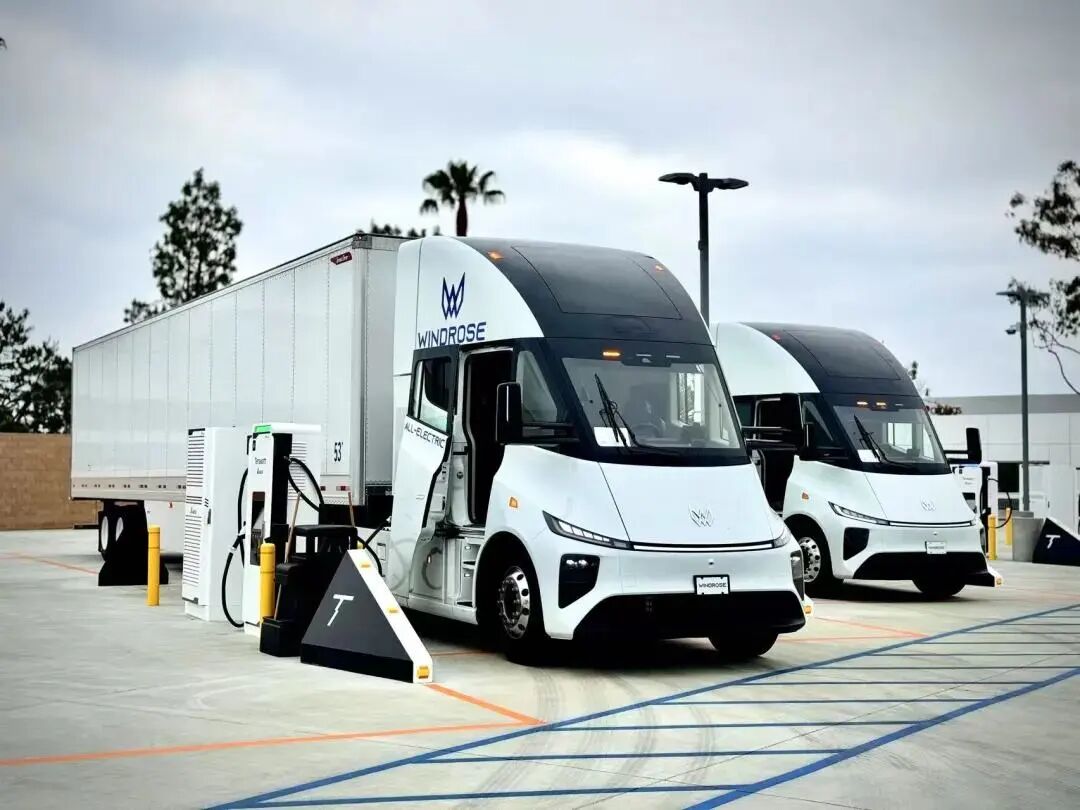
Image source: Weidu Technology official website
Capital re-bets on the track, financing and IPO activities heat up simultaneously
The development path of Robotruck has not been all smooth. In 2023, Embark, a star US autonomous driving truck enterprise, was acquired; in 2024, TuSimple, once known as "the first global autonomous driving truck stock", completed privatization and delisted from NASDAQ. This series of events once made the market re-examine the feasibility of Robotruck commercialization, and significantly cooled down the financing of the entire industry.
However, since the beginning of 2026, the market trend has begun to change. After years of technology accumulation, Robotruck is gradually moving from the pure R&D investment stage to the order verification and commercial implementation stage. The focus of capital has also shifted from "whether the technology is feasible" to "whether the business model is viable".
According to incomplete statistics from reporters, the publicly disclosed financing amount in the Robotruck track since 2026 has exceeded 80 billion yuan. If the financing disclosed since 2025 is counted together, the number of Robotruck financing events has exceeded dozens, and the total financing amount has exceeded 100 billion yuan. Since the beginning of this year, there have been multiple large-scale financing cases of more than 10 billion yuan in the Robotruck track.
At the same time, capital has also begun to flow more concentratedly to leading enterprises. For example, since the beginning of this year, KargoBot has completed a Series B financing of over 100 million US dollars; DeepWay has added a large amount of financing in its Pre-IPO round, with a total raised capital of over 310 million US dollars in this round; Sunu Auto recently closed a 3 billion yuan Series C financing; Lingyi Auto has completed a total of about 28.8 billion yuan in financing within this year.
Compared with the previous widespread "scattered sprinkling" investment in the industry, capital now prefers to concentrate on enterprises with commercialization capabilities, order acquisition capabilities and mass production capabilities.
In addition to financing, what is more noteworthy is that the pace of IPO (Initial Public Offering) has accelerated significantly. For example, Inceptio Technology (03881.HK) became "the first commercial vehicle intelligent driving stock" on the Hong Kong Stock Exchange at the end of 2025; DeepWay submitted its prospectus to the Hong Kong Stock Exchange in November 2025; Trunk Technology also submitted its listing application to the Main Board of the Hong Kong Stock Exchange.
With a number of enterprises carrying out intensive financing or promoting IPOs, the Robotruck industry is forming a capital cycle of accelerated development. From the perspective of industry pattern, the domestic autonomous driving truck track has gradually formed a diverse camp of "listed echelons + new vehicle-making forces + traditional automakers".
On the one hand, companies such as Pony.ai, Inceptio Technology and KargoBot focus on the trunk logistics scenario to promote the commercial implementation of unmanned freight; on the other hand, enterprises such as Inceptio and Trunk Technology are deeply engaged in closed scenarios such as mines and ports, and accelerate technology verification and commercialization through a relatively stable operating environment. At the same time, autonomous driving technology suppliers such as Horizon Robotics and Momenta have also begun to deeply participate in the construction of the whole vehicle and operation ecosystem, further promoting the coordinated development of the industrial chain.
Robotruck begins to deliver commercial value
From the perspective of the industry, the reason why Robotruck first lands in the trunk logistics scenario and gradually becomes the key direction of capital attention is that its business model has strong certainty.
According to public data, fuel and driver salaries account for more than 40% of road freight costs, and the truck driver profession is facing the problem of shortage of new workforce to replace the retiring generation. The demand for cost reduction and efficiency improvement provides an entry window for autonomous driving technology.
"There is a shortage of truck drivers, and some of our own truck drivers have been transferred to safety officers or testers. From our practical experience, the new generation of heavy truck drivers is in very short supply," He Xing, Vice President of Pony.ai and Head of its Truck Division, said in an interview with reporters.
The research report of Changjiang Securities points out that trunk logistics undertakes more than 70% of the cross-regional commodity circulation in China. The high-speed transportation scenario has a high degree of standardization, customers have stronger willingness to pay, and the commercial return path is clearer.
At the same time, the end-to-end autonomous driving technology is maturing rapidly, large models continuously improve the system generalization ability, the cost of core sensors such as LiDAR continues to drop, and the intelligentization of passenger vehicles drives the industrial chain to gradually mature, which further reduces the R&D and mass production threshold of Robotruck.
According to the previous forecast of *Research Report on Autonomous Driving Industry for Highway Trunk Logistics*, starting from 2025, global autonomous driving trucks will enter the stage of large-scale verification of fully unmanned products, and the domestic related market size is expected to exceed 4 trillion yuan by 2030.
Clear market demand, mature operation scenarios and continuously improved industrial chain jointly promote Robotruck to take the lead in entering the fast track of commercialization. However, what really attracts capital to return again is not only the mature technology, but more importantly, the business model has begun to work. Different from the past when autonomous driving enterprises relied more on project-based income, more and more Robotruck enterprises are now exploring sustainable and replicable business models.
Take KargoBot as an example, the company has proposed two modes: TaaS (Transportation as a Service) and SaaS (Software as a Service). Among them, the SaaS mode is regarded as the mainstream business model in the next 1 to 2 years, and also the core incremental source in the next few years. According to Li Xiaoxiao, COO (Chief Operating Officer) of KargoBot, the company adopts the "hardware sales + software subscription" mode, that is, after customers purchase vehicles, they pay for the autonomous driving software service on a monthly basis. This mode can not only reduce the capital pressure in the process of enterprise expansion, but also help form continuous service income.
More importantly, the value created by Robotruck is extending to the entire transportation chain. Li Xiaoxiao said: "At present, the cost of a single road freight order mainly includes driver salary, energy, vehicle depreciation, maintenance and tolls, etc. Except for tolls, all other costs have room for optimization."
He pointed out that L4 autonomous driving can reduce labor costs, autonomous driving platooning can further reduce energy consumption, and the new generation of heavy trucks redesigned for autonomous driving can also help reduce vehicle depreciation and maintenance costs.
From technology competition to commercial competition, the industry enters the knockout stage
Although capital is re-betting on Robotruck, behind the capital boom, the competition rules of the industry are also changing. As Robotruck gradually moves from technical verification to commercial implementation, the core of enterprise competition is no longer only algorithm capability and financing scale, but whether it can complete vehicle delivery, establish an operation system, and form a sustainable business model.
In other words, the financing logic of Robotruck is shifting from "believing in the future" to "verifying the reality".
The recent controversy triggered by Weidu Technology also reflects from the side that the industry is entering a more stringent commercial verification stage, and the industry competition environment is changing.
In the past few years, autonomous driving truck enterprises competed more on technical routes, R&D teams and financing capabilities; but after entering the commercialization stage, enterprises not only need to prove that the technology is feasible, but also need to prove that the business model is sustainable.
In fact, the commercialization of autonomous driving trucks is not a simple technological upgrade, but a comprehensive competition involving vehicle manufacturing, operation system, safety capability and capital strength. Among them, safety capability is becoming an important threshold for the long-term development of Robotruck enterprises.
"If we talk about heavy trucks, Robotruck is definitely more difficult," He Xing said in an interview with reporters. Because heavy trucks have high speed and heavy body, once a collision occurs, the consequence of the accident will be more serious. Therefore, if you want to realize large-scale unmanned operation in long-distance high-speed scenarios, Robotruck naturally has a higher threshold.
However, in He Xing's view, a high threshold is not a bad thing for the industry. "If the threshold is too low, it will easily lead to the bad money driving out the good. Everyone will pay too much attention to cost and so-called scale, and lose some designs for the ultimate safety. Once a major accident occurs, it will be a devastating blow to the industry."
In fact, as autonomous driving enters the stage of large-scale application, the industry's requirements for the safety system are also improving. Many insiders believe that in the future, the competition of Robotruck enterprises will no longer only be the competition of algorithm capability and technical route, but the comprehensive competition of safety system, operation system, manufacturing system and commercial system.
This also means that the Robotruck industry is ushering in a new round of screening process. On the one hand, leading enterprises with capital strength, mass production capacity, customer resources and operation experience are expected to further expand their scale with the help of the capital window and accelerate commercial implementation; on the other hand, enterprises lacking sustainable financing capacity and slow commercialization progress will face greater survival pressure.
(Disclaimer: The content and data of the article are for reference only and do not constitute investment advice. Investors who operate accordingly shall bear their own risks.)
This article is from the WeChat Official Account "National Business Daily", Author: Liu Xi, Editors: Duan Lian, Yu Tingting, Du Hengfeng, Proofreader: Liang Luyue, Published with authorization from 36Kr.