2026 FIFA World Cup USA-Canada-Mexico Live Broadcast Report
Based on multi-source data including China Audiovisual Big Data, iResearch Big Data and UserTracker, this paper conducts a comprehensive review of the live broadcast performance and social media communication of the 2026 FIFA World Cup in USA, Canada and Mexico (104 matches in total) from June 12 to July 20, 2026. The popularity of the 2026 FIFA World Cup matches presents the characteristics of "rising sharply in the early stage and declining stage by stage" along with the schedule. On the opening day, the total social media mentions across all platforms reached 1.13 million, with over 110 million interactions, hitting the peak of the cycle. Star player effect and upset results are the core traffic variables. Although the knockout stage has higher competitive intensity, the attention to the final is even lower than that of many early knockout matches due to the fading of user freshness and the kick-off time at early morning Beijing time. On the large-screen end, CCTV5 of China Media Group accounts for nearly 80% of the total viewing person-times and 86.4% of the total viewing duration, forming the national basic access for watching matches. The mobile end presents a three-layer structure of "Migu taking the lead, Yangshipin following up, and Xiaohongshu breaking into the public view". Migu steadily occupies the core position with a 54.3% user share, and its technological innovations such as AI 3D match viewing and multi-perspective live broadcast form a differentiated division of labor with Yangshipin's exclusive copyright and Xiaohongshu's community content marketing. China Media Group coordinates signal distribution and copyright control, while the three authorized platforms adopt a collaborative mechanism of "shared foundation + differentiated self-produced content". Chinese enterprises' sponsorship of the World Cup started to break the ice in 2010, reached its peak in scale at 1.395 billion US dollars in 2022, and shifted to "precise and in-depth operation" in 2026. Cases such as cross-border co-branding between Mengniu and Hisense, and Wanglaoji's signing of cooperation with Haaland show that Chinese brands' World Cup marketing is moving from extensive exposure to value win-win of co-construction of technology and long-term emotional narrative.
I. World Cup Live Broadcast Analysis
Summary of Official World Cup Data
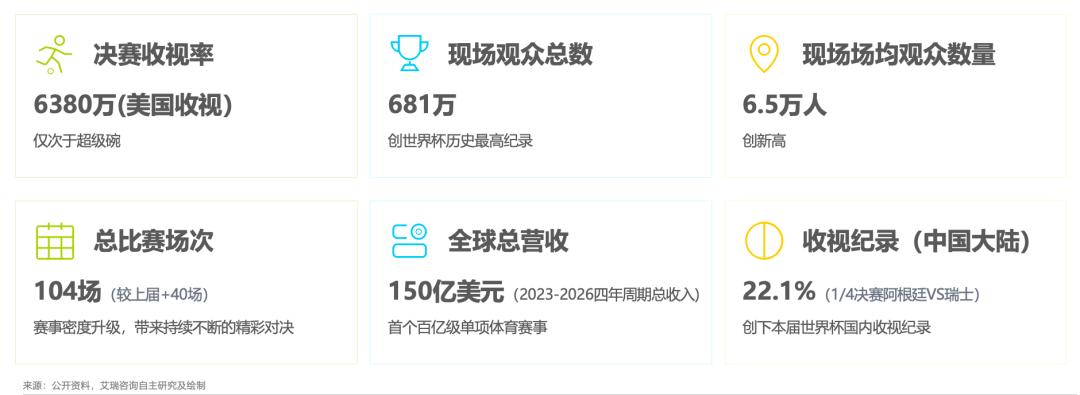
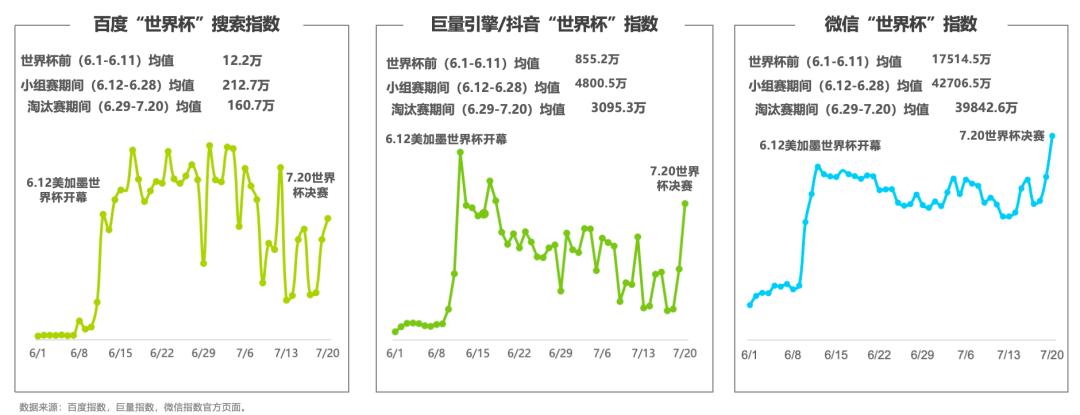
2026 World Cup Popularity Index
Popularity surged sharply after the opening, the group stage had the highest popularity, and the overall popularity declined in the knockout stage. Short video platforms saw the fastest decay of user freshness, while WeChat social scenarios retained the most lasting popularity. The popularity of information and short video platforms declined in the second half of the tournament, and social platforms completed the final rebound of popularity to a new high relying on the final-related topics.
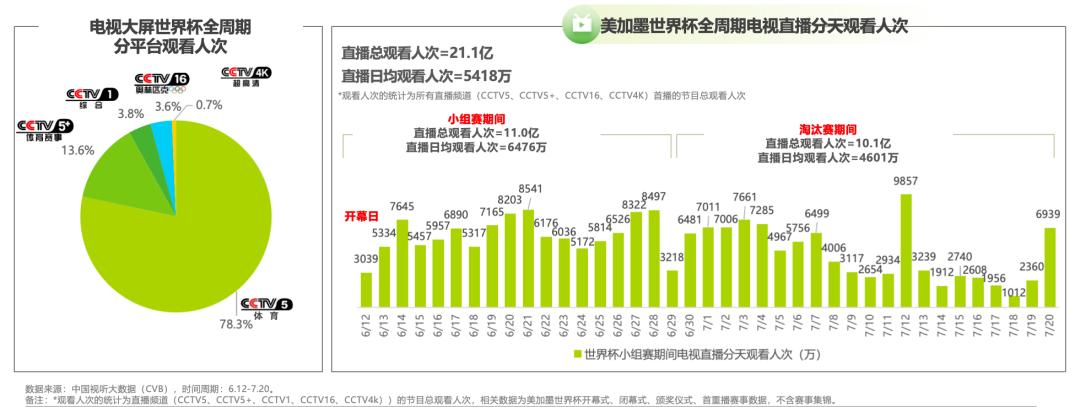
Large-screen End: CCTV TV Live Viewing Performance (1/2)
CCTV5 is the core viewing channel; the cumulative and average daily viewing volume in the group stage is higher than that in the knockout stage, and the top match in the knockout stage sets the highest single-day viewing record in the whole cycle.
From June 12 to July 20, China Audiovisual Big Data (CVB) shows that the viewing differentiation at the channel level is extremely obvious, with CCTV5 accounting for nearly 80% of the total viewing person-times, and the daily viewing trend in the group stage is relatively stable. The differentiation in the knockout stage is obvious, the key match at the final stage sets a single-day viewing peak of 98.57 million person-times, and the viewing volume drops sharply in the period without high-profile matches.
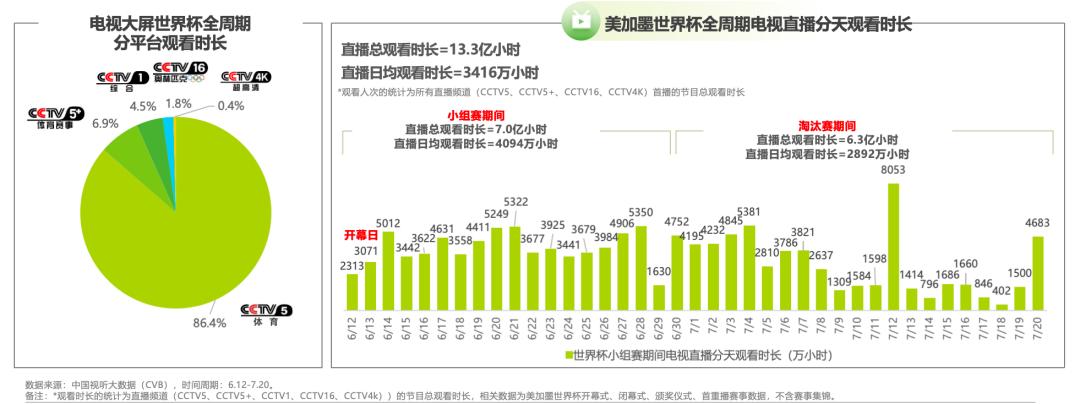
Large-screen End: CCTV TV Live Viewing Performance (2/2)
CCTV5 is the absolute core channel for TV large-screen match viewing; the total TV viewing duration and average daily viewing volume in the group stage are higher than those in the knockout stage, and the peak single-day viewing duration appears at the key match node of the knockout stage.
From June 12 to July 20, China Audiovisual Big Data (CVB) shows that CCTV5 accounts for 86.4% of the total large-screen viewing duration in the whole cycle, CCTV5+ accounts for 6.9%, and channels including CCTV1, CCTV16, CCTV4K account for less than 7% in total. Mainstream sports channels are the first choice for the public to watch matches on TV. The daily viewing duration trend in the group stage is gentle, and the peak of 80.53 million hours in the whole cycle appears in the knockout stage.
Large-screen End: Migu Video Large-screen End
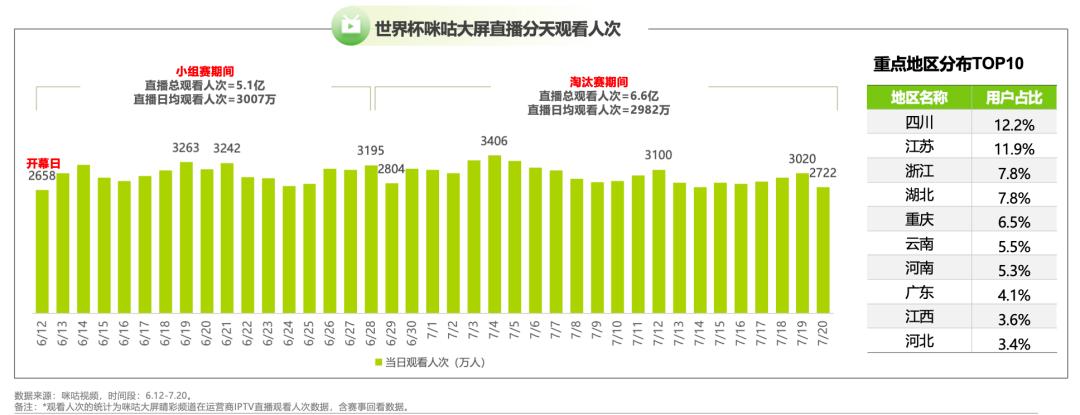
The total number of viewing person-times in the knockout stage on Migu's large-screen end is higher than that in the group stage, the average daily viewing volume of the two stages is basically the same, the overall viewing trend is stable with small fluctuations, and provinces in southwest and east China are the core audience areas for large-screen match viewing.
From June 12 to July 20, the gap between the average daily viewing person-times in the group stage and the knockout stage is small, with 30.07 million per day in the group stage and 29.82 million per day in the knockout stage. The daily viewing volume on the large-screen end is very stable on the whole. The single-day viewing peak appears in the knockout stage, reaching a maximum of 34.06 million person-times, and the key promotion matches are easier to drive family users on the large screen to watch.
Large-screen End: Migu Video Large-screen End (Migu Vision)
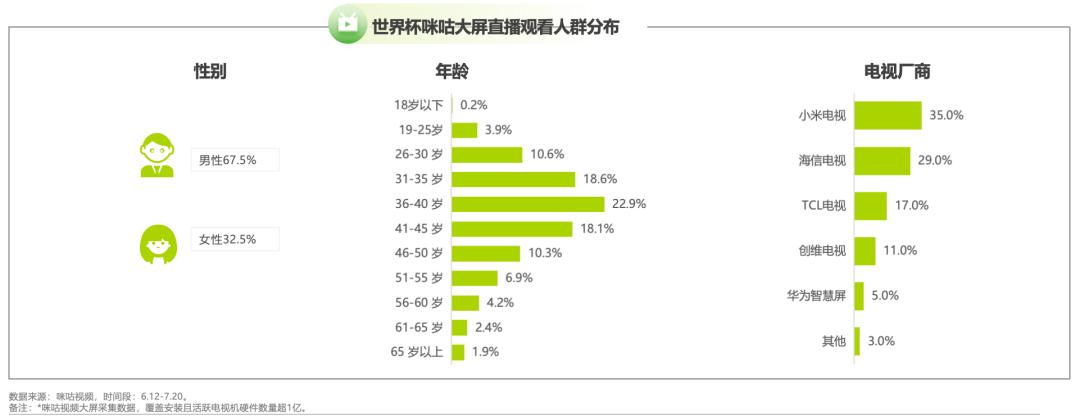
The audience of Migu's large-screen match viewing is mainly young and middle-aged men, and the 31-45 age group is the core audience; in terms of hardware, Xiaomi TV and Hisense TV users account for a higher proportion.
From June 12 to July 20, male viewers account for 67.5% of Migu's large-screen users, while female viewers only account for 32.5%, and the audience of watching football matches on large screens has a very distinct male characteristic. The proportion of young users under 18 years old and elderly users over 65 years old is very low, and young and middle-aged office workers are the main force of large-screen match viewing. Xiaomi TV ranks first with 35% share, followed by Hisense with 29%, and the two brands together account for more than 60% of users.
Large-screen End: Xiaohongshu Screen Casting
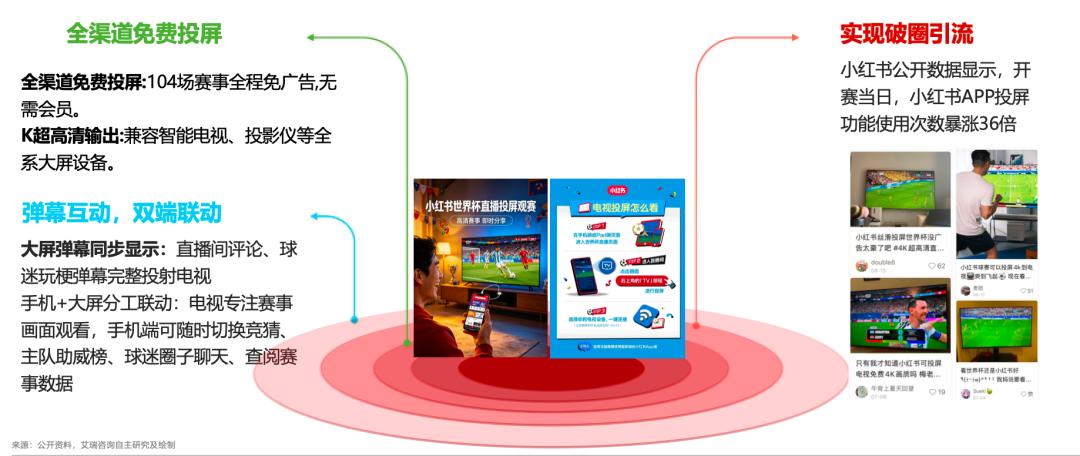
With the help of the screen casting function, it makes up for the shortcomings of the large screen, breaks the limitation of the graphic and text attribute of the mobile end, benchmarks against mainstream platforms, and extends user stay time.
World Cup Live App Viewing Performance
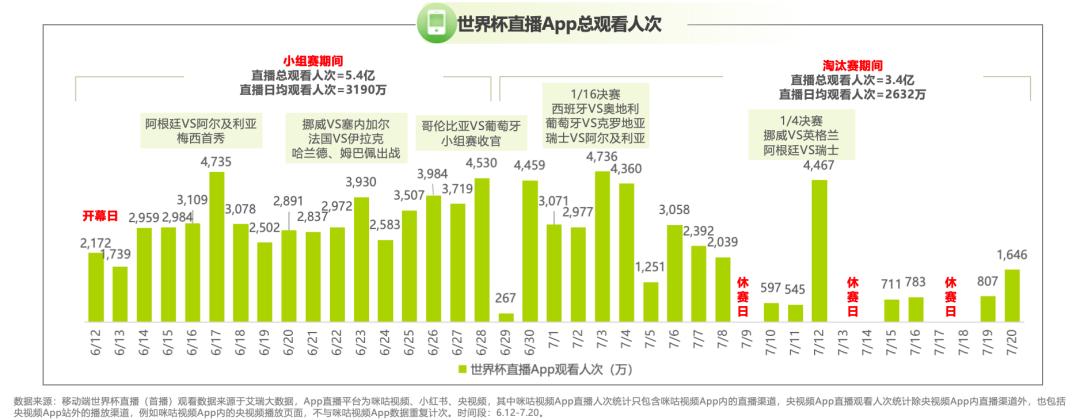
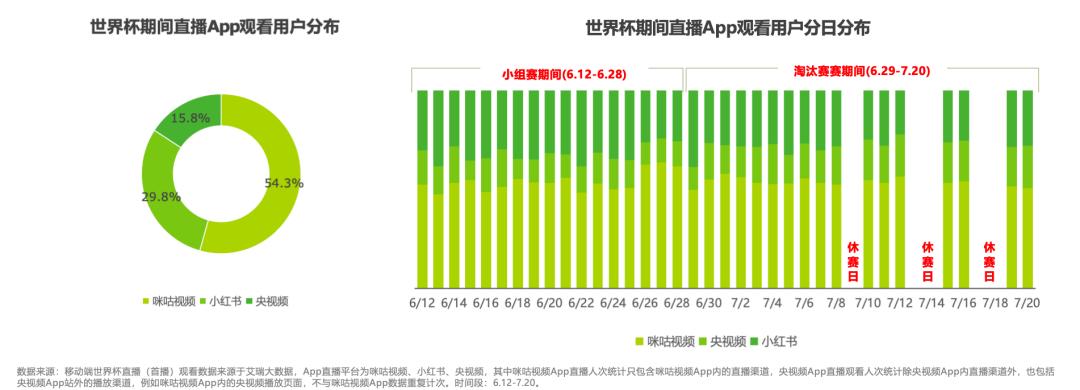
Mobile users are less affected by the match time, the star-focused matches drive the single-day viewing volume to rise sharply, and the number of viewing person-times drops sharply on rest days.
According to the monitoring of iResearch Big Data, the total number of live viewing person-times on mobile terminals in the group stage of the whole cycle is 540 million, with an average of 31.9 million per day, and the total number of viewing person-times in the knockout stage is 340 million, with an average of 26.32 million per day. The viewing volume declined as a whole in the middle of the tournament (June 18-June 22), and many matches with large strength gaps reduced users' willingness to watch online. The viewing volume continued to rise in the last round of the group stage (June 23-June 28). Although the average daily traffic in the knockout stage is lower than that in the group stage, the quarter-final match between Argentina and Switzerland still received 44.67 million high viewing person-times, which proves that in the single-elimination stage, high-suspense promotion do-or-die matches can still fully mobilize users to open the App to watch the live broadcast. Affected by the kick-off time, the number of viewing person-times of the semi-final and final is relatively low instead.
World Cup Live App Viewing Share
Migu is the core traffic platform for mobile live broadcast, the overall hierarchical relationship is relatively stable during the tournament, and Migu's share increased significantly in the last round of the group stage.
The gap in platform traffic share is significant. Migu Video occupies an absolute leading position with a 54.3% user share, Yangshipin forms the second echelon with a 29.8% share, and Xiaohongshu has the lowest share of 15.8%. From the daily viewing trend, Migu's daily user volume leads the two competitors throughout the whole process, with the best user retention and daily opening stability, and is the public's preferred World Cup live broadcast platform. Xiaohongshu enters the sports live broadcast track relying on the attribute of content community, but fails to shake the mainstream position of professional sports video platforms.
II. Social Media Communication Analysis
World Cup Social Media Mentions Volume
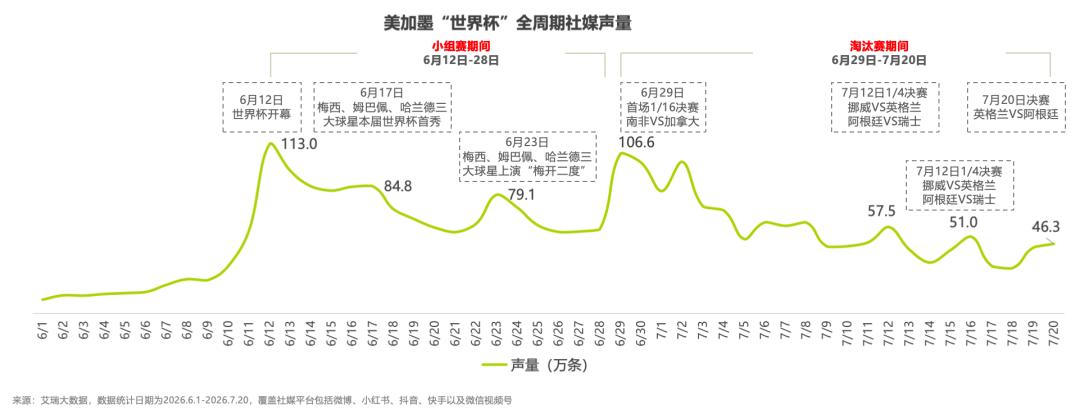
The total social media mentions volume of the 2026 FIFA World Cup across all platforms shows a trend of rising sharply in the early stage and declining stage by stage. The opening ceremony, the appearance of star players, and the start of the knockout stage are the three major peak nodes of traffic, and the public discussion popularity continues to decline in the later stage of the tournament.
The opening of the World Cup ushered in the highest point of popularity in the whole cycle: on the opening day of the World Cup on June 12, the number of mentions reached 1.13 million, which was the peak of public opinion in the whole period, and the official start of the tournament quickly ignited the public discussion atmosphere across all platforms. The popularity in the group stage is continuously maintained by star matches, and top stars such as Messi, Mbappé, and Haaland played one after another, constantly driving small peaks of public opinion. The start of the knockout stage set off the second round of upsurge, and the number of mentions in the round of 16 on June 29 rose to 1.066 million. Entering the quarter-final stage until the final stage, the public opinion popularity gradually declined and was lower than the early level, users' early discussion enthusiasm was consumed, and the communication attractiveness in the second half of the tournament decreased significantly.
World Cup Social Media Interaction Volume
The freshness of the tournament determines the interaction intensity. The overall social media interaction volume of the World Cup presents a peak of popularity in the early stage of the group stage, and then continues to decline in a stepwise manner. The opening match and upset matches bring two rounds of the highest interaction peaks. After entering the knockout stage, users' interaction enthusiasm fades, and the final interaction volume drops to the low level of the cycle.
On June 12, the interaction volume of the World Cup opening reached 114.19 million times; on June 16, the upset draw of Spain refreshed the peak to 115.45 million times again, which was the highest point of interaction in the whole tournament cycle. The opening topic and the upset match event maximized the willingness of netizens to like, comment and repost. As the schedule advances, regular star-to-star matches are difficult to continuously stimulate user participation. The match where three top stars competed on the same field on June 23 only brought 58.31 million interactions, which was almost halved compared with the early peak, and the public's freshness gradually faded. At the beginning of the tournament, the public's expectation value is the highest, and the interaction is the most active; the later the schedule goes, the stronger the user's sense of burnout. Even if the competitive confrontation is more intense, the participation of social media interaction continues to decline.
