The 54-billion-yuan transaction has been officially announced, making the largest merger and acquisition in the history of the radiopharmaceutical sector come into being.
A landmark deal that reshapes the global radiopharmaceutical sector has been announced.
On August 3, 2026 local time, two nuclear medicine companies, Curium Pharma (hereinafter referred to as Curium) and Lantheus Holdings, Inc. (hereinafter referred to as Lantheus), officially signed a merger agreement. Curium will acquire all outstanding shares of Lantheus at a cash price of $102.5 per share, with a base consideration of $7 billion. If the sales milestone is reached before 2030, shareholders can additionally receive a Contingent Value Right (CVR) of up to $12 per share, bringing the total transaction consideration to a cap of $8 billion (approximately 54 billion RMB). This M&A deal sets a new record for the largest transaction amount in the history of the radiopharmaceutical sector.
The Lantheus board of directors approved the transaction by a unanimous vote. Curium stated that the merged operation will cover patients in oncology, neuroscience and cardiology across more than 70 countries. The two companies expect to complete the closing in the first half of 2027 after obtaining approval from Lantheus shareholders and regulatory authorities.
Before the official announcement of this transaction, rumors emerged at the end of May 2026, which already drove a sharp rise in Lantheus' share price at that time. However, in this official agreement, the offer price of $102.5 per share still represents a 38% premium to the 60-day weighted average price before the announcement. The Lantheus board of directors described this as "the path to value maximization".
Renaud Dehareng, CEO of Curium, emphasized the significance of this M&A in the announcement: "Lantheus is the ideal partner that accelerates the integrated diagnosis and treatment platform we have been building. This merger unlocks opportunities that neither company could achieve on its own."
01 Two-way Complementary Demand
Although the $8 billion price cap is very considerable, the highlights of the merger between Curium and Lantheus should not be limited to capital operations. This M&A is an inevitable choice for the two companies, as they each have structural shortcomings that can perfectly complement each other.
Looking at Lantheus first, the characteristics of this enterprise can be summarized as: it holds a leading position in diagnostic access, but its growth has hit a ceiling.
Founded in 1956, Lantheus is one of the first enterprises in the United States to deploy medical isotopes on a large scale. Its core asset Pylarify (piflufolastat F-18) is a PET imaging agent targeting prostate-specific membrane antigen (PSMA). Since it was approved by the FDA in May 2021, it has become the product with a leading market share in the US PSMA PET imaging agent market.
As of September 2025, Lantheus has completed more than 500,000 scans in total. In the first quarter of 2026, Lantheus recorded global revenue of 377.3 million US dollars, with the three products Pylarify, Definity and Neuraceq contributing the vast majority of this revenue.
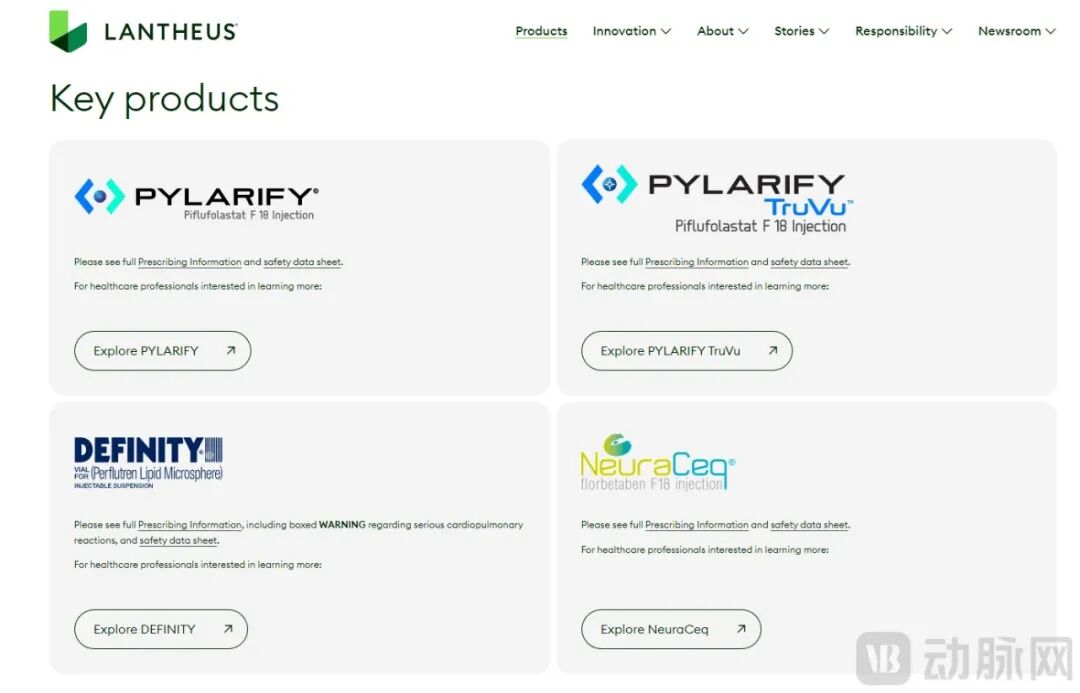
Main products of Lantheus
However, Lantheus also has structural shortcomings. First of all, the company lacks fully independent medical isotope production capacity, and the raw materials for its imaging agents rely on external procurement. More critically, its pipeline is fully focused on the diagnostic track, with no marketed or near-marketed radiotherapeutic products.
In 2025, the PSMA targeted therapeutic drug PNT2002, which Lantheus co-developed with Eli Lilly, had its marketing application suspended in the Phase III trial due to unfavorable overall survival data and interference from cross-treatment of patients. This setback cast a shadow over the commercialization prospects of its therapeutic pipeline, and also exposed the growth ceiling of the "strong diagnosis, weak treatment" model: diagnosis can divert patient flow, but cannot share the high-value returns from the treatment end.
In contrast, Curium holds isotope production capacity and therapeutic pipelines, but lacks sales channels in the United States.
Curium is controlled by private equity firm CapVest Partners, with more than 3,800 employees worldwide and operates more than 80 manufacturing sites. Its core barrier lies in its globally distributed medical isotope production lines, which can stably supply key therapeutic nuclides such as Lutetium-177 and Actinium-225. At the same time, the 177Lu-PSMA-I&T injection, for which Curium leads the Phase III clinical trials and commercialization, has submitted a clinical trial application to China's CDE in January 2026, and obtained the implied clinical approval within the first quarter of 2026.
Curium's advantages lie in its manufacturing and distribution networks in Europe and the Asia-Pacific region, but it lacks a direct sales system for local hospitals in the United States. In 2025, Curium completed a large-scale extension fund capital restructuring at a valuation of $7 billion, introducing institutions such as ICG, TPG and CVC to reserve sufficient capital for this acquisition.
For this M&A, Curium adopted a composite payment structure of "fixed cash + milestone CVR". The one-time cash settlement allows Lantheus shareholders to obtain definite short-term returns; while the CVR tied to the sales target before 2030 allows Curium not to pay high costs in advance for uncertain long-term sales volumes.
02 What Makes This the "Largest Deal in History"?
In the M&A landscape of the radiopharmaceutical sector in the past three years, there have been many high-value representative cases.
In 2022, Novartis' Pluvicto was approved for marketing, becoming the first "billion-dollar molecule" in the radiopharmaceutical sector, and its annual sales in 2025 had approached 2 billion US dollars. This demonstration effect triggered large-scale collective deployment by multinational pharmaceutical companies.
In 2023, Bristol Myers Squibb acquired RayzeBio (Ac-225 alpha therapeutic pipeline) for 4.1 billion US dollars. In 2024, AstraZeneca acquired Fusion Pharmaceuticals for 2.4 billion US dollars, and Eli Lilly acquired Point Biopharma for 1.4 billion US dollars. In 2026, Regeneron and Telix Pharmaceuticals announced a cooperation based on a 50/50 cost and profit sharing model.
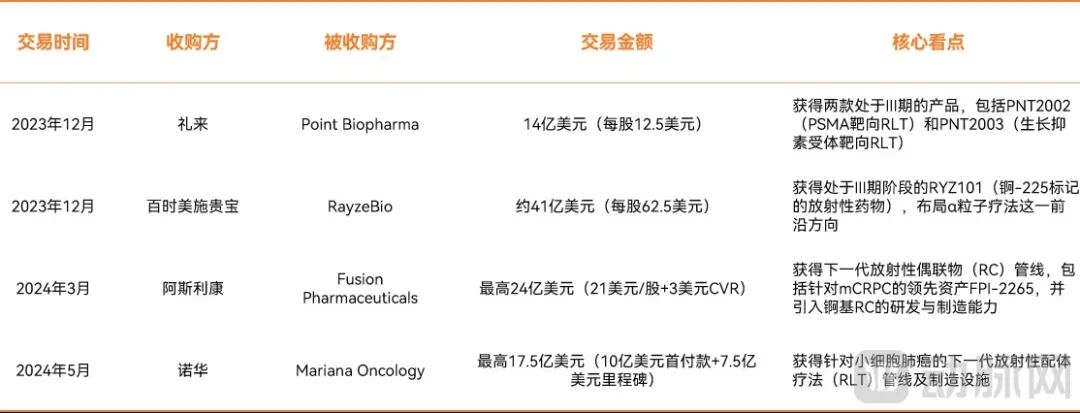
Representative M&As in the global radiopharmaceutical sector
The $8 billion deal between Curium and Lantheus has refreshed the M&A amount record of the radiopharmaceutical track. However, the historical status of an M&A in the industry is determined not only by its amount, but also by the depth of integration of the business itself and the degree to which it rewrites the industry's competition logic.
The biggest difference between the Curium-Lantheus M&A and previous transactions is that the previous M&As in the radiopharmaceutical sector mostly focused on the acquisition of products or pipelines, while the Curium-Lantheus deal is the first full-chain integration that brings multiple links including isotope manufacturing, diagnostic access, therapeutic pipelines and global channels into the same system at the same time.
Furthermore, the industry significance of this transaction is reflected in three dimensions.
First, it upgrades the competition standard of the radiopharmaceutical track from a single drug to a complete chain covering isotopes, diagnosis and treatment. The merger of Curium and Lantheus is essentially a strategic link between "upstream raw material supply" and "downstream market channels". The competition of radiopharmaceuticals has gone beyond the contest of single molecules, and entered the era of full industrial chain ecological competition of "nuclide raw materials + logistics distribution + equipment collaboration + hospital network".
Second, it further verifies that the "diagnosis locks treatment" model conforms to the most urgent clinical needs and has natural commercial value. In the RLT (Radioligand Therapy) track, patients must confirm high target expression through PET imaging before they are eligible for targeted radiotherapy. Novartis relies on its own imaging agents to form a closed loop with Pluvicto, while Curium acquires the PET imaging agent Pylarify to pair with its self-developed therapeutic pipeline. The two paths are different, but the logic is identical.
Third, it sorts out three radiopharmaceutical assets with extremely high entry barriers according to their construction difficulty: the most difficult one is isotope production capacity, followed by diagnostic access, and then the therapeutic pipeline. The global supply of medical isotopes is tight, and clinical trials of many enterprises have been suspended due to isotope supply interruptions. Curium has globally distributed production bases, which constitutes the most fundamental asset of this M&A. After the acquisition of Pylarify, the latter as a diagnostic access determines which patients can enter the RLT treatment process, making it the second scarcest asset. The therapeutic pipeline is the final realization tool of value, but the premise is that the first two assets are in place first.
From the perspective of manufacturing and channels, Curium operates more than 80 radiopharmaceutical production facilities around the world, distributed in Europe, North America and the Asia-Pacific region. Lantheus' products such as Pylarify previously relied on third-party suppliers for isotope raw materials, and can be directly connected to Curium's own production capacity after the merger.
Curium's distribution networks in Europe and Asia-Pacific can also support the overseas market expansion of Lantheus' imaging agents, which is the area that Lantheus failed to effectively develop for a long time in the past. In turn, Lantheus has established a direct sales team covering nuclear medicine departments across the United States and a medical insurance access system in the US market. This system will become a key channel for Curium's therapeutic pipelines to enter US hospitals.
03 Diagnosis and Treatment Closed Loop Becomes the Core Competition Logic
Lantheus' Pylarify is currently the most widely used prostate cancer PET imaging agent in the United States. In the clinical pathway of PSMA targeted RLT therapy, the imaging agent is the starting point, because only patients whose PSMA high expression is confirmed by PET scan can enter the subsequent radioligand treatment process.
Therefore, mastering the market access of PSMA imaging means that the enterprise has the initiative at the key node of patient screening. If the self-developed therapeutic pipeline is connected to this channel, a closed loop of diagnosis and treatment can be completed internally.
Novartis' first-mover advantage in the prostate cancer RLT field is precisely built on this closed loop from diagnosis to treatment. The prescription of Pluvicto depends on patients receiving PSMA PET imaging first to confirm positive targets. If the imaging end and the treatment end belong to different enterprises, the treatment party needs to rely on the imaging products of competitors to screen patients. Lantheus' Pylarify previously played a role in diverting patient flow for Novartis' Pluvicto for a long time, but could not share the returns of the back-end treatment.
The direct value of Curium's acquisition of Lantheus lies in this. If Curium's 177Lu-PSMA-I&T therapeutic drug is successfully approved, it will directly obtain the patient diversion from Pylarify, keeping patient resources in the network independently built by the company, preventing part of the patients from flowing to Novartis.
This "diagnosis-treatment" logic applies to the entire radiopharmaceutical sector. Any targeted radiotherapeutic drug requires a corresponding imaging agent to complete patient screening.
Therefore, the merger of Curium and Lantheus also touches the underlying competition logic of the radiopharmaceutical track — players in a single link are in a passive position in long-term competition, because the requirements of the clinical path determine that the diagnosis end can directly determine the patient flow of the treatment end.
However, it needs to be pointed out that the replication threshold of this model is extremely high. Establishing a global production capacity network, acquiring core diagnostic assets, and advancing self-developed therapeutic pipelines to the late clinical stage, each of these links requires continuous investment on a time scale of nearly a decade. For enterprises that do not have full-chain capabilities, a more realistic path may start with pipeline matching, for example, establishing corresponding diagnostic capabilities while deploying therapeutic pipelines, or forming exclusive strategic cooperative relationships with diagnostic enterprises.
However, beyond the paper synergy, the integration risks of Curium and Lantheus also exist realistically. The antitrust review of the US Federal Trade Commission (FTC) may be the first barrier. At present, Pylarify occupies a dominant position in the US PSMA imaging agent market, and regulators may require the divestment of part of the assets. The integration period of the two R&D, sales and compliance systems is at least 2 years, and the short-term management expenses will rise significantly. The high M&A debt will also bring pressure on subsequent R&D investment.
In addition, Curium's self-developed 177Lu-PSMA-I&T therapeutic pipeline is still in the Phase III clinical stage, and whether it can reproduce or exceed the efficacy data of Novartis' Pluvicto at the trial endpoints remains technically uncertain.
But the above risks do not affect the basic judgment: in the radiopharmaceutical sector, the closed-loop capability from diagnosis to treatment is becoming the core survival bottom line.
04 Enlightenment for China's Radiopharmaceutical Industry
For China's radiopharmaceutical industry, Curium's acquisition of Lantheus can be regarded as a new instruction manual for industrial competition rules.
The most direct warning comes from the supply chain link. Curium's core barrier is its globally distributed medical isotope production lines, that is, the stable supply of key nuclides such as Lutetium-177, Actinium-225 and Iodine-131, which constitutes the underlying capability for launching this M&A.
China once relied heavily on imported medical isotopes, but has made key breakthroughs in recent years. In 2024, the Carbon-14 target part was successfully extracted from the heavy water reactor unit of Qinshan Nuclear Power Plant, marking the first time that China used commercial nuclear power reactors to produce Carbon-14 isotopes in batches. Key nuclides such as Yttrium-90 have also been produced in different reactors. In March 2026, China's Spallation Neutron Source achieved curie-level mass production of medical-grade alpha isotopes for the first time, making substantial progress in the independent supply of Actinium-225.
However, there is still a gap between the domestic nuclide production capacity and the formation of a stable industrial system. Leading pharmaceutical enterprises still tend to purchase imported nuclides in high-end clinical projects. At the moment when isotope production capacity has become a factor determining competitive position, China is focusing on promoting the localization of medical isotopes, the construction of production facilities and the independent control of the supply chain through policy support and technical research.
The paired layout of diagnosis and treatment also needs to be re-examined. The fundamental reason why Lantheus was trapped in the past was "strong diagnosis, weak treatment". The R&D pipelines of Chinese radiopharmaceutical enterprises are currently highly concentrated in the two popular targets of FAPI and PSMA, and most of the early-stage projects focus on the generic and improvement of diagnostic imaging agents. A similar situation was also faced by Curium and Lantheus before they announced the merger.
Fortunately, the industry is also accelerating the transition to therapeutic radiopharmaceuticals and differentiated innovation. With the gradual breaking of the upstream domestic isotope supply bottleneck of the industrial chain, domestic leading enterprises and emerging R&D teams are accelerating the extension to therapeutic nuclides such as Lutetium-177 and Actinium-225, and exploring differentiated innovations such as dual targets and novel ligands.
The changes at the level of competition pattern are more direct. After the merger of Curium and Lantheus, the