From 6% to 24%: Full Breakdown of Maximum Personal Loan Interest Rates for 42 A-Share Banks
On August 1, the Provisions on Explicit Disclosure of Comprehensive Financing Costs for Personal Loan Business officially came into effect. This document, jointly issued by the State Administration of Financial Regulation and the People's Bank of China, requires all lending institutions to display a "Comprehensive Financing Cost Disclosure Form" to borrowers, listing items including interest, installment fees, and credit enhancement service fees one by one and converting them into annualized levels according to the IRR method, to block hidden charges.
According to incomplete statistics, as of August 4, more than 30 of the 42 A-share listed banks have publicized their specific interest rate ceilings on their official websites. The 4-fold gap, ranging from 6% of the four major state-owned banks to 24% of some city commercial banks, reflects the deep differentiation of the banking industry in capital cost, customer group positioning and risk control capability.
Over 30 Banks Publicized the Rules Rapidly, Small and Medium-sized Banks Are Still on the Way
On the evening of July 31, Industrial and Commercial Bank of China, Agricultural Bank of China, Bank of China, and China Construction Bank took the lead in collectively publicizing the upper limit of comprehensive financing cost for personal loans on their official websites. Subsequently, Bank of Communications and Postal Savings Bank of China followed up synchronously. In addition, 12 national joint-stock commercial banks including China Merchants Bank, Shanghai Pudong Development Bank, China CITIC Bank, China Everbright Bank, Huaxia Bank, China Minsheng Bank, China Guangfa Bank, Industrial Bank, Ping An Bank, Zheshang Bank, Hengfeng Bank, and China Bohai Bank have all completed the publicity of the upper limit of comprehensive financing cost for personal loans through official channels, ensuring the full implementation of the new regulations.
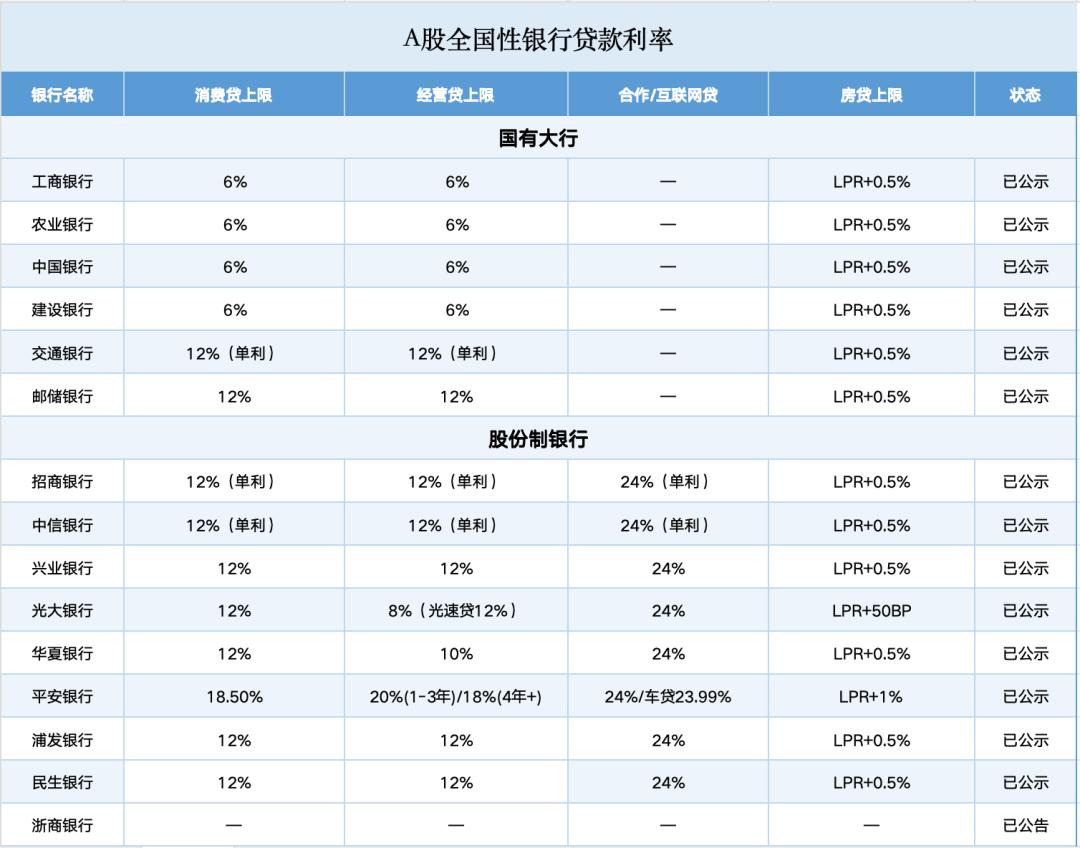
It is worth noting that although Zheshang Bank released an announcement on its official website on July 31, the announcement did not disclose the specific figure of the interest rate ceiling. The bank has independently developed a comprehensive financing cost calculation engine, realizing functions such as pop-up display, mandatory reading, and automatic notification of rate changes, taking the lead in system transformation, but the disclosure of the pricing ceiling still needs to be supplemented. In addition, China Guangfa Bank, which is not an A-share listed bank, publicized a 14% upper limit for consumer loans, 16% for operating loans, and a fixed 3.5% upper limit for housing loans. The annualized interest rate ceiling for personal housing mortgage loans and personal self-operated operating loans of China Bohai Bank is 4 times the LPR, and the upper limit for consumer loans and online loans is 24%. Hengfeng Bank disclosed a single comprehensive upper limit of 24% without subdividing by product. These data provide valuable references for horizontal comparison.
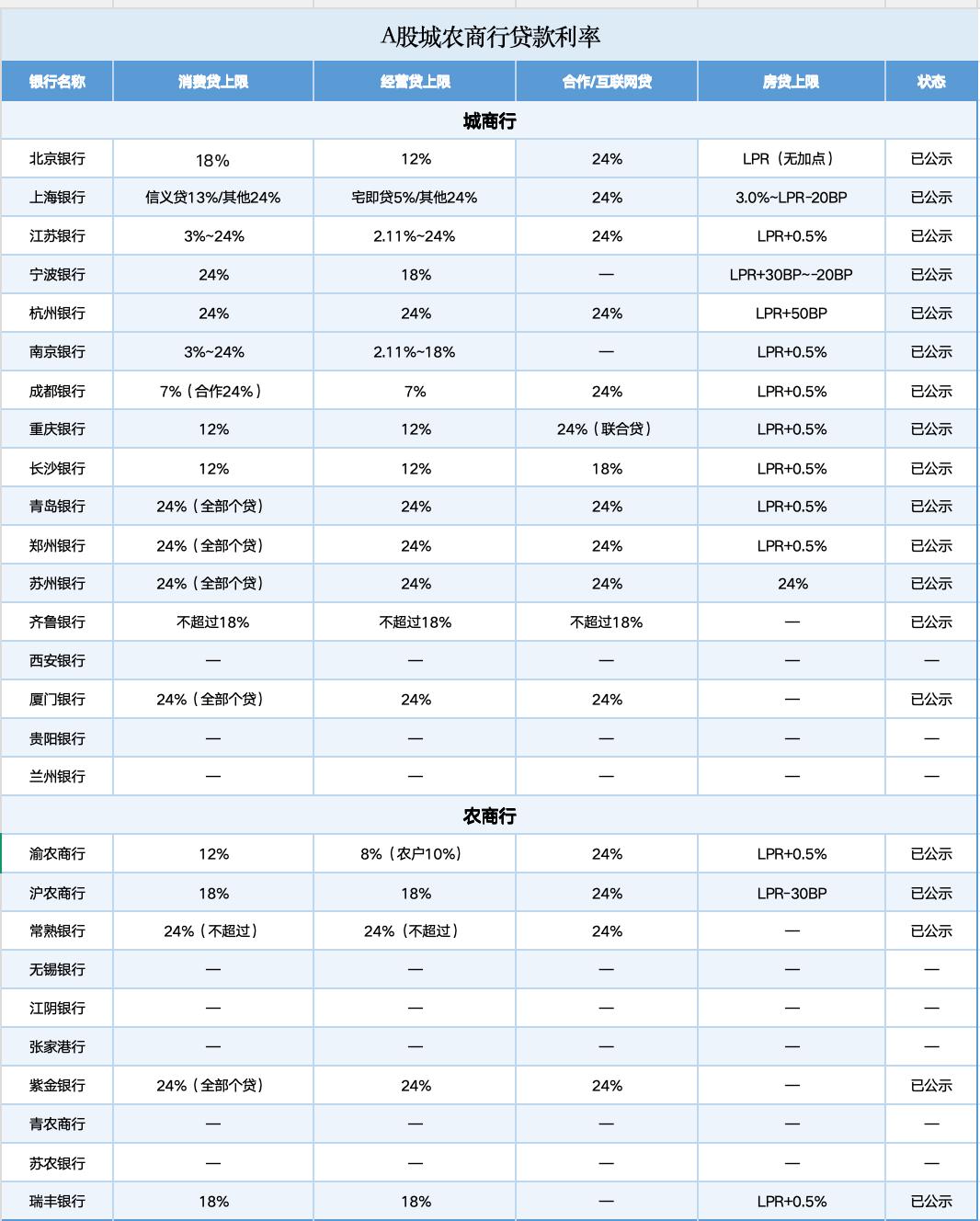
In terms of city commercial banks, Bank of Beijing, Bank of Shanghai, Bank of Jiangsu, Bank of Ningbo, Bank of Hangzhou, Bank of Nanjing, Bank of Chengdu, Bank of Chongqing, Bank of Changsha, Qilu Bank, Xiamen Bank, Bank of Qingdao, Zhengzhou Bank, Bank of Suzhou, etc. have all made public announcements. In terms of rural commercial banks, Chongqing Rural Commercial Bank, Shanghai Rural Commercial Bank, Changshu Bank, Zijing Bank, and Ruifeng Bank have also disclosed specific upper limits. The institutions that have not yet made public announcements are mainly some small and medium-sized city commercial banks and rural commercial banks. The implementation of the new regulations involves multiple links such as product page transformation, back-end billing system upgrade, contract text revision, and customer service training. Restricted by scientific and technological investment and human resources, the relatively lagging progress of system transformation for small and medium-sized banks is an expected phenomenon during the transition period.
From 6% to 24%, the Differentiation of Capital and Customer Groups Behind the 4-fold Interest Margin
Judging from the publicity situation, the bank interest rate ceiling presents a clear "ladder" structure.
Among national banks, the first echelon is the four major state-owned banks, namely Industrial and Commercial Bank of China, Agricultural Bank of China, Bank of China, and China Construction Bank. The upper limits of consumer loan and operating loan interest rates are both set at 6%, which is significantly lower than that of peers, reflecting the positioning of large state-owned banks to serve inclusive finance and the advantage of low-cost capital. The second echelon is Bank of Communications and Postal Savings Bank of China, with upper limits of 12% for consumer loans and operating loans, twice as high as the four major banks. The third echelon is joint-stock banks such as China Merchants Bank, China CITIC Bank, Industrial Bank, and Shanghai Pudong Development Bank. The upper limits of self-operated consumer loans and operating loans are both 12% (China Merchants Bank and China CITIC Bank specify simple interest), but the upper limit of cooperative online loans is relaxed to 24%. The fourth echelon is represented by Ping An Bank, whose consumer loan ceiling reaches 18.5%, products such as Ping An Smart Loan have a ceiling of 24%, and the upper limit of 1-5 year personal auto loans even reaches 23.99%, with a gap of nearly 18 percentage points between internal product lines.
Among joint-stock banks, the upper limits of operating loans of China Everbright Bank and Huaxia Bank are particularly noticeable. China Everbright Bank sets the annualized interest rate ceiling for personal operating loans at 8% (the upper limit of the "Guangsu Operating Loan" product is 12%), and Huaxia Bank's personal operating loan ceiling is 10%, both lower than the mainstream 12% level of joint-stock banks, revealing that the two banks are positioned to target high-quality small and micro customers in the operating loan business. China Minsheng Bank has adopted a "self-operated/joint loan" tiered model: the upper limits of self-operated consumer loans and operating loans are both 12%, and the upper limit of the online joint loan/assisted loan channel is 24%. This tiered model is similar to the "self-operated/cooperative" classification of banks such as China Merchants Bank and China CITIC Bank.
City commercial banks and rural commercial banks have the most significant differences in pricing for different internal products, showing a trend of "exploring the bottom at both ends". On the one hand, the upper limit of "Zhai Ji Dai" in Bank of Shanghai's personal operating loan is as low as 5% (simple interest), which is the most conservative among all banks. Bank of Beijing's housing mortgage loan has an upper limit of LPR (no point addition) for loans with a term of less than 5 years, and the rate for loans with a term of more than 5 years is directly equal to LPR (no point addition), which is the most favorable housing loan pricing among the disclosed A-share listed banks. On the other hand, the upper limit of Bank of Jiangsu's consumer loan directly hits the "ceiling" of 24%, and Bank of Qingdao, Zhengzhou Bank and other banks set the upper limit of comprehensive financing cost for all personal loans at 24% without subdividing product categories.
Bank of Chongqing and Bank of Changsha have chosen a "middle route": the upper limits of self-operated consumer loans and operating loans are 12%, which is the same as most joint-stock banks, but the upper limits of cooperative online loans are 24% and 18% respectively. The 18% upper limit of Bank of Changsha's online loan is at a relatively low level among city commercial banks, reflecting the bank's prudent attitude towards risk pricing of cooperative businesses. Qilu Bank sets the upper limit of comprehensive financing cost at 18%, Ruifeng Bank and Shanghai Rural Commercial Bank set both consumer loans and operating loans at 18%, and Bank of Chengdu's self-operated consumer loan is only 7%. These data show that some banks have realized the upper limit setting "below the ceiling" through refined pricing, instead of simply setting a uniform 24% ceiling.
The maximum interest rates for personal consumer loans and operating loans publicized by banks range from 6% to 24%. This difference mainly stems from many factors: on the one hand, different types of banks have different capital costs. Large banks have low capital costs, and their maximum loan interest rates are mostly around 6%, while small and medium-sized banks such as city commercial banks have high costs, and their maximum loan interest rates can reach 24%. On the other hand, there are differences in customer group positioning and risk control capabilities. High-quality customers enjoy low interest rates, and banks that cover a wider range of customer groups need to set higher interest rates to cover risks. In addition, the regulatory authorities require public disclosure but do not set a unified interest rate standard, allowing differentiated pricing. Therefore, this difference is a normal phenomenon of market-oriented pricing.
Shifting from "Interest Rate War" to "Service War", the Assisted Loan Business Is Accelerating Shuffling
The implementation of the new regulations is far more than just adding a form, but involves in-depth collaboration across multiple lines including product, technology, legal affairs, and customer service. It is understood that commercial banks mainly carry out system transformation in two aspects: first, a comprehensive financing cost disclosure form is generated in the business system and the mobile banking terminal, which is used for offline signing after printing or online display and signing; second, the annualized rate calculation and trial calculation function is developed to measure the comprehensive financing cost.
In the long run, the new personal loan regulations will change the competition logic of the personal loan market. The past business development method that relied on "low nominal interest rate + high hidden fees" to acquire customers is no longer feasible, and the focus of institutional competition will gradually shift to risk control capabilities, product experience and customer services.
Specifically, first, the assisted loan business is restructured. Full disclosure of interest and fees will compress the profit space of channel-based and diversion-based cooperation, non-compliant credit enhancement fees will be cleaned up, and capital parties will further tighten the list of cooperative institutions. In fact, since the implementation of the new regulations on assisted loans in October 2025, the number of cooperative institutions for online loans of banks has continued to shrink.
Second, transparent pricing forces cost control. In the past, hidden costs scattered in guarantee fees, service fees, and membership fees were forced to be included in the annualized interest rate and publicly displayed, which has a squeezing effect on institutions that relied on "split charging" to indirectly break through the 24% red line for a long time.
Third, the protection of consumer rights and interests is upgraded. Borrowers can clearly see the real price of the loan before signing the contract, and compare the product costs of different institutions horizontally. The gap of information asymmetry is being filled by the system.
Judging from the implementation situation, the banking industry's response speed exceeded expectations, and 30 A-share listed banks have completed the publicity, covering nearly 80%. But at the same time, some institutions have problems such as "one-click consent" to multi-institution agreements and too short mandatory reading time. The deepening from "paper regulations" to "industry practice" still requires continuous supervision by regulatory authorities, system iteration of institutions and active rights protection of consumers. The Measures for the Administration of Online Marketing of Financial Products will also be implemented on September 30. The connection of the two new regulations will further reduce the gray area. The era of "ambiguous accounts" for personal loans has come to an end.
This article is from the WeChat Official Account "WEMONEY Research Lab" (ID: wemoney1), written by Lin Jianwei, edited by Liu Shuangxia, and published with authorization from 36Kr.