Even with price cuts, BBA vehicles still cannot sell well, and the money of relevant employees has been trapped first.
Core Tips
Car prices are slashed to rock bottom, and trust is completely shattered.
When BBA strips off its aura, not only are car prices being drastically cut, but 4S stores are also hitting operational crises, leaving employees and customers with nothing but a total mess.
In recent years, under the impact of domestic new energy vehicles, the sales of traditional luxury cars represented by BBA have kept declining. To maintain market share, BBA has to lower its stance, with discounts of hundreds of thousands or even millions of yuan becoming the norm, which has significantly eroded profitability.
However, the strategy of trading price for volume is barely supported by manufacturers, and dealers are also overwhelmed. With continuous cash flow loss, some dealers have hit the wall first. Recently, the news that Wenzhou Oulong Group, which ranked 13th in the 2026 National Top 100 Auto Dealers List, has encountered a major operational crisis continues to ferment. On the one hand, the vehicle certificates of some Mercedes-Benz owners have been mortgaged to banks by the stores, making it impossible for the vehicles to be registered normally; on the other hand, employees lent money to the company to participate in the "Happiness Fund" program, but now they cannot get back their principal for a long time.
As BBA's competitiveness declines, the crisis on the channel side is accelerating to expose and spread to car owners and employees. When the price war triggers a trust crisis, in the face of the continuous aggressive expansion of domestic new energy luxury car brands, does BBA still have a chance to turn the tide?
Resigned, but the money is gone
Ye Bin, who once worked at Wenzhou Oulong Group, never imagined that after he resigned, the 210,000 yuan he lent to the company would still not be redeemed for a long time.
On social media, Ye Bin posted a "debt collection post". The post said that his father went to collect the debt for him, but was verbally abused by the company's leaders, fainted out of anger and was sent directly to the hospital. "The other party even said 'fainting is not the same as dying', it's really unacceptable for a senior executive to say such a thing." Ye Bin said.
The loan contract he showed to Leopard Change shows that Oulong Group signed a "Happiness Fund" loan contract with him in January 2024, with a monthly interest rate of 1.1% and a loan amount of 120,000 yuan. Plus another loan of 90,000 yuan, he lent a total of 210,000 yuan to the company.
According to the contract, the interest payment time is before the 10th of the next month of each quarter. If the loan term is more than 6 months, after the expiration, if there is no objection from both parties, the contract will be extended for another 6 months. If you want to terminate the contract, you must notify the other party one month in advance. In 2025, many employees had conflicts with the company because they couldn't withdraw their money. In October 2025, Ye Bin also submitted an application approval form to the company, but after layers of approval, he still couldn't get his money back.
"I've been urging for more than half a year, and later the finance department always said there was no money and delayed payment." Ye Bin revealed that his 210,000 yuan is not a large amount among the involved employees. Some veteran employees who have worked for 20 years lent 600,000 yuan, and some even lent 1 million to 2 million yuan.
According to Ye Bin's understanding, this loan program involves hundreds of employees, with a total amount of about 200 million yuan. The management can cash out and leave first through channels such as vehicle sales, after-sales payment recovery, and manufacturer rebates, while the redemption demands of ordinary employees have been repeatedly put on hold. "The company also used various connections to put pressure on me. First, they called our village party secretary, and then contacted the boss of my current company." Ye Bin said.
Public information shows that the brands served by Wenzhou Oulong Group include Maybach, Mercedes-Benz, Jaguar, Land Rover, BYD, Lincoln, etc. Among them, Zhejiang Oulong Mercedes-Benz is the group's first Mercedes-Benz 4S store, but Leopard Change found after on-site visit that the store is now empty, with only some tables, chairs and desktop mainframe shells placed randomly in the store; the open space at the entrance has become a parking lot for surrounding residents. The notice posted on the gate shows that the relevant after-sales business of the store has been merged into Wenzhou Oulong Star Mercedes-Benz 4S Store as a whole, with the date of June 25 this year.
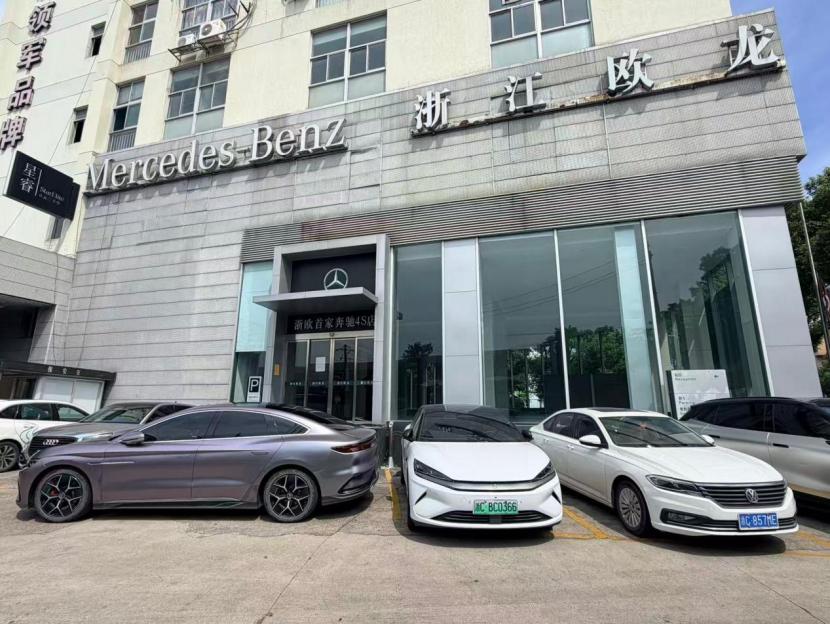
According to the report of Wenzhou Economic Radio's Kelin Rights Protection Hotline, Wenzhou Oulong Star Mercedes-Benz 4S Store, which takes over the after-sales business, also has capital problems. Because it privately mortgaged vehicle certificates to banks for financing, more than 20 car owners could not register their vehicles normally after purchasing, and the store can only redeem the certificates from the bank in batches with the subsequent payment from car sales.
This crisis is not limited to Wenzhou. Ms. Huang, a car owner in Taizhou, told Leopard Change that she suddenly received a notice from the sales staff that the Taizhou Oulong Mercedes-Benz 4S Store where she bought the car would suspend all after-sales businesses such as maintenance, repair, and three-guarantee claims, and the relevant businesses would be taken over by Linhai Oulong Mercedes-Benz, making the round-trip journey much longer.
What is more passive than car owners are the store employees. According to insiders, the attendance of employees at closed stores has been switched to new stores, and failure to clock in on time will be treated as absenteeism. "They want to force employees to resign voluntarily and do not want to pay compensation." The person said.
In fact, such incidents of dealer store closures and damage to the rights and interests of both employees and consumers have also occurred frequently in BMW and Audi in recent years. Earlier, Xingdebao, the world's first BMW 5S store in Beijing, had its brand authorization terminated due to capital chain rupture, and a large number of pre-paid maintenance packages and car purchase deposits of car owners could not be redeemed. Yonghao Aoda, the largest Audi dealer in Tianjin, also suddenly closed down, resulting in many consumers being unable to pick up their cars after purchase, and their after-sales stored value rights and interests were suspended.
When BBA's market cools down, the terminal pressure is transmitted to offline stores, and employees and car owners are forced to bear the pressure.
BBA's collective price reduction
Behind the concentrated outbreak of dealer risks is the simultaneous decline of BBA's brand appeal and product competitiveness in China.
The quotation from Autohome shows that the Audi A7L has a direct price cut of 120,000 yuan, and the bare car price is only 299,000 yuan. This price shocked Ding Jian, who bought a car a few years ago. At the end of 2018, the entry-level bare car of Audi A4L was about 250,000 yuan, and he finally spent 240,000 yuan to buy a Volkswagen Magotan.
"If you work harder now, Audi A7L is not a dream. In the past, this money was only enough to buy A4." Ding Jian said.
Not only Audi's price has plummeted, but the popular models of BMW and Mercedes-Benz also have a large price reduction range. According to Dongchedi, the price reduction of Mercedes-Benz GLC 260 L in Shanghai is basically around 100,000 yuan, with a starting price of about 250,000 yuan, and some stores even reduce the price by more than 140,000 yuan. The BMW X3 of the same class has a price reduction of about 80,000 yuan, with a starting price of around 240,000 yuan.
Usually, the price of BBA in first-tier cities such as Beijing and Shanghai will be slightly lower than that in other cities. At a Mercedes-Benz 4S store in the urban area of Wenzhou, Zhejiang, the salesperson gave a starting price of 261,800 yuan for the same model, which is 90,000 yuan lower than the official guide price. Leopard Change saw that on a weekday afternoon, there were no customers visiting the store, only several salespeople sitting around the table scrolling through their phones. The huge exhibition hall was not brightly lit, and the staff wore black work clothes, which made them easy to "hide" in the dark background.
"When do you need to use the car? Loan or full payment? Do you have a car to replace? It's just the end and beginning of the month these two days, you can negotiate the price further when you come to the store, and we have existing cars." The salesperson threw out a series of questions, trying to judge the customer's willingness to buy a car from the conversation.
In the plan given by the salesperson, if you purchase the classic Mercedes-Benz GLC 260 L by installment, you can get a 5-year loan of 230,000 yuan. Plus the purchase tax and insurance, the landing price is about 300,000 yuan. "You can prepay the loan after two years, and the interest for two years is about 15,000 yuan." The salesperson said. Calculated in this way, users only need to pay a down payment of about 80,000 yuan to pick up the car, and the threshold for buying a luxury car is greatly reduced.
As Mercedes-Benz's old rival, BMW is also following up to cut prices. Earlier this year, BMW lowered the official guide prices of many models, and if combined with dealer promotions, the discount range will be greater. According to Dongchedi, there are currently 12 BMW models priced within 300,000 yuan, among which the starting price of BMW 5 Series has dropped to 260,000 yuan. "How can old BMW 3 Series owners who spent 300,000 yuan back then accept this?" Many BMW car owners complained on social media.
After visits, Leopard Change found that not only does BBA have a large price reduction range, but the supply-demand relationship has also been completely reversed, generally changing from the previous "price markup and waiting for car" to the current "the price can still be negotiated when you arrive at the store". A sales manager of a BMW 4S store in Wenzhou told Leopard Change that the weather is too hot from July to August, and there are not many people coming to the store to see cars. They usually do more live broadcasts to attract customers to leave their information, so the discount is relatively large. If you really want to buy it, the price and rights can be further negotiated.
However, the more BBA tries to please users, the less the market accepts it. Many users who are willing to buy cars said that they will wait and see for a while. On the one hand, the aura of BBA is fading, and they are worried that if they spend 300,000 yuan on a fuel car now, they will be laughed at as a "sucker". On the other hand, cars are being updated and iterated too fast now. If you wait a little longer, maybe the price will drop further, or the configuration of other cars will be upgraded.
Why did it suddenly fall out of favor?
BBA, which was once synonymous with luxury cars, why did it quickly lose its market appeal in just a few years?
In BBA's product structure, the top-selling models are all traditional fuel vehicles. According to data from Dongchedi, in June, the sales of BMW 3 Series, Audi A6L, and Mercedes-Benz E-Class reached 10,549 units, 7,095 units, and 9,600 units respectively, which are the top-selling models of their own brands. At first glance, the sales volume is quite good, but the sales of other fuel models have not kept up. For example, the monthly sales of BMW X5 was 3,629 units, ranking fourth in BMW's sales list; the starting price of Audi A5L has dropped to 210,000 yuan, and only more than 3,100 units were sold in June.
At present, the penetration rate of new energy vehicles in China has exceeded 60% and is still continuing to rise. According to data from the China Passenger Car Association, the core pressure of the decline in the domestic auto market in June came from fuel vehicles, whose retail sales fell by 39% under the impact of high oil prices. The share of conventional fuel vehicles in June was 37.2%, and the year-on-year reduction accounted for 78% of the total reduction of passenger cars. When the basic market of fuel vehicles continues to shrink, even if BBA engages in fierce internal competition, it is difficult to find high growth in the stock market.
Facing such market conditions, BBA is also accelerating its electrification process. But from the actual experience, these models still have obvious gaps with domestic new energy luxury brands in core experiences such as product pricing, smart cockpit, and assisted driving. In June, the best-selling new energy vehicle of BMW in China was i3, which only sold 1,039 units; the top-selling model of Audi was Q6L e-tron, with sales of 600 units.
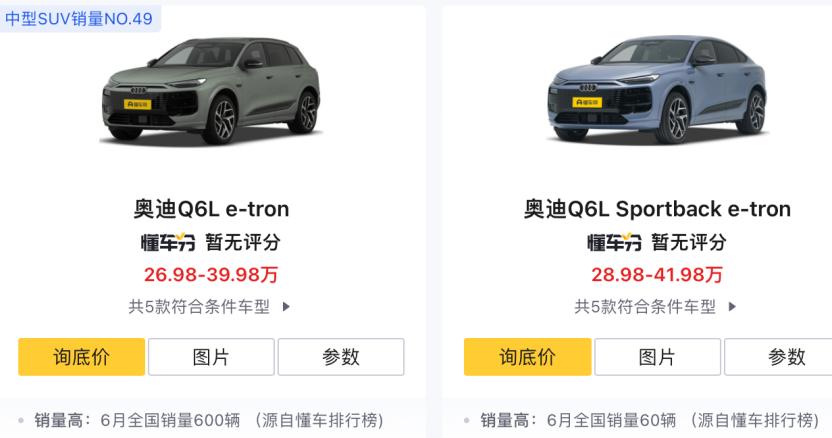
This is not at the same order of magnitude as the sales of domestic high-end new energy vehicles. In June, the sales of NIO ES8 and ES9 were close to 9,000 units, and Zeekr 9X sold more than 5,800 units, far exceeding the sales of BBA's pure electric vehicles in the same month.
The statistics of the China Passenger Car Association further confirm this pattern. In the first half of this year, the cumulative sales of new energy vehicles priced above 400,000 yuan reached 240,000 units, a year-on-year increase of 46%. Among them, domestic high-end new energy brands have become the main driving force for the growth of the luxury car market, accounting for 59% of the market share of this segment, a year-on-year increase of 21%, while the market share of traditional luxury brands represented by BBA has dropped to 38%, a year-on-year decrease of 21%.
China is the world's largest and most competitive new energy vehicle market, and consumers have higher requirements for the product power of electric vehicles. Mercedes-Benz EQA is one of the best-selling entry-level luxury cars in Europe, but its performance in the domestic market is dismal. In June, its pure electric model ranked only over 280th in the pure electric vehicle sales list, and the sales volume was too low for mainstream platforms to disclose specific values.
The contrast between the two markets is enough to show that the shortcomings in intelligence and insufficient localization of BBA's pure electric products have been difficult to retain the original high-end replacement users; when consumers choose high-end new energy vehicles, giving priority to domestic brands has become the current mainstream trend in the market.
For BBA, simply relying on price competition is no longer feasible. Only by making up for the product power of electrification and innovating the traditional distribution model can it regain a firm foothold in the rapidly iterating domestic luxury car market.
(Ye Bin and Ding Jian in the text are pseudonyms)
This article is from the WeChat official account "Le