Anthropic, which offers the highest salaries in the AI industry, is complaining that its employees join the company just for money? Sarcastic remarks are pouring in across the whole internet: That's as contradictory as your unyielding anti-open source stance.
"New employees join for money, not for mission." This is one of the recent concerns of Dario Amodei, CEO of Anthropic. According to foreign media reports, this news was exposed by an insider.
Within hours, this remark spread everywhere, causing a public outcry. Several classic comments read: "Breaking news: people work for money", "Local man discovers the law of economics", "He acts as if he's doing unpaid labor without asking for any compensation".
Amodei's consistent anti-open source stance has also become the best target for teasing. Some netizens said, "The person who said this is worried that open source will commoditize his business", "The reason is the same as why you don't want to give away your models for free".
Engineer Gergely Orosz's comment is more pointed: at almost all positions, Anthropic's compensation exceeds that of any lab in the AI field, even higher than OpenAI. Therefore, worrying that people come for money is a strange complaint for a company that writes the biggest checks.
Some insiders also revealed that some junior/mid-level engineers who are not researchers can get 2 million US dollars at Anthropic, mainly from equity appreciation.
The same group of people "take turns working" among tech giants
Behind all the ridicule is a real phenomenon: personnel turnover in the AI circle seems to happen every day. Elite researchers keep jumping between major AI giants, and these companies almost offer everything money can buy. The most valuable employees may not be retained no matter how high the salary is offered, which is already a disturbing reality commonly faced by the current AI industry.
Last week, Lilian Weng, one of the co-founders of Mira Murati's Thinking Machines Lab, announced her departure, saying that her health was affected and she hoped to get a more focused position. A few days later, she appeared at OpenAI, working on recursive self improvement. Within a year, four co-founders of Thinking Machines have left.
In June, Google transferred two well-known researchers to its competitors: Noam Shazeer went to OpenAI, and John Jumper, winner of the Nobel Prize in Chemistry, joined Anthropic. Last year, the CEO of Safe Superintelligence, a startup founded by former OpenAI co-founder and former chief scientist Ilya Sutskever, went to Meta.
Zuckerberg, who has been heavily recruiting for Alexandr Wang's Super Intelligence team, then watched a number of prized new talents leave one after another, several of whom went to OpenAI.
Nowadays, the researchers behind cutting-edge AI are like an interconnected ecosystem, with the same few hundred people circulating in it. A small group of researchers can get extremely high remuneration while choosing between companies with different cultures, missions and technical resources, which is exactly why Amodei's concern goes beyond the level of a meme.
Top researchers value more than you can imagine
For top researchers, when every lab can pay millions of dollars, salary is no longer a key variable. In addition to amazing salaries, top researchers also pursue computing power, influence on product direction, and the freedom to carry out work according to their preferred technical paths.
Some other researchers see that the window for their own expertise to get a high premium is narrowing. They worry that as AI systems eventually automate more work of improving and developing new models, their bargaining power may decline, and they hope to lock in equity before the potential IPO of companies like Anthropic or OpenAI.
It is very difficult to recruit top AI researchers, and it seems even harder to retain them, even if huge salaries, prominent titles and massive computing resources are offered.
These companies can buy researchers' time, but lasting loyalty cannot be sold, and the labs that pay the highest salaries are the first to realize this.
Mission may be the last remaining chip, which cannot be verified by money. As a developer said, no one can really test their beliefs when the checks are so generous. What will happen to those principles if valuations decline?
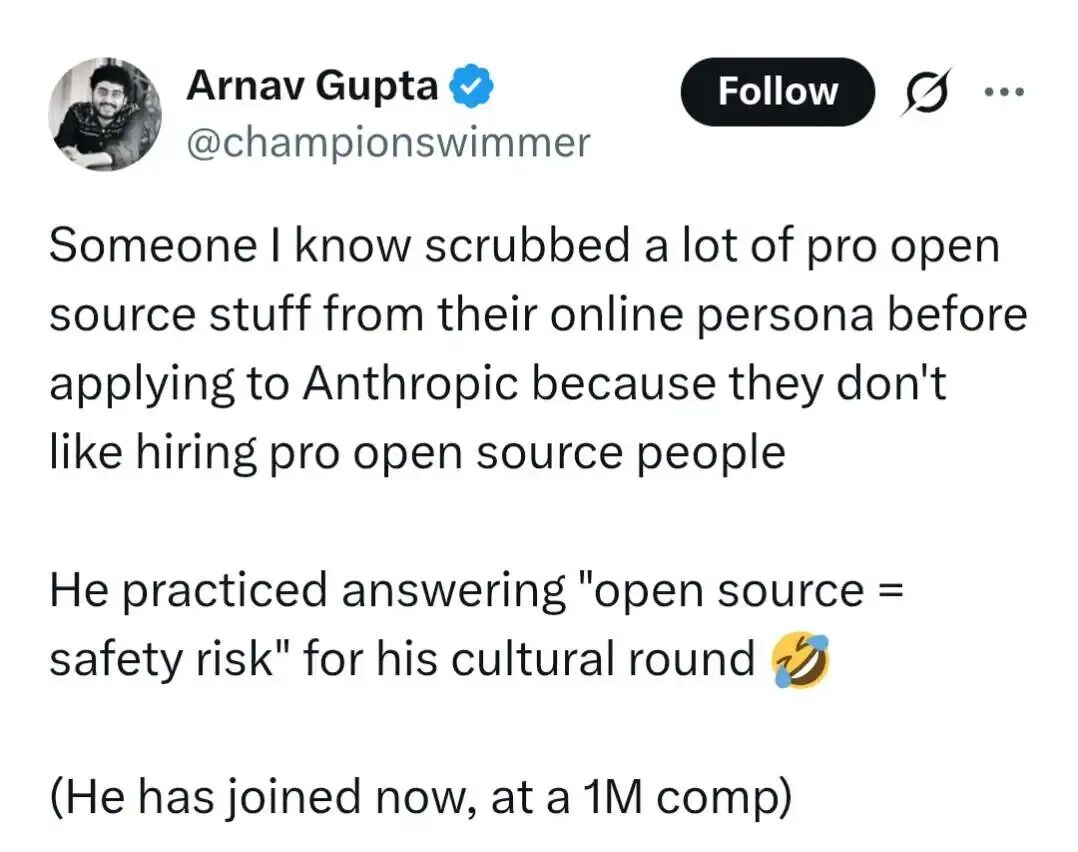
Some netizens shared a real case: a researcher he knew deleted a lot of open source supporting content he posted online before applying for a job at Anthropic, just because Anthropic does not like to recruit people who support open source. During the cultural interview, the candidate answered "Open source = security risk". Now he has successfully joined the company with an annual salary of 1 million US dollars.
A tech industry headhunter revealed that in fact, there are both monetary factors and some "self-drive" or "vanity" to change the world. In this field, many participants believe that their work may reshape the global economy or determine which company will be the first to develop transformative artificial intelligence, so status, ambition and ideological differences may be as important as the wealth provided by the company.
"There is definitely a desire to ensure that everyone has enough financial security," said Tara Shulman, a financial advisor who serves many new tech millionaires. She added that those already successful and well-paid engineers ask themselves: "What if things change... this question comes up very often, more than people think, especially those who hold a lot of equity compensation and are very financially successful."
The hidden cost of the talent war
It is worth mentioning that the battle for talent in the AI field has another more imperceptible cost. Research relies on trust and personnel continuity, and rapid personnel changes will interrupt projects, cause labs to bear double costs for the same small circle of people, and even lead to lawsuits between enterprises.
Last month, Apple sued OpenAI, io Products and two former employees in the Federal Court for the Northern District of California, USA. Now more than 400 former Apple employees are working at OpenAI. Apple stated in the complaint that "from members of the technical team to the chief hardware officer, and to the cooperation with business partners, OpenAI is stealing Apple's trade secrets and confidential information at every level."
Recently, new progress has been made in the matter. According to foreign media reports, several former Apple employees revealed that after leaving their jobs, they did not actively search for or copy old materials, but Apple's confidential documents still remained in their personal iCloud, and some files continued to synchronize. In response, Apple said that the actions involved in the complaint have nothing to do with files shared or stored in iCloud.
It can be seen that frequent poaching between AI labs not only slows down the progress of unfinished achievements, but also leads to "internal friction" in the industry, which may affect the development speed of the entire AI industry.
From a more macro perspective, cutting-edge AI has now become a closely connected single ecosystem, rather than a group of isolated competitors. Companies compete fiercely for talent and customers, while investing in each other, buying each other's services, relying on the same cloud providers, and recruiting talent from the same small group of researchers.
When elite researchers flow back and forth between labs, cutting-edge AI seems to be bustling, but in fact it is hobbling. Perhaps the real bottleneck has never been computing power or algorithms, but how to keep the smartest people staying at the same table with peace of mind.
References:https://www.axios.com/2026/08/03/ai-talent-wars-openai-google-meta-anthropic
This article is from the WeChat official account "AI Front" (ID: ai-front), written by Hua Wei, and authorized for release by 36Kr.