South Korean stocks staged a W-shaped turnaround to positive gains, while South Korea's finance minister made a statement to prop up the market. Is the rebound sustainable?
The divergence and volatility of South Korea's stock market have intensified.
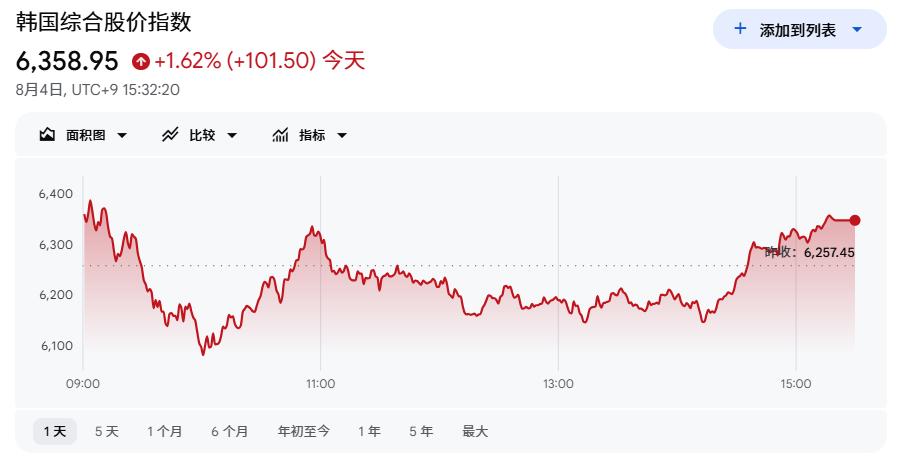
In early trading on Tuesday, South Korea's KOSPI index staged a W-shaped fluctuation.
The index once dived nearly 3% during the session, then rallied to rise more than 1%, returning above the 6300-point mark.
In the afternoon, the KOSPI index continued to fall, but regained its upward momentum near the close, ending up 1.62% at 6358.95 points.
Due to consecutive net purchases by institutional investors, South Korea's KOSDAQ index rebounded strongly during the session and triggered the circuit breaker mechanism, which suspended programmatic buy orders; it closed up 5.88%.
This is the third consecutive trading day that the circuit breaker mechanism has been triggered following July 31 and August 3.
Year to date, the KOSDAQ market has triggered the circuit breaker mechanism 30 times, of which 17 were triggered by the buy side and 13 by the sell side.
Especially since July, the index has fluctuated sharply, and the frequency of triggering the circuit breaker mechanism has increased significantly.
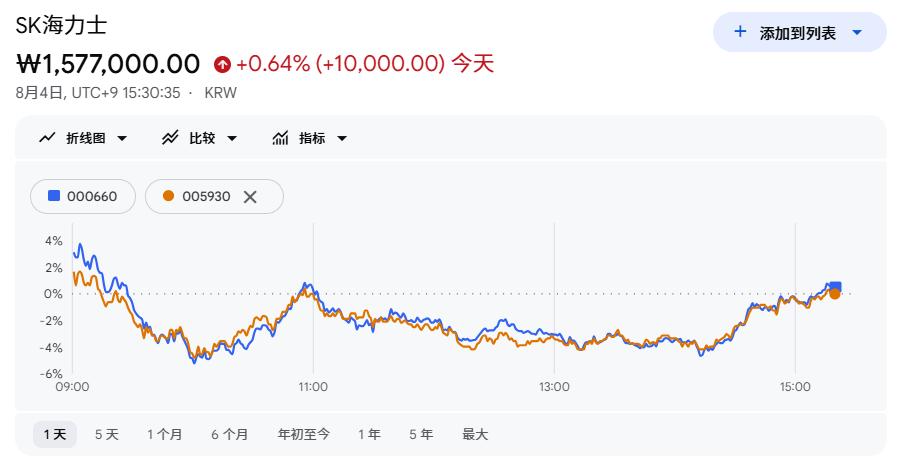
Among individual stocks, the "memory giants" SK Hynix and Samsung Electronics first turned higher and then fell back, but closed up 0.64% and 0.21% respectively.
South Korean Finance Minister's Remarks
Recently, South Korean regulators have been continuously issuing "market rescue" voices.
South Korean Minister of Economy and Finance Koo Yun Cheol stated at a cabinet meeting today that he will make efforts to ease the volatility of South Korea's stock market.
South Korea will commit to improving market fundamentals to ensure long-term structural stability. The Ministry of Economy and Finance will quickly implement the recently announced measures to restrict the use of single-stock leveraged ETFs.
After South Korea's stock market experienced a round of sharp volatility, Koo Yun Cheol previously apologized for the introduction of single-stock leveraged ETFs without careful consideration.
According to another report by South Korean media on August 3, Kim Yong-beom, Director of the Policy Office of the South Korean Presidential Office, is facing criminal charges for "hastily introducing leveraged ETFs".
South Korean President Lee Jae-myung's latest approval rating fell to 45.9%, a record low since he took office, due to economic instability caused by the stock market crash and the leveraged ETF controversy.
To cope with the sharp volatility of the stock market, South Korea has successively launched a series of deleveraging measures recently.
It is reported that South Korean financial regulators are promoting the introduction of an "emergency action authority", which allows regulators to quickly reduce the leverage ratio of single-stock leveraged products in emergency situations.
At present, single-stock leveraged products in South Korea are designed to track 2 times the return. If the emergency authority is triggered, the leverage ratio can be reduced to 1.5 times or even 1 time.
After regulators took measures to curb speculative trading, the trading volume of South Korean stock leveraged ETFs plummeted.
South Korea's largest single-stock leveraged ETF, which is linked to the share price performance of SK Hynix, saw its trading volume drop to 59 million shares on Monday, the lowest level since June 4.
The trading volume of similar smaller ETFs linked to Samsung Electronics also fell to the lowest level since its listing at the end of May.
Cooling Inflation
The easing of the US-Iran situation coupled with cooling inflation has brought phased positive support to the highly volatile South Korean financial market.
Data shows that the year-on-year increase in CPI in July fell to 2.8% from 3.2% in June, lower than market expectations; the core CPI rose 2.6% year-on-year and 0.4% month-on-month.
The core driving force behind this round of price decline is the fall in oil prices.
In July, the year-on-year increase of gasoline and diesel in South Korea narrowed significantly, and fell 6.2% and 6.7% month-on-month respectively, effectively easing imported price pressures.
However, the current inflation level is still higher than the Bank of Korea's 2% policy target, and inflation risks have not been completely eliminated.
The Bank of Korea announced a rate hike in July and released subsequent tightening signals; affected by factors such as tighter monetary policy, South Korea's stock market became increasingly volatile afterwards.
At the end of July, senior South Korean economic and financial officials including South Korean Finance Minister Koo Yun Cheol and Bank of Korea Governor Shin Hyun-song held an emergency joint meeting, and immediately announced a series of market rescue measures.
As for the subsequent trend of South Korea's stock market, the market holds a cautious recovery attitude.
Han Ji-young, an analyst at Kiwoom Securities, said that the sustained oversold sentiment after last month's crash and the sharp fall on Monday, the surge in US stocks overnight and the plunge in oil prices have greatly boosted investor sentiment that had been depressed by geopolitical uncertainty.
However, affected by the risk digestion of the semiconductor weighted sector, although institutional selling has slowed down, it is expected that the upside space for the index remains limited.
"Rather than expecting a sharp rise in the index, it is more accurate to say that the stock market in August will continue to conduct support tests and consolidate the bottom, while gradually solving the problem of excessive sector concentration."
This article is from the WeChat Official Account "Gelonghui APP" (ID: hkguruclub), the author is the editor of Gelonghui, and 36Kr publishes it with authorization.