The core team of Zhiyuan was unveiled for the first time ahead of its IPO: 9 partners made their public debut, with former senior executives from Huawei, Google and Tencent assembled.
On August 3, Agibot's official website updated its partner list, with three senior executives Xiong Yan, Zhu Jie and Zhang Xiuzheng newly joining the core management team. So far, the number of Agibot partners has increased from 7 to 9. In response, Agibot told Tencent Tech that this management expansion aims to provide organizational guarantee for the company's next stage of development.
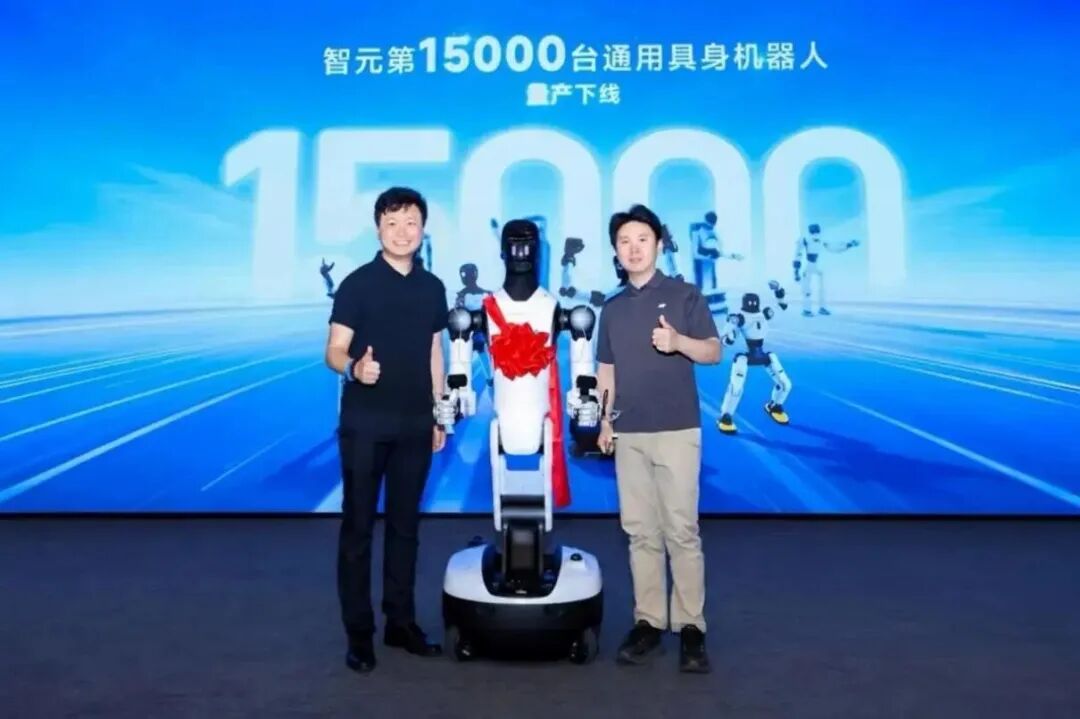
This adjustment takes place at the stage when Agibot's business is accelerating transformation. On June 28, Agibot announced that its 15,000th embodied intelligent robot rolled off the production line, less than three months after reaching the 10,000-unit milestone. At the off-line ceremony, this Elf G2 robot was directly delivered to Longcheer Technology and put into the 3C production line. From mass production off the line to on-site delivery, it also corresponds to Deng Taihua's previous judgment for 2026: embodied intelligence is entering the "first year of deployment state". This also means that Agibot's focus is further shifting from mass production to real scenario implementation.
Meanwhile, Agibot has just confirmed the launch of its Hong Kong listing process.
The acceleration of mass production, the advancement of deployment and the launch of listing converge at the same stage, making this personnel adjustment particularly critical. As Agibot moves from "10,000-unit mass production" to "deployment-state implementation", investors are more concerned about whether its core management has shifted from technology-driven to an organizational configuration that can support large-scale delivery and industrial operation.
So what exactly has Agibot adjusted this time, and why restructure its core management at this moment?
01. The nine-partner team is unveiled, management echelon expanded
According to the latest announced lineup, Agibot's nine-person partner team consists of 1 founder, 3 co-founders and 5 partners. Team members come from technology companies such as Huawei, Google, Tencent, DJI and Cambricon, with capabilities covering multiple fields including AI technology R&D, product engineering, global commercialization, government-enterprise relations and organizational management.
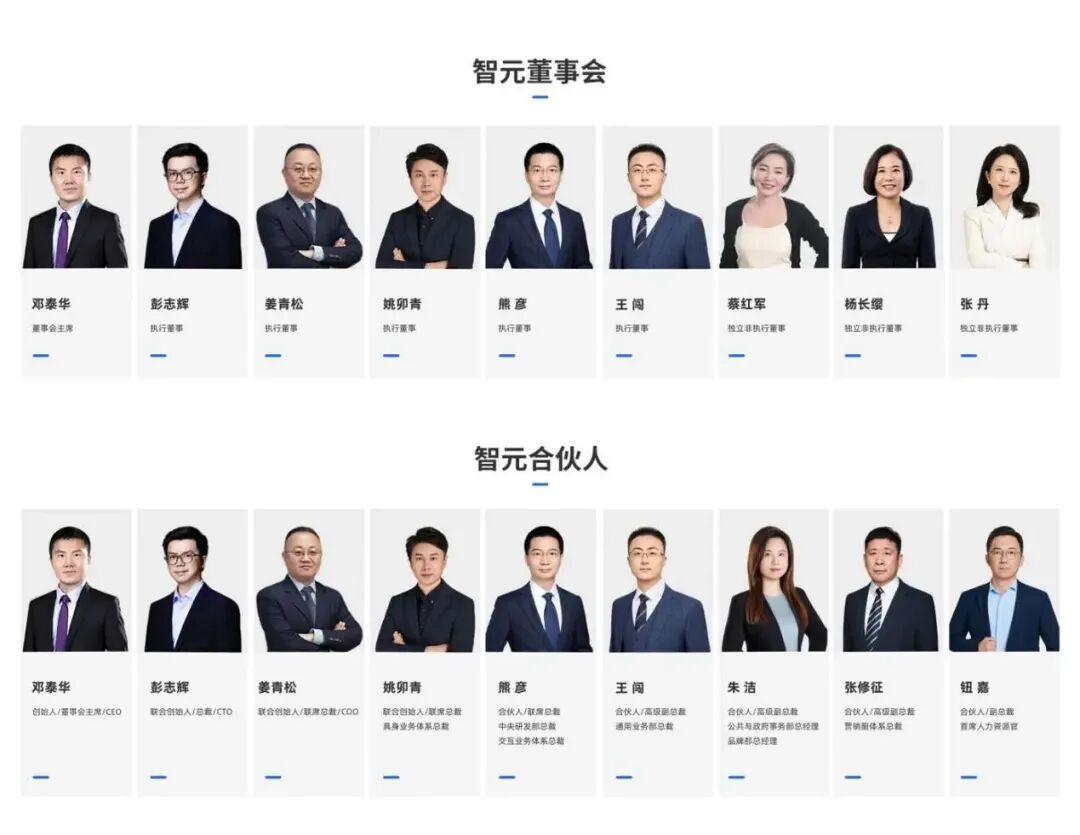
Among them, Deng Taihua, Founder, Chairman of the Board and CEO, is responsible for the company's overall strategy and industrial ecology construction. He previously served as Vice President of Huawei, President of the Wireless Product Line and President of the Computing Product Line, leading the construction of Kunpeng and Ascend AI computing ecology, and building a solid top-level framework for the company's long-term technology strategy and industrial ecology development.
Peng Zhihui (known as "Zhihui Jun") serves as President and CTO, who has long been focused on full-stack R&D of integrated robot software and hardware. He is a member of Huawei's "Genius Youth" program, a recipient of the State Council Special Allowance and the May 4th Youth Medal, with more than 100,000 followers in the open source community in the tech circle, and is a representative young leader in China's AI and humanoid robot industry.
Jiang Qingsong serves as Co-President and COO, with more than 20 years of ToB market experience in large ICT enterprises, responsible for global market expansion and ecological construction. He previously served as Country Head of Huawei's overseas enterprise business and General Manager of Alibaba Cloud for Middle East and North Africa, with rich experience in global market expansion and ecological construction.
Yao Maoqing serves as Co-President and President of the Embodied Business System, who once participated in the R&D of Waymo AI algorithms and led the construction of NIO's intelligent driving system, with experience in AI R&D and mass production delivery.
The more noteworthy changes this time come from the three new partners, Xiong Yan, Zhang Xiuzheng and Zhu Jie.
Xiong Yan serves as Co-President, and is also in charge of the Central R&D Department and Interactive Business System. He previously served as President of Huawei Central Research Institute, as well as R&D Director of Computing, IT and Network Product Lines, and has long been engaged in ICT product R&D and AI technology innovation. After he joined the core management, Agibot's R&D system and interactive business have a clearer coordinator.
Zhang Xiuzheng serves as Senior Vice President and President of the Marketing and Service System. He previously served as President of Huawei Cloud China Region and Solution Head of Huawei's overseas regional departments, and has long been engaged in digital intelligence of the ICT industry and global market development. His responsibility for the marketing and service system this time means that Agibot has further brought market expansion, channel construction and service capabilities into the core management.
Zhu Jie serves as Senior Vice President, in charge of the Public and Government Affairs Department and the Brand Department. She has more than 20 years of experience in public affairs management, has worked in government agencies and Tencent Group, and has long been deeply involved in technology industry policies, government-enterprise collaboration, public relations and social value innovation.
In addition, Wang Chuang continues to serve as President of the General Business Department, responsible for underlying technical architecture and mass production of robot products. Niu Jia continues to serve as Chief Human Resources Officer, responsible for the company's human resources system. So far, the division of labor of Agibot's partner team has covered key links including technology, product, business, market, brand, public affairs and organizational construction.
Disclosed simultaneously with the partner list are three independent non-executive directors. Cai Hongjun has been deeply engaged in the investment banking field for more than 30 years, and previously served as Chairman of Bank of America, Citi and UBS Greater China, and was selected as one of the "30 Most Influential People in China's Financial Industry" by *Institutional Investors* magazine. Yang Changying has more than 30 years of experience in international capital market legal practice, and previously served as partner of Latham & Watkins Hong Kong Office and Greater China Business Chair, and has won many honors such as "Asia's Best Securities Lawyer", "Top 15 Female Lawyers in Asia", and "Visionary Leader" of China's Annual Legal Elites. Zhang Dan has more than 20 years of cross-industry experience in corporate finance, legal affairs and comprehensive management, and previously served as CFO and General Manager of the Comprehensive Management Department of a leading global consumer electronics enterprise in China, and currently serves as Group CFO and General Manager of the Legal Department of a leading HR technology enterprise. The addition of the three means that this adjustment of Agibot not only involves the operation management layer, but also extends to the board of directors and corporate governance level.
From the results, this list change is not a simple expansion, but a more complete re-arrangement of responsibilities: technology and products remain the core, and at the same time, capabilities such as R&D management, marketing services, public affairs and capital compliance are further supplemented.
02. Why did Agibot adjust its core management after the 10,000-unit mass production?
If we only look at the numbers, Agibot's mass production speed is continuously improving, and its mass production curve can be described as "steep".
In 2023, Agibot only had 6 prototype samples; in August 2024, it launched large-scale mass production; by the end of 2025, it exceeded 5,000 units; in March 2026, it crossed the 10,000-unit mark, and reached 15,000 units in June.
But for embodied intelligence enterprises, mass production is not the end point, but the starting point of entering the next stage. At the first Hong Kong Embodied Intelligence Industry Summit, Deng Taihua put forward a key judgment: 2026 is the "first year of deployment state" for embodied intelligence.
According to Agibot's definition, "deployment state" does not simply mean completing robot production, but requires robots to have standardized solutions, 7×24-hour stable operation capability, large-scale delivery capability, and be able to create commercial value in real scenarios.
This means that the focus of competition among robot companies is changing: in the past few years, the industry paid more attention to whether robots can "move"; after entering the deployment stage, enterprises need to answer whether robots can "be put into use", operate continuously, and achieve large-scale replication.
Meanwhile, Agibot has also entered a new stage of capitalization. On July 24, Agibot confirmed the launch of its Hong Kong IPO process. For a hard technology enterprise still in the stage of rapid expansion, IPO not only requires business growth, but also a more mature corporate governance structure and organizational capabilities.
This is also the background of Agibot's adjustment of its management team this time.
The XYZ curve previously proposed by Deng Taihua actually corresponds to the capability requirements of different stages of the embodied intelligence industry. The X curve (2022-2025) is the development and trial stage, whose core task is to let robots "move like humans". At this stage, the company needs scientists and engineering teams to break through technical boundaries. After Luo Jianlan joined Agibot, she took the lead in setting up the Embodied Intelligence Research Center at this stage, promoted the training cycle compression of real machine reinforcement learning from "several weeks" to "tens of minutes", and led the open source of world models such as τ0-VLA.
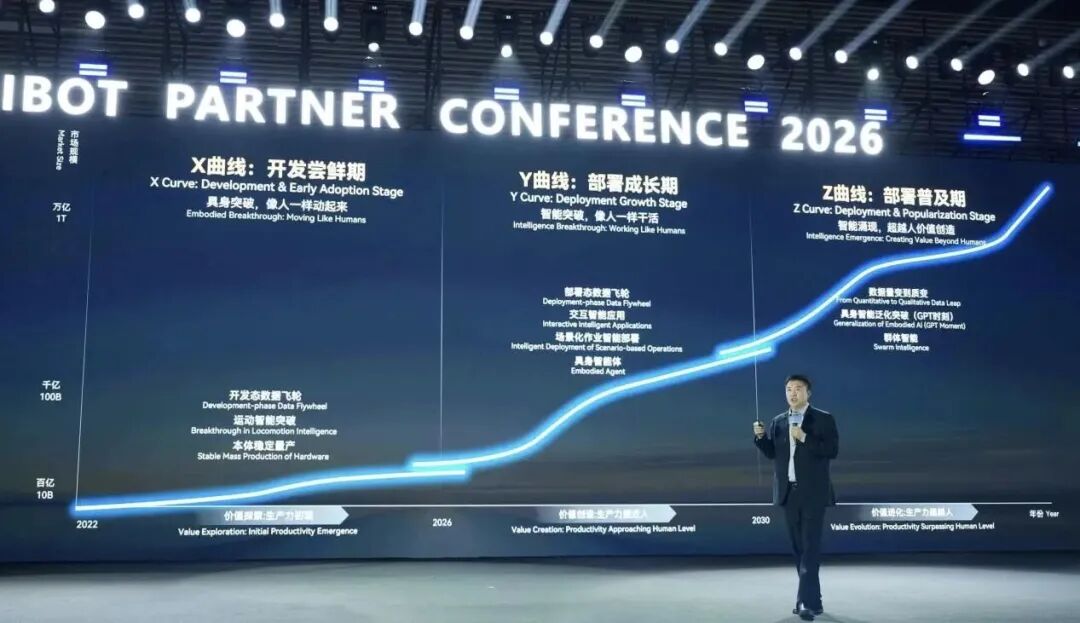
But the X curve is approaching its ceiling. Deng Taihua said frankly: "The total space of the scientific research market is limited, the marginal benefit is gradually slowing down, and a second growth curve is needed." As the industry enters the Y curve (2026-2030) deployment growth stage, the core proposition shifts from "being able to move" to "being able to work". Robots need to operate stably 7×24 hours in factories, create real value in commercial scenarios, and replace human labor in logistics warehouses. This is no longer a technical breakthrough in the laboratory, but a systematic project covering supply chain, quality control, delivery, channels, customer success and government-enterprise relations.
The Z curve (2030+) is the popularization stage of deployment, when the GPT moment of embodied intelligence arrives, and the market size far exceeds that of mobile phones and automobiles.
Agibot's early partner team is a typical technology entrepreneurship team, covering core directions such as AI algorithms, robot hardware, autonomous driving, and LiDAR. However, as robots begin to enter the stage of large-scale deployment, the company needs to supplement more capabilities oriented to industrialization.
This change has already taken place in real scenarios.
At Longcheer Technology's tablet manufacturing factory in Nanchang, Agibot Elf G2 has entered the 3C manufacturing scenario and completed continuous operation tests; in the logistics field, Agibot cooperates with JD Logistics to carry out humanoid robot warehouse scenario deployment; in the public service field, Agibot robots have also been applied in scenarios such as WAIC.
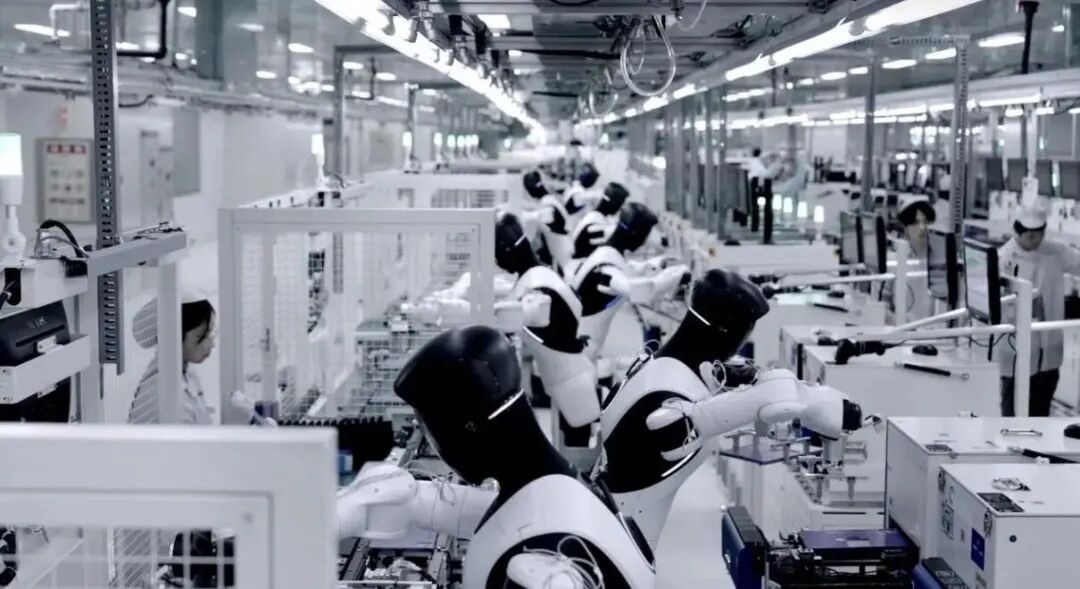
The common feature of these cases is that they are not Demo shows, but "deployment states" that run continuously 7×24 hours. Yao Maoqing, Agibot partner, said frankly at the 15,000-unit off-line ceremony: "Mass production is the core foundation for embodied intelligence to go out of the laboratory and land in the industry. Large-scale production continuously dilutes hardware costs and opens up space for commercial popularization." When deployment-state cases move from "single-point verification" to "batch replication", what Agibot needs is no longer a chief scientist adjusting parameters in the laboratory, but Xiong Yan-style R&D system management, Zhang Xiuzheng-style global channel expansion, and Zhu Jie-style government-enterprise collaboration and public communication. The addition of the three precisely corresponds to the new requirements for organizational capabilities in the Y curve stage.
As for the change of Luo Jianlan, it is more reflected in the adjustment of the role within the technical team. From the timeline, Luo Jianlan has joined Agibot for about one year and four months, focusing on the field of reinforcement learning, which just coincides with the stage when Agibot completes its early layout of cutting-edge algorithms for embodied intelligence. She no longer appears in the partner list this time. From an organizational perspective, this also reflects that Agibot is further precipitating single-point technological breakthroughs into an organized R&D system. It is worth noting that Luo Jianlan was still promoting her VLA work at Agibot on social media last week, and her personal homepage also retains the identity of Assistant Professor of Shanghai University of Innovation and Technology — this dual-track model of "university + industry" is also quite common in the AI research field.
For the capital market, the withdrawal of a chief scientist from the core management will inevitably arouse short-term attention; but more importantly, whether Agibot's technical system has completed the transition from "individual heroism" to "organized R&D". The takeover by Xiong Yan and others is, to some extent, a confirmation of this transition.
03. Conclusion
For Agibot, which is about to promote its Hong Kong stock IPO, the focus of this adjustment may not only be the change of the partner list, but also whether the new management team can support the company to further move from large-scale mass production to a wider range of commercial deployment.
Deng Taihua once stated at APC2026: "When more robot deployments form a data flywheel in the deployment state, we will usher in the Z curve from quantitative change to qualitative change."
From this perspective, the development of embodied intelligence not only depends on algorithms and robot bodies, but also requires organizational capabilities that match large-scale delivery. Agibot's partner adjustment this time is precisely an improvement of its management system and capability structure at this stage.
This article is from the WeChat official account "Tencent Tech", author: Xiao Yan, authorized for release by 36Kr.