Two truths of the auto market in July: domestic players compete on technology, while overseas markets race against time.
The cooling domestic demand and accelerating export have become distinct labels of China's auto market in 2026. Between the two contrasting trends, the "globalization" goal that Chinese automakers have long pursued has finally evolved from a niche layout of a few enterprises to a universal consensus across the entire industry.
Data from the China Association of Automobile Manufacturers shows that China's auto sales reached 15.017 million units in the first half of this year, down 4.1% year on year; of which domestic sales hit 9.921 million units, down 21.1% year on year. Meanwhile, auto exports reached 5.096 million units, up 65.3% year on year, exceeding the 5 million unit mark for the first time in a half-year period.
In July, traditional automakers including BYD, Geely, Chery and Great Wall successively released their latest sales data. From the latest data performance, a very clear conclusion can be drawn: In the stock market era, whoever can pull up the overseas growth curve will gain more incremental space; when the practice of chasing data and "racing" for sales volume in the domestic market is already outdated, whoever has stronger technical reserves that can be deployed at any time will own a healthier sales structure and grasp more initiative in this round of auto market elimination competition.
BYD, Boasting Robust Overseas Growth Momentum
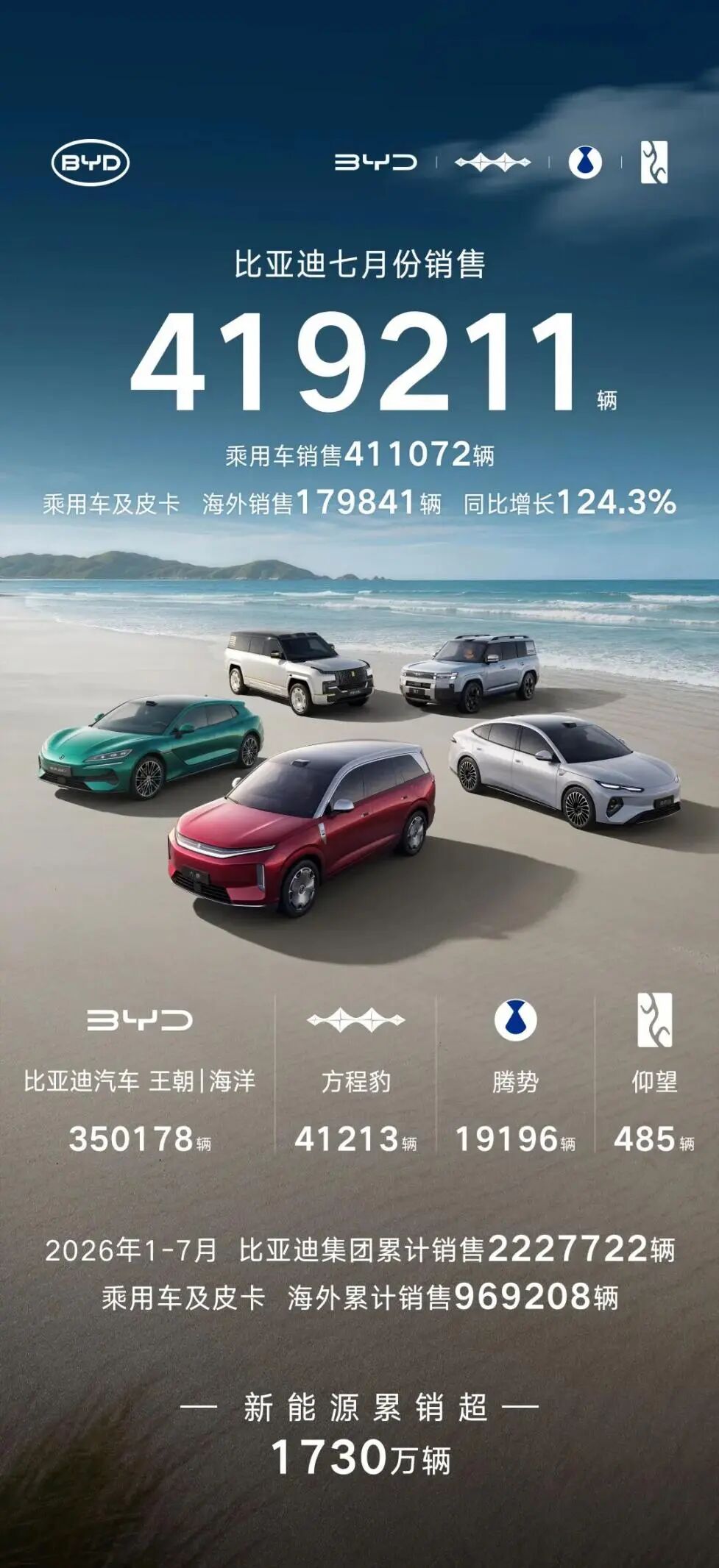
BYD sold a total of 419,211 units in July, up 21.8% from 344,296 units in the same period last year; among which, passenger vehicle sales reached 411,072 units, pure electric models hit 233,105 units, up about 31% year on year, and plug-in hybrid models reached 177,967 units, up about 9.1% year on year. However, if we extend the time horizon, BYD has not completely shaken off the pressure accumulated in the first half of the year. Its cumulative sales from January to July 2026 reached 2.228 million units, with a year-on-year decline still at double-digit level of 10.54%; of which cumulative pure electric sales fell 8.38% year on year, and cumulative plug-in hybrid sales dropped 13.18% year on year.
The coexistence of sharp year-on-year growth in a single month and cumulative year-on-year decline over the year means that July marks the start of sales recovery, rather than the end of operational pressure. In any case, such performance is still a positive warming signal for the global new energy industry leader.
Behind the over 20% year-on-year growth in July, the core driving force still comes from overseas markets.
In July, BYD sold 179,841 passenger vehicles and pickup trucks overseas, up 124.3% year on year, accounting for about 42.9% of the group's total monthly sales; its cumulative overseas sales from January to July reached 969,208 units.
After a simple calculation, Node Auto found that this means more than 4 out of every 10 vehicles sold by BYD are from overseas markets.
At the brand level, sales of BYD Auto's Dynasty and Ocean series reached 350,178 units, still serving as the absolute core base; Fangchengbao sold 41,213 units, Denza sold 19,196 units, and Yangwang sold 485 units. Fangchengbao has become the second largest growth pole among BYD's high-end and personalized brands, but the sales volume of Yangwang still indicates that the million-yuan price segment market cannot be quickly captured only by technical publicity influence.
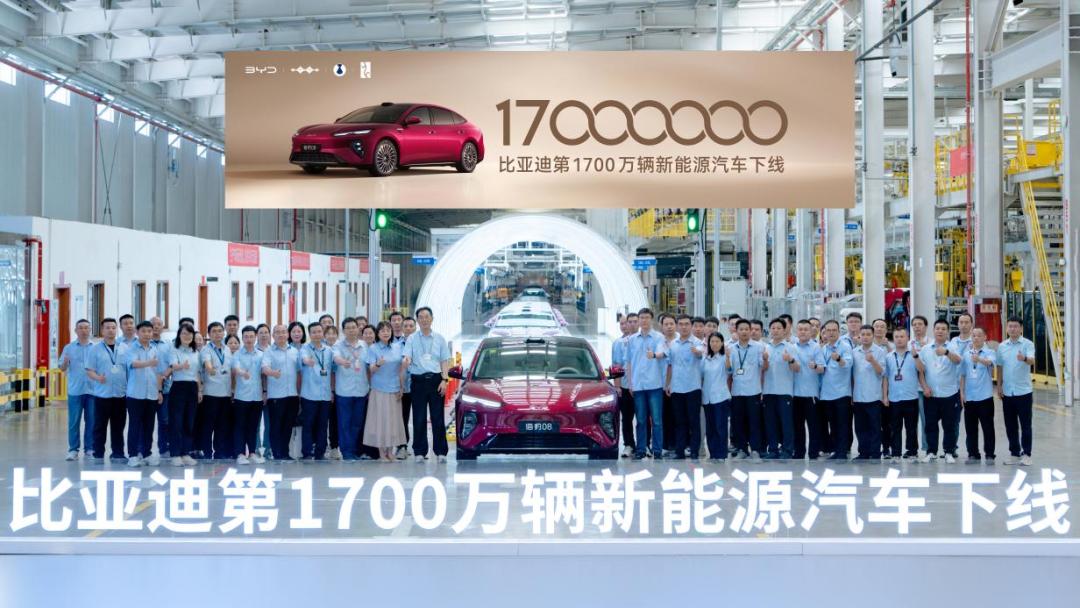
On July 8, 2026, BYD's 17 millionth new energy vehicle rolled off the production line at its Xi'an plant, and the Seal 08 was launched at the same time with an official guide price range of 196,900 yuan to 239,900 yuan. This model has a pure electric cruising range of 905 kilometers, and is also equipped with high-end configurations including flash charging, Cloud-A suspension and rear-wheel steering. It can be seen from this model that BYD is essentially leveraging its flagship technologies to further penetrate the mainstream price range, and continues to adopt the "dimensionality reduction strike" strategy with technology to seize greater market share.
In the view of Node Auto, BYD's core task in the second half of the year is not to continuously prove its top sales ranking, but to focus on three key balances:
The first is the balance between domestic and overseas markets. If domestic sales continue to face downward pressure, overseas growth cannot be limited to short-term export surges, but also needs to be supported by local factories, sales channels, after-sales services and financial systems. It can be seen from BYD's strategies in the European, Japanese and North American markets that it has already launched more in-depth global localization deployment.
The second is the balance between pure electric and plug-in hybrid vehicles. In the fierce market competition, the leading advantage previously built by BYD's DM-i technology in the plug-in hybrid market is facing head-on competition from products such as Geely Galaxy and Chery Fengyun. In the follow-up period, BYD will face greater challenges in both the pure electric and hybrid tracks, and how to balance the pace of product launch will test BYD's vision and patience.
The third is the balance between scale and brand building. Judging from the performance of specific brands, sales of Fangchengbao are growing rapidly, but high-end brands Denza and Yangwang still need stable hit products to prove their high-end operation capabilities.
Geely, Expanding Exports to Make Up for Shortcomings
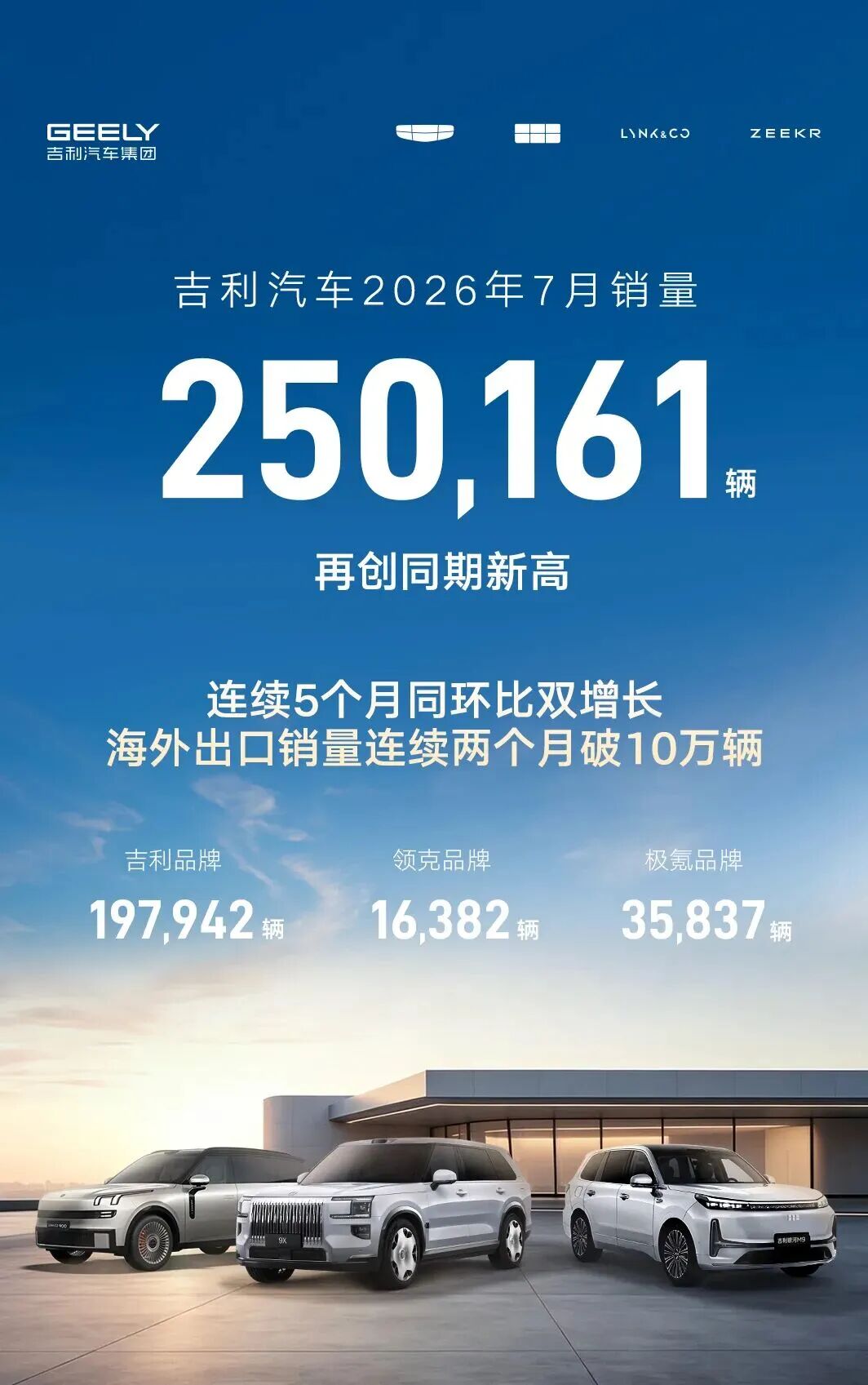
Geely Auto sold 250,161 units in July, hitting a record high for the same period in history, and achieving both year-on-year and month-on-month growth for five consecutive months. Compared with 240,799 units in June, the month-on-month growth in July was about 3.9%.
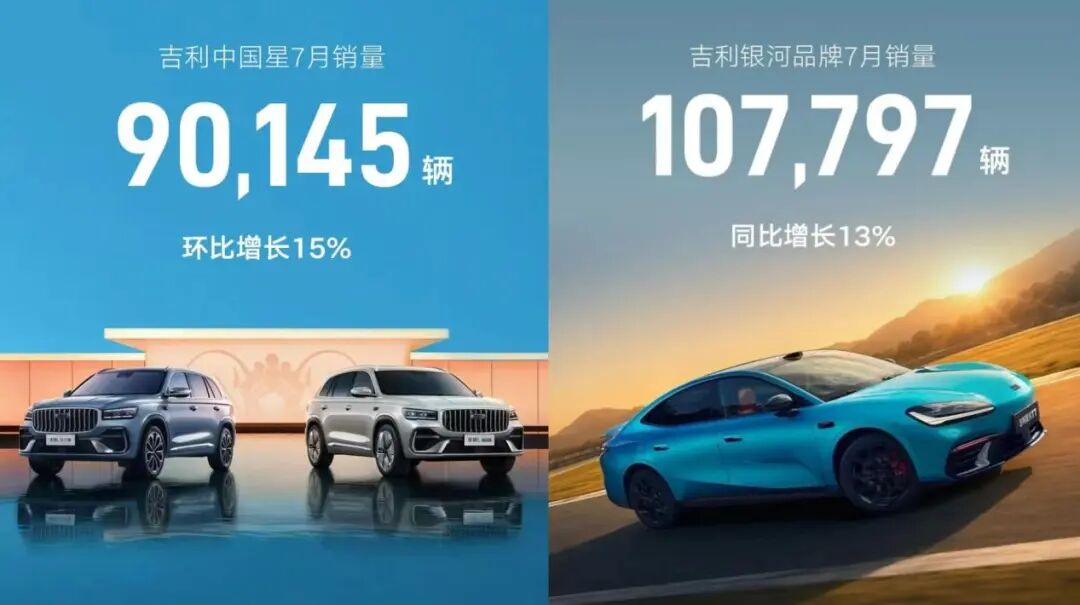
Among them, Geely China Star series sold 90,145 units, Geely Galaxy series sold 107,797 units, and Geely brand recorded a total sales of 197,942 units in July.
Specifically, the high-end sub-series of Geely China Star sold 20,892 units in July, Geely China Star Boyue sold 16,709 units, and Geely China Star Bin series sold 31,152 units, up 68% year on year. The total sales volume of Geely Xingyue L even hit the milestone of exceeding 1 million units in July, making it the first high-end fuel SUV of Chinese brand that has exceeded 1 million cumulative sales.
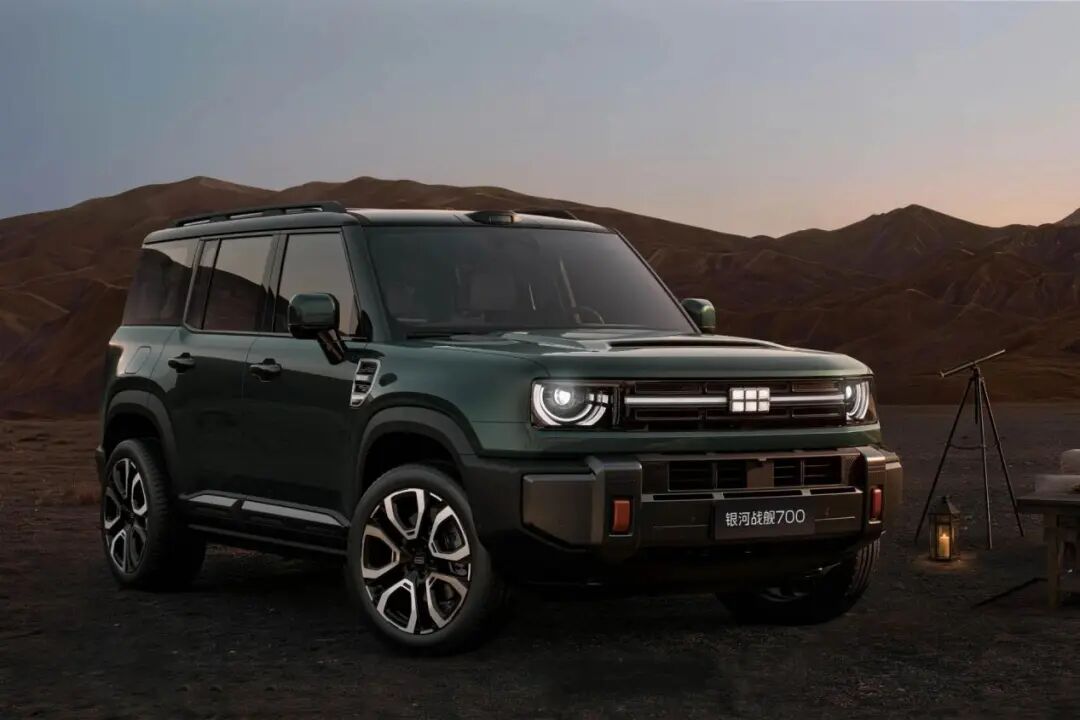
In terms of new energy products, Geely's first AI all-terrain hardcore SUV Galaxy Battleship 700 held its global debut in July, which is also a heavyweight new "box-style" off-road vehicle launched by Geely in the new energy segment. Geely Xingyuan, the core sales pillar, sold 55,105 units in July, with cumulative sales exceeding 800,000 units.
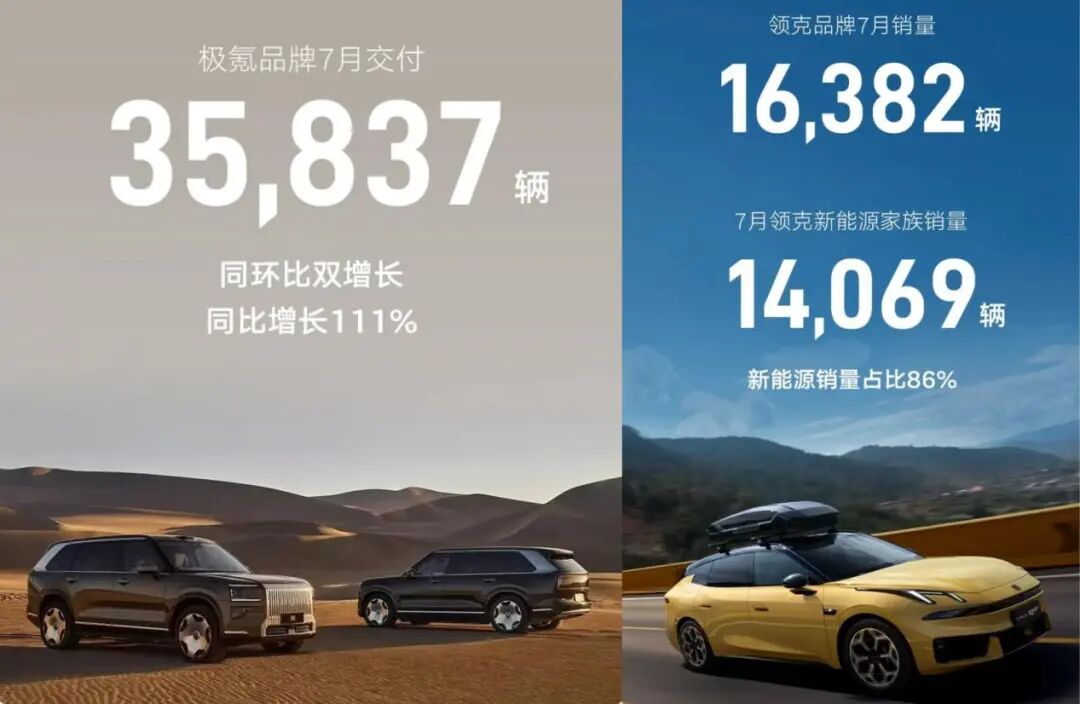
In terms of high-end brands, Lynk & Co sold 16,382 units in July; Zeekr delivered 35,837 units. Among them, the new energy product family of Lynk & Co recorded sales of 14,069 units, accounting for 86% of the brand's total sales, marking initial achievements in product transformation. Zeekr even achieved impressive double growth of year-on-year and month-on-month at the beginning of the second half of the year, with a year-on-year growth rate of 111%. In terms of product layout, the five-seat version of Zeekr 9X was launched in July, further covering the high-end large five-seat SUV market; the Zeekr 8X Qianli Haohan G-ASD H9 version started delivery, which means Zeekr will bring more surprises in the second half of the year.
What is more noteworthy is Geely's export performance. Geely exported 106,663 units overseas in July, up 202% year on year, exceeding the 100,000 unit mark for two consecutive months.
However, Geely also faces an awkward reality. Its 2026 annual sales target is 3.45 million units. After 7 months, the cumulative sales volume is about 1.673 million units, with a completion rate of about 48.5%. To achieve the full-year target, it needs to sell about 355,000 units per month on average in the remaining five months, which is 100,000 units more per month than its record high performance in July. This challenge is very difficult to accomplish.
Node Auto believes that the biggest highlight of Geely in the second half of the year is not whether it can meet another sales target number, but whether it can stabilize the high export growth, make exports no longer a short board, and convert the growth of Lynk & Co and Zeekr into profit quality that can be reflected in financial statements.
Chery, the Export Leader, What Happened to Its Domestic Market Performance?
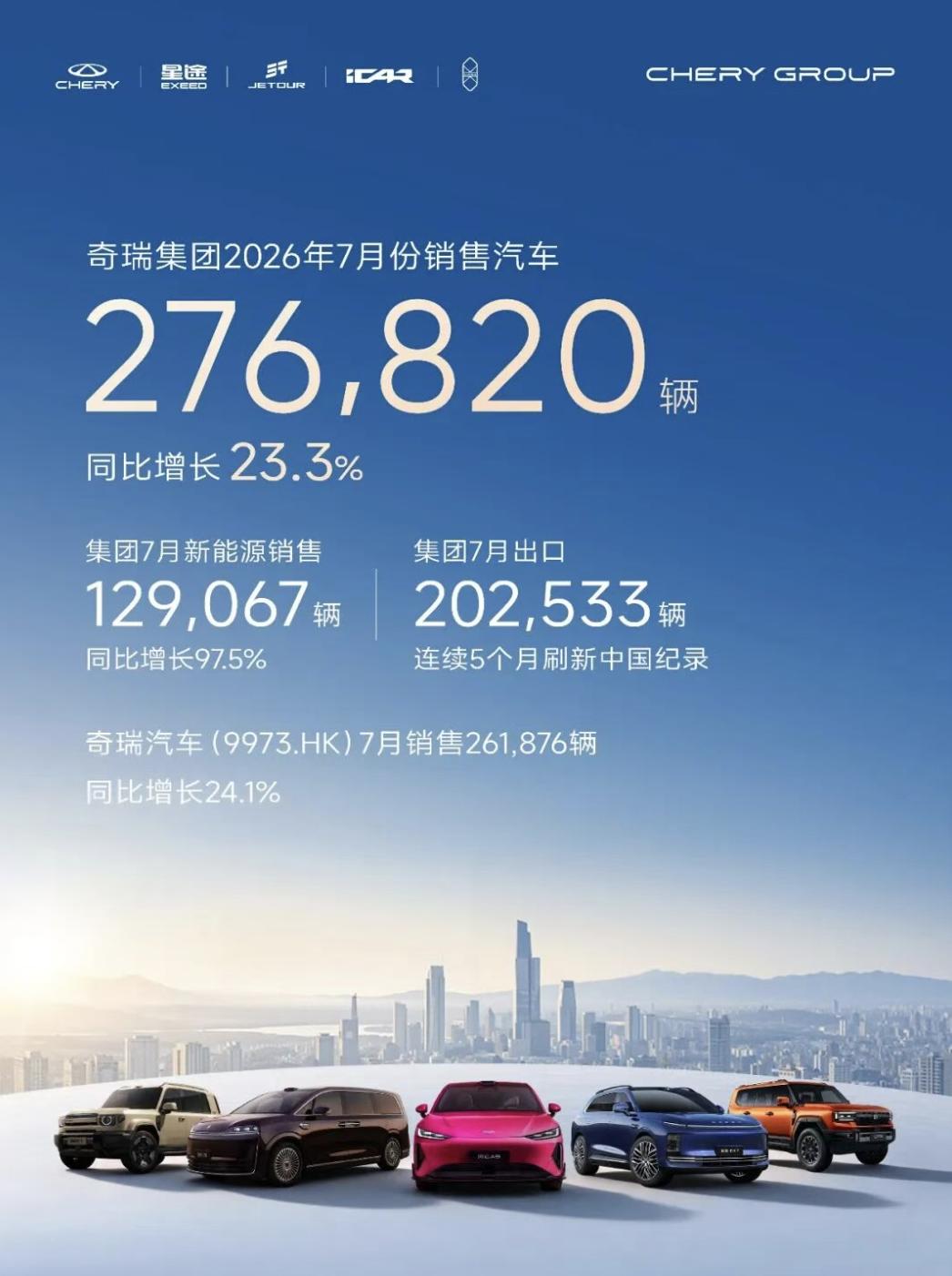
Chery Group sold 276,820 units in July, up 23.3% year on year; among which new energy vehicle sales reached 129,067 units, up 97.5% year on year, lifting the proportion of new energy sales to 46.6%.
As the leading enterprise of Chinese automakers going global, Chery's export data has always been outstanding: it exported 202,533 units in July, exceeding 200,000 units for the first time in a single month, and has refreshed the monthly export record of Chinese automakers for five consecutive months. Exports accounted for about 73.2% of Chery Group's total monthly sales. BYD has faster overseas growth, and Geely's new energy exports are catching up rapidly, but in terms of absolute scale and global channel depth, Chery is still the benchmark for Chinese automakers expanding overseas at present.
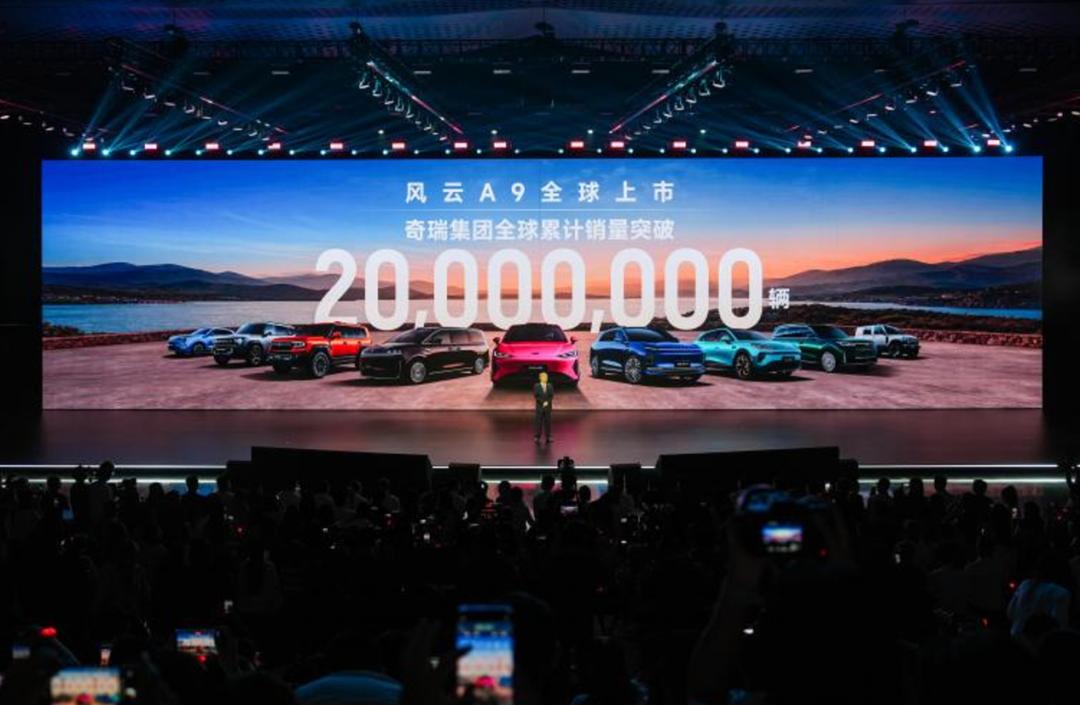
According to Chery's official statistics, sales of QQ3 EV exceeded 10,000 units in July, and the monthly delivery volume of Zhijie V9 also exceeded 10,000 units. It is worth mentioning that at the launch ceremony of Chery Fengyun A9 on July 25, Chery Group's global cumulative sales volume exceeded 20 million units.
This is the result of Chery's long-term globalization accumulation, but the other side of the data cannot be ignored either. Chery's domestic sales volume in July was about 74,287 units, accounting for only about 26.8% of the group's total sales.
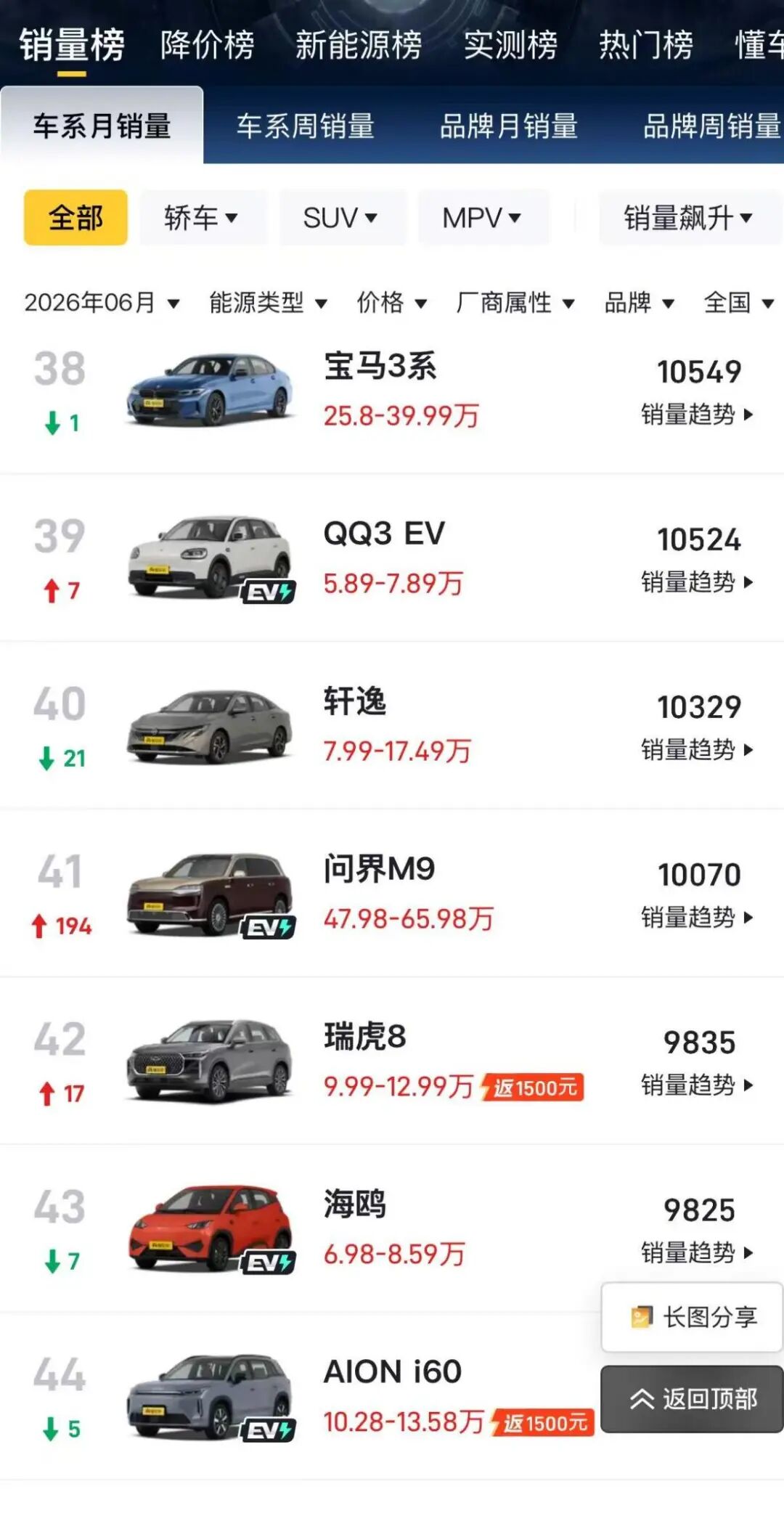
Image source: DCar Emperor App
According to rough statistics from Node Auto, Chery Group has more than 65 on-sale models under its Chery, Exeed, Jetour, iCAR and Zhijie brands. In the latest national vehicle sales ranking of June from third-party statistics, the highest-ranked model is the small pure electric car QQ3 EV at No.39, with monthly sales remaining above 8,000 units in the past three months and reaching 10,524 units in June; following QQ3 EV is Chery's classic model Tiggo 8 at No.42, with monthly sales of 9,835 units in June; then comes Arrizo 8 at No.67, with monthly sales of just over 7,000 units in June.
Chery owns a complete brand matrix and the most mature overseas channels among domestic Chinese automakers. But in terms of intelligent technology, design expression and technology mass production speed, it must keep up with the accelerating pace of other Chinese automotive brands. In the view of Node Auto, what Chery faces in the second half of the year is not "whether exports can continue to set new records", but whether it can convert export advantages into brand premium and stop the loss of market share in the domestic market.
