Beware of the AI Deflation Trap: As efficiency is improved, all profits are completely eroded away by cutthroat competition.
The AI hype is gradually fading, and enterprises are rushing to translate the technology into tangible benefits. However, an easily overlooked risk is emerging: while AI boosts productivity, it may also trigger fierce price competition and lead to technological deflation. Only by understanding this harsh rule can enterprise managers make rational AI layouts and avoid the trap of rising efficiency coupled with shrinking profits.

Over the past year or so, the frenzied AI optimism in the boardroom has gradually faded, replaced by calm and prudent thinking. Global corporate executives, faced with rising costs for data scientists, software and tokens, have no choice but to engage in a race: to turn AI from a promising vision into actual productivity.
We have long held the view that the economic effects brought by AI will be rolled out slowly and unevenly. To this day, there is still no final conclusion on how much economic impact AI can actually generate.
But even if enterprise managers find ways to make AI create value, a more survival-critical challenge is already waiting ahead: the battle for profits.
This is similar to the "winner's curse": the industries that are best at leveraging AI to drive productivity growth will most likely usher in white-hot cost and price competition, which will eventually lead to continuous compression of profit margins. Technologies with the power of economic transformation are inherently deflationary, and consumers will become the ultimate beneficiaries. The contradiction is that a substantial increase in productivity may instead lead to a decline in corporate profits.
Understand the Deflationary Nature of Technology
While AI is undoubtedly a highly disruptive technology, its way of improving productivity is no different from others: it changes the ratio of input to output. When a technology is widely popularized, it usually functions through the following three paths:
1. Less input, constant output
Enterprises use AI to reduce the input cost corresponding to the same actual output. This cost advantage is likely to prompt enterprises to cut prices to seize market share, thereby triggering price wars and compressing profits across the entire industry. All participants will be drawn into the competition, but only enterprises with relative cost advantages can retain profits. Everyone joins the race, but in the end only a few winners emerge.
2. Constant input, more output
Relying on AI, enterprises expand their actual output with stable input to build scale advantages. The resulting surge in supply will easily trigger price competition for market occupation and erode industry profits; if the supply increment continues for a long time while market demand is inelastic, the profit pressure will be particularly prominent.
3. New models replace old models
Enterprises can use AI to create brand-new business models. This path has the potential to build more lasting competitive advantages and temporarily avoid direct profit fights. However, once the technology is widely popularized, the replication speed of innovative achievements will also accelerate, and a new round of competition for market share and profits will begin.
Although the three productivity growth paths are different, they all eventually lead to the same deflationary trend. Popularized technologies mean that competitive advantages are difficult to maintain for a long time. Increased productivity does not necessarily lead to profit expansion, but may instead cause profit contraction.
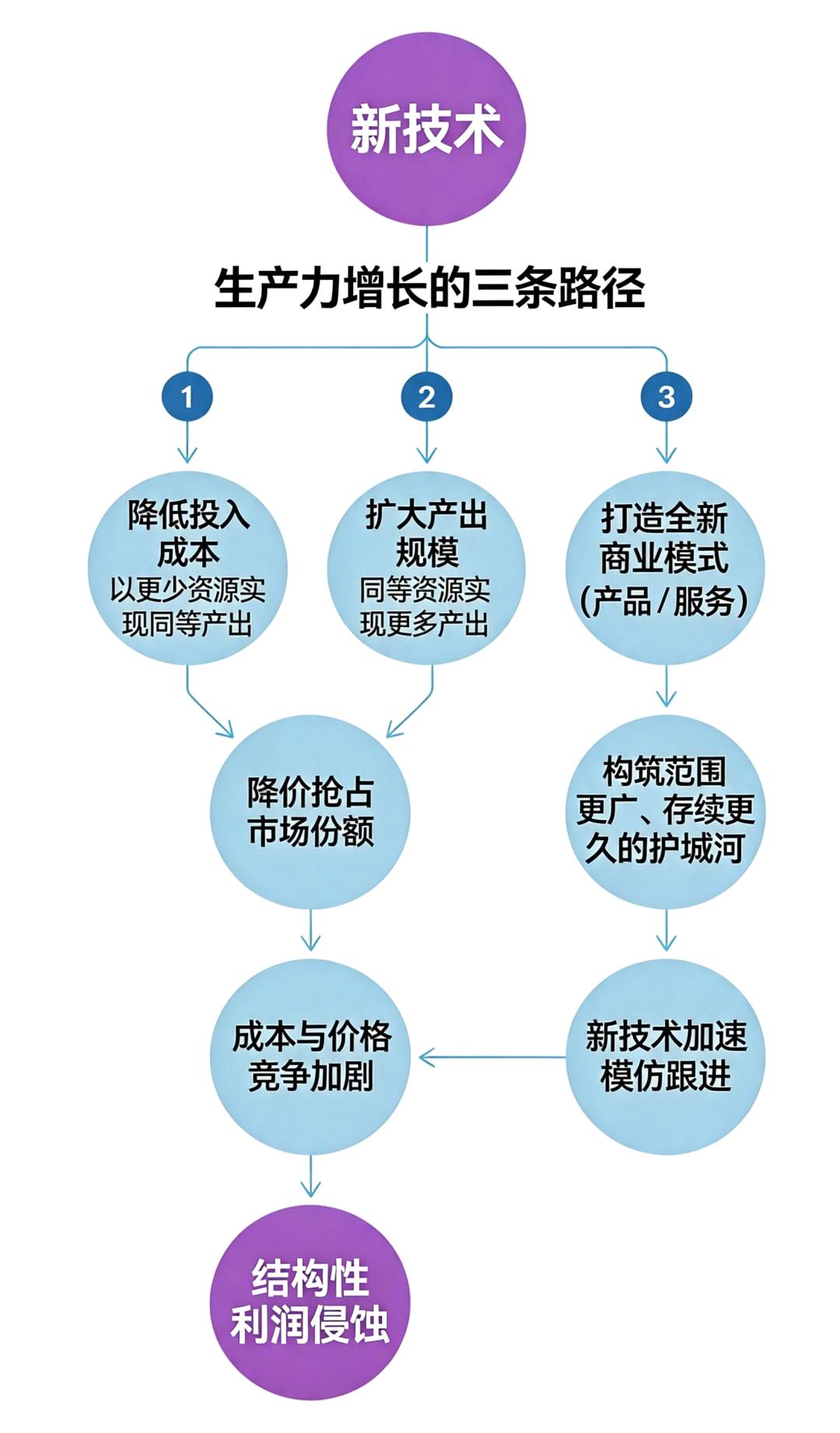
The challenges do not end there. In a dynamically changing industry, the above three paths may occur simultaneously. Taking the impact of the Internet, a popular technology, on the retail industry as an example: the Internet has reduced inventory and supply chain management costs, allowing players with scale advantages to squeeze competitors by virtue of operational efficiency and thin profits. At the same time, large retailers have incubated new segments such as advertising business and third-party seller business based on their platforms.
Real-world Cases of Technological Deflation
Take the automotive industry as an example. It is an industry with continuous incremental technological innovation. Over the past 70 years, technology has steadily replaced labor input (reflected in the continuous decline in the proportion of employment in the automotive industry), realizing "more output with less input". This has stimulated price competition, manifested as a steady decline in relative prices. Profit margins have been eroded accordingly. The industry profit margin was stable at around 30% for a long time in the early years, but now it has been squeezed to a meager level.
Technology has left similar marks in other industries, one of which is agriculture. Food used to account for more than 40% of residents' budgets, and nearly half of American workers were employed in the agricultural field. Rounds of technological innovations such as mechanization, chemical fertilizers, and genetic breeding have greatly saved labor costs. Today, agricultural workers account for only 1% of the total labor force. Although recent food inflation has sparked heated discussions, the deflationary trend is clear: current Americans' food expenditure accounts for only 13% of their total budget.
Deflationary Effects Do Not Appear Evenly
Of course, not all industries are impacted by the force of technological deflation to the same extent, and some industries are even hardly affected at all. The difference depends on the fields where the technology plays a role, as well as the inhibiting and amplifying factors of competition.
1. Competition Inhibiting Factors
If an enterprise masters a hard-to-replicate AI implementation plan and builds a deep moat, it is possible to form a monopolist in the AI field. Monopoly profits will replace price competition and avoid profit erosion.
But the probability of this scenario is low, the root cause being that the popularization threshold of AI technology is not high. All types of enterprises can use the same large model, and the advantages formed based on applications are difficult to sustain. The minor difference of access restrictions for cutting-edge models cannot change the general trend either.
Competition is also very fierce on the AI supply side. ChatGPT, Claude, Gemini, Llama, and Grok have all launched multiple models at different price points, and these are only products in the US market. As corporate AI budgets tighten, a price war has already begun to sprout. Major AI labs are likely to lower token pricing to compete for market share.
In addition, multiple factors will slow down the AI implementation speed and weaken the deflationary effect, which will not come as fast as many views have predicted:
Implementation Difficulties. "Less input with unchanged output" or "Unchanged input with increased output" may not always translate into revenue growth. A recent working paper shows that while the amount of code written has increased by more than 10 times, the number of product releases has only increased by 1.3 times.
Implementation Operation and Utilization Rate. Many employees are not very interested in using AI, and high-frequency users are even rarer. 50% of office workers will use AI, but only 13% use it on a daily basis. To obtain significant benefits, enterprises must cultivate a group of employees who are proficient in using AI.
Regulatory Support. Policy makers and the public need to embrace this new technology. For example, New York City recently refused to renew Waymo's operating license, dealing another blow to the autonomous driving industry which was already lagging behind in progress.
Social Acceptance. The public needs to recognize the social value of AI. A March 2026 survey by Pew Research Center shows that 50% of Americans are worried about the impact of AI on daily life, rather than looking forward to it.
Market Structure. Some industries themselves are not suitable for price competition. The healthcare industry has a complex system, and price competition is difficult to play a role.
2. Competition Amplifying Factors
The greater the productivity improvement brought by AI, the stronger the resulting deflationary force will be. A small increase in efficiency generally will not trigger a price war; a huge productivity breakthrough is very likely to trigger cutthroat competition.
The form in which productivity improvement is realized is also critical. If the new production capacity is difficult to shrink and price cuts cannot effectively stimulate demand, the market will easily fall into a vicious cycle of continuous price reduction. On the contrary, if cost reduction can stimulate demand growth, the intensity of price competition will be moderated. But in either case, as long as productivity is greatly improved, the deflationary impact will appear; the more significant the AI implementation effect, the more brutal the ensuing battle for profits will be.

Implications for Current Enterprise Managers
The uncertainty and unevenness of AI's impact pose multiple challenges for managers who need to formulate strategies:
1. You cannot choose to stay out of the AI race. Even managers who are skeptical about AI must invest in it. The risk of giving up layout is asymmetric: if AI finally delivers disruptive value, absent enterprises will face an existential crisis; if AI fails to meet expectations, the investment cost is certainly high, but competitors will also suffer, and the competitive landscape will not change fundamentally.
2. Participating in the AI race is almost an inevitable choice. CEOs who originally wanted to focus on basic business operations have to step aside to make strategic bets.
3. Only relative advantages matter. It is far from enough to just realize the value of AI. When the cost war and price war break out, if the efficiency improvement lags behind the top players in the industry, such optimization will be of no value. Winners do not only rely on AI to improve efficiency, but achieve a greater efficiency improvement than their peers.
4. There are often only a few winners. Once technology disrupts the industry, opportunities and crises coexist, but gains and losses are not evenly distributed. The earlier case of the Internet reshaping the retail industry has illustrated this: if the effective implementation of technology requires a large amount of capital or scale support, the industry will most likely move toward consolidation.
5. Measure actual output, not input scale. At the stage when AI value remains to be verified, many enterprises overly focus on easily countable indicators, such as token consumption and lines of code. To judge the success or failure of the AI race, we ultimately need to look at the change in output per working hour.
6. Rationally adjust return on investment expectations. Chief Financial Officers will hardly readily approve such mandatory investments: the prospect is likely to be that future profits will continue to be under pressure, and the return on investment will be meager. Furthermore, if AI boosts productivity and squeezes profit margins, enterprises investing in AI seem to be seeking competitive advantages, but in essence they are only doing so for survival.
The cultural and social impact brought by AI is an undeniable fact. It will also generate economic effects, but the scale and form of the impact remain unknown. Only when we observe obvious deflationary phenomena can we confirm that it has disruptive economic value. If no deflationary effect is seen, it means that the actual influence of AI is limited.
Keywords: #AI
Philipp Carlsson-Szlezak, Paul Swartz | Written by
Philipp Carlsson-Szlezak is Managing Director and Partner of the Boston Consulting Group's New York office, and also serves as the firm's Global Chief Economist. Paul Swartz is Executive Director and Senior Economist of the BCG Institute, based in the New York office.
Zhou Qiang | Edited
This article is from the WeChat Official Account "Harvard Business Review" (ID: hbrchinese), author: HBR-China, published with authorization from 36Kr.