AI assistants such as ChatGPT and Claude have secured top positions on the bestseller lists in many global markets. Against the backdrop of fierce competition in the general artificial intelligence sector, how can small and medium-sized developers stand out by focusing on vertical niche scenarios?
According to the monitoring data from Qimai Data, at 10:00 on August 3, ChatGPT ranked 1st and Claude ranked 10th in the overall paid bestseller list for iPhone in the United States; meanwhile, among the top 5 apps on the US iPhone efficiency paid bestseller list, four AI products namely ChatGPT, Claude, Grok and Perplexity took up 4 spots.
The above rankings reflect a noteworthy signal: the competition of AI assistants on the App Store is no longer a stage of simply competing for download volume, but has entered a new round of "rankings competition" centered on payment capacity. Of course, this does not mean that small and medium-sized development teams have no opportunities, and new industry opportunities still exist. When general-purpose AI assistants occupy the top positions on the ranking list, the breakthrough direction for new entrants is shifting from replicating the general chat entry to focusing on more segmented, specific vertical scenarios with more intuitive value.
The popularization of top AI assistants creates commercialization space for vertical AI Apps
According to Qimai Data's monitoring, at 10:00 on August 3, ChatGPT not only ranked 1st on the overall iPhone paid bestseller list in the US, but also took the 1st spot on the overall paid bestseller list in multiple markets including Brazil, South Korea, Vietnam, the United Arab Emirates and Israel; it ranked 2nd on the overall paid bestseller list in Indonesia and Saudi Arabia, and 6th in the Japanese market.
At the same time, the top four apps on the US iPhone efficiency free list are ChatGPT, Google Gemini, Claude and Meta AI in sequence, which are almost all AI products; among the top 5 positions on the US iPhone efficiency paid bestseller list, 4 spots are also occupied by AI assistants and AI search products.
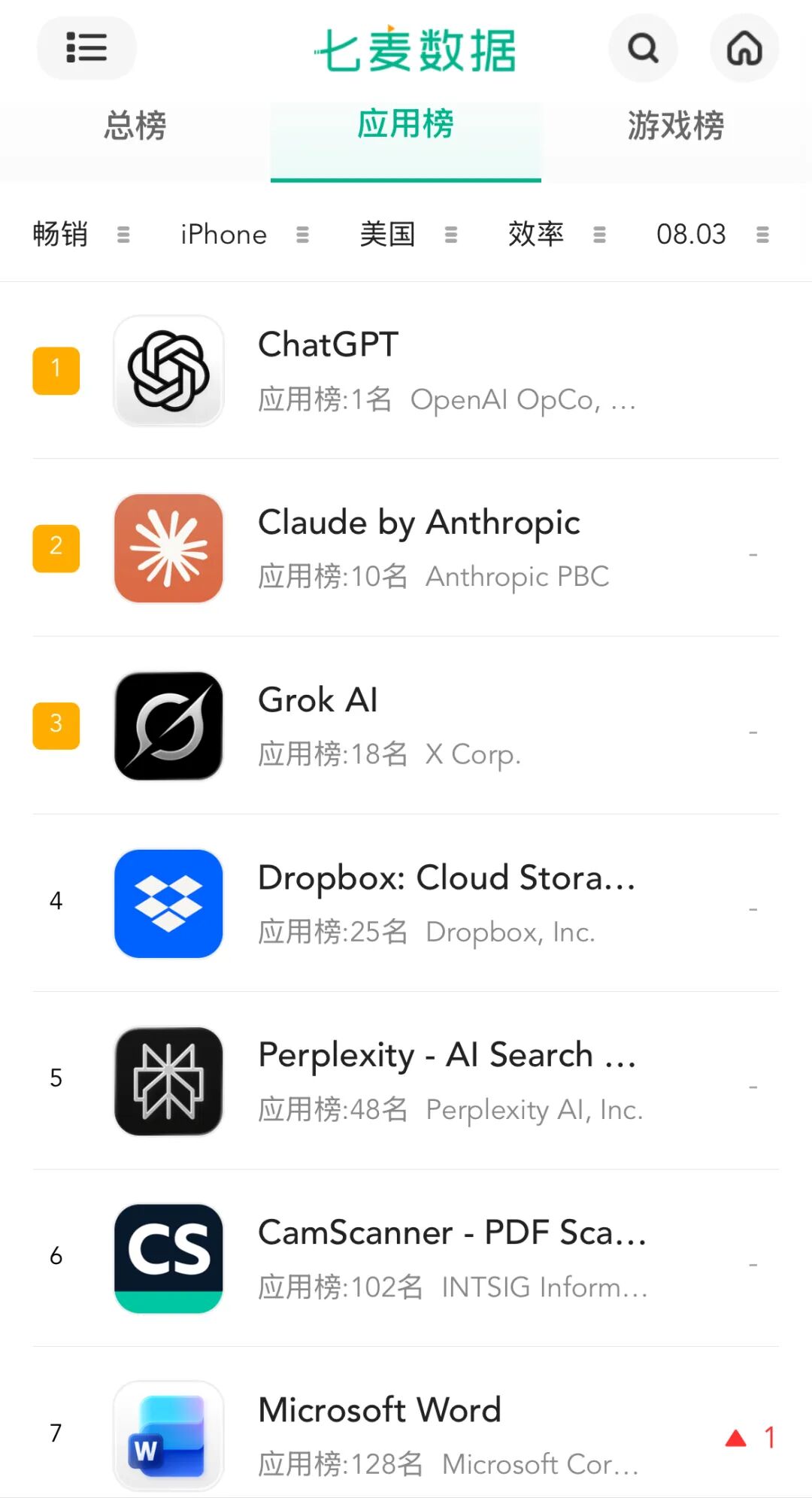
Ranking of US iPhone Efficiency Paid Bestseller List on August 3
At the same time, Claude, an AI assistant launched by the US company Anthropic, also performed remarkably in many global markets. It not only ranked 10th on the overall US paid bestseller list, but also entered the top tier of the overall paid bestseller list in markets such as Brazil, the United Arab Emirates, Israel, Vietnam and South Korea. It is not hard to see that, AI assistants have transformed from the early battle for free traffic entrants to the paid commercialization competition across multiple global markets.
However, the industry has also released a brand new differentiated signal. From the changes in the AI application market trends in 2026 and the monitoring of data of small and medium-sized apps on the App Store, it can be observed that the market size of AI products is not equal to their growth rate, and top products do not have all-round monopoly. At present, a large number of developers are still deeply engaged in niche vertical tracks, launching exclusive apps for segmented scenarios such as travel planning, sports health, finance and bookkeeping, and have gained a stable user group.
Comprehensive analysis of various industry phenomena shows that: Not all market opportunities are seized by general-purpose AI assistants. On the contrary, the popularization of top general-purpose AI assistants has greatly improved users' awareness and willingness to pay for efficiency tools, creating commercialization space for vertical segmented AI Apps.
Vertical segmented scenarios may become the breakthrough opportunity for small and medium-sized teams
Many developers tend to simply regard the ranking of AI applications as a competition of the large model capabilities of products. But in fact, the advantages of top general-purpose AI assistants are the superposition of multiple factors including model capability, brand influence, subscription system, multi-terminal entry coverage and user usage habits. It is difficult for small and medium-sized teams to replicate this set of strategies on the same track.
For ordinary developers, a more feasible opportunity is to deeply integrate AI capabilities into a sufficiently specific user work and life process. For example, AI can automatically sort out meeting content into to-do items, input bill information into the ledger with one click, convert scattered materials into reusable knowledge cards, and use AI to reduce the comparison and decision-making cost of users' shopping. The key point why users are willing to pay for AI products is not "one more AI chat window", but that the product can effectively simplify operation steps, save time and energy, and solve specific pain points.
The development trend of the domestic market also confirms this logic. For example, the office task mode and the shopping assistant "Ask Doubao before buying" updated and launched by Doubao some time ago, targeted to solve the two specific scenario needs of office work and shopping. On the China iPhone efficiency paid bestseller list, AI assistants and AI office products such as Doubao, WPS, Kimi and Kouzi compete with tools such as cloud disk, scanning and voice-to-text transcription. The current competition in the AI track is more like a competition for vertical scenarios, rather than a competition for a single chat function.
The competition of AI applications in the next stage will no longer depend on the number of functions and coverage, but on whether the scenario positioning is accurate and clear, whether the payment value is easy to understand, and whether the product page description is verifiable.
Abandon extensive operation and focus on precise scenario conversion
For the growth team, the free ranking list can reflect the traffic popularity of products, and the paid bestseller list can better reflect the real willingness of users to pay, but the data of the two types of ranking lists cannot be directly equated with download volume and revenue scale. For most developers, what they should focus on at this stage is whether the product's free traffic entry, version update description, product page description, etc. are highly unified and focused on the same scenario.
If a product focuses on vertical functions such as AI meeting sorting, AI bookkeeping, AI scanning, AI writing and AI shopping, the first screen of its product page should not only pile up empty phrases such as "intelligent", "all-powerful" and "stronger model". A more efficient and user-friendly promotion method is to clearly inform users: what content needs to be uploaded, what results the system will output, what operation steps it can help users save, which user data will not be misused, and what the subscription payment value of the product is after the free trial.
The corresponding growth and operation actions also need to be precisely narrowed and focused on implementation. First, you can test the core scenario selling points through product page optimization; then use custom product pages to precisely target different user groups and match search keywords precisely; when the product launches new functions and new activities, you can use in-app activities to amplify the scenario advantages and improve user activity; in the process of Apple Ads placement, you can consider focusing on precise keywords for vertical scenarios, instead of only laying out broad AI keywords.
Conclusion
Combining the trend of the global App Store rankings, the ranking structure of the efficiency paid bestseller list, the iteration direction of top App versions, user usage data and other comprehensive factors, the signal released by current AI products has entered the second stage. The first stage is that general-purpose AI assistants have proved that users are willing to pay for AI products; the second stage is that vertical Apps need to prove that they can continuously create value in specific task scenarios. At the same time, the phenomenon that AI products occupy top positions in the paid bestseller lists of many global markets also reminds us to re-sort out our own product positioning and optimize the payment value.
What is worthy of our continuous attention in the future is not how many more products have accessed AI and added AI to their product titles, but which products can deeply embed AI capabilities into the scenario links where users are willing to open repeatedly, retain data, and pay for subscriptions for a long time.
For products that are still at the stage of "accessing AI functions", the problem that needs to be solved now is to figure out why users need to pay for your vertical scenario service in addition to the general-purpose AI assistant?
*This article is from Nicole, and the copyright of the article belongs to the original author. The content is for communication and reference only, and does not constitute professional advice.
This article is from the WeChat Official Account "Qimai Research Institute", author: Nicole, authorized to be published by 36Kr.