The Internet has returned to an era of clique-building and factionalism.
In the business world, the more connections you have, the more paths you can take.
If you are an ordinary office worker, would it be useful for you to know Pony or Richard Liu?
Certainly not. Connections with a huge gap in social hierarchy have no value. A food delivery worker knowing Pony Ma is not a valuable connection, but knowing the community security guard is.
Let's change the question: if you are a senior executive of another internet giant, you know Pony and you have built deep investment and business cooperation relations, must this be very useful?
Actually, not necessarily.
01. The Internet Industry Used to Be Keen on Forming Cliques
In 2014, when Paipai.com faced a competitive disadvantage against JD.com, Tencent clearly realized that it was almost impossible for it to defeat JD.com. So the two sides carried out a share swap.
You don't need to care about the specific capital operation, the key is the result: from now on, if JD loses money, Tencent loses money, and if Tencent loses money, JD loses money.
At the same time, Tencent gave JD the valuable first and second-level entry positions in WeChat, making JD a de facto "WeChat-backed e-commerce platform" — of course, this was not free, JD still had to pay. According to the disclosure in JD's 2021 annual report: JD generated RMB 248 million in commission service revenue through advertising business cooperation with Tencent, and purchased a total of RMB 5.01 billion worth of Tencent advertising resources and payment processing services.
Since then, JD and Tencent have become allies. Pony, who "doesn't like taking planes", even flew to Australia in person to attend the wedding of his ally. The photos of the two appearing together are all over the internet.
Making friends can sometimes be quite addictive. After that, Tencent used this "investment + entry provision" model to continuously expand its circle of friends. A large number of internet companies including Meituan, Trip.com, Pinduoduo, Huya, Douyu, Zhihu, and Didi formed alliances with Tencent, forming the famous "Tencent System" in the industry.
In 2017, a famous business dinner was held in Wuzhen. At the dinner, almost all the attendees were so-called members of the "Tencent System" except Zhang Yiming and Lei Jun.
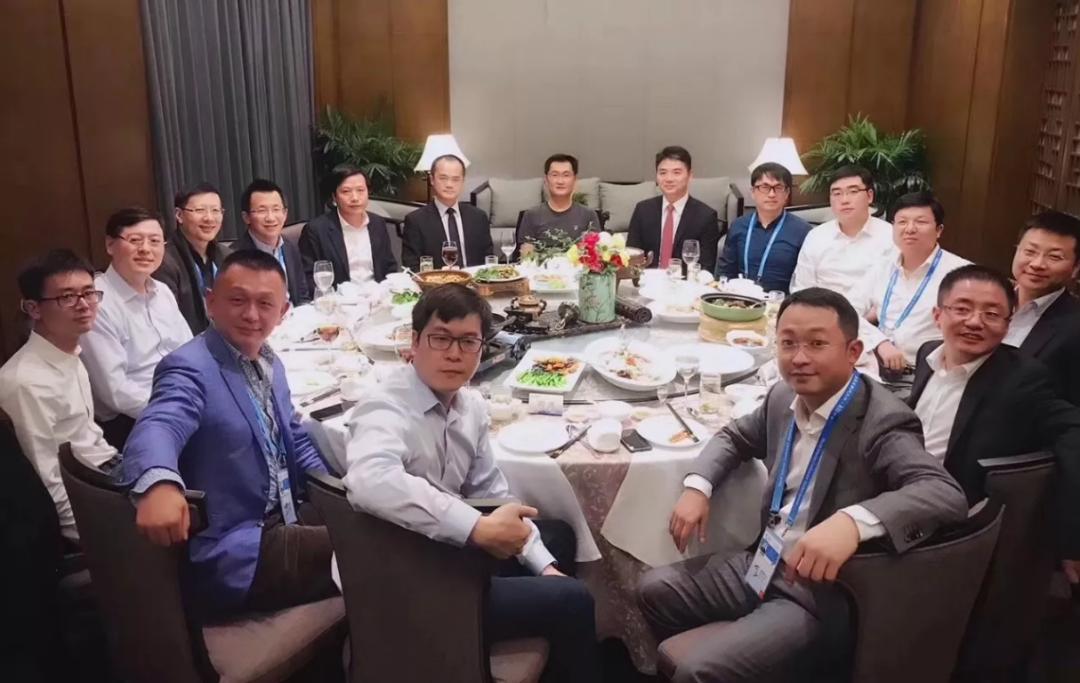
In contrast, Alibaba seems to be not so keen on forming cliques?
Actually that's not the case. It seems that Alibaba doesn't have as many "allies" as Tencent, but its cooperation model is more aggressive: it prefers to acquire companies wholly and directly turn them into members of the Alibaba family. This is the case for Ele.me, Hellobike, UC, and AutoNavi.
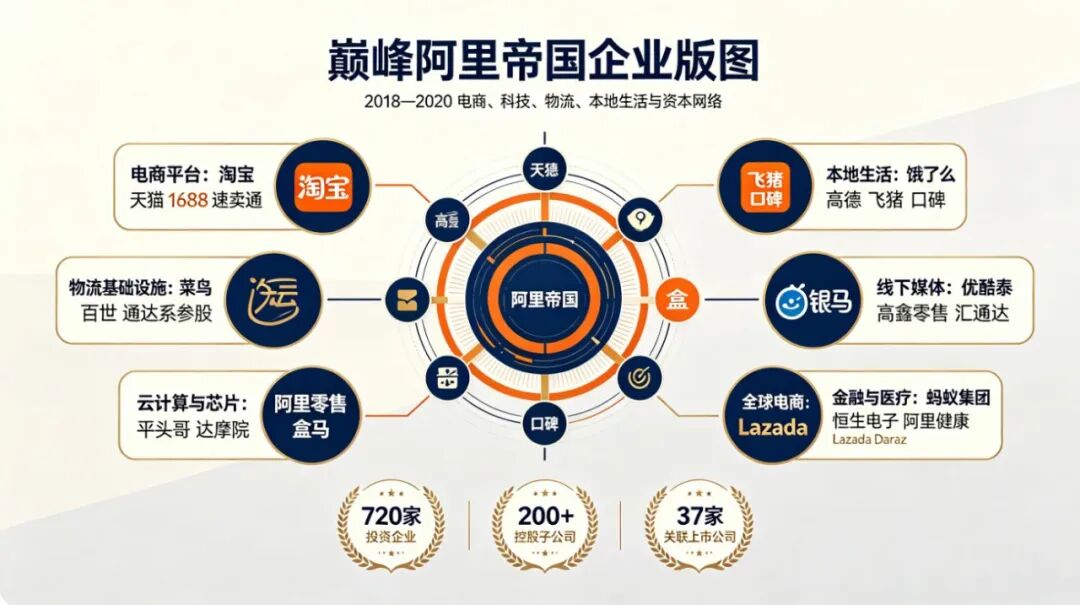
Caption: The Alibaba Empire at its peak
A few tough companies, such as Weibo which refused to be wholly acquired, formed an alliance with Alibaba in the form of equity investment.
Under the equity connection that is even stronger than blood ties, around 2020, almost every enterprise had its affiliated giant and "faction".
At that time, the internet landscape was not stable, and no giant knew where the boundary of its business was. Tencent even tried to become the leader in the short-video field, and Alibaba also tried to become a large game manufacturer.
This huge circle of friends gave them the confidence to explore business boundaries.
02. Made Lots of Friends, But Failed to Make Profits
But Ding Lei does not recognize the value of forming cliques.
He said in an interview with Wu Xiaobo: Do you have to form a so-and-so system? It is very difficult to produce synergistic effects.

Young people hate the way their parents behave in social situations, thinking that it is stupid for their parents to regard low-value connections as useful networks. But even if your connections are not low-value, but powerful giants like Tencent, Alibaba and Baidu, are they really useful?
Judging from the facts, the author agrees more with Ding Lei: they are really not that useful.
The synergistic effect is a half-truth and half-false lie in the internet industry. Its underlying logic is traffic: different products can divert traffic to each other. For example, Company A runs a social networking site for young people with a large amount of traffic, and Company B sells footwear and clothing, then there can be a synergistic effect between them to make more efficient use of traffic.
But in fact, traffic is not river water that flows along the channels you dug. Behind the traffic are users with their own emotions, habits and cognition.
Take WeChat as an example. WeChat has massive traffic. If it is combined with e-commerce, the sales should surge rapidly and beat Taobao completely. But what is the actual situation? Tencent failed in every attempt to run its own e-commerce business. Users will not place orders just because they are "diverted" to the platform, they have their own shopping habits and mindsets. Some users even prefer to open the JD and Pinduoduo APPs separately, rather than clicking the JD and Pinduoduo ads in WeChat.
JD also disclosed in 2015 that orders brought by QQ and WeChat accounted for only a very small part of JD's mobile transaction volume. But in 2019, Richard Liu revealed that WeChat contributed a quarter of JD's new users, and Pinduoduo also got a large number of users from WeChat. In terms of user acquisition, this synergy does seem to have a significant effect.
But today, the value of this effect is diminishing — which e-commerce platform still has a large number of new users? All platforms are now fighting for stock users.
The underlying logic is very complex, but the result is straightforward: traffic will not flow as people expected. For the diversified and synergistic investments of internet companies, far more investments lose money than make money. Especially after the internet industry entered the stock stage, forming cliques has become even more unnecessary.
These large companies realized this earlier than the author.
In 2021, Tencent directly distributed a large number of JD and Meituan shares to its shareholders. A few years later, at the 2025 employee meeting, Pony revealed that Tencent had exited its investments in JD and Meituan. In 2022, Tencent shut down more than 40 projects within the year. Not long ago, Tencent sought to significantly reduce its holdings in Kuaishou.
So far, the "Tencent System" has almost collapsed. Tencent still maintains a good relationship with JD and Meituan, but the deepest interest binding no longer exists.
Of course, Tencent still holds shares in many companies such as Pinduoduo, Huya, Douyu and Zhihu. But is it really because it doesn't want to sell? Take Zhihu as an example. The company's current market value is only 280 million US dollars, which is even less than the financing amount of its Series F round and the cash on its books. Selling their shares cannot recover the capital at all, so it is better to wait for a huge dividend like Douyu and Huya.
After abandoning the so-called "business empire", has Tencent's performance regressed due to the loss of "synergistic effect"? Of course not. On the contrary, the revenue of the WeChat ecosystem is growing at an extremely fast speed. The net profit of the whole company is getting better and better, and its operating status is getting healthier and healthier.
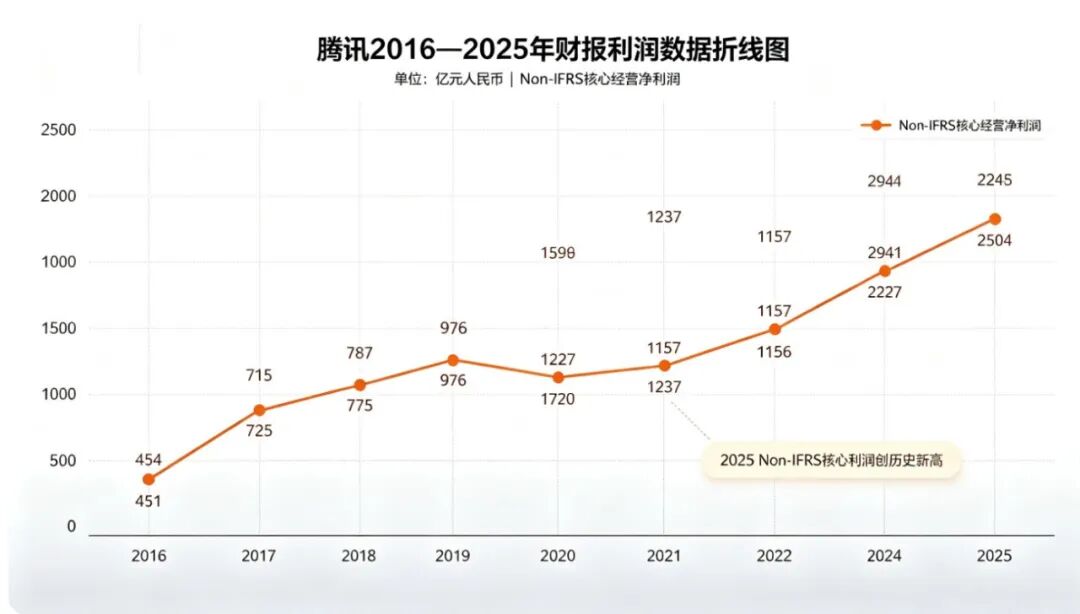
Caption: The weaker the Tencent System is, the stronger Tencent becomes
Alibaba also seems to have begun to understand this truth. After the new management took office, the company returned to its e-commerce business and began to focus on e-commerce and cloud services. In 2023, Alibaba sold its shares in companies like Lirun Lishuang and Enlight Media. At the end of 2024, within just two months, Alibaba successively sold its shares in Intime Department Store and Sun Art Retail. In June this year, there were reports that Alibaba planned to spin off its game business.
Even Ele.me has been repeatedly rumored to be sold to ByteDance.
Alibaba's "circle of friends" is also shrinking rapidly, and it has lost the so-called "synergistic effect", but this has not prevented Alibaba's net profit from improving, and its stock price has reached a new peak.
As for ByteDance? This company has been very smart from the very beginning: no matter what synergistic effect or business empire it is, it will cut off the project immediately if it cannot make money.
It must be admitted that Tencent and Alibaba's large-scale divestment of businesses was initially driven by anti-monopoly pressure, but in recent years, the large-scale divestment is obviously out of business considerations
— Friends in business are made to make money, but these friends did not bring them a lot of profits.
03. The Agent Era Is A Social Game
But AI is different from the internet.
The internet industry is a typical "go-it-alone" industry. Take Taobao as an example. It does not need Foxconn to do OEM for it, does not need Qualcomm to provide patents for it, does not need channels to help it sell goods, and only needs users. As for merchants? Taobao has millions of active sellers and does not rely on any single one of them.
But AI cannot work this way.
If Nvidia says it will stop supplying chips to OpenAI today, OpenAI will suffer a heavy blow overnight, with no alternative at all. If TSMC stops providing OEM services for Nvidia, Nvidia will also get into trouble, as the wafer foundry capabilities of Intel and Samsung are far behind TSMC.
The application side also has similar characteristics, especially for the super entrance that Tencent, Alibaba and ByteDance are deploying.
In this super entrance, the highest-frequency scenarios in daily life such as search, food ordering, and ride-hailing will no longer be completed through independent APPs, but distributed by AI. From the Doubao mobile assistant to the future mobile phone trend mentioned by Elon Musk, they all follow this logic.
This "connection" feature brings a problem: there must be service providers behind the entrance. When users order food through Doubao, there must be delivery riders to deliver the food. When users take a ride through Doubao, there must be drivers to take the order.
This means that to build an AI super entrance, it is not enough to just develop a model, you must also have an ecosystem that connects various services behind it. How to obtain this ecosystem is a huge challenge. Without the support of Meituan and Ele.me, even if you have a GPT100-level model capability, users cannot order food through this entrance.
The advantage of forming cliques has emerged again.
In June this year, WeChat announced that it would open up AI ecosystem access capabilities to developers. JD, Meituan, Didi and Trip.com were the first batch of companies to get access, and users can directly call the services of these ecosystems in the AI assistant named "Xiaowei".
It should be noted that the largest sectors of the entire internet consumption are exactly these four: e-commerce, local life services, mobility services and OTA. After accessing these four good partners, WeChat's AI can cover the vast majority of consumer demands of users.
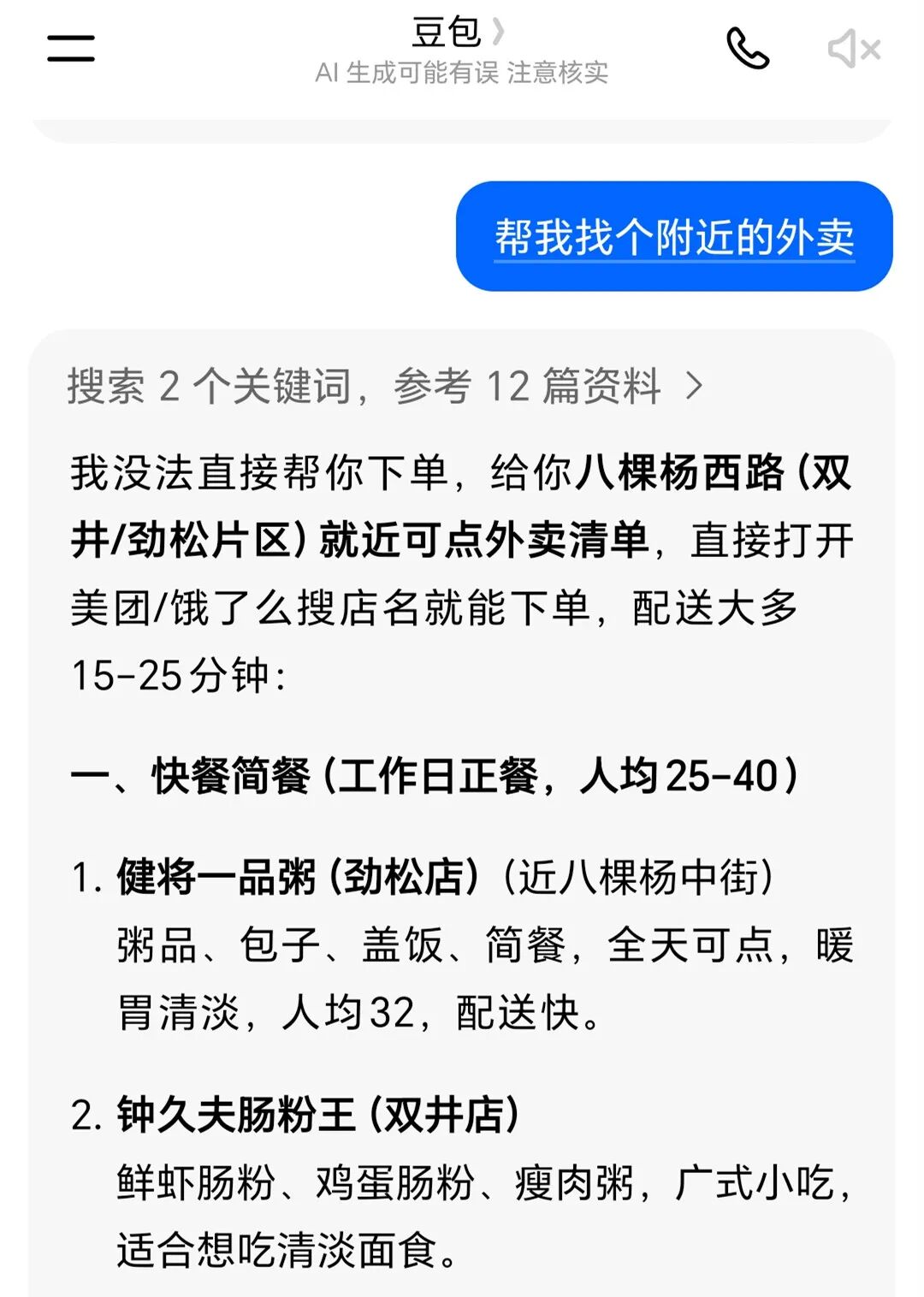
Caption: Doubao can directly rely on the Douyin e-commerce ecosystem to provide links to women's clothing, but if you want to order food delivery, it can do nothing without the help of Meituan and Ele.me.
Not only that, Tencent's circle of friends also includes five major mobile phone manufacturers, namely Huawei, Honor, Xiaomi, OPPO and Vivo, which have cooperated with WeChat to launch agent interconnection capabilities.
This is also a very valuable friend resource.
Because AI capability is a underlying capability, it requires high system-level permissions to work well. To give a smallest example: only by connecting with mobile phone manufacturers can WeChat AI have the opportunity to realize the demand of "help me find a photo in my phone".
E-commerce APPs do not rely on mobile phone manufacturers, but the AI super entrance must rely on mobile phone manufacturers to grant permissions. That's why Doubao will have in-depth cooperation with ZTE and customize a mobile phone from scratch. That's also why a large number of investors are optimistic about the value of Google and Apple in the AI wave, because they control the underlying system.
In China's mobile phone market, the entity that controls the underlying permissions is not Google, but mobile phone manufacturers. WeChat's cooperation with the five major manufacturers means that its AI ecosystem can be directly connected to the entire mobile phone.
Alibaba's advantage in its circle of friends has also emerged: the business territory it acquired covers all transaction behaviors. For e-commerce it has Taobao & Tmall, for OTA it has Fliggy, for food delivery it has Ele.me, for in-store services it has AutoNavi, and for mobility services it has AutoNavi and Hellobike. Moreover, all these transactions are controlled by Alibaba itself, forming a highly closed loop just like the iPhone.
However, Alibaba's disadvantage is that outside the e-commerce sector, its food delivery, in-store service, OTA and mobility service businesses are basically not the number one in the industry. There is a certain gap between Alibaba and the industry leader in terms of supply richness, price and service quality.
Doubao, which has the strongest AI capability and the largest number of users, is at a greater disadvantage in this regard. ByteDance itself has the e-commerce sector, and its in-store service business also has rich group-buying coupons in the Douyin ecosystem. But Douyin is not Doraemon's magic pocket, there are still many services that it cannot cover, and at the same time, it does not have solid allies like Trip.com and Meituan.
Building all services from scratch is a fantasy. No internet company can excel in all fields. But the "super AI entrance" requires you to provide the vast majority of services, otherwise it cannot be called a super entrance. Therefore, the necessity of social networking has emerged again in the AI era.
If an AI product wants to become a super entrance, it must acquire more partners, and let irreplaceable giants like Meituan, Didi, Trip.com and Taobao provide services for it — these super platforms are different from small and medium-sized ecological partners, they have no equivalent alternatives.
Of course, the AI super entrance is still in the experimental stage at the moment, not many people really use AI to order food or shop.