Cyber godfather Tibo breaks the news that Google developed a ChatGPT counterpart a full year earlier, but simply did not dare to release it.
Wait, did Google actually build a ChatGPT equivalent a full year earlier than OpenAI?
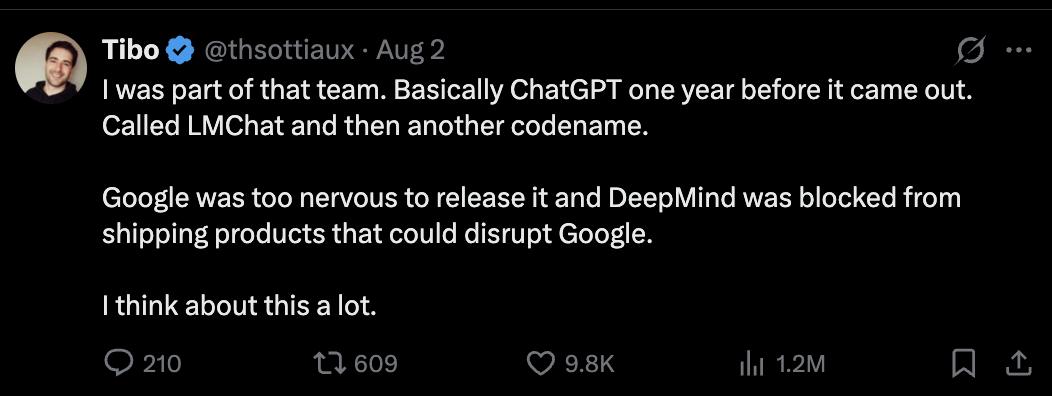
This isn't Google retroactively making excuses after the fact. The news was just corroborated by someone from OpenAI's inner circle, Tibo, Head of Codex:
That was the one-year-earlier version of ChatGPT. It was originally named LMChat, and later got another codename.
Google was so nervous that it dared not release it, and DeepMind was prohibited from launching products that might impact Google's core business.
But why is Tibo so familiar with this old story from years ago?
The answer is: he was on that very Google team back then.
I was a member of that team at the time.
Yes, Tibo, who now builds the "unlimited Token" feature for OpenAI, was exactly a firsthand witness of that Google project back in the day.
Netizens are all shocked that Tibo has such a past experience:
No way, I always thought you were just the reset button for Codex (not really).

Jeff Dean: I'm so not over it!!!
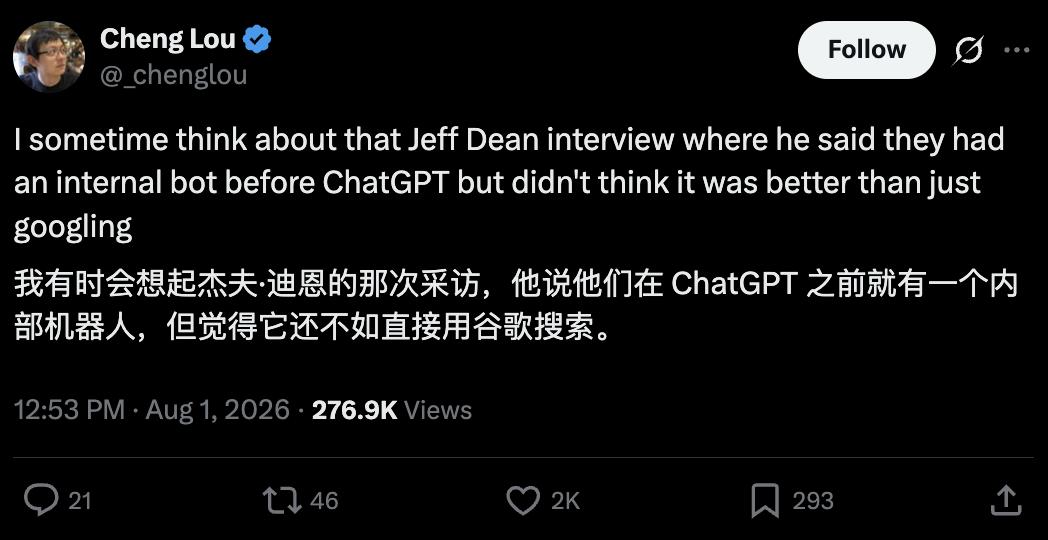
Here's what happened: an engineer from Midjourney recently dug up an old interview with Jeff Dean, former head of Google Brain, on X:
I sometimes think back to that interview Jeff Dean gave, where he said they had an internal chatbot before ChatGPT came out, but they thought it was no better than just using Google Search directly.
Unexpectedly, Tibo personally stepped in to reply, having a cross-space conversation with Jeff Dean:
The project Jeff mentioned did exist. It was originally called LMChat, and it was almost exactly a ChatGPT that came out a year earlier.
As for why it was never released, Tibo said helplessly that DeepMind didn't have the authority to do so. The LLM would have a huge impact on Google Search, and the executives were so panicked that they refused to give the final go-ahead.
After telling this story, Tibo only left a sigh:
Alas, I think about this all the time.
Netizens who heard this are completely speechless...
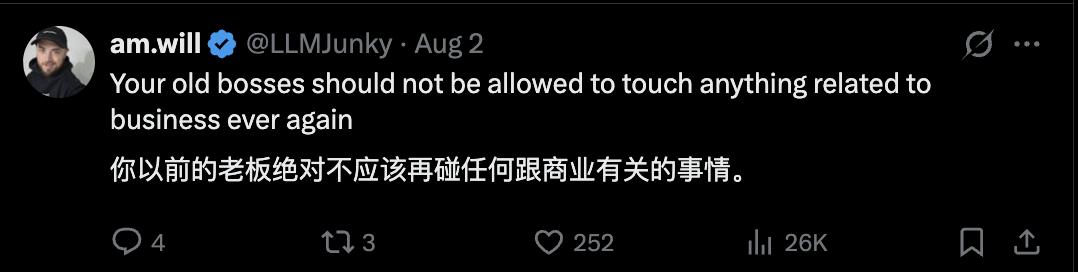
Your former boss at Google should never be allowed to touch anything related to business ever again.
Coincidentally, Demis Hassabis, the top leader of Google AI, also mentioned in his biography that OpenAI didn't make any disruptive innovations at all. Back then, many people realized the power of LLMs, it was just that Sam Altman was bold enough to completely ignore safety concerns and release it directly.
To be fair, it's not entirely Google's fault. The baseline of "Google Search" was set so high from the very beginning. If the product only served search scenarios, Google Search was already extremely mature.
But what about the LLMs back in 2023? They got almost everything wrong, and all content involving timeliness was full of hallucinations.
But now, Scaling has solved all these problems.
"Better than Google Search" — this acceptance standard Google set for itself back then ended up costing it an unprecedentedly huge price.
The Unfinished Google Journey
Tibo, real name Thibault Sottiaux, Head of Codex, the man behind the unlimited Token feature, aka "Cyber Godfather".
(ps: Reset, reset o(╥﹏╥)o, I accidentally used all my tokens over the weekend!!!)

In 2015, Tibo joined Google, initially working on Google Maps related projects, before moving to DeepMind.
Back then, DeepMind was still a very pure research lab, where AlphaGo, reinforcement learning and AGI research were at the peak of public attention.
At DeepMind, Tibo was mainly responsible for building AI and machine learning infrastructure used by researchers.
According to Tibo's recollections, DeepMind once developed a chat product called LMChat, which later was renamed with another codename. Its user experience was already very similar to that of ChatGPT.
But Google's approval process was extremely cautious. After all, this product would directly impact its existing core business, and DeepMind did not have enough authority to launch it. In the end, this product never reached the public.
In November 2022, ChatGPT was launched and took the world by storm.
Tibo was completely stunned when he saw it.
In 2024, he ended his nearly 9-year career at Google and officially joined OpenAI.
As it turns out, Tibo made the right choice.
The premature death of products like LMChat was no accident. Just like Vibe Coding, it only happens zero times or countless times (not really).
This small story eventually became the epitome of Google's status in the entire AI era.
Nowadays, Google's lag in the coding battlefield is triggering a more brutal talent exodus inside the company.
On June 18, Noam Shazeer announced that he was joining OpenAI.
This name needs no further introduction. He is one of the core authors of the 2017 Transformer paper "Attention Is All You Need" that ignited the entire AI era. He left Google in 2021 to found Character.AI, and in 2024 Google spent 2.7 billion dollars to acquire the company along with him, making him co-lead the Gemini project.
But in the end, they couldn't even keep the man they bought for 2.7 billion dollars for less than two years.
On June 19, John Jumper announced that he was moving to Anthropic.
He is Vice President of DeepMind, a core general hand picked by Demis Hassabis himself — only six months after graduating with his doctorate, he was appointed as the head of the AlphaFold team.
In 2024, he and Demis Hassabis won the Nobel Prize in Chemistry for their breakthrough work on protein structure prediction with AlphaFold.
But now, the Nobel laureate has chosen to join Google's competitor.
After suffering two heavy losses in a row, Google is still continuously losing top talents.
On June 24, two new names appeared on Google's talent "wanted list": Jonas Adler and Alexander Pritzel.

Both of them are core contributors to Gemini. Adler leads Google's AI programming direction, while Pritzel works on pre-training. Both have participated in AlphaFold research, and are former colleagues of John Jumper.
Their destination is also Anthropic.
One More Thing
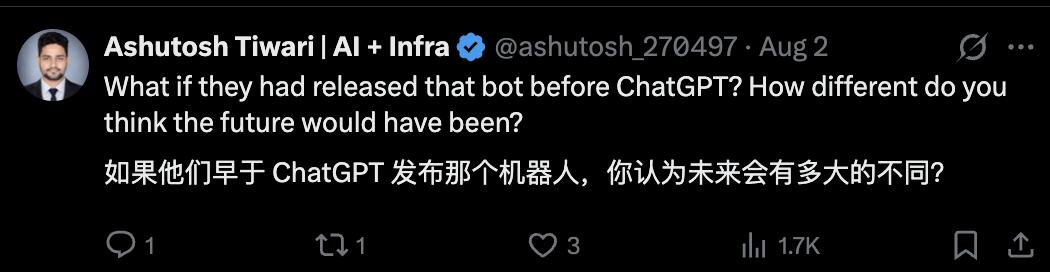
In the comment section of the post, someone raised a very interesting question:
What would be different now if Google had released GPT first?
Unfortunately, almost no one replied to this question.
But I know the answer to this question!!
This is exactly the most classic old joke in the tech industry.
Back in the 1970s, Xerox PARC invented the graphical user interface, the mouse, and Ethernet. They basically held all the winning cards for the entire PC era in their hands, a perfect royal flush.
But what happened? Xerox simply didn't take these inventions seriously.
Because Xerox's sales team did the math: would this fancy interface help us sell two more boxes of toner, or two more packs of A4 paper? No. Then why bother developing it?
...
Just like that, Xerox watched Steve Jobs come for a visit, go back and develop the Macintosh, and then rise to the throne of the personal computer era.
Since then, Xerox has become the "scapegoat" of Silicon Valley. Every time there is a paradigm shift in the industry, industry leaders will drag Xerox out to criticize it as a cautionary tale:
See? This is the classic big company disease! (crack, the sound of whipping)
But to be honest, anyone sitting in that position, looking at tens of billions of dollars in annual profit from printers, would be reluctant to kill their own cash cow...
Replace "toner and A4 paper" with "search and advertising", and replace "graphical user interface" with "ChatGPT" —
Google, which wrote the Transformer paper back in 2017 and held all the top-tier advantages, eventually in the AGI marathon...
ended up being the "US equivalent of Doubao".

Reference link: [1]https://x.com/thsottiaux/status/2083596911060324570
This article is from the WeChat Official Account "QbitAI" (ID: QbitAI), written by Jay, published with authorization from 36Kr.