New Architecture · New Capabilities: Sobot Unveils AI Agent-Driven Next-Generation Customer Contact Platform
Over the past decade, the customer engagement industry has evolved by building increasingly comprehensive "systems" — online customer service, call centers, work orders... every single link has been digitalized. But the people behind the systems are the ones who truly deliver services and solve problems. The emergence of large language models has opened up a new possibility: AI is no longer just a tool to boost human efficiency, but an intelligent agent that can independently understand, make decisions, and get things done for real.
On July 30, with a comprehensive upgrade of its AI Agent product portfolio, Zhichi Technology once again stands at this inflection point. The new version of Agents will be fully revamped around four core capabilities: construction, execution, operation and analysis, evolving from "a robot that can answer questions" to "a self-evolving intelligent agent operation system". Synchronized with this product upgrade, Zhichi Technology has officially upgraded its overall product architecture into three major series: "Agents, Nexus, Experts".
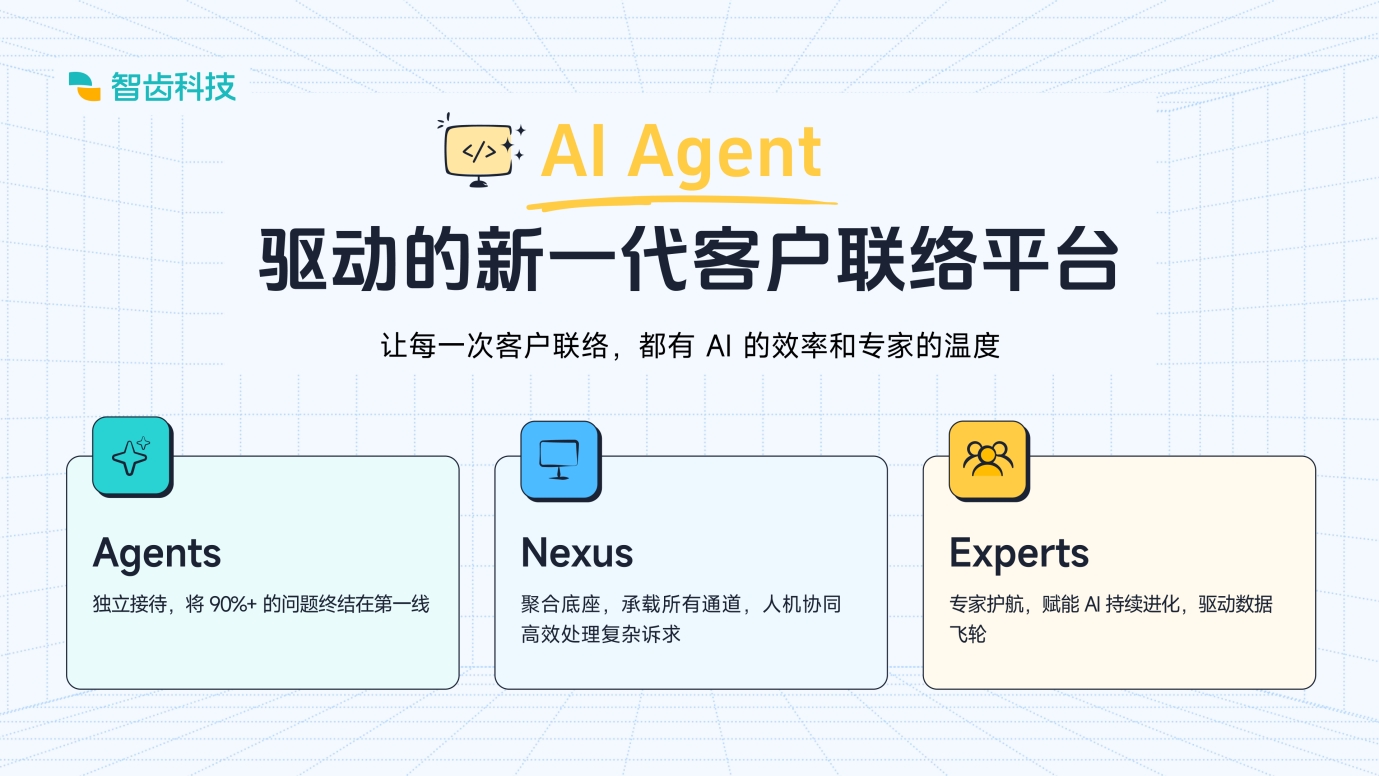
Different from vendors that simply add AI to traditional customer service systems, Zhichi Technology is built for Agents right from the architecture layer: independent reception and active outreach by intelligent agents, a unified base that supports all channels, and real human experts who continuously optimize performance behind the scenes. All these point to one fact — Zhichi Technology is transforming from an "integrated customer engagement SaaS company" to "a new-generation customer engagement platform driven by AI Agents".
Agents·Nexus·Experts: Triple Architecture, Mutual Support
Let's start with the most intuitive changes this time. The new version of Agents has completed a leap from "answering questions" to "getting things done": you can build, diagnose and optimize an Agent with just one sentence, lowering the operation threshold from "expert-level" to "conversation-level"; knowledge, skills, tools and memory are uniformly precipitated into reusable enterprise assets, enabling intelligent agents not only to understand problems, but also to connect to systems and get things done for real; launch is no longer the end point, and the closed loop of construction → evaluation → optimization → observation allows it to learn and get better every day...
What is visible in this upgrade is the Agent itself, while what is invisible is a whole new set of architecture launched synchronously — Agents, Nexus, Experts.
What stands in front of customers are Agents. From pre-sales consultation, after-sales service, exclusive VIP service to internal enterprise employee service desks, different scenarios correspond to different intelligent agents, which independently receive visitors and take the initiative to reach out, solving the vast majority of repetitive and procedural problems at the front line. They are not robots waiting to be asked questions, but digital employees that can judge "what to do next" on their own and get things done for real.
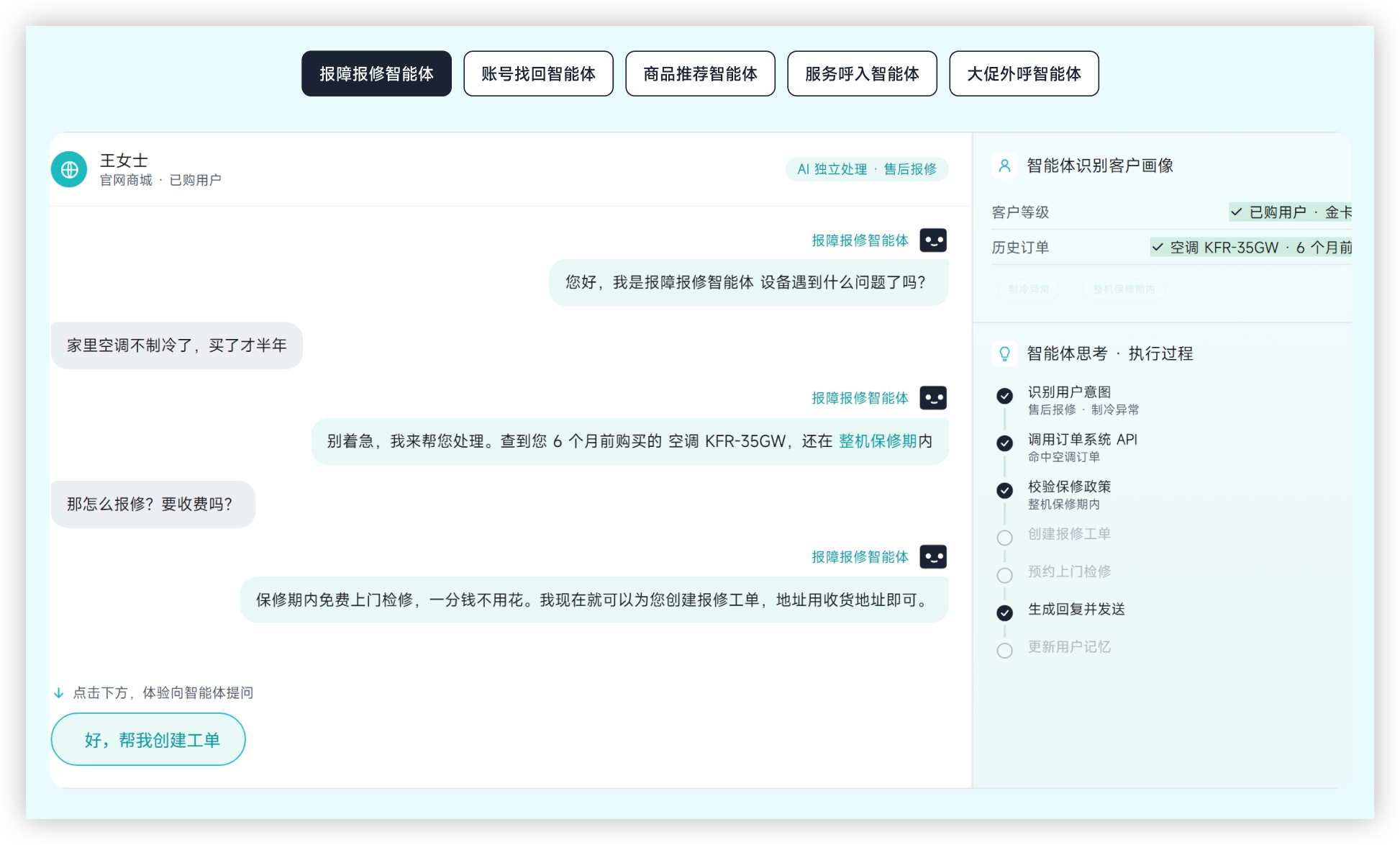
What makes all Agents run smoothly is Nexus. Web pages, Apps, emails, phones, social media, IM, e-commerce platforms — in the past, accessing a new channel often meant rebuilding a whole set of systems; now, all channels are connected to the same unified base, every intelligent agent of Zhichi runs on Nexus, and data, context and service standards remain consistent across all channels.
What stands behind Agents are Experts. The expert team is present throughout the whole process, from solution design and AI deployment to training optimization and daily operation — instead of leaving after delivering the system to customers, they continuously observe and optimize, making every intelligent agent more accurate and reliable in real business scenarios as it is used more often.
The three are closely linked and indispensable: without Nexus, Agents can only be trapped in a single channel; without Experts, Agents will not evolve so fast; without Agents, Nexus and Experts will have no real service targets.
For customers, this means three things happening at the same time: there is no need to rebuild a whole set of systems for every new channel; you no longer have to judge whether AI works well by feeling, the effect can be quantified, tracked and continuously optimized for the first time; you also don't have to worry about the performance degradation of AI after long-term use — it will keep learning in day-to-day operations, and become more familiar with your business the more you use it.
This is exactly what "good service" looks like in Zhichi's eyes — problems are solved at the front line, standards are unified in the base, and professional experience is precipitated in people. The reason why this architecture takes shape right now is backed by a larger judgment.
Why Now: A Judgment of the Era
Every day, billions of customer interactions take place around the world — a late-night refund consultation, a call that took a long time in queue to get connected, a message that was sent and never got a reply... Behind every single one of them is a person waiting for a response.
Over the past decade, the industry has been used to using "systems" to receive these demands: online customer service, call centers, work orders, as well as early AI based on rules and keyword matching. But at that time, no matter the system or AI, they all played the role of "empowerment" — helping people work faster and with less effort, and it was always people who truly understood problems, made judgments and delivered services.
It was not until the emergence of large language models that this situation was rewritten for the first time. AI is no longer just a tool passively waiting for instructions, but can listen, think and take action — understand customer intentions on its own, judge the next step on its own, and get things done. In one sentence: AI is no longer a tool, but a labor force. The underlying logic of customer engagement is shifting from "people operating software" to "intelligent agents working independently, with people making them smarter".
This is not just a technical upgrade, but also an expectation upgrade. Customers no longer settle for "being received by someone", but hope that "problems are solved on the spot"; enterprises no longer settle for "reducing labor costs", but hope that AI can truly deliver business results — refunds are processed, work orders are closed, customers are satisfied, rather than just a polite reply. Whoever can first turn AI from a "tool" into a "labor force" that can really do work will be the first to meet this expectation.
Tools have been upgraded countless times, but this time, it is a paradigm revolution. Zhichi Technology chooses to stand at this inflection point and set off again.
More Than Ten Years of Accumulation Pave the Way for Today's New Start
This new start does not mean that Zhichi starts from scratch.
Since its establishment in 2014, Zhichi Technology has been moving forward on this path: in the early stage, its first product "online customer service robot" used AI to handle repetitive problems; later, it successively integrated call centers and work order systems to form "intelligent full customer service"; starting from 2018, it launched marketing-side products such as outbound calling and lead generation, realizing the integration of service and marketing; starting from 2019, it expanded around private domain operation and BPO business, gradually forming a three-dimensional integrated customer engagement solution of "service + marketing", "public domain + private domain" and "software + BPO", and officially released the "integrated customer engagement center" strategy in 2021. In the following years, Zhichi promoted internationalization and intelligent transformation at the same time. It is one of the first batch of domestic enterprises that applied large language models to customer engagement scenarios, and also one of the first batch of enterprises that went global and quickly grew into a "leader of new overseas expansion forces".
In the past more than ten years, Zhichi Technology has served tens of thousands of enterprises around the world, covering industries such as intelligent manufacturing, retail e-commerce, interactive entertainment, finance and insurance, and life services. From the globally expanded Kuro Games, to realme in the intelligent manufacturing field, to Eastbuy in the live streaming e-commerce sector, every smooth after-sales conversation and every accurate order query may have Zhichi Agents behind it — these accumulations are not only the confidence for Zhichi to set off again, but also the best starting point for the real implementation of Zhichi Agents.
We believe that in the future, every enterprise will have a team of intelligent agents that never get tired and get smarter the more they are used; and every person who contacts them will still feel that they are being taken seriously.
Xu Yi, Co-founder and CEO of Zhichi Technology, said: "Over the past decade, we have helped customers build more and more comprehensive systems, but it is not until the advent of large language models that AI truly starts to 'work' independently. With this upgrade, we are not adding a new function to the product, but redefining what Zhichi is — we are built for Agents right from the architecture layer, rather than stuffing AI into old systems. AI is responsible for efficiency, and experts are responsible for delivering human warmth. This is not a trade-off, but our full answer to 'good service'."
Since the day of its founding, Zhichi's vision has never changed — to enable every enterprise to enjoy the changes brought by intelligent services. Today, this vision has a new annotation: Zhichi Technology is a new-generation customer engagement platform driven by AI Agents, which enables AI to truly enter every service process and every customer communication of enterprises, turning the vision into a fact that happens every day. Let every customer interaction have the efficiency of AI and the warmth of experts.