Amazon hit the jackpot, raking in 360 billion yuan from Anthropic, and its after-hours share price surged by 10%.
Reported by Zhidx on July 31, in the early hours of today, Amazon released its 2026 Q2 financial results. In this quarter, Amazon's cloud business AWS recorded its fastest growth rate in nearly 18 quarters, with revenue rising 37% year-on-year to 42.232 billion USD (approximately 285.1 billion yuan). The annual revenue of both AWS's AI business and chip business exceeded 25 billion USD (approximately 168.8 billion yuan).
According to the financial report, Amazon's Q2 revenue reached 200.6 billion USD (approximately 13.5 trillion yuan), up 20% year-on-year; operating profit hit 27.5 billion USD (approximately 185.7 billion yuan), up 43% year-on-year; net profit amounted to 62.6 billion USD (approximately 422.9 billion yuan), an increase of about 244% compared with 18.2 billion USD (approximately 122.9 billion yuan) in the same period last year.
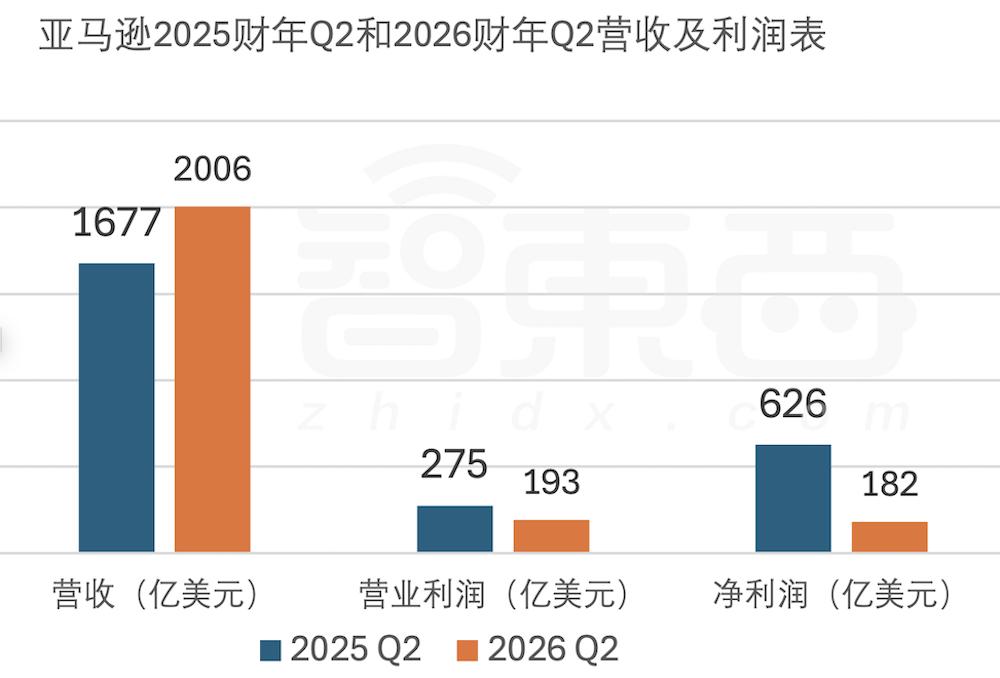
▲ Amazon's Q2 2025 Fiscal Year and Q2 2026 Fiscal Year Revenue and Profit Statement
Among them, Amazon's net profit this quarter also includes pre-tax non-operating income of 53.4 billion USD (approximately 360.7 billion yuan), which mainly comes from the fair value appreciation of its equity investment in Anthropic. This means that the sharp jump in profits this quarter is largely driven by changes in equity investment valuation, not entirely from the expansion of main business.
In this quarter, AWS's operating profit reached 16.6 billion USD (approximately 112.1 billion yuan), up more than 60% year-on-year. The rapid growth of AWS is mainly driven by enterprise AI demand. Amazon is building a complete AI infrastructure system through cloud services, AI chips and model platforms.
In the second quarter, Amazon's capital expenditure reached 53.1 billion USD (approximately 358.5 billion yuan), remaining at a high level. Most of the funds are invested in AWS infrastructure, generative AI data centers and related hardware procurement. In the past 12 months, Amazon's equipment procurement expenditure increased by 66.1 billion USD (approximately 446.5 billion yuan) year-on-year.
At the same time, Amazon's rolling free cash flow decreased by about 142% year-on-year, turning from a net inflow of 18.2 billion USD (approximately 122.9 billion yuan) in the same period last year to a net outflow of 7.6 billion USD (approximately 51.3 billion yuan).
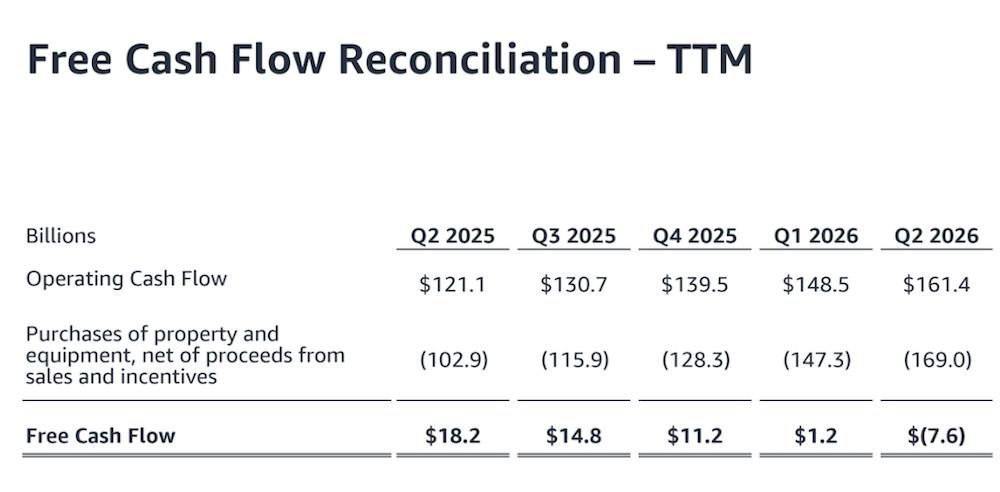
▲ Amazon's Rolling Free Cash Flow (Source: Amazon)
At the conference call, Amazon CEO Andy Jassy mentioned that Amazon plans to continue expanding investment in AI infrastructure. Currently, about 85% of global IT expenditure is still deployed in on-premises environments. In the next 10 to 20 years, the migration of enterprises to the cloud and the popularization of AI applications will continue to drive AWS growth.
In terms of personnel changes, according to Amazon's official news, in January 2026, Amazon announced that it would cut about 16,000 employees worldwide. Since October 2025, the company has cut more than 30,000 employees in total. According to Reuters reports at the end of July, Amazon also cut positions such as model customization and post-model training in its general artificial intelligence (AGI) team.
As of the close on July 30 Eastern Time, Amazon's share price closed at 235.50 USD per share (approximately 1590.8 yuan per share), up 3.90% from the previous trading day, with a total market value of about 2.53 trillion USD (approximately 17.09 trillion yuan). As of 20:00 Eastern Time after market close, Amazon's share price rose 9.53% from the closing price of the day to 257.95 USD per share (approximately 1742.45 yuan per share).
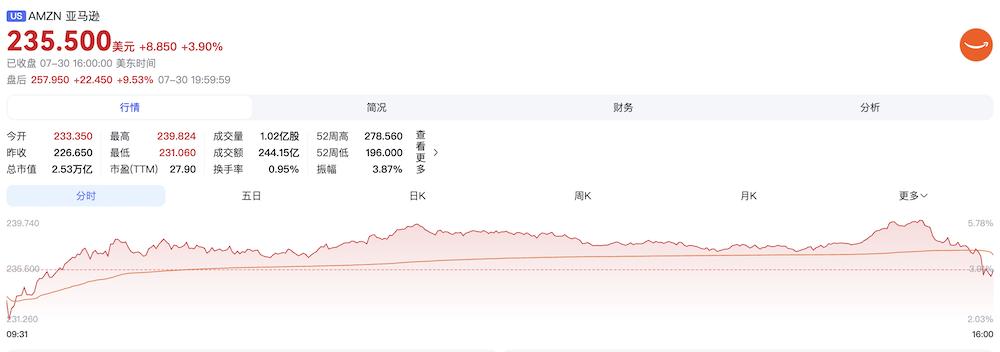
▲ Amazon's Share Price (Source: Baidu)
01 AWS Growth Hits New High in Nearly 18 Quarters, Self-developed Chips Become Important Part of AI Infrastructure
In this quarter, all three major business segments of Amazon achieved year-on-year growth, among which AWS maintained the fastest growth rate. Data shows that the revenue of North American retail business was 116.2 billion USD (approximately 784.9 billion yuan), up 16% year-on-year; the revenue of international retail business was 42.2 billion USD (approximately 285 billion yuan), up 15% year-on-year; the revenue of AWS reached 42.232 billion USD (approximately 285.277 billion yuan), up 36.7% year-on-year, and the growth rate was significantly higher than other business segments.
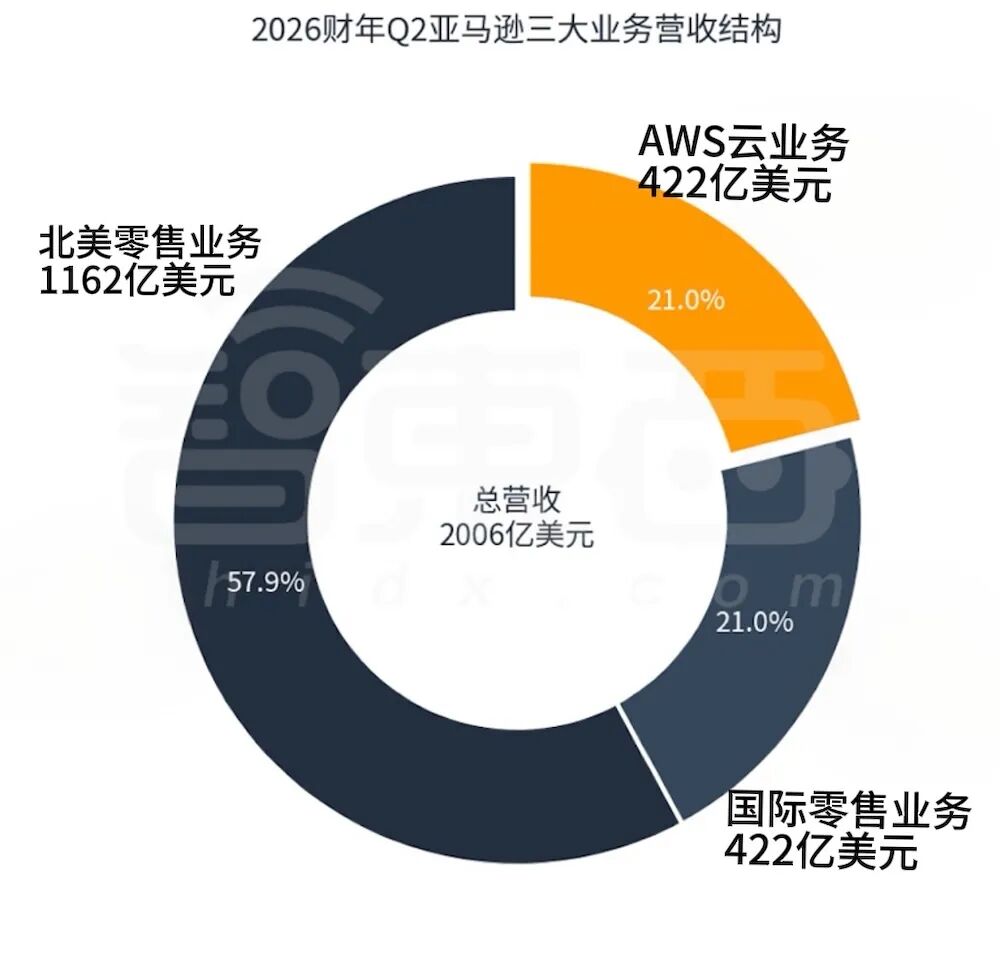
▲ Proportion of Revenue from Amazon's Three Major Businesses
In terms of profitability, AWS's operating profit in the second quarter reached 16.6 billion USD (approximately 112.1 billion yuan), with an operating profit margin of 39.4%, up 650 basis points year-on-year. Amazon CFO Brian Olsavsky said that even excluding the impact of the fair value gain of about 600 million USD (approximately 4.05 billion yuan) from energy contracts this quarter, AWS's operating profit margin still increased by 520 basis points year-on-year, which mainly benefited from the optimization of computing resource scheduling, the application of self-developed hardware and the improvement of fixed cost management efficiency.
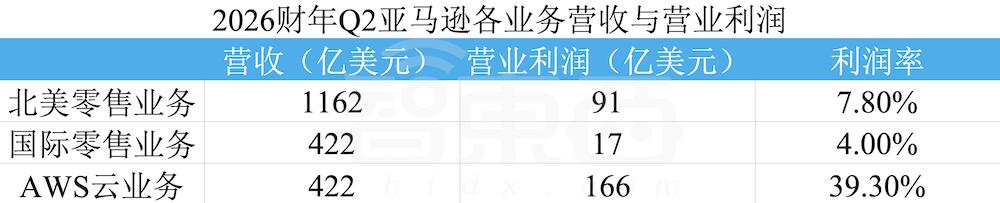
▲ Revenue, Operating Profit and Profit Margin of Amazon's Three Major Businesses
Jassy pointed out at the conference call that current AI demand mainly comes from two directions: on the one hand, large model companies such as Anthropic and OpenAI continue to increase their demand for computing power for training and inference; on the other hand, more and more enterprises begin to apply AI to scenarios such as customer service, business process automation and risk control.
Jassy believes that enterprise AI applications are still in the early stage. At present, about 85% of global IT expenditure is still deployed in on-premises environments. There is still much room for enterprises to migrate to the cloud in the future, and the growth of AI workloads will further drive cloud computing demand.
Self-developed chips are an important direction for AWS to reduce costs and improve service differentiation. Amazon continues to promote the layout of Trainium and Graviton series chips. At present, the annualized revenue of both Trainium AI chips and Graviton general-purpose computing chips has exceeded 25 billion USD (approximately 168.9 billion yuan), and maintains rapid growth.
Among them, Trainium is being adopted by more AI enterprises. Amazon revealed that both large model unicorns Anthropic and OpenAI have reached multi-year, multi-gigawatt Trainium procurement commitments with AWS, and more and more AI startups are beginning to use Trainium for model training.
In addition, Amazon's latest generation of general-purpose computing chips Graviton5 has been officially opened for use. Amazon said that Graviton has a maximum 25% improvement in computing performance compared with the previous generation, and the Graviton series is currently used by 98% of AWS's top 1000 EC2 customers.
02 Large Model Platform Continues to Expand, Amazon Bedrock Accelerates Enterprise AI Implementation
In addition to the underlying computing power infrastructure, Amazon is further expanding the entry point for enterprise AI applications through Amazon Bedrock. At present, Amazon Bedrock has become an important platform for AWS to provide large model services to enterprise customers. Amazon said that Bedrock has accessed more than 10 managed foundation models, including OpenAI's GPT-5.6, Anthropic's Claude Opus 5, Google DeepMind's Gemma 4 and xAI's Grok 4.3.
Amazon revealed that hundreds of thousands of customers are now using Bedrock. The number of new customers in the past six months has exceeded the cumulative growth of the previous two years, and customers' investment in the second quarter has exceeded the sum of all previous quarters.
At the same time, Amazon has not given up on self-developed cutting-edge models. Jassy said that self-developed models are mainly used in three directions: first, to further reduce the cost of models and improve the price competitiveness of its AI services; second, to optimize for Amazon's retail, enterprise services and other business scenarios; third, to enhance the ability of independent control over model R&D direction and iteration rhythm. He predicts that in the next few years, there will be multiple leading models with similar capabilities in the market, and Amazon's self-developed models will be one of them.
In the direction of Agent, Amazon has also begun to explore AI agent capabilities. The financial report mentions that AWS is launching more enterprise tools based on AI Agent. Among them, Kiro is a code agent for developers, which can assist in software development tasks; Amazon Quick is for enterprise office scenarios, helping users complete information sorting, business analysis and other work through natural language.
In addition, Amazon has launched security-related AI tools such as Continuum to help enterprises use AI to discover code vulnerabilities and design repair solutions; Bedrock AgentCore further adds capabilities such as payment, search and process orchestration, enabling enterprises to build agents with tool invocation and task execution capabilities.
03 AI Investment Continues to Expand, Free Cash Flow Turns Negative
While increasing investment in AI infrastructure, Amazon's cash flow is also affected by the growth of capital expenditure. Financial report data shows that as of the past 12 months, Amazon's operating cash flow reached 161.4 billion USD (approximately 10.9 trillion yuan), up 33% year-on-year. However, as the company continues to build AI data centers and procure servers and related hardware, capital investment has increased significantly.
In the past 12 months, Amazon's equipment procurement expenditure increased by 66.1 billion USD (approximately 446.5 billion yuan) year-on-year, driving free cash flow to turn from a net inflow of 18.2 billion USD (approximately 122.9 billion yuan) in the same period last year to a net outflow of 7.6 billion USD (approximately 51.3 billion yuan), a year-on-year decrease of about 25.8 billion USD (approximately 174.3 billion yuan).
In the second quarter, Amazon's capital expenditure reached 53.1 billion USD (approximately 358.7 billion yuan), which is mainly invested in AWS infrastructure, generative AI computing power construction and related hardware equipment. Amazon said that current AI demand is still in a stage of rapid growth, and the company will continue to invest in the expansion of data centers and computing power resources in the next few years.
At present, a large amount of new computing power of AWS has been pre-booked by customers. Faced with the rising cost pressure of hardware supply chains such as servers and storage, Amazon said that it will reduce the impact of price fluctuations through long-term customer agreements and cost management measures.
At the same time, Amazon is still continuously promoting operational efficiency improvement. In terms of the logistics fulfillment system, the company plans to expand the deployment scale of new-generation robotic arms including Cardinal and Sparrow to more than twice the current level in 2026, and reduce long-term operating costs through automation.
In terms of finance, the profits this quarter are also affected by two one-off gains. Among them, Amazon obtained about 600 million USD (approximately 4.05 billion yuan) of tariff-related refunds, and obtained about 600 million USD (approximately 4.05 billion yuan) of gains due to changes in the fair value of energy contracts. The two factors combined to bring a positive impact of about 1.2 billion USD (approximately 8.1 billion yuan).
04 Conclusion: Long-term Returns Remain to Be Verified Under AWS's Heavy Investment Layout
Judging from the second quarter financial report, AWS is re-entering a stage of rapid growth. The 37% quarterly growth rate, the annual AI business revenue scale of more than 25 billion USD (approximately 168.9 billion yuan), and product layouts such as Trainium, Graviton and Bedrock show that Amazon is further upgrading AWS from a traditional cloud computing platform to an AI infrastructure platform.
However, AI competition is still in a stage of high investment. Data center construction, chip R&D and model training all require continuous investment, which also puts pressure on Amazon's free cash flow.
Whether AWS can maintain its leading position in the AI infrastructure competition and convert the increasing computing power investment into long-term commercial returns will become a key indicator for the market to pay attention to Amazon's next stage of development.
This article is from the WeChat Official Account "Zhidx" (ID: zhidxc om), author: Qiezi, published with authorization from 36Kr.