At Tim Cook's last Apple earnings call, all performance indicators posted strong results. Why did the stock price plummet by 8% in after-hours trading?
Zhidx reported on July 31 that Apple released its fiscal 2026 third-quarter earnings report this morning, with both revenue and net profit hitting all-time highs for the same period in history.
Apple's revenue reached 109.4 billion USD (about 7.39 trillion RMB), up 16% year on year, higher than the 15.5% growth expected by analysts. Its net profit reached 29.8 billion USD (about 2.013 trillion RMB), up 27.12% year on year, with diluted earnings per share of 2.02 USD (about 13.65 RMB).
Its gross margin reached 50.1%, of which about 2 percentage points of the growth came from the impact of tariff rebates. Apple's R&D expenses for the quarter were 11.729 billion USD (about 79.2 billion RMB), up 32.3% year on year.
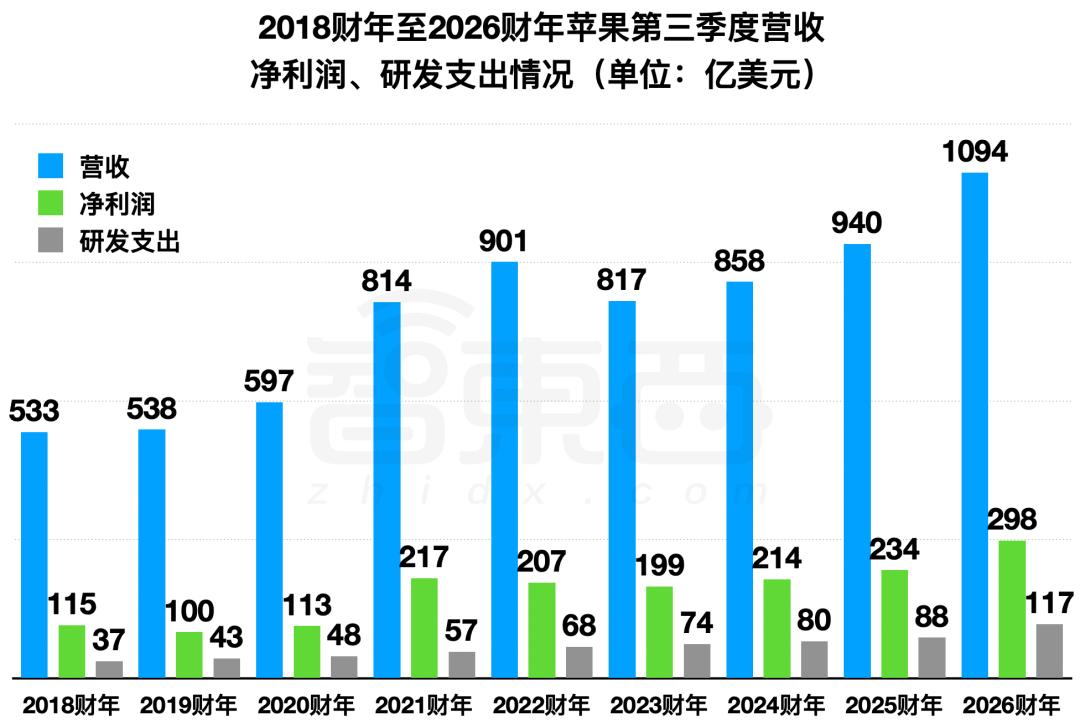
▲ Apple's revenue, net profit and R&D expenditure in the third quarter from fiscal 2018 to fiscal 2026 (unit: 100 million USD)
At present, there are 2.5 billion active Apple devices worldwide, which means roughly one Apple device for every three people on average, and the number of paid subscription users has exceeded 1.5 billion.
Apple CEO Tim Cook said that Apple's performance in this quarter has reached the best level in history, with double-digit growth achieved across iPhone, Mac products, service business, and revenue from different regions.
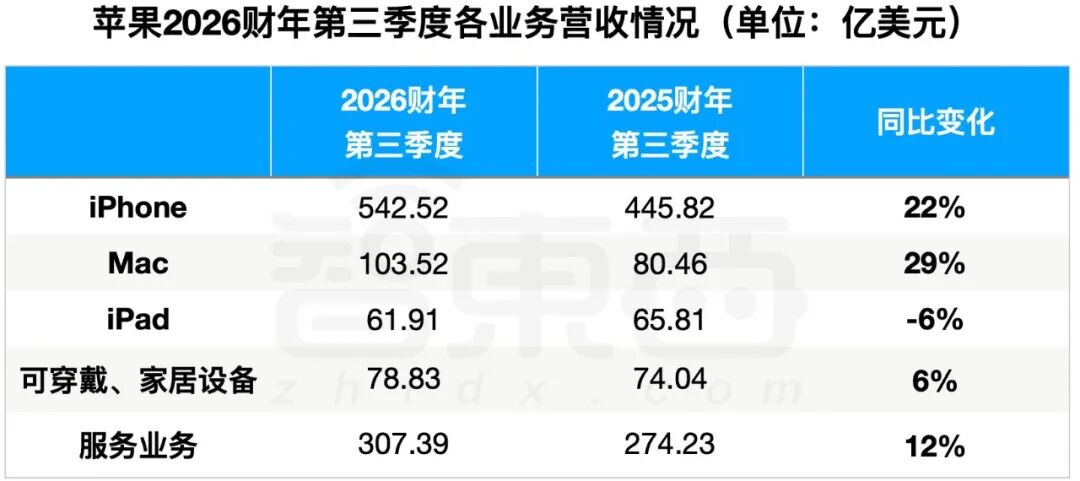
The two core product lines are iPhone and Mac. The former recorded revenue of 54.25 billion USD (about 3.664 trillion RMB), up 22% year on year, while the latter posted revenue of 10.35 billion USD (about 699 billion RMB), up 29% year on year.
In the Chinese market, Apple's revenue in the third quarter of fiscal 2026 reached 18.816 billion USD (about 127.1 billion RMB), up 22.43% year on year, but failed to meet the average analyst expectation of 19.67 billion USD (about 132.9 billion RMB).
It is worth noting that this is also the last earnings call that Cook will attend at Apple. He will hand over the position of Apple CEO to John Ternus on September 1 and transition to the role of Executive Chairman of Apple's board of directors. Cook said the transition is proceeding smoothly, and he is extremely looking forward to Ternus leading Apple into the next era. He believes Ternus is truly unique and unmatched, and is the most suitable person to take charge of the company.
When asked during the call to comment on OpenAI's hardware technology and SpaceX's launch of network-enabled phones that can bypass carriers, Ternus said: "There are a huge number of opportunities in this field for us, we are very focused on our own plans and are very excited about it."
In addition, Apple also announced its quarterly dividend plan, with a dividend of 0.27 USD per share (about 1.82 RMB), which will be paid to shareholders of record as of August 10 on August 13.
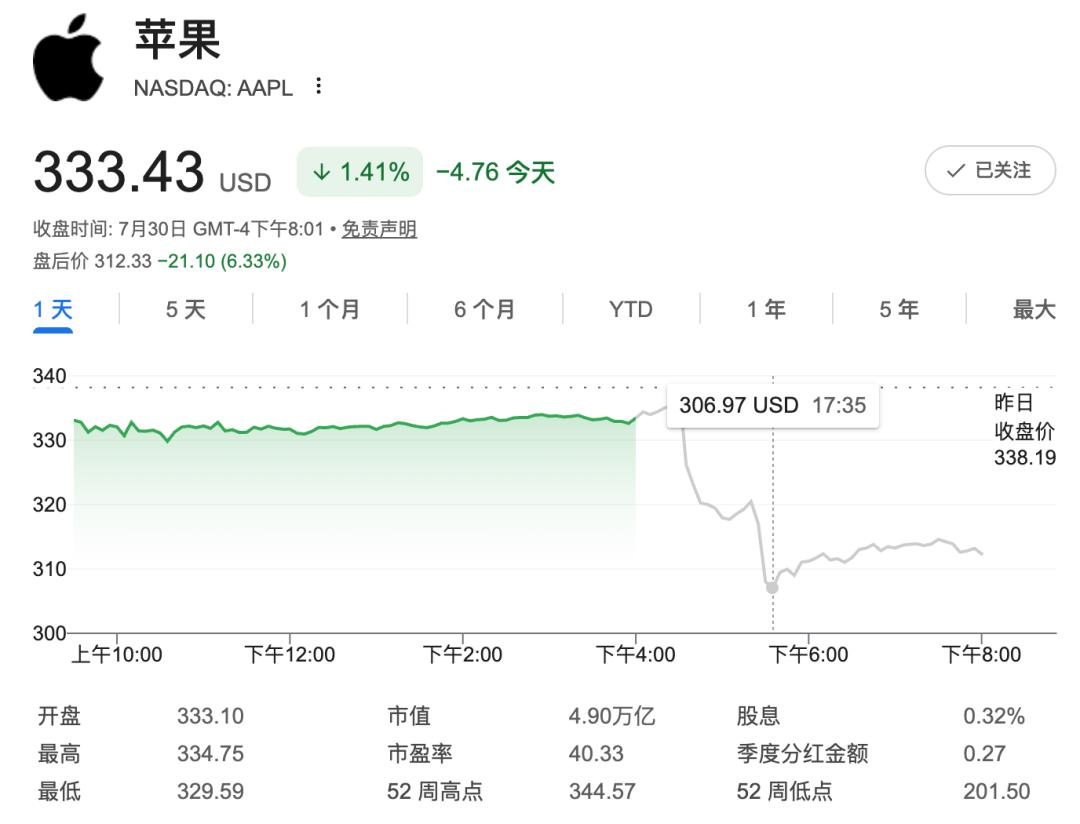
After Apple's earnings report was released, as of the close of US stocks on July 30 local time, Apple's share price fell 1.41% to 333.43 USD per share (about 2252 RMB), with a market value of 4.9 trillion USD (about 33 trillion RMB). The after-hours share price fell as much as 7.94% to 306.97 USD per share (about 2072 RMB).
01 iPhone remains Apple's cash cow, Mac revenue surges 29%
Let's first take a look at the revenue of each of Apple's business lines.
In the third quarter of fiscal 2026, Apple's total product revenue reached 78.7 billion USD (about 5.316 trillion RMB), and its gross margin reached 50.1%, exceeding expectations.
Apple previously warned that rising memory costs would impact its gross margin. In its latest gross margin, tariff rebates contributed 2 percentage points of gross margin growth. Excluding this rebate benefit, the actual gross margin was 48.1%, which still exceeded the market expectation of 47.92%.
iPhone revenue reached 54.25 billion USD (about 3.664 trillion RMB), up 22% year on year. Cook said the iPhone 17 lineup is the most powerful and most popular iPhone lineup ever.
This revenue figure exceeded the consensus expectation of market analysts. As the iPhone 17 product cycle gradually enters the mature stage, coupled with the upcoming launch of new products in September, iPhone sales will increase significantly.
In an interview with CNBC, Cook called this sales figure an "amazing victory", and they saw that many users were replacing old iPhones with new ones this quarter, with upgrades being very common.
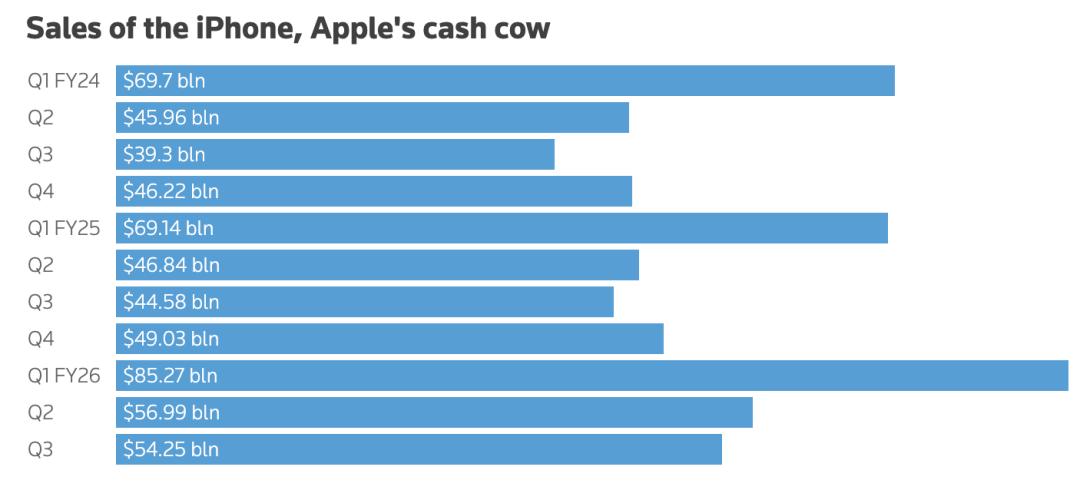
▲ Changes in Apple's revenue from iPhone since fiscal 2024 (Source: Reuters)
Mac revenue was 10.35 billion USD (about 699 billion RMB), up 29% year on year. Apple attributed Mac's growth to the sales of MacBook Neo and MacBook Pro. It also recorded the highest revenue in the Chinese market in history, hitting all-time highs for both Mac upgrade users and first-time Mac buyers.
Wearables, Home and Accessories business generated revenue of 7.88 billion USD (about 53.2 billion RMB), up 6% year on year. iPad revenue for the quarter was 6.19 billion USD (about 41.8 billion RMB), down 6% year on year. The performance pressure is mainly due to the launch of iPad products equipped with A16 chips in the same period last year, which raised the revenue base of the same period last year and formed a high comparison benchmark.
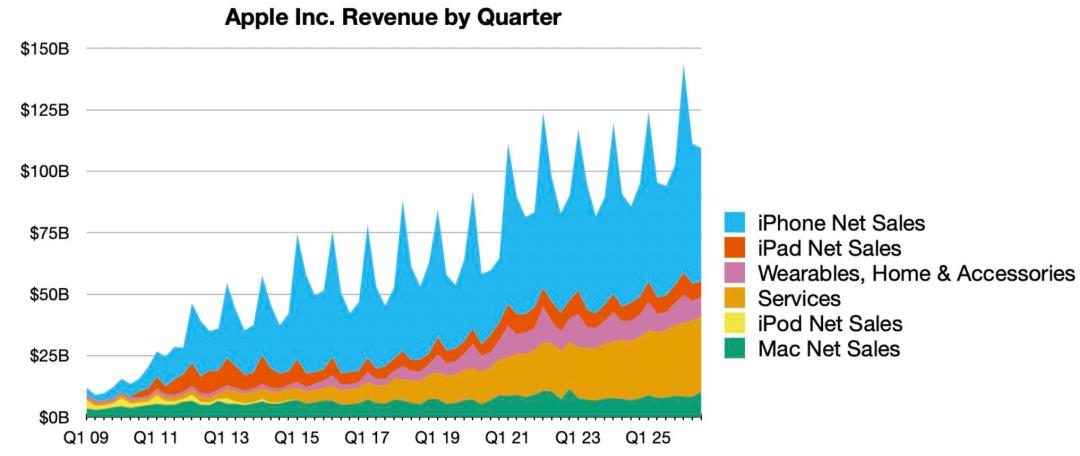
In addition, Apple's operating expenses were 19.1 billion USD (about 1.29 trillion RMB), up 23% year on year, of which R&D expenses were 11.729 billion USD (about 79.2 billion RMB), up 32.3% year on year.
02 Service revenue and China market revenue fell short of analyst expectations
Apple's overall revenue beat expectations this time, but the market did not buy it, and its after-hours share price fell more than 5%. There are two main reasons behind this: both service revenue and China market revenue fell short of expectations.
The first is service revenue. Apple's service revenue was 30.74 billion USD (about 2.076 trillion RMB), up 12% year on year, but lower than the expected 31.22 billion USD (about 2.108 trillion RMB).
The service business, with stable cash flow and higher profit margins, has long been Apple's key business to hedge against revenue fluctuations caused by hardware sales ups and downs.
However, this time hardware product revenue exceeded expectations while service business revenue fell short, indicating that this high-margin business is facing obvious growth pressure.
Apple's Chief Financial Officer Kevan Parekh said the decline in service revenue was due to slowing growth of mobile games on the App Store, coupled with changes in its business model.
Apple was previously forced by a court order to allow app developers to process user payments outside the App Store, which means these payments are no longer subject to Apple's commission system.
Apple has filed an appeal, and the final ruling on the case will be decided by the U.S. Supreme Court, which will hear the case in 2026.
Cook also mentioned that exchange rate changes are another major reason, and the release of the F1 movie last year raised the revenue base of the same period last year.
The other underperforming metric is Apple's revenue in the Chinese market.
The latest data shows that Apple's revenue in the Chinese market in the third quarter of fiscal 2026 reached 18.816 billion USD (about 127.1 billion RMB), up 22.43% year on year.
Cook said this is thanks to the fact that iPhone sales in mainland China hit a record high in June this year. At the same time, the performance of Mac products also reached Apple's best quarterly result in mainland China in history.
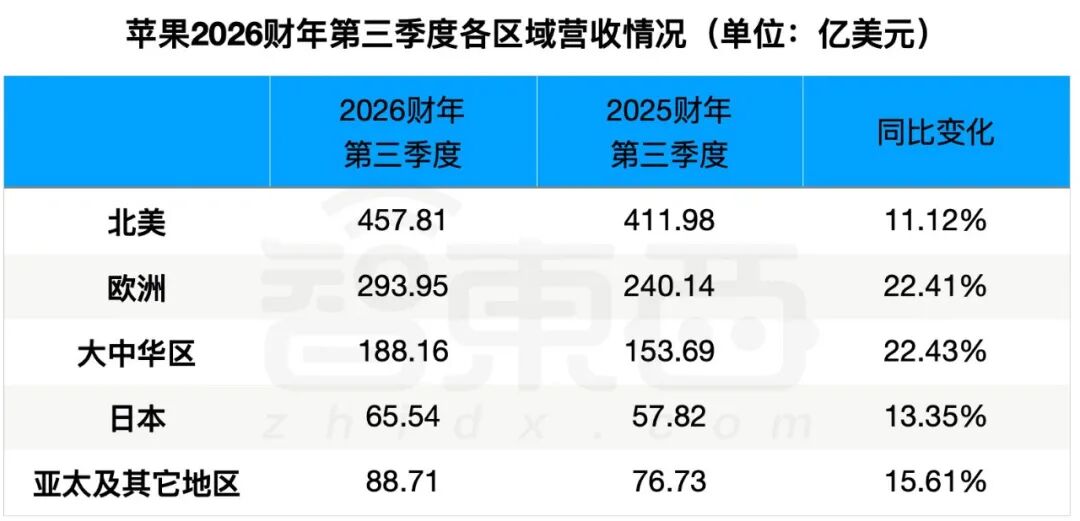
However, according to survey data from data analytics platform Visible Alpha, Apple's revenue in the Chinese market failed to meet the average target of 19.67 billion USD (about 132.8 billion RMB), and only 6 analysts believed Apple's revenue in China hit this target.
In addition, for the forecast of the fourth quarter of fiscal 2026, Apple expects the overall year-on-year revenue growth rate to fall in the range of 9%–11%, which is also lower than the 12.1% predicted by analysts on average.
Apple said this is due to the impact of supply-side capacity constraints, which will affect all three hardware product lines of iPhone, Mac and iPad.
03 Cook expects memory price hikes to continue, Mac price hikes are a last resort
During the earnings call, there are three top concerns: supply chain constraints, rising memory prices, Mac price hikes, and new progress in Apple AI.
First, supply chain constraints and rising memory prices.
Cook said Apple is facing supply chain constraints on Mac, while the impact on iPhone and iPad is relatively mild for now. This is because market demand is very strong, but the supply of advanced process wafers required for producing its self-developed chips is insufficient.
At the same time, as memory prices grow exponentially, the amount Apple pays for memory increases year by year. This impact is offset to a certain extent by the inventory carryover effect in September, but Cook expects the payment amount to rise further.
Apple is making up for this through its accumulated inventory and expected cost savings on non-memory components. Cook expects memory costs to rise further, and future market competition should expand beyond the current three major suppliers.
Second, pricing.
This is a chain reaction of supply constraints and rising memory prices.
On June 25, Apple announced price hikes across the entire Mac lineup, with price increases for MacBook Air, MacBook Pro, Mac mini, iMac and Mac Studio ranging from 1500 yuan to 3500 yuan. Cook said this is because they are in a "once-in-a-century" pricing flood. With memory prices rising exponentially, they made the business judgment to raise prices based on business units, revenue and gross margins.
Wall Street analysts expect Apple to raise iPhone prices at its September launch event.
Cook also mentioned that the current supply shortage is not caused by insufficient performance capacity of partners or suppliers. In a sense, it is a positive signal, as the demand for this wave of iPhone and Mac products far exceeds expectations.
At TSMC's Arizona plant, Apple's component procurement volume this year has exceeded 100 million units, which is part of its plan to fulfill its commitment to invest 600 billion USD in the United States.
Finally, Apple AI.
Cook is very satisfied with the current progress of Apple AI.
Apple AI-related products are still in the early stage of implementation, and they have not finalized all implementation details. However, Apple judges that there will be a large number of users who use this function frequently, so it plans to add paid upgrade tiers within the iCloud+ system to provide users with advanced service packages, and will follow up to observe user conversion of this paid service later.
For the global rollout of Apple AI, Cook said Apple is working with the European Union to try to reach a solution for releasing related products. He also mentioned that on July 15, Apple was approved to start deploying the basic native functions of Apple AI in China.
In addition, Cook also mentioned Apple's recently launched leasing program, which has received positive initial feedback, and specific performance in the future will depend on customer acceptance.
04 Conclusion: Apple's earnings report is impressive, but hidden risks lie in storage and supply chain
Against the backdrop of the global consumer electronics industry being dragged down by rising storage prices and sluggish consumer demand, Apple's revenue has increased instead of decreasing, exceeding previous analyst expectations. At the same time, the explosive growth of Mac confirms that the software-hardware integrated barrier built by Apple with self-developed chips may form a natural advantage in the AI PC wave.
From the user perspective, the number of active users of Apple devices has exceeded 2.5 billion, and the 1.5 billion subscribers mean that more than half of the ecosystem users have completed paid conversion. Apple has transformed hardware consumers into long-term paying customers.
However, current pain points such as supply chain and storage have also become hidden risks behind Apple's impressive performance this round. Cook believes that there is no sign of an end to this round of storage price hikes. If memory prices continue to rise after September, it may have a greater impact on Apple, and this pressure is now being transmitted to product lines such as iPhone and iPad.
This article is from