Survey of 317 Global AI Unicorns: Over Half Do Not Publish Papers, Chinese Companies Are More Active
Recently, the journal Science published a news article titled "AI’s top startups are barely publishing their research".
This article focuses on a paper published by a Stanford University team on the preprint platform bioRxiv. The research team counted the paper publication status of 317 AI unicorn companies between 1998 and 2025, and found a counterintuitive phenomenon:
More than half of the AI unicorn companies have no public paper output, and scientific output is mainly concentrated in a small number of AI unicorn companies, with only a handful of core authors producing relevant content.
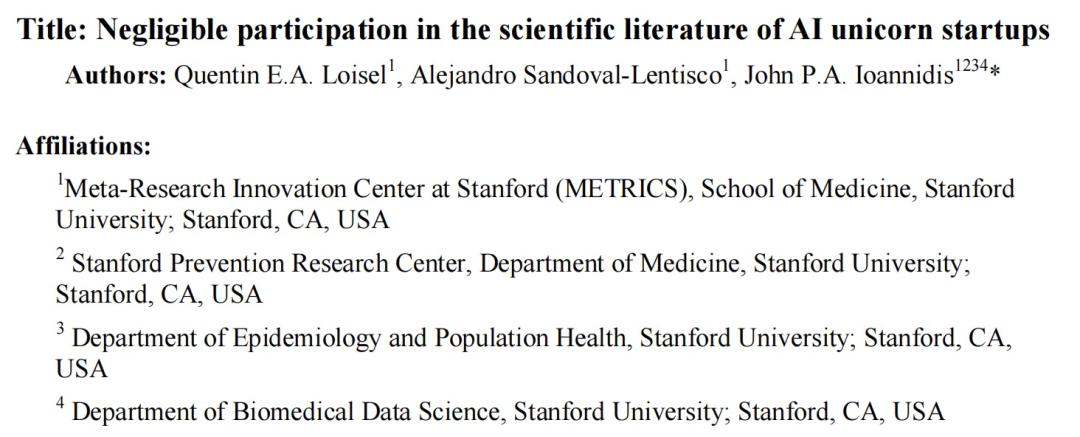
Paper link: https://www.biorxiv.org/content/10.64898/2026.07.15.738744v1
Meanwhile, a higher company valuation does not mean more paper output. Although the number of papers they have published in the past 10 years has increased, the overall proportion remains very low. Among the AI-related papers published in 2025, only one out of every 1000 papers comes from these AI companies.
The Science article also notes that leading frontier laboratories in the United States mostly adopt the "closed-source" model, while leading companies in China are actively embracing the "open-source" model. Nearly two-thirds of Chinese AI unicorn companies have published papers, while more than half of U.S. companies have not published a single eligible paper.
John Ioannidis, the corresponding author of the paper and a metascientist at Stanford University, expressed concern about this phenomenon. "For a field that claims to be reshaping science and is considered to have huge scientific potential, having almost no scientific literature is a very strange paradox."
Only a small number of AI companies are producing research outputs
The article points out that most AI unicorn companies actually rarely publish papers. Among the 317 companies, more than half have no eligible scientific output at all. Even for those with publication records, most of them only publish sporadically, and high-citation achievements are very few, accounting for only 6.4% of the total sample.
The visible influence of AI unicorn companies is also mainly dominated by a few leading companies. In terms of citation indicators, the top 5% of companies contribute more than 90% of the total citations. OpenAI alone contributes nearly 40% of the citations, followed by Megvii and Hugging Face. Highly cited papers are concentrated in a small number of companies, and only 7.6% of the companies have produced such achievements.
In addition, companies have different choices of publication channels, especially reflected in the proportion of preprint use. Almost 90.6% of Anthropic's citations come from preprints; companies including OpenAI, Megvii, Waymo, and Momenta mainly rely on peer-reviewed papers.
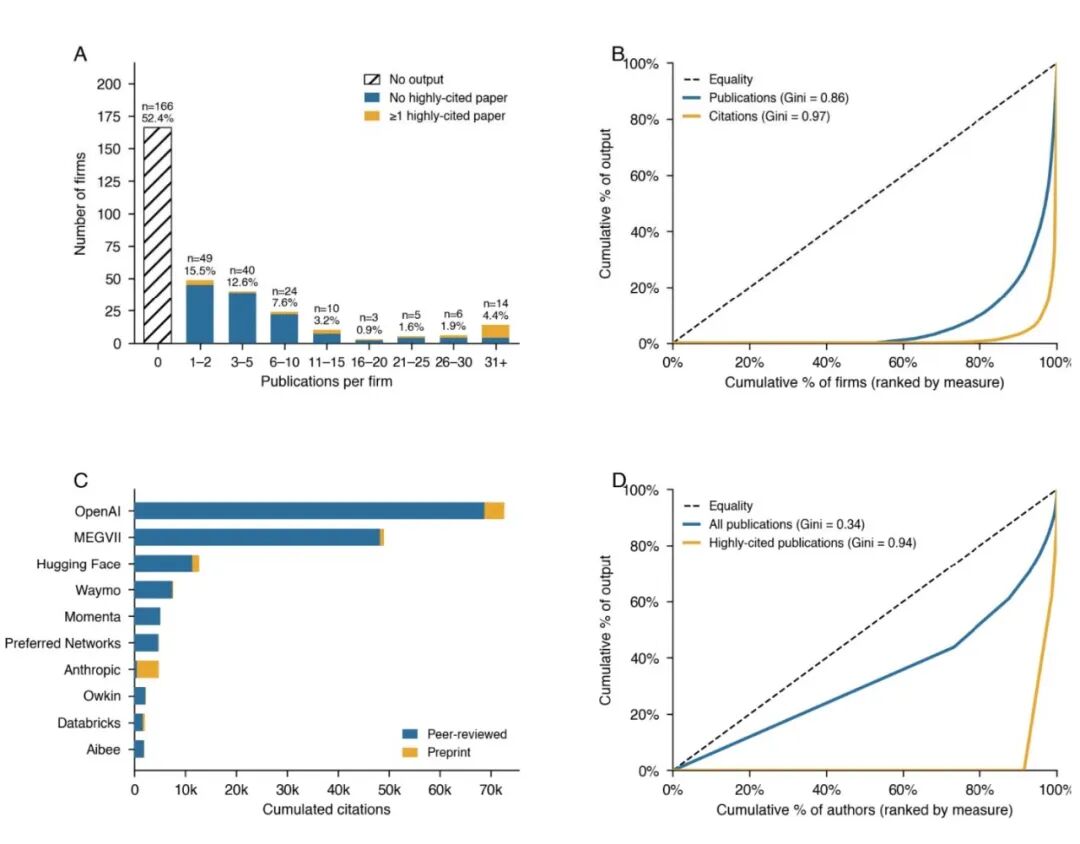
Figure | Distribution and concentration of scientific output at the company level.
Only a small number of people are producing outputs
People who continuously produce paper content are only a small group of core authors. Among nearly 2000 affiliated authors of startups, more than half sign their papers with their company as the affiliation; 38.0% of the authors also sign with universities or research institutions at the same time.
Papers are mainly produced repeatedly by a small number of authors. Among 132 highly cited papers, 27 high-productivity authors contribute nearly 40% of the signatures, and most of them have only contributed to one of the papers. Specifically, the author teams of Megvii and OpenAI both have more than 100 people, and only 8 people in each team have published more than 5 papers. Compared with the employee size of thousands of people, this proportion is still very low.
High valuation does not bring more papers
The higher the valuation of an AI company, does not mean the more papers it has or the higher its influence. The data shows that there is no significant correlation between company valuation and total number of papers, as well as the number of highly cited papers. Although companies with more financing are more likely to publish papers, this connection is not strong. High-impact scientific research is still concentrated in a small number of companies, and will not grow synchronously with the company's financing scale.
The proportion is only 0.1%
In terms of time, the number of AI unicorns participating in paper publication has indeed increased rapidly. In 2016, there were only 18 papers led by startups, and the number rose to 534 in 2025. The growth of collaborative papers is more obvious, and the number of such papers increased from 5 in 2016 to 416 in 2025.
However, looking at the global total number of papers, these figures are still insignificant. In 2025, the total number of global AI papers has exceeded 900,000, and there are only 950 relevant papers involving these startups, accounting for only 0.1%.
Chinese AI companies prefer to publish papers
From a regional perspective, Chinese AI unicorn companies are the most active in publishing papers, although the total number is still not large.
Among the 40 Chinese AI unicorn companies, nearly two-thirds of the companies have published papers; in contrast, among the 209 U.S. companies, more than half of the AI unicorn companies have not published any papers. The Science article writes that leading frontier laboratories in the United States mostly adopt the "closed-source" model, while leading companies in China are actively embracing the "open-source" model.
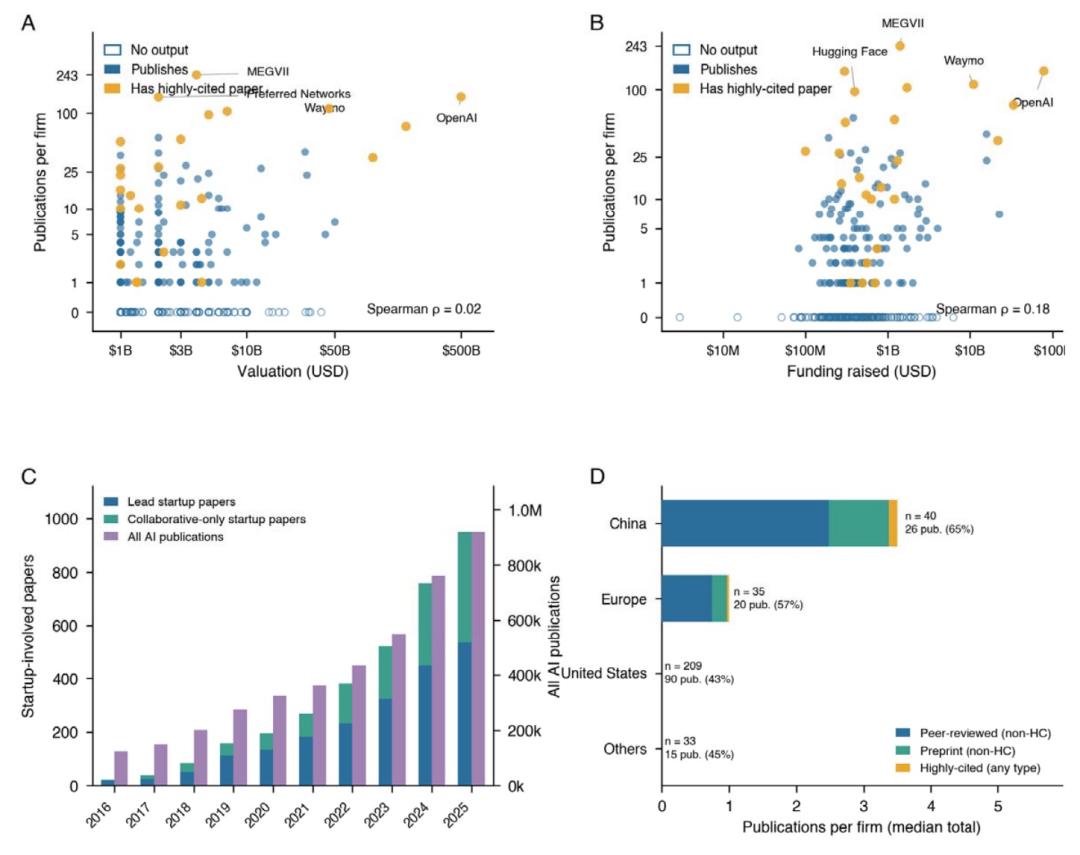
Figure | Economic scale, temporal change and geographical distribution of scientific activities.
The impact of this situation goes beyond the companies themselves: only when research is publicly published can researchers, policymakers and industry observers have materials to participate in discussions. If research only stays inside the company, only a small number of people can see the development direction of AI.
This article is from the WeChat official account "Academic Headlines" (ID: SciTouTiao), author: Academic Headlines, published by 36Kr with authorization.