Compensation for executives of 154 listed food companies: 12 individuals have an annual salary exceeding 10 million RMB
Salaries and compensation are the most sensitive nerve for every practitioner, and high-paid executives in the industry are a group that receives extremely high attention. Which segmented tracks, which positions, and which people obtain high salaries are permanent hot topics across the sector.
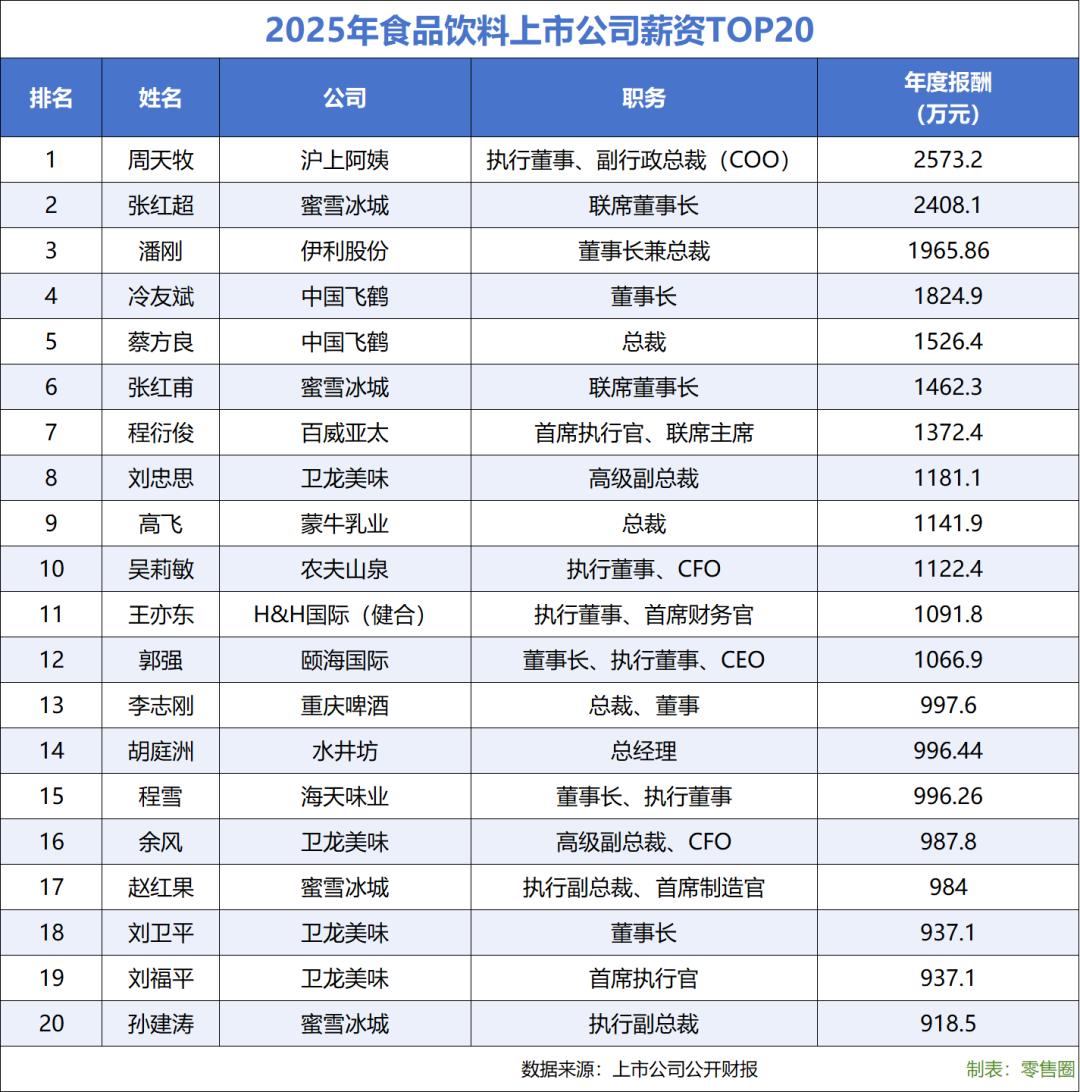
Retail Circle has reviewed the 2025 annual reports of 154 listed companies in the food and beverage sector, focusing on the top 20 highest-paid executives (all compensation figures in the text refer to total pre-tax remuneration including performance bonuses and equity incentives, sourced from the annual reports publicly disclosed by corresponding companies), to explore what forces are rearranging the high-salary ranking of the industry in 2025.
The highest annual salary for full-time on-post performance in the food and beverage industry in 2025 hits 25.732 million RMB, earned by Zhou Tianmu, Vice President of Hushang Ayi. As a professional manager, this figure is 1.65 million RMB higher than the highest-paid business owner Zhang Hongchao from Mixue Bingcheng, and it is not an isolated case that professional managers get higher compensation than the company's founder.
Personnel Occupying Core Strategic Positions
The public has labeled Zhou Tianmu as the "Working Emperor", but what the list truly demonstrates is not an individual's wealth creation miracle, but the pricing logic of corporate positions. Of the total 25.732 million RMB remuneration, performance bonuses and equity incentives jointly account for 87%, while the fixed base salary only takes up a tiny fraction. His compensation is deeply bound to the store expansion progress of Hushang Ayi, and the company ties his personal interests to business growth. This is no longer a simple labor remuneration, but a strategic statement written by the company in the language of capital, representing an open bet on the scarcest capabilities at the current stage.
The most expensive payroll of Hushang Ayi conveys a clear message with money: at this stage, scale is the most valuable core asset, and the position Zhou Tianmu occupies is the strategic throat of Hushang Ayi.
Zhou Tianmu is not the only person on the list that occupies such a core position.
No matter in business operation or capital operation, capital is the lifeline of an enterprise. Capital allocation and financing capabilities determine the advance and retreat of a company in the economic cycle, and the personnel in charge of the capital lifeline have been pushed to the center of the value chain. A number of CFOs have obtained higher compensation than the top leader of their companies.
Wu Limin, CFO of Nongfu Spring, earns 11.224 million RMB (ranks TOP 10). She joined the company from Yonghui Superstores in 2022, and was promoted to Executive Director and Head of Finance in 2023. After taking office, she promoted financial digital transformation, optimized the global capital pool and improved profit assessment mechanisms. During her tenure, operating cash flow further increased from 120 billion RMB in 2022 to 173 billion RMB in 2023, continuously consolidating the company's financial foundation.
Wang Yidong, Chief Financial Officer of H&H International (parent company of Swisse and Biostime), earns 10.918 million RMB (ranks TOP 11). He led the M&A integration and capital layout of brands including Swisse, promoted multi-channel financing through bonds and syndicated loans to complete the financing of H&H International, and the refinancing project he cooperated with Goldman Sachs USA was once nominated for the Asian Deal of the Year by Finance Asia. He maintains a balance between profit margin and cash flow, supporting the company's global collaborative operation.
Yu Feng, CFO of Weilong, earns 9.878 million RMB (ranks TOP 16), whose compensation is also higher than that of the company's chairman. He has just taken the position for a short time, and the market will wait and see whether he can convert the trust behind this high salary into the capital efficiency of Weilong in the next stage.
The three of them hold the capital lifeline of the company, and being able to improve capital efficiency and tell a complete capital story is itself an integral part of business growth.
Then look at the executives in charge of product and supply chain. Products are the facade of consumer-facing companies, and the supply chain is the strong backbone behind them. As the industry growth shifts from extensive market expansion to intensive refined operation, a group of executives in charge of core business segments have also stood at the forefront of the industry in terms of compensation.
Liu Zhongsi, Senior Vice President of Weilong, earns 11.811 million RMB (ranks TOP 8). The vegetable products such as konjac snacks he oversees account for 62.38% of total sales in 2025, with revenue reaching 4.506 billion RMB, up 33.7% year-on-year, which has overtaken spicy gluten to become the largest product category. Among the most expensive payrolls of Weilong, there is one for him, which pays for the company's path to get rid of single-product dependence.
Zhao Hongguo, Chief Manufacturing Officer of Mixue Bingcheng, earns 9.84 million RMB (ranks TOP 17). She is responsible for supporting the huge supply chain network covering tens of thousands of stores, ensuring every link from raw material procurement, central factories to warehousing and logistics operates seamlessly, making every cup of beverage low-priced with stable quality. The biggest internal challenge of Mixue Bingcheng lies in this back-end system, and the position Zhao Hongguo presides over is exactly the backstage that supports Mixue's cost-performance myth. Her colleague Sun Jiantao earns 9.185 million RMB (ranks TOP 20), who is in charge of the franchise operation system, controlling the business rhythm and standard processes of tens of thousands of franchisees. The larger the scale grows, the lower the fault tolerance rate of the operation system, and the more important the personnel who control the franchise operation hub become.
The three of them, one in charge of product development, one presiding over the supply chain, and one controlling the operation hub, are all located at the most solid nodes of the business chain.
Putting all these people's business cards together, the rule is very clear: they are not founders, not top leaders, nor major shareholders. Where the enterprise's core focus lies, the highest-paid compensation will flow to that corresponding position.
This is only one layer of the list, and there are two other groups of people later, with different identities and different high-salary logic.
Growing from Front-line Staff to Top Leader
Some people in this group are not founders or business owners, but workers who have worked their way up from the grassroots level all the way to the top leadership position.
Pan Gang, Chairman and President of Yili Co., Ltd., earns 19.6586 million RMB (ranks TOP 3). He graduated from university in 1992 and joined the Hui Min Dairy Food Factory, the predecessor of Yili, taking his first post as a workshop worker, moving boxes in the workshop and monitoring data in the laboratory. When Pan Gang was 29 years old, he established Yili's liquid milk division, growing the annual revenue of liquid milk from 60 million RMB in 1999 to 4.6 billion RMB in 2003, nearly 80 times increase in four years. His success not only changed Yili, but also opened the era of liquid milk in China's dairy industry, making milk a daily consumer product from a traditional gift. In 2005, at the age of 35, he was elected as Chairman and President with a unanimous vote. In 2025, Yili's net profit reached 11.565 billion RMB, up 36.82% year-on-year. In the food and beverage sector of A-share market, Pan Gang's compensation stably ranks at the top.
Cheng Xue, Chairman of Haitian Flavouring & Food, earns 9.9626 million RMB (ranks TOP 15). She graduated from university in 1992 and joined Haitian Soy Sauce Factory as an ordinary employee at the age of 22. In 1995, the factory carried out joint-stock reform, and 25-year-old Cheng Xue subscribed for 15,000 shares with all her savings, which was her first equity stake. After that, she moved up step by step in Haitian, and officially took over the position of Chairman from Pang Kang in September 2024. For 32 years, Cheng Xue grew from a female worker in the soy sauce factory to the head of a company with a market value of hundreds of billions. The public calls her the most outstanding working professional, but she has long been far more than an ordinary employee.
Gao Fei, President of Mengniu Dairy, earns 11.419 million RMB (ranks TOP 9). He was the 77th employee when Mengniu was founded in 1999, a veteran who grew up with Mengniu from scratch. He led the creation of the Telunsu brand, whose annual sales exceeded 30 billion RMB, making it the largest single product in the global dairy industry. He took office as President in March 2024, becoming the fifth head of Mengniu. There is a clear contrast in his compensation: it is only slightly more than half of the peak salary of his predecessor. The overall compensation of Mengniu's management has been declining for four consecutive years, while the average compensation of Mengniu's frontline employees has increased rather than decreased in the same period. Raising salaries for employees while the management collectively cuts their own pay shows the awareness of the management team during the industry downturn.
Chen Yanjun, CEO of AB InBev Asia Pacific, earns 13.724 million RMB (ranks TOP 7), and Li Zhigang, President of Chongqing Brewery and Head of Carlsberg China, earns 9.976 million RMB (ranks TOP 13). The two foreign beer giants have handed over the Chinese market business to local professional managers. Chen Yanjun is in charge of AB InBev Asia Pacific, the most valuable asset of AB InBev in China. Li Zhigang takes charge of Carlsberg China on one hand, and serves as President of Chongqing Brewery on the other hand, as Carlsberg bets all the growth of the Chinese market on him. Foreign-funded enterprises use market-oriented high compensation to assign the most difficult battlefield to the people who know the Chinese market best.
Guo Qiang, Chairman and CEO of YiHai International, earns 10.669 million RMB (ranks TOP 12), compared with about 6.82 million RMB in the previous year. Guo Qiang joined YiHai in 2016, starting from Director of Sales Management Department, promoted to CEO in 2020, and took the position of Chairman in April 2026, moving up step by step inside the company. YiHai's net profit increased by 13% to 900 million RMB in 2025, as Haidilao's hot pot base track is still expanding, and his compensation rises along with the business performance.
Pan Gang, Cheng Xue, Gao Fei and Guo Qiang have all taken the top leadership positions, but none of them are the actual business owners. Their compensation is the pricing for their capabilities and performance, and the most direct recognition for those who have worked their way up all the way from the front line.
Founders Who Also Act as Core Operators
There is the last group of people on the list. They are business owners as well as core operators, and their compensation is not priced by the market, but the return for working for their own business.
The two brothers Zhang Hongchao and Zhang Hongfu of Mixue Bingcheng are both co-chairmen, with the former earning 24.081 million RMB (ranks TOP 2) and the latter 14.623 million RMB (ranks TOP 6). The two brothers are founders who started from a cold drink stall on the streets of Zhengzhou. In 2025, the number of their stores ranks first in the tea drink industry, and their compensation is tied to the expansion speed of stores. The money they get is not salary for working for others, but the deserved return after winning the battle of scale expansion.
The two brothers Liu Weiping and Liu Fuping of Weilong, the former as Chairman earns 9.371 million RMB (ranks TOP 18), and the latter as CEO earns 9.371 million RMB (ranks TOP 19). Adding the previously mentioned Liu Zhongsi with 11.81 million RMB and Yu Feng with 9.878 million RMB, four people from one company are on the top list, with all core positions controlled by the family members. The business owners leave the highest payrolls to their own family members, because this company is the entire family property of the Liu family.
Leng Youbin of Feihe earns 18.249 million RMB (ranks TOP 4), and Cai Fangliang earns 15.264 million RMB (ranks TOP 5). Leng Youbin took over Feihe in 2001, and turned a small dairy factory in Kedong, Heilongjiang into the leading domestic infant formula brand. Cai Fangliang is the President, the second-in-command of Feihe, who coordinates production and national distribution channels. The highest compensation of this company is paid to the combination of the business owner and core operator, because this brand was built bit by bit by them.
Putting these three groups together, Mixue focuses on scale expansion, Weilong focuses on product category optimization, and Feihe focuses on brand building. Their strategies are different, but the highest payrolls are all issued to the business owners and core operators. This group of people get top salary while working for their own business, and the compensation is the realization of the deep tie between their personal wealth and the business scale.
Industry Changes Reflected by the List
7 out of the top 20 people are not the top leaders of their companies. This is no longer an individual phenomenon, but a signal that the industry's compensation logic is in the process of transformation.
Sorting these 7 people by their functions, the rule is immediately obvious: none of them are in the position of business owner, and all of them are in charge of scale benefit, capital efficiency, supply chain efficiency and product category innovation.
In the past, the food and beverage industry was mainly focused on consolidating existing business, building brands and opening up distribution channels, then the market pattern would basically stay stable. The business owner presided over the core, seniority and position determined the compensation, and the remuneration decreased layer by layer from top to bottom, which was taken for granted.
But things have changed in recent years. Brands need to expand, capital needs to operate, channels need to sink, and the second growth curve needs to be explored. These battles cannot be won just by sitting in the office. Someone must rush to the most critical position, and whoever can drive the growth will get the high salary.
The signal behind this is more important than the figures themselves, which means that the food and beverage industry is shifting from identity-based compensation pricing to value-based compensation pricing. It no longer depends on what position you sit in, but on what core link you are in. It is no longer about climbing up the hierarchy, but about moving to the throat position, finding the most critical combat post that the company needs to win at the current stage.
A special case is the large Baijiu sector. The only person who enters the top 20 list is Hu Tingzhou, General Manager of Shuijingfang, whose 2025 compensation reaches 9.9644 million RMB (ranks TOP 14). Hu Tingzhou joined Shuijingfang in July 2024, and resigned from all positions including General Manager and Director on May 6, 2026 for personal reasons, with a tenure of less than two years. Shuijingfang is controlled by the foreign company Diageo, so its compensation follows the market-oriented mechanism. The compensation level of Baijiu enterprise executives is determined by the nature of the controlling shareholder.
To be fair, there is another figure that needs to be clarified. Jan Craps, the former CEO of AB InBev Asia Pacific, left his post on April 1, 2025, and only served for one quarter of the whole year. The 2025 compensation disclosed in the annual report is about 10.8 million US dollars, equivalent to more than 70 million RMB. If it is included in the list, it will rank TOP 1, but the bulk of this money is the centralized realization of equity incentives for his 23 years of service in the AB InBev system and