Epic rebound, Japanese and South Korean stock markets have soared across the board.
Today, the Japanese and South Korean stock markets staged an epic "big reversal".
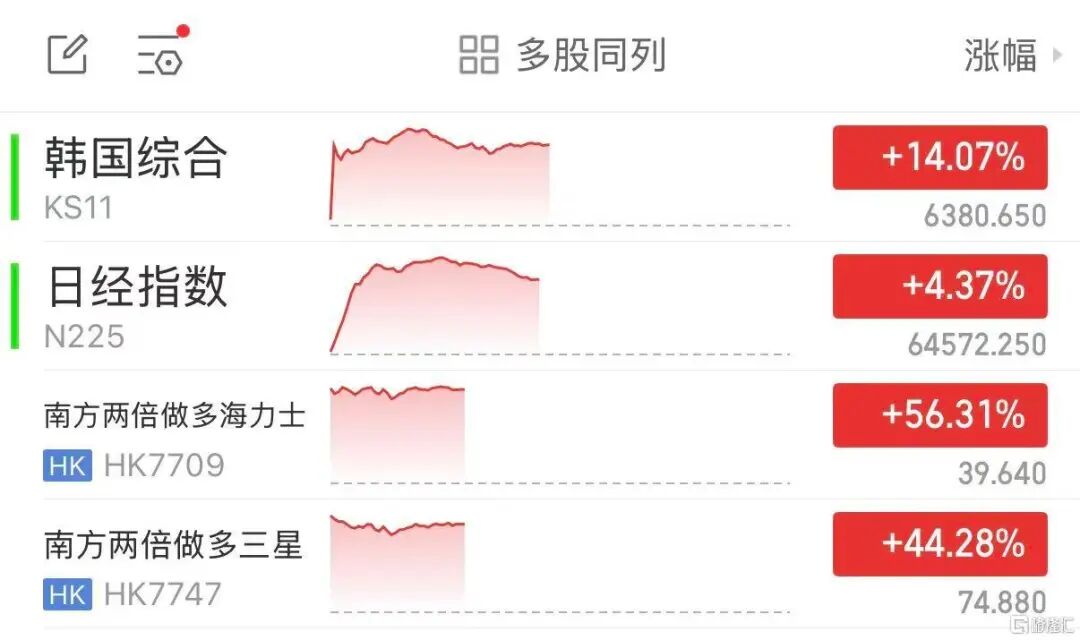
South Korea's KOSPI index once surged more than 16%, hitting its largest intraday gain in a single day in history. SK Hynix's share price rose by 24%, while Samsung Electronics' share price climbed over 20%.
The Nikkei 225 Index also jumped more than 5%, surging more than 3,200 points at one point. SoftBank's share price once rose 15%, hitting the daily limit up.
The Hong Kong stock market's semiconductor sector rallied sharply. As of press time, the South leveraged 2x long Hynix product rose more than 56%, and the South leveraged 2x long Samsung Electronics product rose more than 44%.
Just a few days ago, this market was still mired in panic.
On July 29, the South Korean KOSPI index plunged more than 12% at one point, triggering a circuit breaker; since July, the index's monthly decline has reached 33.19%, setting a new record for the largest single-month drop in history, even exceeding the 27.24% recorded during the 1997 Asian financial crisis.
From "stampede-style plunge" to "epic rebound", what exactly happened?
Concentrated Explosion of Multiple Positive Factors
The successive policy and capital signals released by South Korea, combined with the overnight boost from the US stock market, have led multiple positive factors to erupt at the same time window.
1. The government's 20 trillion won sovereign wealth fund
On July 31, the South Korean Ministry of Finance announced that it will establish a new sovereign wealth fund next year with an initial size of at least 20 trillion won (about 14 billion US dollars), focusing on strategic industries such as artificial intelligence, data centers and infrastructure.
After the tech stocks experienced violent volatility, this move is regarded by the market as a clear signal that the South Korean government will stabilize the stock market and strongly support the AI industry.
2. The rare "bottom-fishing" move by the chairman of SK Group
Regulatory filing documents show that Chey Tae-won, chairman of SK Group, bought 3,620 shares of SK Hynix on the public market, worth about 4.8 billion won (about 3.2 million US dollars). This is the first time Chey Tae-won has directly held shares of the company in his personal name, and he previously only held shares indirectly through the holding company.
This move is widely interpreted as a strong endorsement of the company's long-term value by its top leader.
3. The deleveraging process is nearing the end
A large part of the previous plunge in the South Korean stock market came from the forced contraction of leveraged positions.
The JPMorgan Chase Equity Macro Research Team pointed out that the size of leveraged ETFs targeting South Korean assets once expanded to about 500 billion US dollars at the end of June, then shrank sharply as the market plummeted, and recent capital inflows have also stalled significantly. Hedge funds are also reducing their positions at the same time — JPMorgan Prime account data shows that the long-short ratio in the South Korean market has dropped significantly from the high level, about 90% of the deleveraging process has been completed, and the room for continued concentrated selling has narrowed significantly.
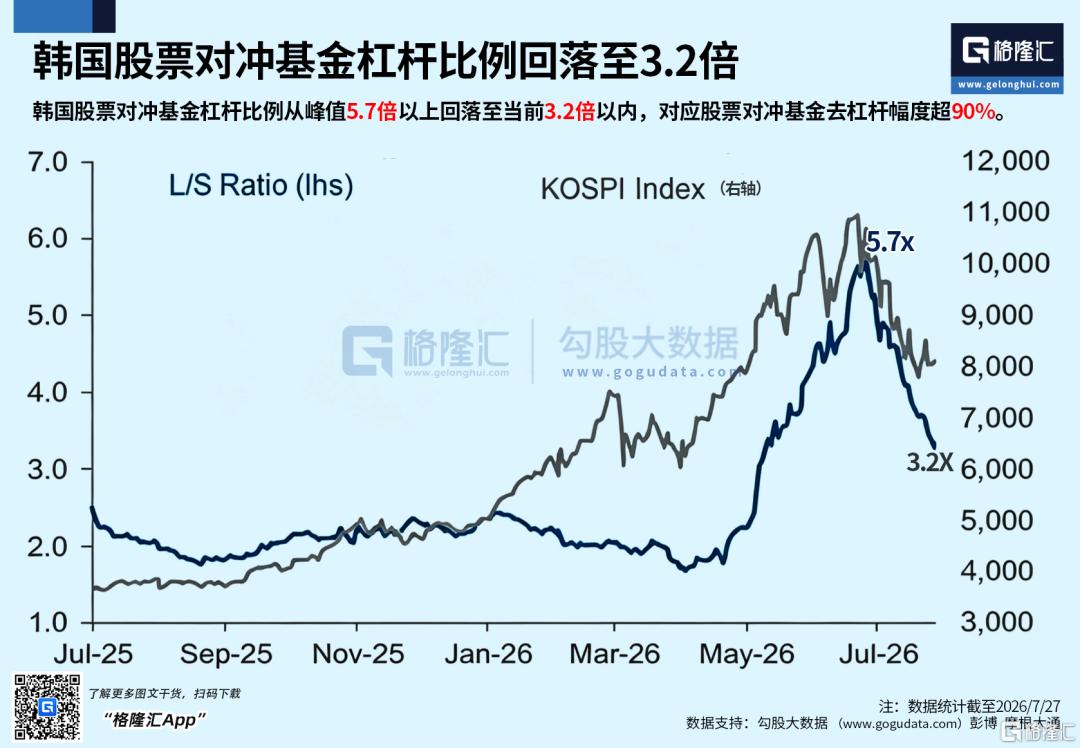
This means that the previous trading structure has changed from the vicious cycle of "price decline triggering margin calls, ETF rebalancing and mechanical selling" to a sensitive state where "after selling pressure is exhausted, a slight positive signal may trigger a sharp short covering".
The high-leverage liquidation of the AI hedge fund Situational Awareness has become the latest signal on Wall Street that the "AI trade" has hit bottom.
4. Giant earnings reports reignite confidence in AI
The core trigger of this round of rebound is the full outbreak of US tech stocks overnight.
On local time July 30, Microsoft released strong earnings data, with cloud business growth far exceeding market expectations. Its share price soared more than 15%, posting its largest single-day gain since October 2008. Its market value increased by about 450 billion US dollars (about 3 trillion RMB) in a single day, setting a new record in the history of the stock market.
Amazon also delivered impressive results, with cloud computing business revenue exceeding analysts' expectations, and strong demand for AI services driving sales acceleration for the fifth consecutive quarter.
Collective Calls for "Bottom Fishing"
Although the market was in severe panic earlier, the mainstream voices are almost unanimous — as South Korea's deleveraging is nearing completion and the valuation of Japanese AI stocks returns to a reasonable range, the market is collectively calling for "bottom fishing".
Gelonghui APP once published an in-depth article titled "This Is a Golden Pit" on July 29, the day when South Korean stocks plunged, pointing out that based on the history of global stock markets and current data, this is most likely a suitable investment opportunity — which is commonly referred to as a "golden pit".
JPMorgan Chase gave a core judgment in its latest report: the deleveraging process of the South Korean stock market has been roughly completed, the chip-side pressure that previously caused violent market volatility has been significantly reduced, and the market is gradually approaching a phased bottom.
A team of strategists at HSBC led by Max Kettner released a research report on July 29, arguing that now is the time to raise stock positions to "maximum overweight".
HSBC gave five reasons: economic growth expectations have been fully revised down, corporate earnings continue to exceed expectations, valuations have a safety margin, bond yields have room to fall, and capital rotation continues to unfold. HSBC pointed out that the global stock market is only about 1% away from its historical high, and the market has proved that it can withstand a series of negative factors such as soaring oil prices, escalating geopolitical conflicts and tech stock corrections, while what has not been fully priced in is the new round of upward momentum that may be brought by corporate earnings continuing to exceed expectations and falling bond yields.
This article is from the WeChat Official Account "Gelonghui APP" (ID: hkguruclub), author: Gelonghui editor, authorized by 36Kr for release.