Another game of Nobel laureate Demis Hassabis: Conspiring with the market
Demis Hassabis, co-founder of DeepMind, is portrayed as an oddity in popular romantic narratives. He is not a geek tinkering in a Silicon Valley garage, nor a tycoon at the helm of a computing-power behemoth, but a classicist who emerged from the chessboard. He started playing chess at the age of 4 and reached the chess grandmaster level at 13. As a teenager, he developed video games, and as an adult, he pursued a PhD in cognitive neuroscience, studying how the hippocampus encodes episodic memory. Born into an ordinary immigrant family in North London, he eventually stood at the cutting edge of research on human intelligence and was awarded the Nobel Prize in Chemistry in 2024.
Sebastian Mallaby documented these details in his book The Infinity Machine. After Hassabis won the Nobel Prize in 2024, Mallaby congratulated him. Hassabis took out his medal and said, "I wouldn't trade this for any amount of money." After a short pause, he added, "Now I want a second one." His ambition and frankness are completely unmasked.
In romantic narratives, these details are extracted and amplified to form a caricature: a brain that never bends to money and only bows to the truth. Google's 650 million dollars, Wall Street's computing power bills... are nothing but unavoidable prices on the way to the altar.
But this interpretation is ridiculously wrong.
The mistake does not lie in the factual level. It is true that Hassabis wears suits, plays chess, never talks about going public, and is passionate about science. The mistake lies in the way of understanding these facts. It presupposes a series of black-and-white binary oppositions: genius vs. capital, ideal vs. reality, purity vs. utilitarianism. Under this framework, all of Hassabis's behaviors are interpreted as an escape from the market. It seems that with the wings of genius, he can fly freely as he wishes, and capital is nothing but an original sin that has to be endured.
But in Mallaby's writing, there is a more real Hassabis hidden.
In 2013, DeepMind was running out of funds, and Hassabis was maneuvering between Google and Facebook. Mark Zuckerberg offered more favorable terms than Google. Hassabis went to Zuckerberg's home for dinner, and deliberately diverted the conversation from AI to emerging fields such as VR and 3D printing — he wanted to observe Zuckerberg's reaction. As a result, Zuckerberg was equally excited about every new technology. Later, Hassabis said: "Facebook offered a higher price, but what I wanted was someone who truly believed that AI was more important than everything else."

Image source: AI generated
This is the test of a top chess player before a game. He was evaluating the buyer's "cognitive focus", and wanted to use institutional design to lock in his future autonomy space.
What kept the "crazy dream with zero revenue" running for eight years was a complete set of institutional arrangements in his hands. From the staged option logic of financing to the defensive strategic moat of acquisition; from the independent ethics committee written into the contract to the mission narrative that replaces KPI; from the boundary dispute between open source and closed source of AlphaFold to the rigid support of common law contracts. Every layer of arrangement answers the same question: How can a person from an ordinary middle-class family leverage a technological revolution that costs tens of billions of dollars?
Genius and market institutions are never in an antagonistic relationship, but a synergy that achieves mutual success.
Part I: How Hassabis Uses Market Institutions
I. Chess Player and Chessboard: From Chess to Business Game
Chess shaped Hassabis's cognitive structure. When he practiced chess, what he thought about every day was not just "what move I make", but also "how the opponent responds, and how I counterattack". This is a thinking system: find the optimal strategy under constraints, and calculate the situation after multiple steps.
There is no luck on the chessboard, only the opponent's intention and hard constraints of resources. He condensed decades of experience into one belief: the strategy must withstand the scrutiny of the opponent, and obvious loopholes will definitely be exploited. But this does not mean pursuing absolute perfection. In the real world with incomplete information, what matters is to quickly identify loopholes, adjust dynamically, and use institutional tools to hedge against uncertainty. He fully transplanted this cognitive framework to the business world.
The chess player's thinking is reflected in multiple dimensions. He planned a long-term blueprint since his twenties. He recalled: "Even at that time, I realized that this would be a 20-year plan." This sounds like far-sightedness today, but it was more like delusion at that time. He also took "staying in London" as a strategic defense: staying in London, the team was isolated from the short-term financial pressure of Google's headquarters; staying in London, talents had fewer job-hopping options than in Silicon Valley; staying in London allowed DeepMind to maintain the identity of a "state within a state" and gain higher bargaining power within Google.
But chess-style deduction alone is not enough. The reason why this 20-year plan did not turn into a fantasy is not because Hassabis saw everything clearly back then, but because he later found an institutional interface that combines long-term vision and short-term market logic. Chess taught him to deduce the endgame, and market institutions gave him steps to move towards the endgame step by step.
The chess player's intuition made him identify the gaps of institutions and the key nodes of the game; what really turned these deductions into reality were the institutional tools that already existed in the market: staged options of venture capital, enforceability of contract law, and autonomy arrangements of corporate governance. Without these foundations, no matter how sophisticated the deduction is just a piece of paper talk.
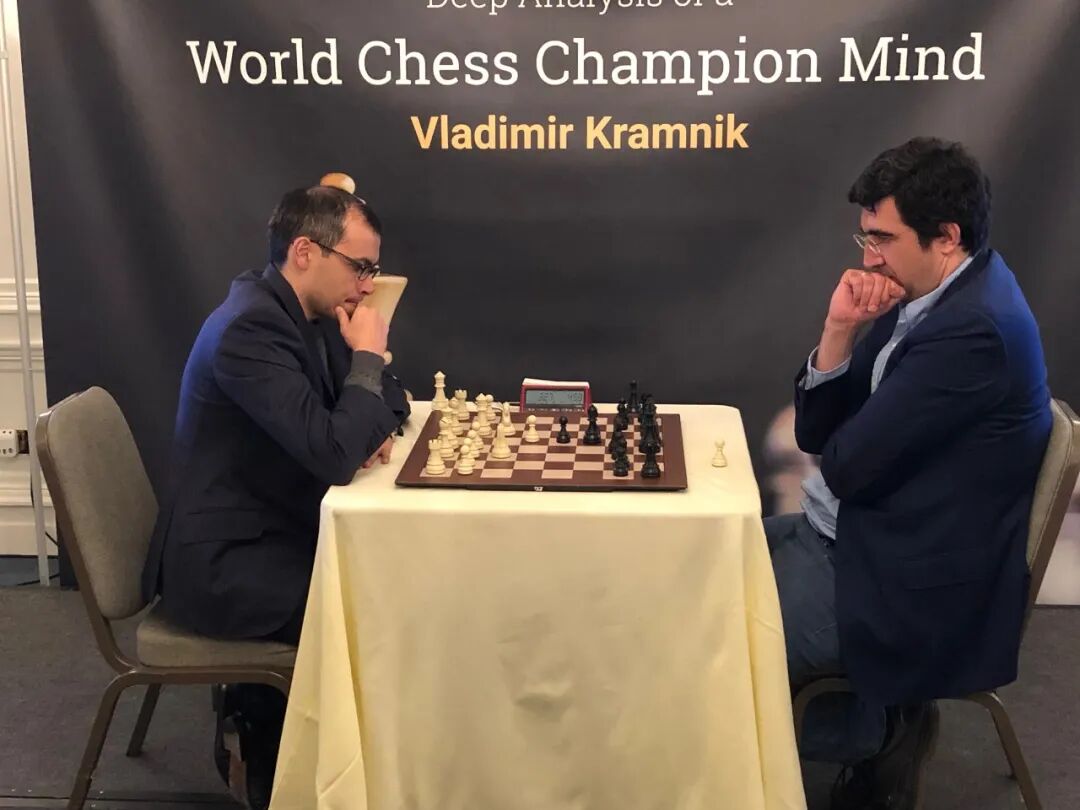
Hassabis plays against former world champion Vladimir Kramnik (Image source: Hassabis's X account)
II. Financing Game: Cut Uncertainty into Pricable Pieces
Hassabis was rejected by dozens of venture capital institutions. A London venture capitalist once told him: "You want to build a self-aware robot? This is more like science fiction." But in 2011, DeepMind made a breakthrough on Atari games — the algorithm learned to play games on its own — which attracted the attention of Silicon Valley. When Google and Facebook launched a bidding war for DeepMind in 2014, those London VCs that had rejected him back then did not even qualify to raise their placards.
The seeds of this reversal were sown at the end of 2010. That year, Hassabis had no personal wealth, and his only assets were himself and the accumulated contacts. In the angel round, he opened the due diligence channel to Peter Thiel and two other institutions at the same time, deliberately creating a pattern of multi-party bidding. He knew that dispersed negotiators would overestimate the value of assets in the case of information asymmetry. In the end, the valuation he got in the angel round far exceeded that of AI startups in the same period. The "threat manufacturing" thinking familiar to chess players was accurately applied to the financing negotiation table.
Thiel's story is particularly illustrative. When Hassabis flew to San Francisco to attend Thiel's Singularity Summit, he deliberately did not talk about AI or business models, but only talked about chess with Thiel. Thiel himself has a technical background and was once among the top teenage chess players in the United States in his youth. Hassabis used the game metaphor on the chessboard to explain DeepMind's path. Thiel was impressed, but the condition was that DeepMind had to move to Silicon Valley. This is the standard clause in the investment history of Founders Fund, "no relocation, no investment". Hassabis's reply was "no relocation", and attached a set of deductions: moving to Silicon Valley would make DeepMind fall into a talent arms race with Google and Facebook, leading to soaring labor costs and reduced team stability; staying in London, he could use the academic talent pool of University College London (UCL) and the University of Cambridge to recruit top European neuroscience and machine learning talents at a controllable cost. This is the chess player's logic of "if the opponent takes move A, I will take move B". Thiel finally compromised. This was the first time in Founders Fund's history to invest in a company outside Silicon Valley.
Then, Li Ka-shing's Horizons Ventures also joined the table. Horizons Ventures is known for its "forward-looking bets". Li Ka-shing may not understand the technical details of deep reinforcement learning, but he believes that "the next world-changing technology must come from AI" and is willing to pay the admission fee for this long-term judgment. In 2012, Elon Musk joined the investment. It is said that Hassabis threw out a view in the early investment meeting: Musk's Mars colonization plan is only feasible under one premise, that no super-intelligent machine seizes the resources of Mars in advance. Musk is easily impressed by the logic of existential crisis. He was convinced and decided to inject millions of dollars. But his motivation was not traditional financial returns, but to obtain internal information and "keep an eye on" the progress of cutting-edge AI. This is a kind of "monitoring investment".
Before Google's acquisition in 2014, DeepMind had received more than 23 million dollars in cumulative venture capital injections.
From an economic perspective, the essence of this financing model is "staged betting": decomposing the overall uncertainty that "no one can see through" into a series of small risks that "can be observed and priced in stages". The capital market does not require you to see through everything ten years later in 2010, it only requires you to come up with new evidence at each node to prove that you are still on the right track. In each round, the valuation is not an accurate financial calculation, because in the stage of no revenue, any discounted cash flow model will give zero; valuation is more like a consensus based on beliefs among investors.
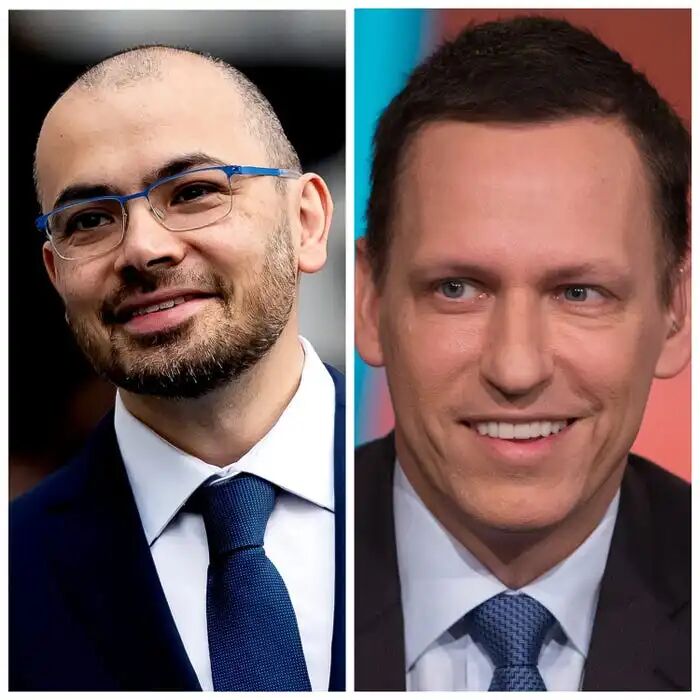
Hassabis and Peter Thiel (Image source: Business Insider)
The operation of this mechanism relies on a premise: there must be enough capital types in the capital market that are willing to accept "non-standard valuation". Founders Fund is willing to pay for "madness", betting on paradigm-level breakthroughs; Horizons Ventures bets on trend judgment; Musk wants information rather than profits. Three types of capital, three kinds of motivations, but all did the same thing: in the era when artificial intelligence could not even recognize a picture of a cat, they dared to place bets.
This is not the market "supporting science", but the market voting in advance in the face of extreme uncertainty.
III. Talent Packaging: Why Google Has to Take Over the Entire Team
DeepMind's bargaining power at the M&A negotiation table does not come from a single-point breakthrough, but from a carefully pre-designed fact: it has turned itself into an indivisible whole.

Hassabis, Suleyman and Legg
The capabilities of the three founders are clearly complementary and rarely overlapping. Hassabis is a visionary operator — chess grandmaster, neuroscience PhD, and the core figure of financing; Shane Legg holds a PhD in AI and is the builder of DeepMind's theoretical foundation; Mustafa Suleyman is in charge of product and public affairs, later left DeepMind and served as CEO of Microsoft AI. The three are firmly bound together through equity, the board of directors and long-term contracts. This arrangement makes the team's intellectual capital highly "specialized". In layman's terms, poaching a few people is not equal to replicating DeepMind. If you buy back the key members separately, their value will be greatly reduced; only in the original team, original projects and original trust structure can they continue to produce AlphaGo-level achievements.
The organizational form of the company locks scattered intellectual capital into the same set of property rights contracts, making it an indivisible whole. This is exactly the most critical hidden card in Hassabis's 2014 M&A negotiation: Google must take over the entire entity, there is no compromise option of "only buying the technology and leaving the people". This packaging capability directly determines what will be discussed next: the rigidity of the contract and the high price of the acquisition. The seller first makes itself indivisible, and the buyer has to make concessions on the terms and pay a premium on the valuation.
IV. Contract and M&A: Two Sides of the Same Transaction
Google paid 650 million dollars to acquire a company with zero revenue, and at the same time accepted a series of unprecedented harsh terms. These two things seem very contradictory. After accepting so many constraints, why was it still willing to pay such a high price? The answer is: they are two sides of the same transaction.
The seller's side: rigid contracts weld "independent operation" into the contract
At the negotiation table, the first condition put forward by Hassabis's team was not the price, but "independent operation". This order is extremely critical: if the price is discussed first, Google can use the high price to exchange for control; if autonomy is discussed first, the buyer is forced to commit not to interfere with the technical route before raising the price. The terms finally written into the contract include: DeepMind stays in London and will not move to Silicon Valley; the technology is prohibited from being used for military purposes; an independent ethics committee is established, which has the legal right to prevent Google from commercializing certain core technologies.
To understand the power of these terms, we need to break them down into three levels.
First, the completeness of the contract. DeepMind decomposed the abstract goal of "independent operation" into specific, verifiable clauses: not "non-interference as much as possible", but "the ethics committee has the right to veto". The fewer fuzzy areas, the smaller the space for post-event disputes and the lower the execution cost.
Second, the credibility of remedies. Under common law, courts can order "specific performance" — forcing Google to continue to fulfill its commitments. This means the court can order Google to accept the veto of the ethics committee, instead of just awarding a sum of compensation. Compensation is "freedom to breach the contract", and specific performance is the real rigid constraint.
Third, the mortgage of reputation. If Google tears up the agreement, the cost is not only legal compensation, but also the distrust of all counter-parties in future M&A transactions. Who would dare to sign a long-term contract with a company that can go back on its written words?
The contract is clearly written, the court can enforce it, and the reputation is too costly to lose.
The three layers of guarantees progress step by step, making DeepMind a unique "independent research enclave within the enterprise" inside Google: relying on Google's cash flow, but not directly responsible for profits; enjoying ultra-large-scale resources, while retaining academic freedom.
The buyer's side: 650 million dollars is paid for an insurance policy
Then what exactly is Google buying? Google is buying a defensive strategic moat.
In 2014, Google had become an absolute oligarch in the field of search and advertising. The biggest threat an oligarch fears is not that competitors surpass it on the existing track, but the emergence of a "dimensionality reduction strike" alternative. As long as AGI (Artificial General Intelligence) is born, users