The small blue light of L2 is about to go out, and the small blue light of L3 is about to turn on.
With the implementation of L3-level autonomous driving, after the rights and responsibilities between human drivers and vehicles change, surrounding road participants need to clearly understand the status of autonomous vehicles. Therefore, the autonomous driving warning light also involves public safety. From this perspective, blue light should no longer be a forbidden zone for private cars.
Is the small blue light for autonomous driving going to be forcibly removed from the market by mandatory national standards?
This news sparked debates and verification from all parties yesterday.
The basis for banning the small blue light on passenger cars is that it does not meet the requirements of GB4785 "Installation Provisions for External Lighting and Light Signal Devices of Motor Vehicles and Trailers".
In its report, Yicai quoted feedback from Geely Auto as saying, "We are aware of this news, will strictly follow national regulations and wait for further requirements from the state." An internal source of another car company confirmed that starting from July 27, 2026, the state has banned the use of "small blue lights" for new certified models.
Last night, China Automotive Standardization Research Institute released an article on its official WeChat public account to confirm this news at the official level:
Some vehicle products are installed with "small blue lights" to show other road participants that the vehicle's driving assistance system is in working condition. However, there is currently abuse of "small blue lights", which is likely to cause safety risks. The "small blue lights" turned on at night are prone to causing glare to other road participants, with a dazzling visual experience, especially interfering with surrounding drivers' judgment of road conditions; vehicles equipped with this indicator light are more likely to be cut in by other car owners or followed at a close distance, increasing road traffic risks.
In China, although GB 4785—2019 "Installation Provisions for External Lighting and Light Signal Devices of Motor Vehicles and Trailers" has not yet made clear requirements for the use of "small blue lights", in principle, external lighting and light signal devices not defined by this standard should not be used according to the standard.
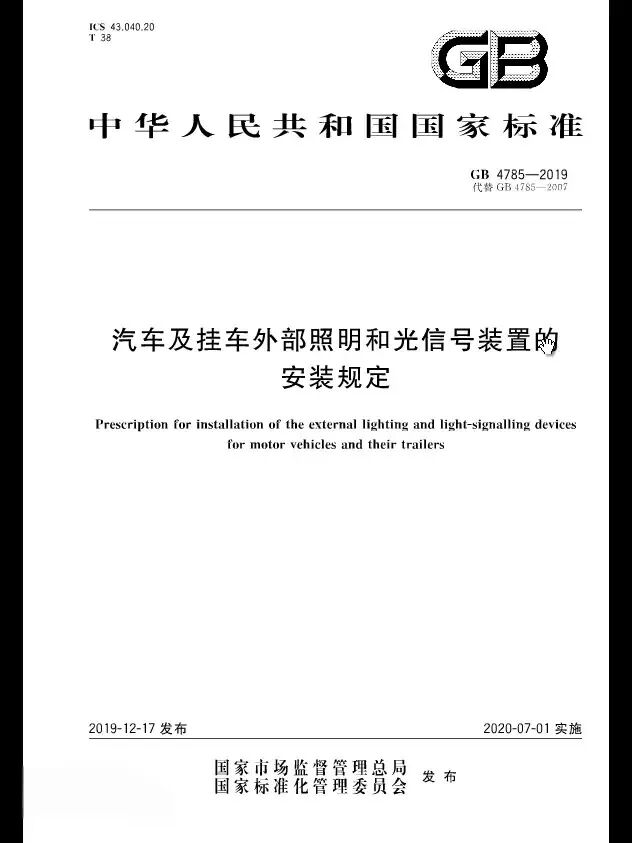
The current mandatory national standard "Installation Provisions for External Lighting and Light Signal Devices of Motor Vehicles and Trailers" (GB 4785-2019) only allows four colors of external signal lights: white, red, amber and yellow, and blue is not in the legally permitted list.
The reason why blue is not in the legally permitted list for passenger cars is that blue is the exclusive light color for special vehicles such as public security, fire fighting and rescue, according to experts. Ordinary civilian vehicles privately equipped with external blue lights are essentially illegal light modification.
01. Banning the small blue light for autonomous driving is intended to establish a clear boundary between L2 and L3
According to comprehensive information from AutoR, in view of the current compliance loopholes and hidden safety hazards of small blue lights, the regulatory system has launched a systematic rectification, forming a full-chain management and control system of "banning installation on new cars, rectifying existing stock vehicles, and strict inspection in annual vehicle inspections", aiming to end the current disorderly development state.
The most influential measure is the zero-tolerance access control for new vehicles.
It is reported that the review mechanism of the Ministry of Industry and Information Technology's product announcement has been clearly defined. If newly declared mass-produced models are equipped with external small blue lights for autonomous driving, they will not pass the review, eliminating new non-compliant configurations from the source.
For the stock vehicles with greater impact, orderly compliance rectification will be promoted.
For the already launched and sold models equipped with small blue lights, the regulatory authorities have made it clear that rectification will be gradually carried out through OTA upgrades, hardware adaptation and other methods to turn off the blue light lighting function when the vehicle is in driving state. At the same time, this requirement will be included in the annual inspection standards. If the blue light automatically lights up when the vehicle is driving, it will be judged as an illegal modification and cannot pass the annual inspection. Only the static display state when the vehicle is parked will be retained to eliminate road driving safety risks to the greatest extent.
So are small blue lights completely banned?
China Automotive Standardization Research Institute stated that internationally, the Working Party on Lighting and Light-Signalling (GRE) and the Working Party on Automated/Connected Vehicles (GRVA) under the United Nations World Forum for Harmonization of Vehicle Regulations (UN/WP.29) are conducting research on "small blue lights", and there are still disputes over their safety benefits and potential risks.
Under the guidance of the competent department, the National Automotive Standardization Technical Committee is carrying out the formulation and revision of GB 4785 "Installation Requirements for External Lighting and Light Signal Devices of Motor Vehicles and Trailers" (plan number 20262535-Q-339). At the same time, it cooperates to carry out relevant work to strengthen the access review and test verification management of "aggressive" product innovative designs, further standardize the installation and use of vehicle lamps, and improve the safety performance of automotive products.
When did the small blue light for autonomous driving first appear? It was first installed by Li Auto in the Chinese market. But the idea of using small blue lights to prompt other road participants about the autonomous driving status originated from the J3134 standard released by SAE International in 2019, which stipulates that turquoise light sources should be used to identify the autonomous driving status; Mercedes-Benz referred to this standard and first piloted its application on the EQS, while in the Chinese market, Li Auto L9 took the lead in being equipped with 5 small blue lights for autonomous driving in 2022.
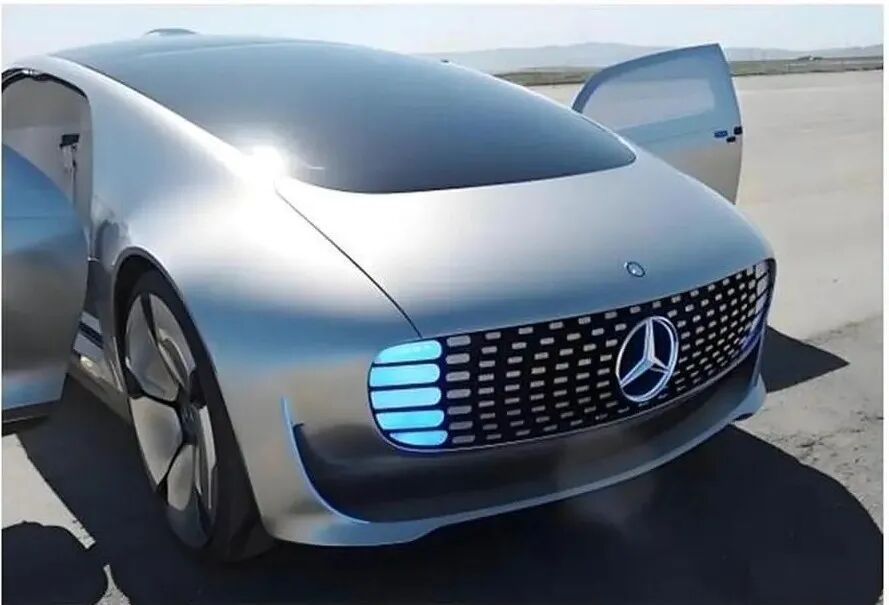
The autonomous driving indicator light first appeared on the F015 concept car launched by Mercedes-Benz in 2015. When the vehicle is in autonomous driving state, the LED lights on the front face of the car emit blue light
That is to say, small blue lights for autonomous driving have appeared on Chinese roads for four years, and today, small blue lights can be said to be everywhere on urban roads in China.
So after the implementation of the new national standard, will the small blue light for autonomous driving really withdraw from the historical stage?
Zhu Xichan, a former professor of Tongji University, told AutoR, "Vehicles with autonomous driving need external indicators."
In response to the rumor that the new international standard bans the installation of small blue lights on L2-level assisted driving vehicles but will not affect L3, he said: "Autonomous driving vehicles must be equipped with small blue lights. Assisted driving vehicles are not allowed to be equipped with small blue lights."
He emphasized: "Of course, the light indicators (small blue lights) for autonomous driving will be standardized when the mandatory lighting standard is revised, including light color, brightness, size, installation position, etc."
So is this view supported by laws and regulations?
At present, there are no requirements for external indicators of autonomous vehicles in the mandatory national standard "Safety Requirements for Autonomous Driving Systems of Intelligent and Connected Vehicles" (draft for approval), which will be officially implemented on July 1 next year.
However, according to AutoR's understanding, as Professor Zhu Xichan said, the autonomous driving indicator light will be a standard configuration in the L3 or higher level autonomous driving stage, which has become a consensus in the industry.
This ban on small blue lights for autonomous driving not only reflects the reflection on the extensive innovation of smart cars in the past few years, but also aims to establish a clear boundary between L2 and L3.
But this issue does not end here.
02. External light colors involve public safety and will be strictly managed
Under the circumstance that small blue lights on Chinese roads have been recognized by the public, after the news that the new national standard bans small blue lights came out, all parties reviewed the regulations and surprisingly found that these small blue lights have never been legal and compliant.
The setback of small blue lights this time actually involves a wider range of public management. Its underlying logic is that road light colors are a set of public visual languages with legal exclusive rights for specific colors.
Blue has infringed on the exclusive right of emergency special vehicles to use blue light colors.
Today, China's domestic road traffic system has formed a long-term solid color cognition:
Blue: The core warning color for police cars, ambulances and engineering rescue vehicles;
Red flashing light: Emergency warning for fire engines and first aid vehicles;
Amber yellow: Road repair and engineering operation vehicles;
This cognition is a conditioned reflex established by all drivers during driving school training.
At present, for the external lighting/light signal devices of civilian passenger cars, the national standard only allows four colors: white, selective yellow, amber and red. Blue, green, purple and other colors are not allowed to be used as external constant-brightness signal light sources.
From the perspective of laws and regulations, the list of colors permitted for passenger cars is a closed list, and colors outside the list are equivalent to being prohibited.
If a large number of civilian private cars use blue and unconventional color light sources in their external lamps, the signal uniqueness of special vehicle lights will be diluted. Once there is a real rescue task on the road, other drivers cannot quickly distinguish the civilian decorative blue light from the emergency warning light, which will hinder the passage of special vehicles and directly affect the emergency efficiency of fire fighting and first aid.
This logic is not difficult to understand. In fact, all countries have also made explorations on autonomous driving indicators.
The color of the SAE J3134 ADS autonomous driving indicator light released by SAE International in 2019 is actually blue-green (Teal).
Although no single fixed RGB/hexadecimal color code is specified, a CIE 1931 xy chromaticity quadrant color gamut interval (the luminous chromaticity of the light source, not the display color on the screen) is defined.
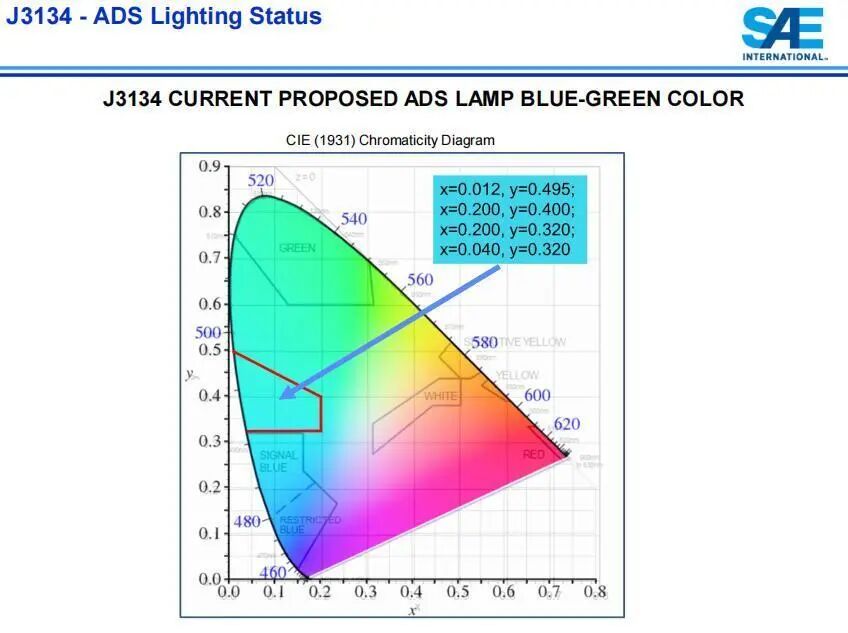
The standard requires that the luminous chromaticity of all ADS indicator lights must fall within this quadrant. The so-called small blue light for autonomous driving is actually colors such as turquoise and sky blue.
In fact, the domestic autonomous driving light indicator is not pure blue, but a kind of sky blue close to the above standard, which is different from the police light, but the difference is not obvious.
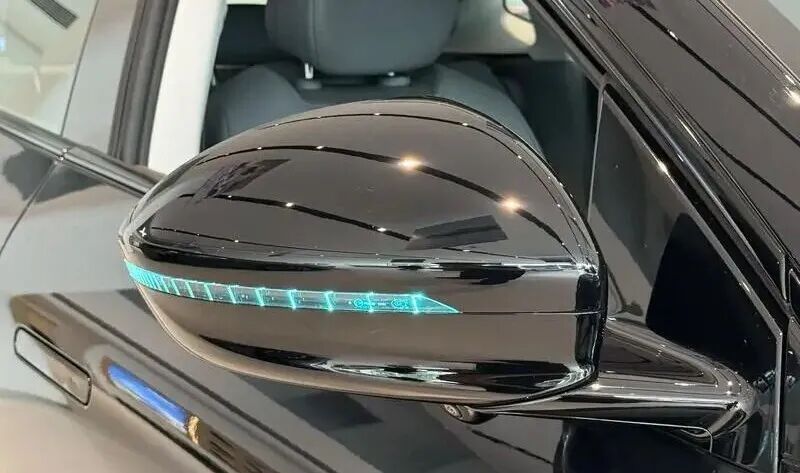
The small blue light for autonomous driving is actually a kind of sky blue light
However, SAE J3134 has not finally become a mandatory standard in the United States, but has always been a technical recommended standard.
At present, only some states in the United States, such as California and Nevada, have officially approved Mercedes-Benz to use it on their vehicles.
In China, in fact, several rounds of game have been carried out on which color to use for the autonomous driving indicator light.
At present, China has two sets of standards for automotive lights: "Installation Provisions for External Lighting and Light Signal Devices of Motor Vehicles and Trailers" (GB 4785-2019) and GB 5920-2024 "Light Signal Devices and Systems for Motor Vehicles and Trailers". The former regulates the whole vehicle, and the latter regulates component manufacturers.
In September 2021, when the Ministry of Industry and Information Technology released the national standard "Light Signal Devices and Systems for Motor Vehicles and Trailers" (draft for comments), special provisions for ADS indicator lights were added in Appendix D.
The scope of application of this provision requires that only M-class and N-class motor vehicles of L3 level and above shall be equipped with ADS indicator lights, and at least 1 group shall be arranged symmetrically at the front and rear of the vehicle. Meanwhile, the installation height, luminous intensity and lighting logic are specified.
Referring to the CIE1931 chromaticity coordinate quadrant boundary defined by SAE J3134 in the United States: (0.012, 0.495), (0.200, 0.400), (0.200, 0.320), (0.040, 0.320), it specially stipulates that the light color is blue-green.
However, all the above relevant clauses were deleted from the national standard officially released in 2024. This national standard has been mandatorily implemented on July 1, 2025. The small blue light for autonomous driving, which once seemed to have legal basis, is still in a state of no legal basis three years after its birth.
With the start of a new round of revision of "Installation Provisions for External Lighting and Light Signal Devices of Motor Vehicles and Trailers" (GB 4785-2019), the small blue light for autonomous driving is facing the possibility of completely withdrawing from the market.
Regarding the concern that the small blue light for autonomous driving may affect public service vehicles such as police cars, fire engines and ambulances, some automakers once proposed to use green light as the autonomous driving ready indicator.
However, this proposal has also been rejected. If the green warning authority is reserved for road rescue and special operations in the future, occupying this color in advance will lead to long-term compliance risks.
Industry insiders pointed out that after the small blue light for autonomous driving, the management of decorative ambient light strips at the rear of the vehicle, under-car light carpets and colorful welcome light displays will also be strengthened. The compliance department will also check the light that switches between multiple colors: it is not allowed to exceed the amber color gamut, and there can be no mixed red and blue colors; at the same time, flashing logic that does not meet the definition is prohibited.
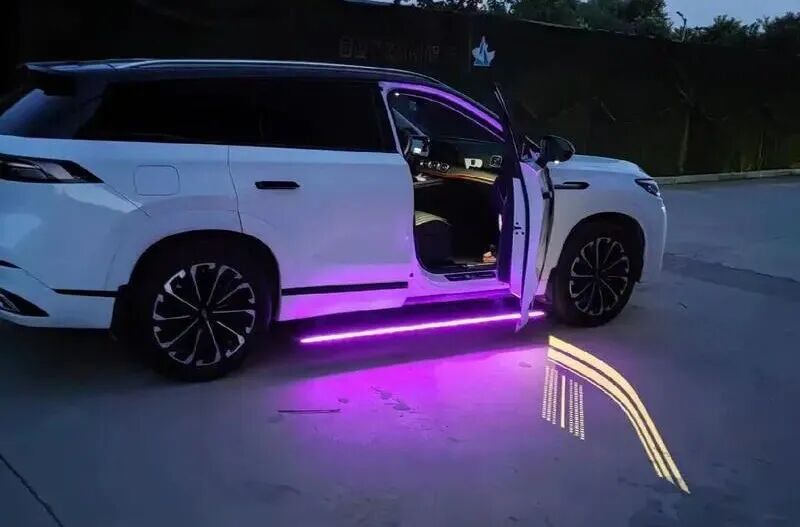
It can be said that vehicle light colors are similar to short-wave frequency bands and satellite orbits, which require top-level design and management. With the expansion of Chinese autonomous driving enterprises to overseas markets, it also involves international coordination and consensus building.
03. Autonomous driving warning lights also involve public safety
The small blue light for autonomous driving is banned. To be precise, it is a high probability event that the small blue light for L2-level assisted driving will be banned.
However, it is also a consensus at home and abroad that L3-level autonomous driving needs to be equipped with external indicator signs. It is just that all parties need to reach a game on which color the autonomous driving indicator light will finally adopt.
For users who have already purchased vehicles equipped with small blue lights for autonomous driving, there is actually no need to worry.
