AI makes the resumes of fresh graduates more and more similar, what is the real competitiveness?
In June this year, an HR shared an interview experience on Weibo, which made the phrase "meeting a fresh graduate with a strong Doubao vibe in an interview" go viral and spark widespread discussion. She interviewed a fresh graduate whose resume was entirely written by Doubao, and all her conversations were full of distinct Doubao-style phrasing. But then the HR thought to herself: the workplace is close to her home, so commuting is super convenient; the position is a clerical role that doesn't require hardcore professional skills at all; the only threshold is the education requirement, which she already meets. With these three points adding up, the HR still decided to bring her in for the interview. Throughout the whole interview, the girl kept looking down at her phone to type, and the HR estimated that for most of the 20 minutes, she was secretly asking Doubao for answers. At last, when the HR asked if she had anything else to know about the role, she replied: "Let me ask Doubao."
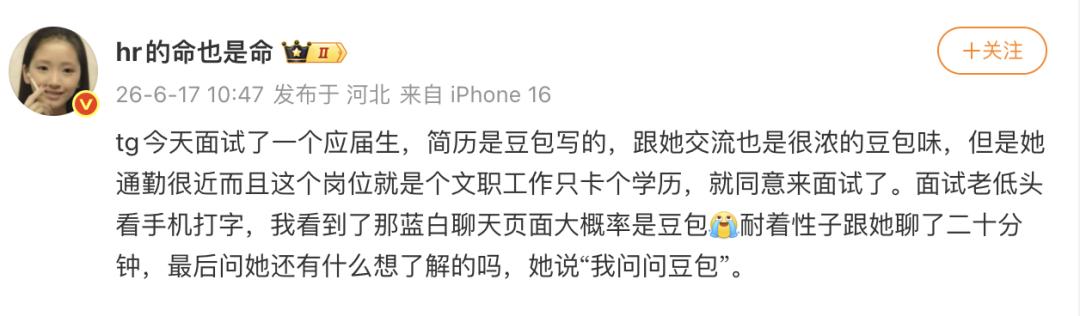
This experience was later forwarded everywhere as a joke, because the line "Let me ask Doubao" was far too obvious. But most other resumes are not that easy to expose their AI origins — they are written to look more and more polished, each one fancier than the last. The report *The AI-Native Job Hunting Era* released by Beisen AI Talent Science Research Institute points out: in the past, when we went through resumes, we could filter out more than half of them at a glance if they had messy formatting or empty content. That's no longer the case now. Everyone's resume looks perfect, "everyone has internship experience at big companies, everyone is a project lead". HRs are left wondering: how come this generation of students all suddenly become so outstanding?
The answer is simple: everyone has access to an AI tool.
Within One Year, 95% of Fresh Graduates Have Become "AI-Native Job Seekers"
In 2025, 66.7% of campus recruits used AI during their job hunting process; in 2026, this proportion is expected to jump to 95%. Almost every resume placed on an HR's desk has been polished with the help of AI.
The downside has also emerged: AI makes resumes more and more "perfect", but it becomes increasingly impossible to tell the candidate's real capability. An ordinary experience in the student union can be packaged into "coordinated a team of more than 50 people, completed a large-scale university-level event, and received university-level recognition".
Some enterprises can no longer put up with this situation, and have returned to the most primitive screening method: re-prioritizing school reputation, education background, and GPA. But this path also doesn't work well. High-potential candidates who don't graduate from top schools but have strong learning capabilities are very likely to be filtered out in the first round. At the end of the day, resumes can no longer tell who is truly competent, which has little to do with whether you used AI or not.
The Value of Resumes Was Originally Built on the "Cost of Falsification"
Economist Michael Spence put forward a theory in 1973: submitting a resume, essentially, means you spend time and energy to prove to the employer that "I deserve an interview". Why should HR trust you? Because writing a good resume used to take real effort, and that effort itself formed the threshold.
AI has pushed this cost to nearly zero: a plain experience of "participated in a project" can be rewritten into a standard sentence structure with action verbs and specific data in just a few seconds.
Let's temporarily call this phenomenon "resume inflation" (it's not an established economic term, it's just a metaphor borrowed from excess currency issuance). It is different from "degree inflation": degree inflation means diplomas themselves depreciate due to oversupply; resume inflation is far more thorough. Even if all the experiences on the resume are real, as long as the wording is the same as everyone else's, HRs can no longer extract effective information from it. The more standard it is written, the less meaningful it appears to be, as if nothing is written at all.
Both Sides Are Using AI, and Eventually the Competition Falls Back to Real Human Capability
Enterprises are not standing still. According to survey statistics, in the past year, the number of enterprises using AI interviewers has increased 4 times year on year, 84% of which are applied in campus recruitment. After Changan Automobile introduced AI interviewers, the consistency of judgment between human and AI reached 70% to 80%, the re-interview pass rate increased by 20%, and 8333 working hours were saved in one campus recruitment season; the resume screening efficiency of JHIC increased by 39%, and the hiring rate rose from 45% to 65%.
Job seekers use AI to polish their experience, while enterprises use AI to re-score resumes and interview performance. The efforts from both sides offset each other, and no one gains an extra advantage. But no one can quit this game, the root cause lies in the huge volume of job seekers: the number of college graduates nationwide in 2026 is expected to exceed 12 million, with an employment rate of about 65%; tech blogger "Hangtong She" counted that in 2025, internship positions that mention AI received an average of 78 applications, and non-AI positions also received 32 applications. One position can get hundreds of resumes which is impossible for humans to process manually, so enterprises have no choice but to use AI for screening.
Job seekers also have no way out: resumes without AI polishing are very likely to be eliminated in the first few seconds of HR's initial screening for being "not professional enough". The first one who stops using AI will suffer losses, and the cost has to be borne by themselves, which cannot change the existing rules. This is the solid foundation of "everyone uses AI": no one needs to force others, everyone will make the same choice after calculating the trade-off on their own.
The screening right finally falls back to the part that AI cannot replace: follow-up questioning.
AI Can Fabricate Wording for Experiences, But Cannot Make Up Details That Stand Up to Follow-Up Questions
According to HuffPost, Zapier hiring manager Bonnie Dilber says that at least a quarter of the applications she reviews are obviously AI-generated at first glance. Many candidates use the exact same case to answer "why are you interested in this position", even the metaphors are identical. LHH recruiting director Laurie Chamberlin put it more directly: if the resume is full of empty phrases like "strong communication skills" and "team player" without specific supporting cases, it can basically be judged as AI-written.
Can you win just by writing the resume "real, specific and full of details"? This conclusion is no longer valid.
There is a tool called Walter Writes, which is specially designed to rewrite AI-generated resumes and cover letters to "look like they were written by humans". According to its public data, texts that were originally judged by GPTZero to be more than 98% AI-generated can be judged as more than 99% "human-written" after being rewritten by Walter Writes. Similar tools include HumanLike and Undetectable AI, with almost the same selling point: rewrite AI-generated content so that even AI detectors cannot identify it. Making content "sound real" has already become a business that you can subscribe to monthly.
It is not new that AI can generate deceptive content. What really makes people uneasy is that "looking real" itself can also be produced in batches.
But what these tools can process are still the content written on paper: you need a draft first, then modify it to erase AI traces. Follow-up questioning is different: the question raised by the interviewer does not exist at all before it is asked, so there is no draft for you to let AI "purify" first and then memorize.
For anything written down and can be modified repeatedly, AI will be able to smooth out all traces sooner or later. Even the process of "erasing AI traces" itself can be done by others for you. Only those ideas that have never been written down and have to be thought of on the spot can still retain the real signal of your capability.
AI Can Take Over Writing Skills, But It Cannot Take Away Judgment Ability
Under this trending search post, one comment is more specific: two things are truly scarce, the first is the ability to raise good questions — AI can answer the questions, but it is human that decides which direction to ask; the second is the ability to filter information — AI can produce more content in one day than an ordinary person can write in a whole year, and you have to judge by yourself what information to trust. The comment suggests fresh graduates: treat AI as a research assistant, not a ghostwriter. Those unpolished, half-baked ideas are exactly what interviewers want to see the most.
A fresh graduate's choice perfectly matches this idea. She graduated from a second-tier college, has no internship experience at big companies, and no competition awards, most of her resumes sent out got no response. Instead of wasting more energy making her resume look more like a big company employee's, she took an outsourced on-site position (known as OD in the industry) first, to get access to real online business: microservices, middleware governance, online problem troubleshooting. When the interviewer asked "what exactly did you do for middleware governance", she could give a clear answer because she had real hands-on experience. In her own words, this experience is more useful than "an ordinary formal labor contract". This is the post she published on the "Solo Independent Developer Community" (Solo.xin) under the screen name Crystal this year.
The real lesson that campus recruitment needs to learn is how to understand, judge and attract the new generation of talents, not just improve efficiency.
For job seekers, the answer is more specific: instead of rewriting the wording of your resume ten more times, go find a real experience that AI cannot fabricate and you can explain clearly: a real pit you stepped on, that you can answer three consecutive follow-up questions from the interviewer without breaking down. If you don't have such experience, go take a job that can expose you to real business first, even starting from an unglamorous outsourced on-site position. As long as you have done it for real, you have something to talk about when being questioned.
When the interviewer asks "what pitfalls did you run into during this iteration you mentioned", resumes written by AI usually can only stay silent for three seconds. The threshold has not disappeared, it has just shifted from "how well is your resume written" to "can you stand up to follow-up questioning".
When everyone's resume looks almost the same, the real competitiveness never lies in how fancy your resume is, but whether you have a real experience that can stand up to a whole series of follow-up questions.
This article is from the WeChat official account "Qidian Wai", author: wiwi, authorized for release by 36Kr.