Qualcomm announced a price hike taking effect on September 1, and has been badly stung by the troubles in the memory chip sector.
XinDongXi reported on July 30 that Qualcomm released its third fiscal quarter earnings report today, announcing that it has become "the leading supplier of computing chips for the BMW Group's digital cockpit and autonomous driving technologies over the next decade", and that it has completed the acquisition of Modular, an AI-native software infrastructure enterprise.
Under the cooperation agreement reached between Qualcomm and the BMW Group, Qualcomm will provide computing chips for the BMW Group's next-generation digital cockpit as well as advanced driver assistance systems/autonomous driving (ADAS/AD) over the next decade. This cooperation covers multiple solutions under Qualcomm's Snapdragon Digital Chassis, including the top-tier version of the Snapdragon Automotive Platform and dedicated AI accelerators.
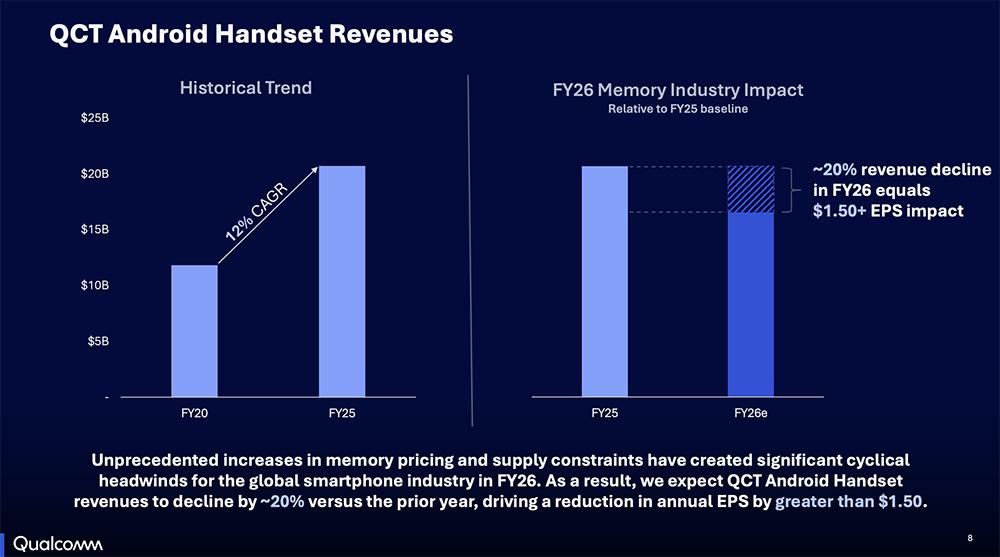
In terms of performance, Qualcomm announced that its core mobile phone business is weak due to the global smartphone sales decline caused by rising memory prices, and it expects its revenue related to Apple to decline at an accelerated pace.
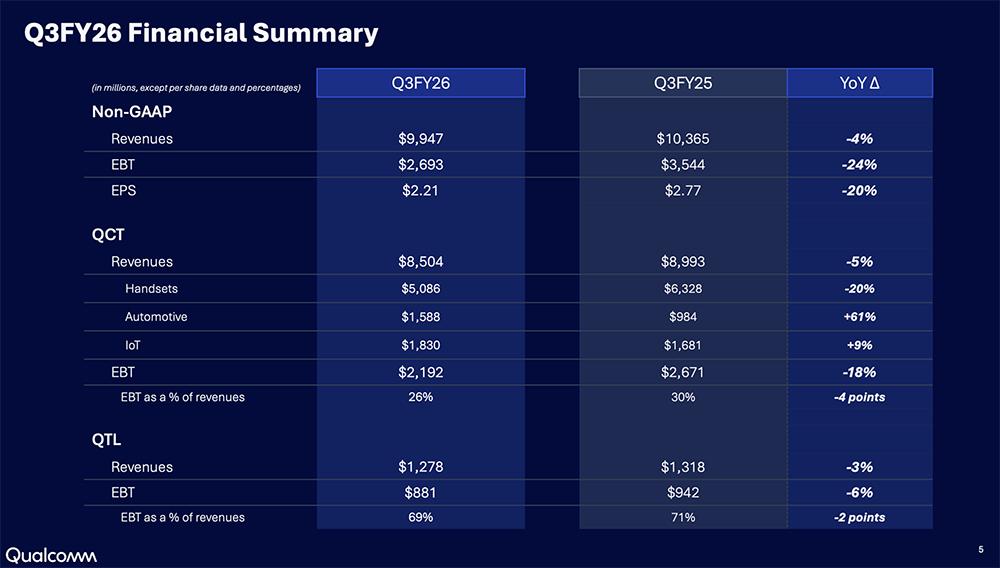
In the third fiscal quarter, both Qualcomm's revenue and profits declined. Its revenue reached 9.95 billion US dollars, down 4% year on year, of which the revenue from the mobile phone business fell 20% year on year to 5.09 billion US dollars; its net profit was 2.0 billion US dollars, down 25% year on year.
The impact of the memory market on the global smartphone industry has already emerged.
Qualcomm wrote in its press release: "The input costs across the semiconductor industry are rising in all aspects, including wafer manufacturing, assembly, testing, advanced packaging, memory and other materials."
1. Full price increase effective from September 1
During the earnings call, Cristiano Amon, President and CEO of Qualcomm, said that Qualcomm judges that the mobile phone revenue from Chinese OEMs has bottomed out in the quarter ending in June, and is expected to resume double-digit sequential growth in the quarter ending in September.
Amon revealed in an interview with foreign media that Qualcomm is taking practical measures to expand its profit margins in the future, including the plan to fully raise the prices of the company's chips starting from September 1, and exploring other ways to simplify the company's supply chain.
"We are experiencing a situation of sharp cost increases," Amon said, adding that Qualcomm has to negotiate with every customer, "the temporary disconnect between cost and pricing has led to a slight temporary decline in gross profit margin."
He said that the dynamic changes in the smartphone market have reduced the competitiveness of mid-to-low-end mobile phones, mainly due to price factors. Even high-end Android phones where Qualcomm chips dominate are facing consumers' demand for lower prices. Mobile phone manufacturers are forced to raise prices, which in turn prompts consumers to shift to lower-end products in the high-end mobile phone market or even older models, all of which have damaged Qualcomm's profit margins.
Akash Palkhiwala, Chief Financial Officer of Qualcomm, said that as contracts expire and product cycles renew, the benefits of price increases will gradually emerge, and gross profit margin is expected to return to the company's historical level in the coming quarters.
2. Lowered performance forecast related to Apple
Akash Palkhiwala said that by the last quarter of 2026, Qualcomm's modem share for the iPhone 18 series will be "much lower than our previous estimate of 20%".
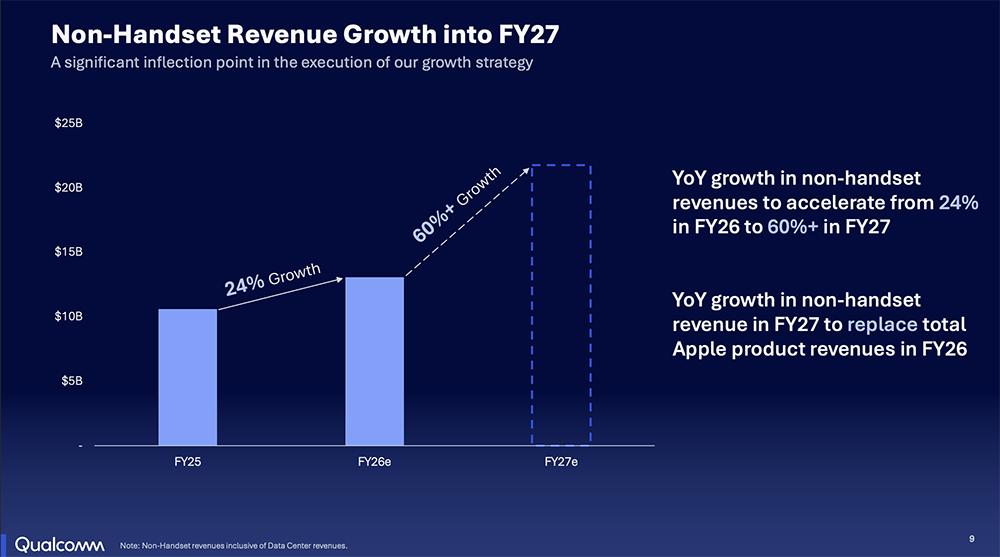
He revealed that Qualcomm's revenue from Apple products is expected to decline by about 50% sequentially in the quarter ending in December. The revenue from Apple products in fiscal 2027 is expected to be slightly lower than the previous expectation of "slightly over 2 billion US dollars". It is expected that the growth of Qualcomm's non-mobile phone business in fiscal 2027 will replace the revenue related to Apple in fiscal 2026.
Qualcomm's partnership with Samsung remains solid. According to Amon, about 70% of Samsung's current flagship models are equipped with Snapdragon platforms.
3. Accelerated growth of non-mobile phone business
In the third fiscal quarter, Qualcomm's chip business segment OCT recorded revenue of 8.5 billion US dollars, and its licensing business segment QTL recorded revenue of 1.28 billion US dollars.
The revenue from OCT's non-mobile phone business increased by 28% year on year. Among them, Qualcomm's automotive business sales reached 1.59 billion US dollars, up 61% year on year, and the annualized revenue target for the automotive business in fiscal 2026 was raised to about 7 billion US dollars; IoT revenue increased by 9% year on year to 1.83 billion US dollars.
Amon said that in the short term, Qualcomm expects the year-on-year growth rate of non-mobile phone business revenue to accelerate from 24% in fiscal 2026 to more than 60% in fiscal 2027.
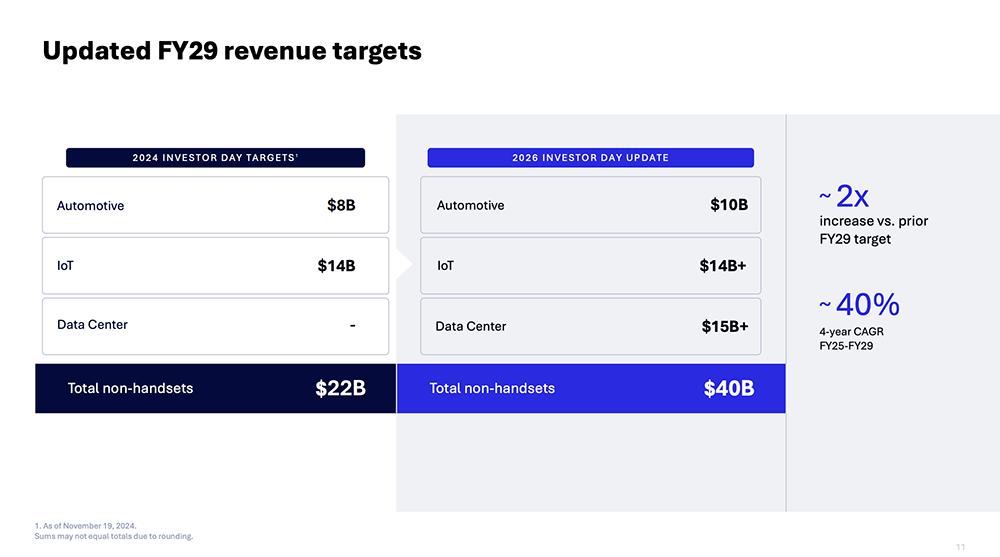
It is expected that by fiscal 2029, Qualcomm's non-mobile phone business revenue will grow to 40 billion US dollars, almost 2 times the target announced by the company in November 2024.
4. Forging ahead into the data center market
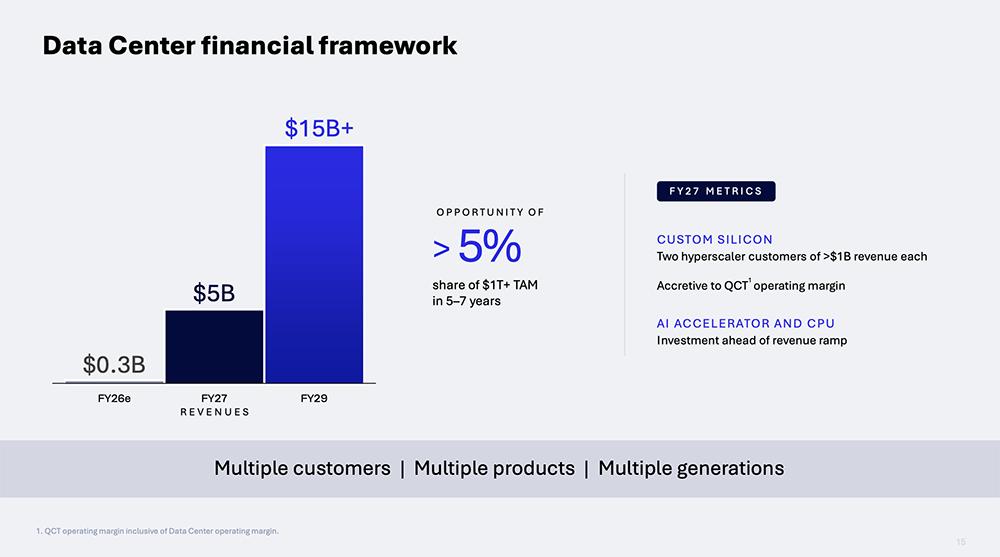
Qualcomm has been expanding into the AI data center market. It is expected that the revenue of its custom chip data center business will start growing in the December quarter, with the target of achieving 5 billion US dollars of data center business revenue by fiscal 2027, and 15 billion US dollars of data center business revenue by fiscal 2029.
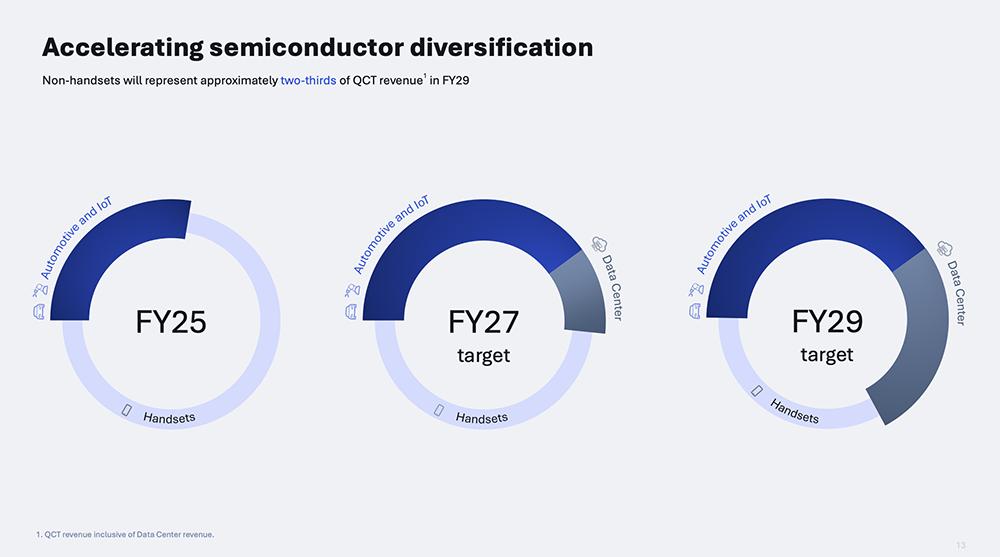
"To some extent, we are using the data center business to replace the business from Apple," Amon said.
Qualcomm regards the data center as its "largest growth opportunity", and expects the TAM to reach 1 trillion US dollars in 2029.
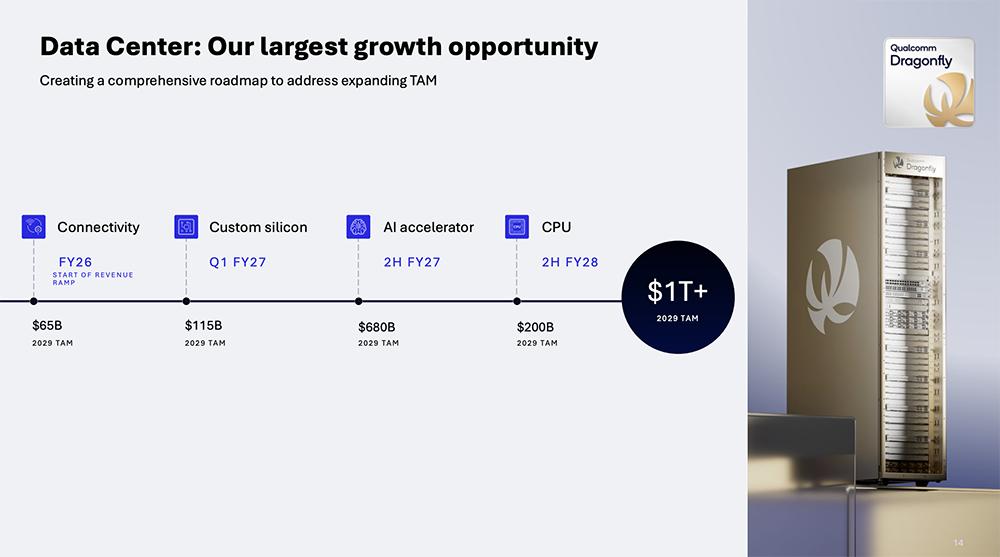
According to Amon, two custom chip design orders (each generating revenue of more than 1 billion US dollars) from Qualcomm and hyperscale data center customers have started wafer production, and are expected to generate revenue starting in the quarter ending in December.
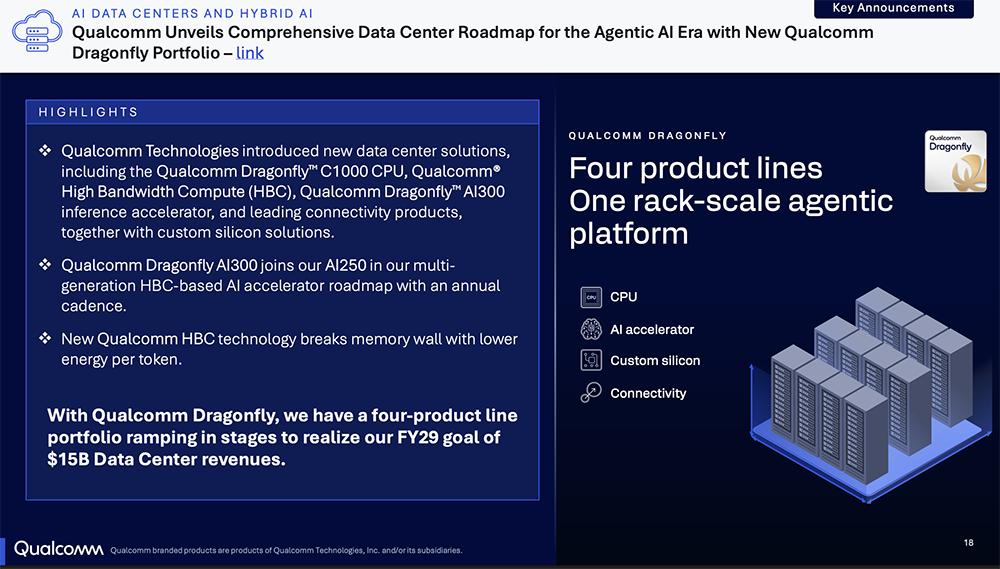
Qualcomm's data center solutions include CPUs, High-Bandwidth Computing (HBC), AI inference accelerators and connectivity products.
Its first-generation HBC chip has completed tape-out. The chip integrates computing and memory in one package, and is scheduled to be launched in mid-2027.
Qualcomm's share price fell 4.4% in after-hours trading, with a cumulative decline of more than 17.5% in the past month.
This article is from the WeChat Official Account "XinDongXi", Author: ZeR0, Editor: Mo Ying, published with authorization from 36Kr.