Microsoft has just earned 21.6 billion from Anthropic.
According to Zhidx report on July 30, earlier today, Microsoft released its financial results for the fourth quarter of fiscal 2026 (corresponding to the second calendar quarter of 2026) and the full fiscal year. The commercialization scale of its AI business continues to expand, while computing power investment and cost pressure are also rising simultaneously. Among them, Azure's annual revenue exceeded 100 billion US dollars for the first time (approximately 6.77 trillion RMB), the number of paid seats for Microsoft 365 Copilot exceeded 30 million, and Azure AI Foundry reached 100,000 customers; at the same time, capital expenditure in this quarter increased by 70% year-on-year to 41 billion US dollars (approximately 277.57 billion RMB).
In this fiscal quarter, Microsoft's revenue reached 90.007 billion US dollars (approximately 609.35 billion RMB), up 18% year-on-year; net profit reached 35.766 billion US dollars (approximately 242.14 billion RMB), up 31% year-on-year; diluted earnings per share was 4.81 US dollars (approximately 32.56 RMB), up 32% year-on-year.
For the full fiscal year 2026, Microsoft's revenue reached 331.839 billion US dollars (approximately 2.25 trillion RMB), up 18% year-on-year; net profit reached 133.749 billion US dollars (approximately 905.48 billion RMB), up 31% year-on-year.
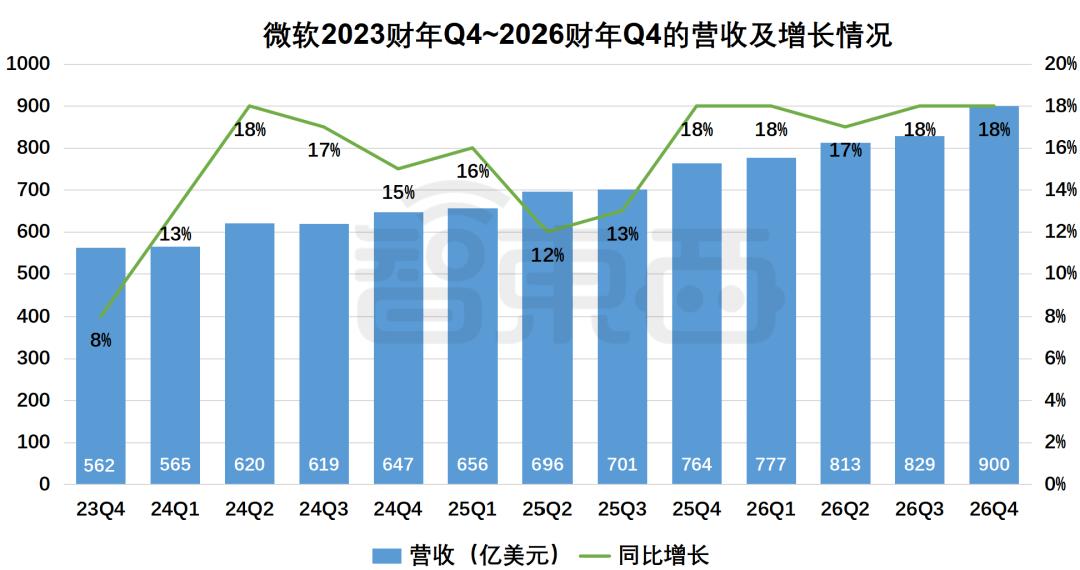
Microsoft's revenue and growth trends in the past 3 years (Chart by Zhidx)
The cloud business remains Microsoft's core growth driver. Microsoft Cloud's revenue in this quarter reached 59.3 billion US dollars (approximately 401.46 billion RMB), up 27% year-on-year; revenue from Azure and other cloud services increased by 43% year-on-year.
However, the rising investment in AI infrastructure is also affecting cash flow. Of the total capital expenditure in this quarter, about two-thirds was allocated to short-term assets such as GPUs and CPUs; free cash flow dropped by 23% year-on-year to 19.639 billion US dollars (approximately 132.96 billion RMB).
In addition, Microsoft's net profit in this quarter was also boosted by investment gains. Microsoft's investment in Anthropic generated a gain of 3.2 billion US dollars (approximately 21.66 billion RMB), which brought a positive impact of 0.33 US dollars (approximately 2.23 RMB) on diluted earnings per share.
In terms of headcount, as of June 30, 2026, Microsoft has approximately 223,000 full-time employees worldwide, which is about 5,000 less than the same period last year, representing a year-on-year decrease of 2.2%. Among them, the number of US employees decreased by about 4,000, and overseas employees decreased by about 1,000; the headcount of R&D, sales and administrative positions all declined. After the end of the quarter, on July 6 local time, Microsoft announced the layoff of about 4,800 positions, accounting for about 2.1% of its total global employees, while more than 30% of eligible employees joined the company's voluntary retirement program.
As of the close of trading on July 29 Eastern Time, Microsoft's share price closed at $390.54 per share (approximately 2643.96 RMB per share), down 0.71% from the previous trading day, with a total market value of approximately 2.90 trillion US dollars (approximately 19.63 trillion RMB). As of 8 p.m. ET after the market close, Microsoft's share price rose 8.83% from the closing price of the day to $425.01 per share (approximately 2877.32 RMB per share).
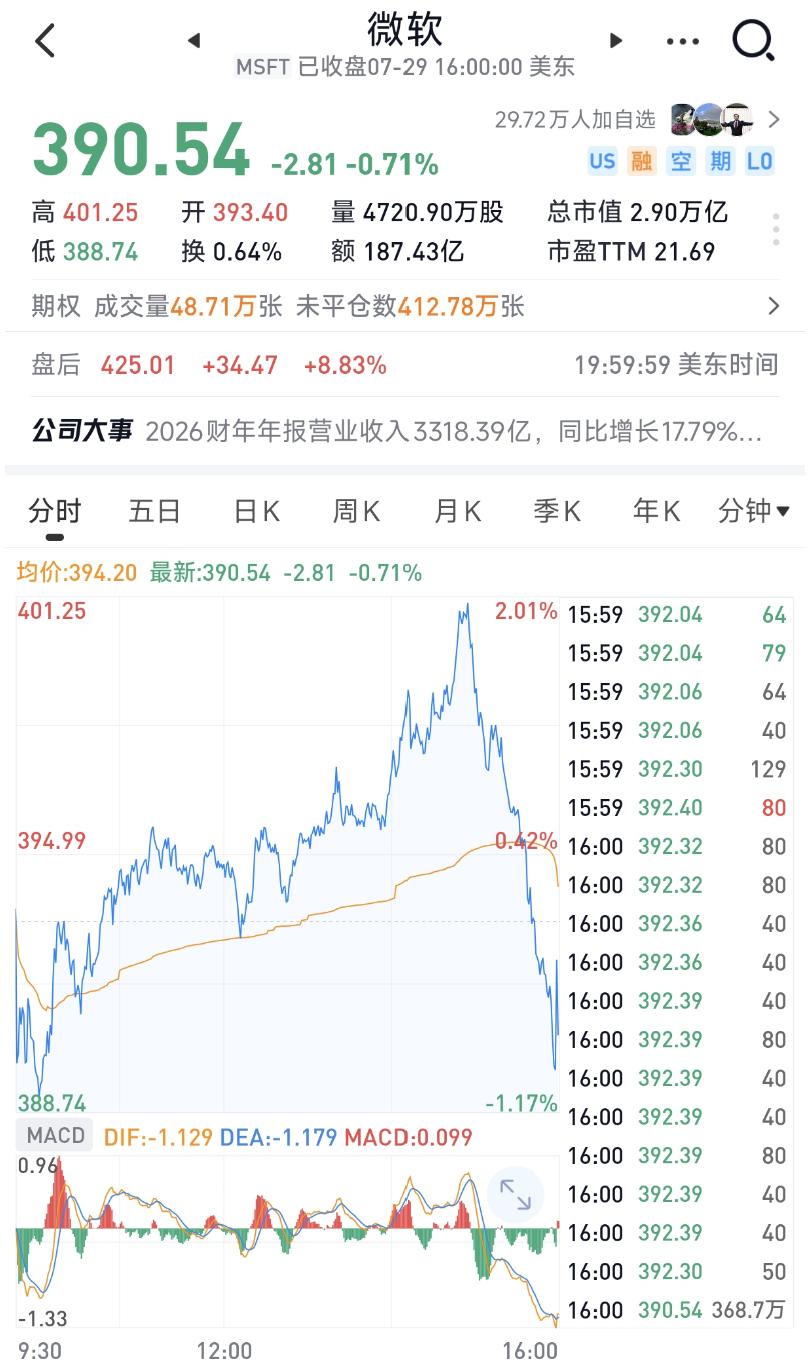
Changes in Microsoft's share price on July 29 Eastern Time (Source: Xueqiu)
01. Cloud service revenue increased by 43%, Azure's annual revenue exceeded 100 billion US dollars for the first time
In this fiscal quarter, Microsoft's operating profit was 40.603 billion US dollars (approximately 274.88 billion RMB), up 18% year-on-year; the operating profit margin was about 45%, which was basically the same as the same period last year. The overall gross profit margin of the company was 67%, down 1 percentage point year-on-year, which was mainly affected by the increasing proportion of Azure revenue, continuous investment in AI infrastructure and rising usage of AI products.
By business segment, the revenue of Productivity and Business Processes business was 37.847 billion US dollars (approximately 256.22 billion RMB), up 14% year-on-year; the revenue of Intelligent Cloud business was 39.306 billion US dollars (approximately 266.10 billion RMB), up 32% year-on-year; the revenue of More Personal Computing business was 12.854 billion US dollars (approximately 87.02 billion RMB), down 4% year-on-year.
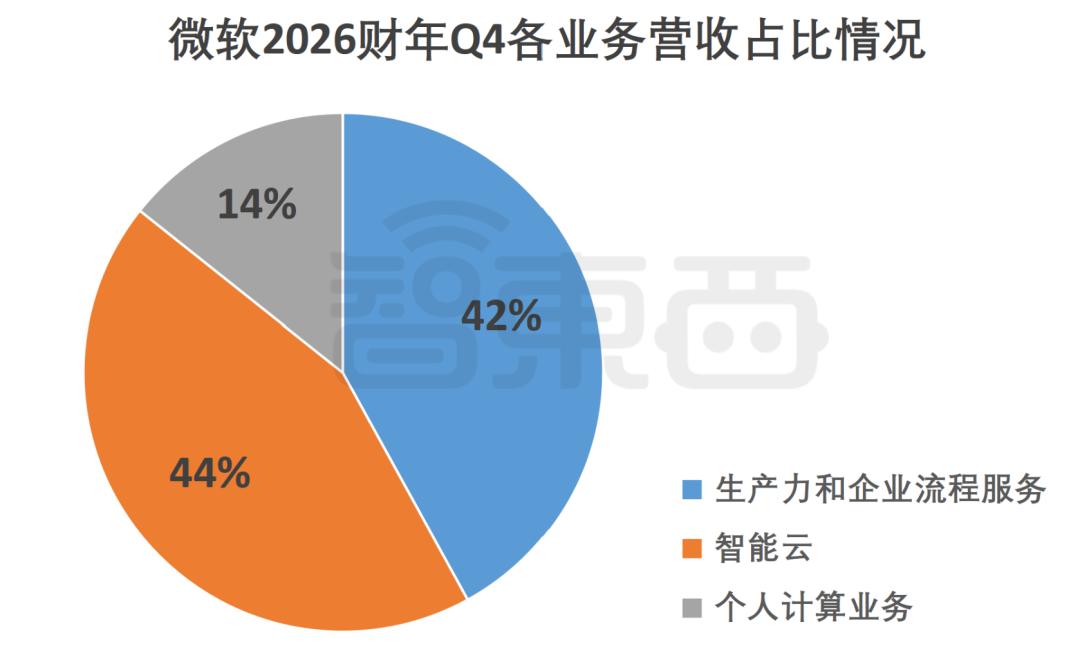
Revenue proportion of each business segment of Microsoft in Q4 FY2026 (Chart by Zhidx)
The Intelligent Cloud segment is the fastest-growing sector among the three business divisions. Its operating profit in this quarter reached 15.955 billion US dollars (approximately 108.02 billion RMB), up 31% year-on-year. The revenue of Azure and other cloud services increased by 43% year-on-year, higher than the 40% growth rate of the previous quarter, which was mainly driven by the growing demand for various cloud workloads. In fiscal year 2026, Azure's annual revenue exceeded 100 billion US dollars (approximately 6.77 trillion RMB) for the first time.
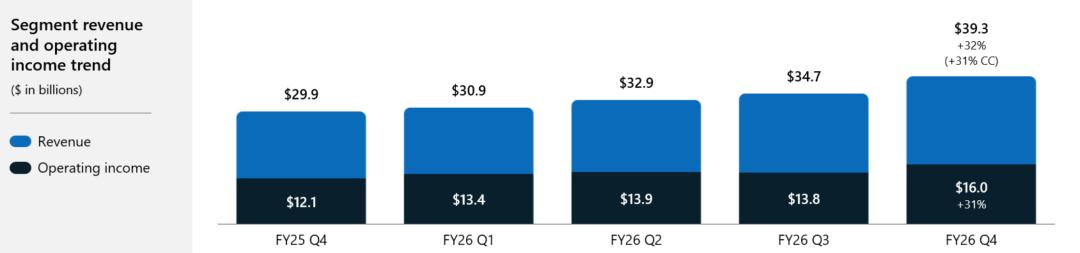
Changes in Intelligent Cloud revenue and operating profit (Source: Microsoft)
With the rapid growth of the cloud business, related costs are also rising significantly. The cost of revenue of the Intelligent Cloud segment in this quarter increased by 42% year-on-year, higher than the 32% revenue growth rate; the gross profit margin of Microsoft Cloud dropped from 68% in the same period last year to 65%, which was mainly affected by AI infrastructure investment, rising product usage and the business structure tilting towards Azure. The efficiency improvement of Azure and Microsoft 365 commercial cloud offset part of the pressure.
Amy Hood, Microsoft's Executive Vice President and CFO, said that customer demand for Azure still exceeds Microsoft's available computing power. Azure's revenue growth in this quarter exceeded expectations, which was mainly benefited from the improved efficiency of CPU and GPU clusters and the early delivery of new computing power. Over the past 90 days, Microsoft has also shortened the time from the arrival of CPUs and GPUs to their deployment and launch, enabling new computing power to be converted into revenue faster. Microsoft expects Azure's revenue in the first quarter of fiscal 2027 to grow by about 45% year-on-year, and the growth rate in the first half of the fiscal year will continue to accelerate.
02. Paid Copilot seats exceeded 30 million, and the billing model began to shift to "seat + usage"
The number of paid seats for Microsoft 365 Copilot exceeded 30 million in this quarter, and the net new seats more than doubled from the previous quarter. Satya Nadella, Microsoft CEO, said that the number of customers with more than 50,000 Copilot seats has increased to more than 7 times that of the same period last year, and the per capita conversation volume has also increased to nearly twice that of the same period last year.
From the overall commercial business of Microsoft 365, the revenue of commercial cloud in this quarter increased by 14% year-on-year on a reported basis, excluding the impact of approximately 2 percentage points of in-period revenue recognition in the same period of last year, the year-on-year growth rate was 16%. The number of Microsoft 365 commercial seats increased by 6% year-on-year, maintaining this growth rate for five consecutive quarters.

Revenue growth rate of Microsoft 365 and related businesses (Source: Microsoft)
The enterprise adoption rate of Copilot is increasing. The time required for customers to reach a monthly active penetration rate of over 80% after purchasing licenses has been shortened from several months in the past to several days, and the weekly average usage activity is close to that of Outlook and Teams. At the same time, Copilot is expanding from Chat to Cowork and Autopilots. Microsoft has added usage-based billing for Cowork, and the business model has begun to shift from simple seat-based billing to "seat + usage".
In terms of AI development platforms, the number of Azure AI Foundry customers has reached 100,000, and related revenue has more than doubled compared with the same period last year. Microsoft currently provides more than 11,000 models, covering OpenAI, Anthropic, Mistral, xAI and its self-developed MAI series; since the beginning of this year, the number of customers using models from multiple vendors at the same time has increased to 5 times that at the beginning of the year. Nadella said that Microsoft is separating the enterprise's execution framework, context and memory from a single model, so that customers can replace models according to performance, cost and compliance requirements.
About two months after the launch of Agent 365, tens of thousands of enterprises have registered nearly 40 million agents. The number of GitHub Copilot users has reached 50 million. After adopting usage-based billing, related revenue has increased by more than 60% compared with the previous quarter; currently, about one-third of the code pull requests on GitHub have been assisted by agents.
03. Capital expenditure increased by 70% year-on-year, expected to exceed 338.5 billion RMB in the next quarter
Microsoft's capital expenditure in this quarter reached 41 billion US dollars (approximately 277.57 billion RMB), up 70% year-on-year. Amy Hood, Microsoft's Executive Vice President and CFO, said that about two-thirds of the funds were invested in short-cycle assets such as CPUs and GPUs, and the remaining funds were mainly used for long-term assets such as data centers.

Changes in Microsoft's capital expenditure in fiscal 2026 (Source: Microsoft)
From the perspective of the cash flow statement, Microsoft's cash expenditure for the purchase of property and equipment in this quarter was 35.802 billion US dollars (approximately 242.38 billion RMB), up 110% year-on-year. The company also added 5.6 billion US dollars (approximately 37.91 billion RMB) of new finance leases, which were mainly used for large data center sites.
Microsoft's cash flow from operating activities in this quarter reached 55.441 billion US dollars (approximately 375.34 billion RMB), up 30% year-on-year; after deducting the cash expenditure for the purchase of property and equipment, free cash flow was 19.639 billion US dollars (approximately 132.96 billion RMB), down 23% year-on-year.
Microsoft expects capital expenditure in the first quarter of fiscal 2027 to exceed 500 billion US dollars (approximately 338.5 billion RMB). Affected by the change in data center lease classification, the company adjusted its capital expenditure forecast for calendar year 2026 to 175 billion US dollars (approximately 1.18 trillion RMB), but Hood said that Microsoft did not lower its actual investment plan accordingly.
Regarding the risk of over-construction of AI infrastructure, Hood said that short-cycle assets such as CPUs and GPUs are the largest component of current capital expenditure. If demand changes, Microsoft can slow down procurement quickly. The construction time of data centers and server deployment can also be adjusted, and the related computing power can be allocated between Azure, Microsoft 365, GitHub and security business to reduce the risk of idle production capacity.
04. Conclusion: Cloud business is accelerating growth, and AI investment continues to suppress cash flow
Overall, the quarterly revenue growth rate of Azure increased to 43%, the annual revenue exceeded 100 billion US dollars for the first time, and the number of paid seats for Microsoft 365 Copilot exceeded 30 million, indicating that Microsoft's AI and cloud business are continuing to expand their commercial scale.
At the same time, the quarterly capital expenditure of 41 billion US dollars, the gross profit margin of Microsoft Cloud dropped to 65%, and the free cash flow decreased by 23% year-on-year, which also reflects that AI growth still requires high-intensity infrastructure investment. Going forward, whether Microsoft can control the cost of AI infrastructure while maintaining the rapid growth of Azure, and whether the paid seats of Copilot can continue to be converted into more obvious revenue increments, will become the main indicators to observe its performance in the next stage.