Meta plummets, the better-than-expected revenue fails to ease the anxiety brought by AI investment, its Q3 guidance is underwhelming, and free cash flow hits a new low in four years.
Despite the revenue maintaining a high growth rate of nearly 30% in the second quarter, Meta still failed to ease the market's concerns over the payback period of its huge AI investments.
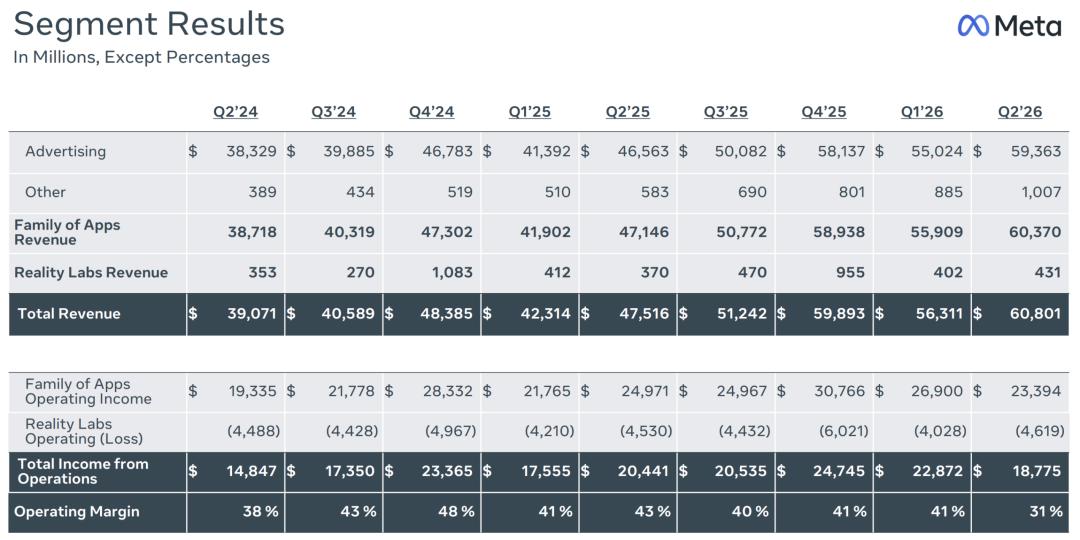
On local time July 29, Meta released its financial report for the second quarter of 2026, posting a revenue of 60.8 billion USD in the quarter, up 28% year on year, slightly higher than the market expectation of 60.3 billion USD. However, the company's revenue guidance for the third quarter is only between 61 billion USD and 64 billion USD, with the midpoint of 62.5 billion USD lower than the average analyst expectation of 63.2 billion USD, which disappointed the market.
At the same time, the company narrowed its full-year capital expenditure guidance range and raised the lower limit, adjusting it from the previous 125 billion to 145 billion USD to 130 billion to 145 billion USD, indicating that the investment in AI infrastructure will remain at a high level.
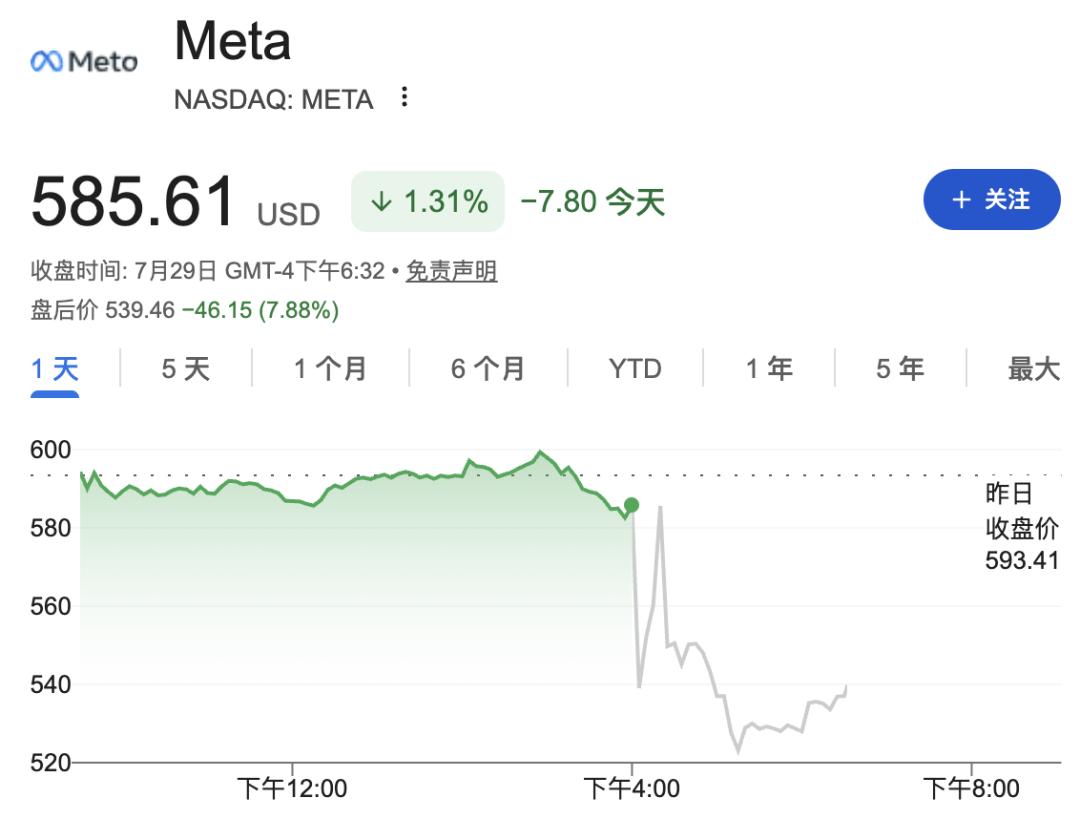
Affected by the lower-than-expected performance guidance and the upward adjustment of AI capital expenditure, Meta's after-hours stock price once fell by more than 10%.
Revenue Growth Remains Strong, But Profits Are Eroded by Costs
The financial report shows that Meta's Q2 revenue reached 60.801 billion USD, up 28% year on year, and 27% at constant exchange rates. The advertising business remains the core growth driver: ad impressions rose 14% year on year, and the average ad price increased by 12%, pushing advertising revenue to 59.363 billion USD, up 27% year on year.
Mark Zuckerberg, Founder and CEO of Meta, said:
AI is accelerating our core business, driving next-generation products, and opening up entirely new enterprise-level business opportunities, and the results have started to show.
However, in sharp contrast to revenue performance is the profit performance.
In Q2, Meta's operating profit fell 8% year on year to 18.775 billion USD, with the operating margin dropping sharply to 31% from 43% in the same period last year. Net profit fell 14% year on year to 15.848 billion USD, and earnings per share stood at 6.18 USD, down 13% year on year.
Profit pressure mainly comes from the substantial growth of costs.
According to the financial report, Meta's total costs and expenses in Q2 reached 42 billion USD, a surge of 55% year on year, including 2.4 billion USD in legal litigation expenses and 1.18 billion USD in layoff-related expenses.
R&D investment continued to grow rapidly, with R&D expenditure in the quarter reaching 21.656 billion USD, up 67% year on year, accounting for more than one third of total revenue.
Q3 Revenue Guidance Lower Than Expectations, AI Monetization Speed Still Fails to Satisfy the Market
What really triggered the stock price drop is the future outlook.
Meta expects its third-quarter revenue to be between 61 billion USD and 64 billion USD, with the midpoint of 62.5 billion USD lower than the average analyst expectation of 63.2 billion USD counted by Bloomberg. The company also expects exchange rates to drag down revenue growth by about 1 percentage point.
This means that Meta's massive AI investment has not yet been quickly translated into sufficiently fast revenue growth.
Over the past year, Meta has been continuously expanding its AI business layout, including launching consumer AI chatbot subscription services and paid large model services for developers, hoping to gradually build new revenue streams. But at present, the vast majority of the company's revenue still comes from advertising on platforms such as Facebook and Instagram, and it will still take time for the AI business to achieve large-scale profitability.
The market therefore keeps asking a core question: When can Meta truly recover its hundreds of billions of dollars in AI investment?
Minda Smiley, Senior Analyst at market research firm eMarketer, said:
Meta's strong revenue growth has once again been overshadowed by the capital expenditure outlook. Even if the company does not further raise its capital expenditure expectations, investors still want more information about the AI computing business planning and AI commercialization path.
AI Capital Expenditure Remains at Historically High Level, Expected to Reach a Maximum of 145 Billion USD This Year
Capital expenditure remains the biggest focus of the entire financial report.
Meta adjusted its full-year 2026 capital expenditure guidance to 130 billion to 145 billion USD, slightly raising the lower limit from the previous 125 billion to 145 billion USD.
Although the company did not further increase the investment scale, this figure still means that Meta will continue to maintain one of the most aggressive data center investment paces in the global technology industry.
Bloomberg reported that Meta recently announced a partnership with BlackRock to build a 14 billion USD data center project in El Paso, Texas; it also plans to build another ultra-large AI data center in Louisiana, with the total investment expected to exceed 250 billion USD.
Meta is currently competing with rivals including Alphabet, OpenAI and Anthropic in the AI infrastructure race, hoping to take the lead in building a leading large model and AI product system.
Free Cash Flow Falls to the Lowest Level in Nearly Four Years, AI Investment Begins to Significantly Consume Cash
Compared with the decline in profits, cash flow can better reflect the pressure of AI investment.
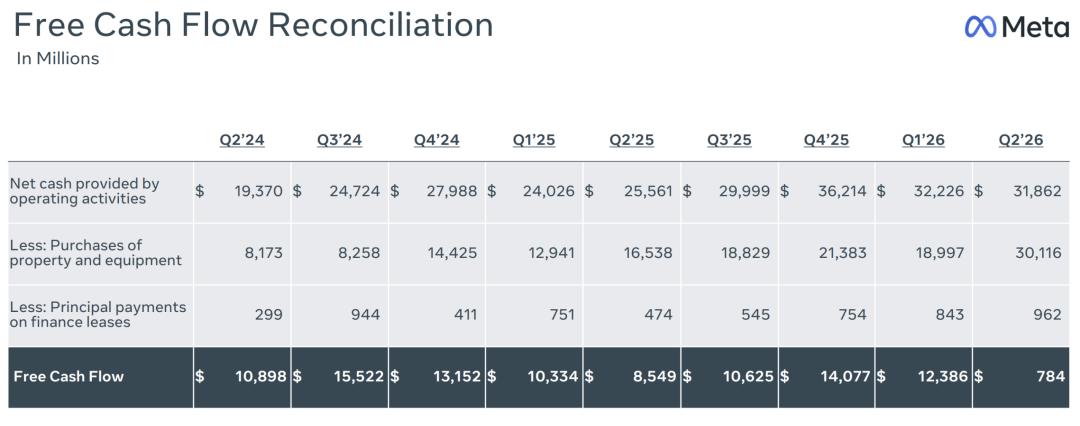
According to the financial report, Meta's operating cash flow in Q2 reached 31.862 billion USD, but due to the capital expenditure of up to 31.08 billion USD, the free cash flow was only 784 million USD, a sharp decrease from 8.549 billion USD in the same period last year, hitting the lowest level in nearly four years.
This fully reflects the huge scale of Meta's current AI investment — the company is building AI infrastructure at an unprecedented speed, and most of the cash generated by the advertising business is continuously flowing to data centers, computing power and AI R&D.
Legal Litigation Costs Continue to Rise
In addition to AI investment, Meta is also facing increasing legal risks.
The company narrowed its full-year expense guidance to 165 billion to 169 billion USD, including the 2.4 billion USD legal litigation-related expenses recognized in the second quarter.
Meta said that the company is still facing a number of major legal and regulatory matters, especially lawsuits filed by multiple U.S. states around minor protection issues. Many related cases are still pending trial this year, which may cause significant losses in the future.
The AI Arms Race Is Still Ongoing
Meta is not the only tech giant bearing the pressure of AI investment.
The total capital expenditure of large U.S. tech companies is expected to reach a maximum of 725 billion USD this year, the vast majority of which will be used to build AI data centers. Just last week, Alphabet also further raised its full-year capital expenditure expectation to 205 billion USD, which also triggered market concerns.
At present, investors' criteria for judging tech giants have changed: compared with revenue growth, they pay more attention to whether AI investment can eventually form sustainable profitability.
For Meta, the advertising business still maintains strong growth, but with capital expenditure remaining at historically high levels for a long time and free cash flow shrinking rapidly, the market needs to see not only the continuous improvement of AI capabilities, but also that AI truly starts to contribute revenue and profits. Before this answer becomes clear, Meta's stock price may continue to be tested by the payback period of AI investment.
This article does not constitute personal investment advice, does not represent the position of the platform. The market is risky, and investment requires caution. Please make independent judgments and decisions.
This article is from WeChat official account "Wall Street CN", author: Yang Chen, published with authorization from 36Kr.