Operating profit surged by 1814%, Samsung delivered its strongest quarterly performance in history.
Samsung Electronics released its financial report for the second quarter of fiscal year 2026 on July 30.
The company recorded KRW 171.50 trillion in sales in the second quarter, up 130% year on year; its operating profit reached KRW 89.49 trillion, up 1814% year on year, with both figures hitting new all-time highs again.
Meanwhile, the company holds a positive outlook for the second half of 2026, expecting the chip supply shortage to persist in the second half of the year.
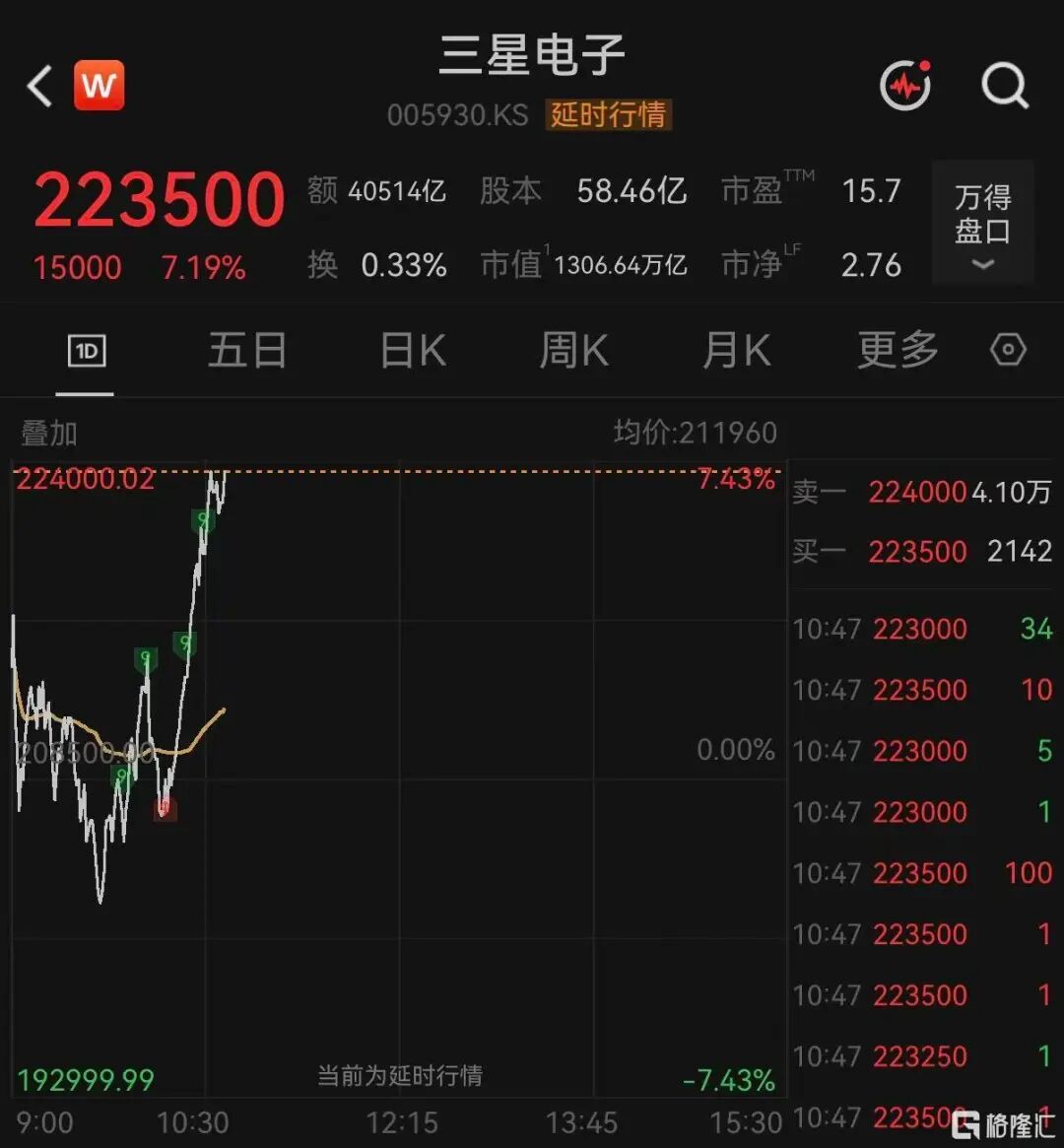
With the financial results far exceeding expectations and the South Korean government's measures to stabilize the market, Samsung Electronics' share price rose by more than 7% today.
Q2 Operating Profit Surges 1814%
Data shows that the company's consolidated revenue for the quarter reached KRW 171.5 trillion, up 28% quarter on quarter and 130% year on year, continuously refreshing the all-time record for a single quarter;
Operating profit stood at KRW 89.5 trillion, up 56% quarter on quarter and a staggering 1814% year on year, also hitting a new all-time high. The operating margin reached as high as 52.2%, up 9.4 percentage points from the previous quarter.
Net profit for the second quarter was KRW 71.62 trillion (about USD 49.6 billion), skyrocketing 1299.9% year on year, against the estimated KRW 68.36 trillion. The depreciation of the Korean won brought a positive impact of KRW 3.1 trillion in the second quarter.
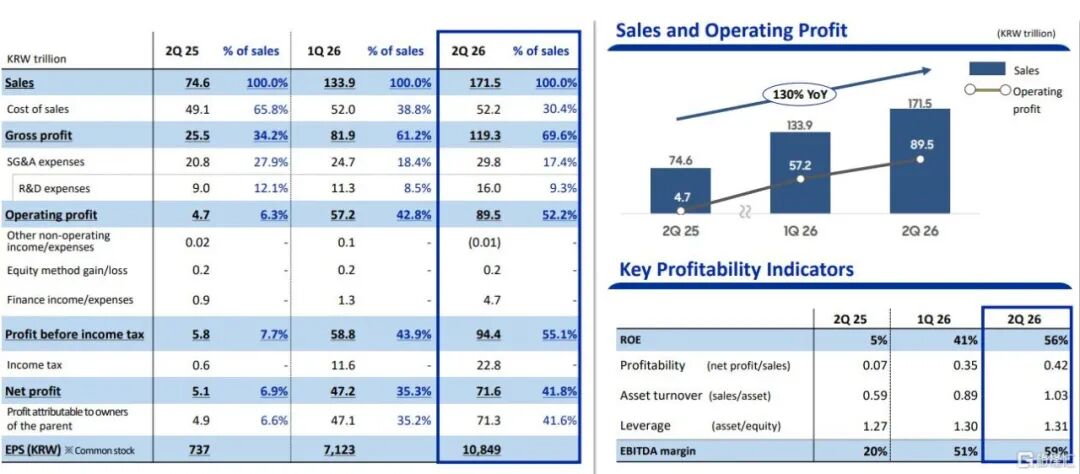
Earnings per share (EPS) came to KRW 10,849 (the same for common shares and preferred shares), up KRW 3,726 quarter on quarter and KRW 10,112 year on year. Samsung stated that this level "ranks among the highest for global tech companies".
Cash flow from operating activities in this quarter was KRW 105.08 trillion, net outflow from investing activities was KRW 47.31 trillion (including KRW 14.11 trillion in capital expenditure), and net outflow from financing activities was KRW 17.89 trillion (including KRW 6.21 trillion in dividends and KRW 5.63 trillion in share repurchases).
In terms of gross margin, the company's overall gross margin in Q2 jumped to 69.6% from 34.2% in the same period last year, up more than 35 percentage points, mainly driven by high-value, high-margin products in the memory business.
It is worth noting that the company's R&D investment in Q2 reached KRW 16.0 trillion, up 41% quarter on quarter and 78% year on year, demonstrating its increased investment in the AI technology arms race.
The DS Division Contributes Almost All the Profit
By business segment:
1) The semiconductor business (DS) is undoubtedly the biggest contributor to this quarter's performance
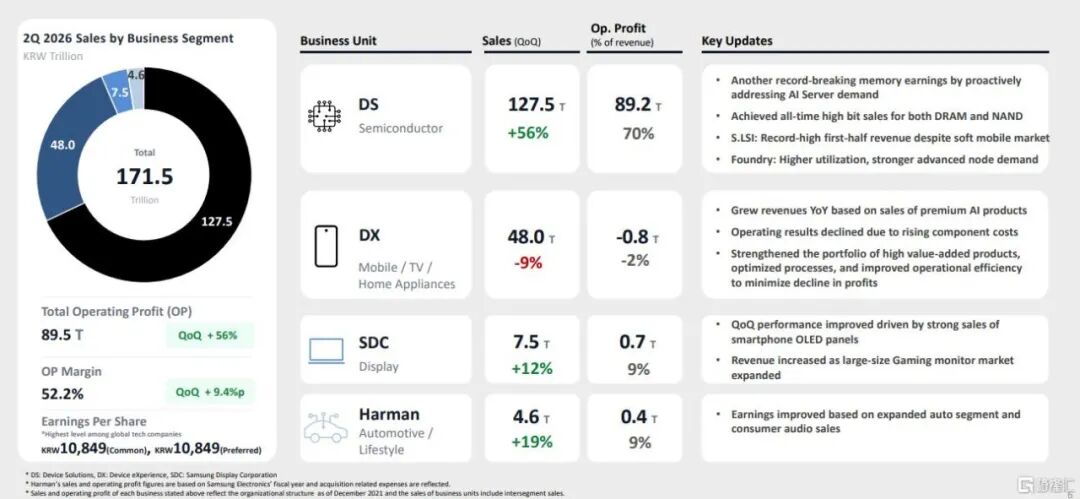
The DS division posted Q2 revenue of KRW 127.5 trillion, up 56% quarter on quarter and a staggering 357% year on year; its operating profit hit KRW 89.2 trillion, up KRW 35.5 trillion quarter on quarter and KRW 88.8 trillion year on year — which means DS contributed 99.7% of the total company's operating profit.
Among them, the memory business (DRAM+NAND+HBM) generated revenue of KRW 120.8 trillion, up 62% quarter on quarter and a staggering 471% year on year, once again refreshing the single-quarter revenue and operating profit records. The bit shipments of both DRAM and NAND hit all-time highs.
The System LSI and Foundry businesses also delivered notable performance.
The System LSI business was affected by seasonal factors of flagship models and weak demand for mobile phones in China, but maintained quarterly revenue by expanding shipments of mobile SoCs and image sensors, with its first-half revenue hitting an all-time high, and it has already secured orders for next-generation flagship SoCs.
Driven by demand for HBM base-die and strong orders from US customers, the Foundry business saw a significant increase in capacity utilization, and its 2nm HPC (High Performance Computing) process has won design wins from key customers.
2) The DX Division Turned From Profit to Loss
The Device eXperience (DX) division recorded Q2 revenue of KRW 48.0 trillion, down 9% quarter on quarter and up 10% year on year; but its operating profit was KRW -0.8 trillion, turning from profit to loss.
The MX (Mobile eXperience) business was the main drag. While robust sales of the Galaxy S26 series and A series drove year-on-year revenue growth, industry-wide component cost hikes severely eroded profit margins, resulting in an operating loss of KRW 0.7 trillion.
The TV and home appliance businesses delivered mediocre performance. The Visual Display (VD) business saw year-on-year improvements in revenue and profit thanks to replacement demand driven by large-scale sports events, but posted a quarter-on-quarter decline due to rising costs; the Digital Appliances (DA) business achieved revenue growth driven by rising demand for air conditioners, while also facing cost pressures.
3) The SDC Division Achieved Steady Growth
The mobile display business (SDC) generated revenue of KRW 7.5 trillion and operating profit of KRW 0.7 trillion. The small and medium-sized OLED business benefited from demand for high-end mobile phones, while the large-sized business was driven by the growth of the gaming monitor market. In the second half of the year, SDC will push forward with mass production on the 8.6-generation IT OLED production line to expand into the tablet, gaming and automotive markets.
Harman recorded revenue of KRW 4.6 trillion, up 19% quarter on quarter and 19% year on year; its operating profit stood at KRW 0.4 trillion. Expanded sales of automotive businesses and portable audio products drove improved profitability. In the second half of the year, it will focus on high-growth automotive segments such as central computing units.
H2 Outlook: Sustained Strong AI Demand, Tight Supply Remains
Samsung holds a positive outlook for the second half of 2026, expecting sustained profit growth in the second half of the year.
The company expects that with the continuous investment in AI infrastructure and the popularization of Agentic AI, server-centric demand will remain strong. The growth in demand for server DRAM, enterprise SSD and HBM is expected to accelerate, leading to a continued state of supply falling short of demand in the market. Although demand on the mobile and PC sides may slow down slightly, the overall market structure remains healthy.
Samsung Electronics stated that it will continue to lead the market with its technological edge, optimize product mix, focus on meeting demand for high value-added products, and strive to expand production, but supply constraints will still exist.
The company aims to continuously lead the development of next-generation AI platforms through leading products such as HBM4, DDR5 and SOCAMM2, as well as the penetration of solutions including PCIe Gen6 and UFS 5.0.
This article is from the WeChat Official Account "Gelonghui APP" (ID: hkguruclub), authored by the Gelonghui editorial team, and published by 36Kr with authorization.