How have those funds that piled into high-tech sectors in the second quarter fared?
The tech market rallied in the second quarter, and a number of active equity funds have significantly increased their allocation to tech stocks.
According to statistics from CLSA based on the heavy position holdings data of funds in the first and second quarters, a total of 67 active equity funds significantly increased their TMT positions in the second quarter: the TMT weight in the top ten heavy positions in the first quarter did not exceed 15%, rose to more than 45% in the second quarter, with a single-quarter increase of at least 30 percentage points.
The average TMT weight of these 67 funds in the first quarter was only 6.75%, and it rose to 54.99% at the end of the second quarter. Among them, 15 funds had no TMT targets in their top ten heavy positions in the first quarter; by the second quarter, 41 funds had a TMT weight of more than 50%, and 19 funds exceeded 60%.
If the statistical scope is further relaxed to that the TMT weight in the first quarter does not exceed 25%, the second quarter is not less than 35%, and the single quarter increases by at least 20 percentage points, another 230 funds meet the conditions. Calculated according to this caliber, the number of active equity funds that have significantly increased the allocation of tech stocks in the second quarter is close to 300.
Judging from the top ten heavy positions disclosed in the second quarterly report, the position changes of many funds are very obvious. Tech stocks were hardly seen in the first quarter. By the second quarter, stocks such as semiconductors and optical modules have occupied most of the seats. The total proportion of TMT top ten heavy positions of individual products in the fund's net value even exceeds 80%.
The change in positions is quickly reflected in the net value. Among the 67 funds mentioned above, 63 achieved positive returns in June, with an average increase of 16.62%; after entering July, as of July 28, all 67 funds have turned to decline, with an average decline of 19.21%, of which 33 fell by more than 20% and 12 fell by more than 25%.
The rapid switching of the tech market has also made this batch of funds that significantly increased their TMT positions in the second quarter a topic of market discussion again. Many investors left messages on social platforms saying, "As soon as the quarterly report comes out, I find that the fund I bought has almost become a semiconductor fund" "The fund manager chased high and entered, but unexpectedly got trapped."
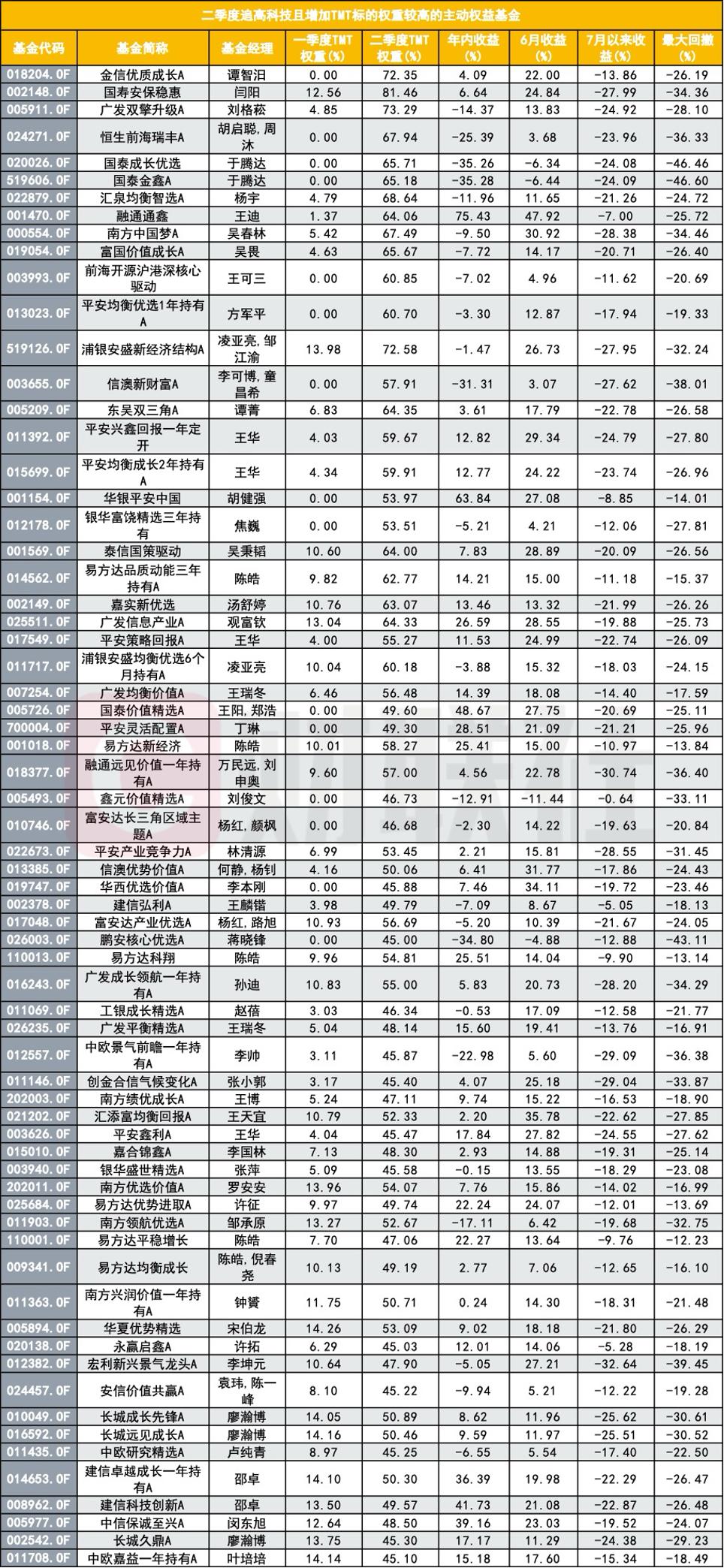
(Note: The TMT weight in this article is the sum of the proportion of electronic, communications, computer and media Internet stocks in the top ten heavy positions of the fund to the net value of the fund. It only reflects the top ten heavy positions disclosed in the regular report, and does not represent the complete position of the fund)
Just caught up with the tech market, it fell back in July
The Jinxin High-Quality Growth managed by Tan Zhimi is one of the products with the most obvious position switching.
In the first quarter, the top ten heavy positions of this fund were all medical-related companies, with a TMT weight of zero; in the second quarter, Haituang Information, Hua Hong Hongli, Muxi Co., Ltd., Shengke Communications, SMIC, Cambricon, etc. entered the top ten, and the TMT weight directly rose to 72.35%. Judging only from the top ten heavy positions, this fund has almost changed its investment style. In terms of performance, the net value of this fund has fallen by 13.86% since July as of July 28, the return in June was still 22.00%, the return for the year was left at 4.09% after being eroded, and the maximum drawdown for the year reached 26.19%.
The Guoshou Anbao Wenhui managed by Yan Yang has its TMT weight increased from 12.56% to 81.46%, which is a product with a relatively high proportion of tech positions among this batch of funds. Yuanjie Technology, Xinyisheng, Dongshan Precision, Zhongji Xuchuang, Yongding Co., Ltd., etc. have become heavy positions. The fund rose 24.84% in June, fell 27.99% since July, and its annual return narrowed to 6.64%.
The Cathay Growth Select and Cathay Jinxin managed by Yu Tengda also concentratedly bought companies such as Zhongji Xuchuang, Cambricon, Xinyisheng, Hudian Co., Ltd., and Shengyi Technology in the second quarter. The TMT weights of the two funds rose from zero to 65.71% and 65.18% respectively.
The difference is that these two funds did not even catch up with the rise in June. Cathay Growth Select and Cathay Jinxin fell by 6.34% and 6.44% respectively in June, and both fell by about 24% since July. The declines for the year both exceeded 35%, and the maximum drawdown was close to 47%.
Some fund investors joked that "the fund manager caught up with the tech market, but the holders did not catch up with the returns". According to the data, among the 67 funds, 25 have already had negative returns for the year, 10 have lost more than 10%, and 6 have lost more than 20%. Peng'an Core Select fell 34.80% for the year, and Xin'ao New Wealth fell 31.31%.
Famous fund managers such as Liu Gansong and Xiao Nan are also increasing their positions in tech
In this round of position switching, many fund managers familiar to the market have also appeared.
In the top ten heavy positions of Guangfa Dual Engine Upgrade managed by Liu Gansong in the first quarter, only Dongshan Precision belongs to TMT, with a weight of 4.85%. By the second quarter, GigaDevice, Zhongji Xuchuang, Xinyisheng, Shengyi Technology, Cambricon, SMIC, etc. concentratedly entered the top ten, the TMT weight rose to 73.29%, an increase of 68.44 percentage points in a single quarter.
Guangfa Dual Engine Upgrade rose 13.83% in June, fell 24.92% since July, and its annual return fell back to -14.37%. This fund, once well-known in the market for its tech growth style, has clearly turned to semiconductors, optical modules and the electronic industry chain again in the second quarter after several years of position adjustment.
Chen Hao has multiple products under his name that simultaneously increased their tech positions.
The TMT weight of E-Fund Quality Kinetic Energy 3-Year Holding increased from 9.82% to 62.77%, E-Fund New Economy from 10.01% to 58.27%, E-Fund Kexiang from 9.96% to 54.81%; the TMT weights of E-Fund Steady Growth and E-Fund Balanced Growth also rose to 47.06% and 49.19% respectively.
The heavy positions of these products have a high degree of overlap, and Xinyisheng, Dongshan Precision, Cambricon, Zhongji Xuchuang, Xiangnong Chuang repeatedly appear. Most of these funds have fallen by between 10% and 13% since July, and E-Fund New Economy and E-Fund Kexiang still rose 25.41% and 25.51% respectively for the year.
The Yinhua Rich Select 3-Year Holding managed by Jiao Wei had no TMT stocks in the top ten heavy positions in the first quarter. In the second quarter, it bought semiconductor companies such as Huafeng Test & Control, SMIC, Naura Technology, Shennan Circuits, Tuojing Technology, and the TMT weight rose to 53.51%.
The ICBC Growth Select managed by Zhao Bei has its TMT weight increased from 3.03% to 46.34%, with Cambricon, Core Source Micro, Haiguang Information, and Xinyisheng entering the top ten. The Ruitong Vision Value 1-Year Holding co-managed by Wan Minyuan and Liu Shen'ao has its TMT weight increased from 9.60% to 57.00%, rose 22.78% in June, and fell 30.74% since July.
Slightly relaxing the screening scope, E-Fund Ruiheng managed by Xiao Nan, Wells Fargo Ingenuity Growth managed by Bi Tianyu, Guangfa Growth New Kinetic Energy managed by Zheng Chengran, also significantly increased their TMT positions in the second quarter. Some products managed by Xie Zhiyu, Gui Kai, and Qu Yang also showed similar changes.
Some fund market insiders believe that the tech sector rose significantly in the second quarter, and some funds rapidly increased their relevant positions at this stage, which can amplify the net value elasticity in the short term, but it is also easy to face the problems of high buying positions and overly concentrated positions. Once the market weakens, products that add positions later tend to have larger drawdowns. Compared with whether to allocate tech, the timing and concentration of fund managers' position increase are more worthy of attention.
This article is from the WeChat official account "ChiNext Observation", author: Wu Yuqi, published with authorization from 36Kr.